Lured in
Enticed by folds of foliage and dark pools, I get lost in painting pitcher plants. All those reds blending into greens and purples. Tiny hairs leading downward into open mouths. It’s not hard to see how these plants work their magic. Once lured in, leaving is difficult—and for some, impossible.
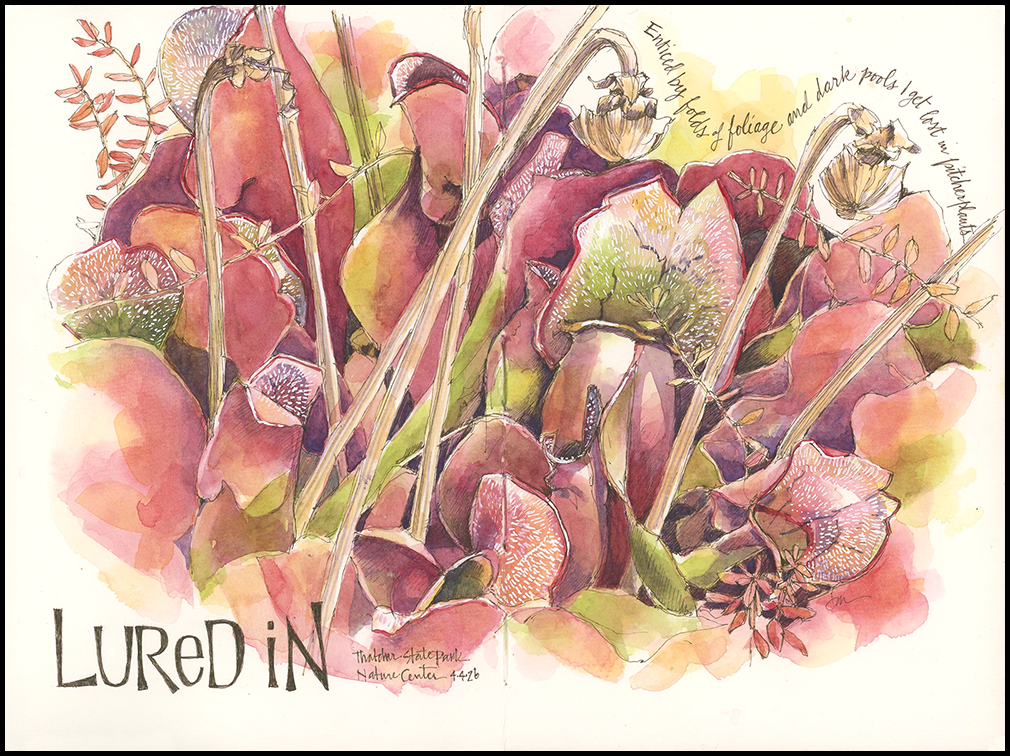
Tips and Techniques– When you are working with a complicated subject, take time to study it closely and record enough information in the drawing stage before you start painting. This is especially important if you will be painting it later. I spent nearly an hour drawing these plants and then painted them over the course of several evenings. While my reference photos were helpful, it was my underlying drawing that kept me from getting completely lost in these remarkable plants. Learn more about purple pitcher plants here.
New workshops! I’m excited to announce a new online class, Savoring Summer Sketchbook Series, starting in May, and an in person workshop, Creative Nature Journaling, next January in Tucson, Arizona. Learn more on the Workshops page or directly on the class links.
 Drawn In
Hi Jean!
What a beautiful page, I’ve never seen this plant before! I wanted to say I really enjoyed your demo @winslowartcenter Springfestival: your sketchbooks are so inspiring! I was really looking forward to your next online workshop and what the subjects would be. Being in Europe, makes it a bit of a challenge: our magnolia’s are almost finished with flowering and although our neigbour had a trumpet vine, there are no hummingbirds here. I’ve decided to joint anyway, because I like your workshops, your style and I learn a lot every time! One question: will the harvest one be similar to your workshop last year (farmer’s market)? I hope you’ll do one in the future about landscapes and trees (I know that was part of the january one, but I could not join at the time).
Ilse
Thanks Ilse! I’m sorry we are not in synch with the nature of where you are. Feel free to gather some reference photos of species that occur there and substitute them when you do your sketchbook pages. I do think that the vegetable piece will be similar to last year– I’ll choose some different vegetables, but I think it will have a similar flair. Let me know if you have additional questions. See you soon!
Thanks for the reply Jean! In this case it’s maybe interesting for me to join only the ones I can use in my area. I’ll keep an eye on future one classes!
ilse
Glorious!
I’ve mounted Pitcher Plants at our Texas herbarium. By the time I see them, they’ve turned brown. They are really quite beautiful. Thank you, Jean, for sharing your words of wisdom on painting complicated subjects.
I suspect they have very particular growing requirements. I love seeing the hanging variety in a nearby conservatory. They are such fascinating plants!
Oh my Oh my! Your illustration of the pitcher plant leaves and dried flowers is amazing! Literally. It’s easy to see how someone might get lost in the details, not only in your illustration but especially in the tangle of a real life population. Your tips and techniques explain perfectly the careful and patient observational steps needed to make sense of complex subjects. You obviously use this approach when tackling a complex bird nest?
Seriously, tho, your ability to tease out the details is stellar. But for my mind to make sense of what you portrayed took the extra step of delving into the botanical parts and pieces of the species, beginning with opening your very welcome link to the FS page about purple pitcher plants. Needing more, I followed your initial lead to iNat, and then botanical diagrams. The leaves are fascinating, but what an incredible flower! Still not sure if they are self-pollinating, (do you know?) but that ‘plate’ that shields the ovary is part of the style, and the stigmas are tiny embedded structures attached to the underside of the plate! I’m flabbergasted! Nature is brilliant; your excellent illustrations always invite an understanding of nature into our lives!
Thank you always for sharing!
Hi Barb– It sounds like you are ready to take on this plant in your own journal. You’ve already done the research…now time for drawing! Thanks for you support– I’m way behind in reading blogs, so I’ll catch up with yours soon.