
Heard but not seen
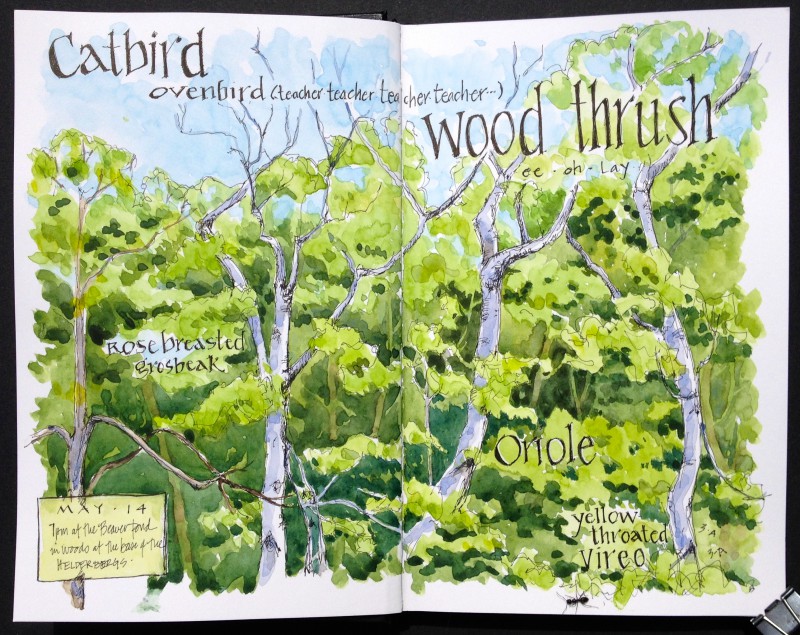
I went out with a friend one evening this week to sketch at a beaver pond. The water was dark and still, trees were lay crossways in heaps where beaver had felled them, and a large mud lodge rose on the far shore. But what struck me most about the place was not the pond itself, but the beauty and intensity of bird song in the surrounding woods. Other than a pair of catbirds and the flash of the rose-breasted grosbeak as it darted into the trees, I saw no birds. But I’m good enough at birding by ear to identify the singers. I decided to try to capture the ethereal experience of hearing these birds in the darkening woods.
Seen, but silent were birds of Connecticut on display at Yale’s Peabody museum, where I enjoyed a brief visit on Friday. I had time to do a pencil sketch of these two vireos, which are commonly heard, but seldom seen.

Moving Through
Spring bird migration is at its peak. Every day new birds are arriving. Carried by countless wing beats and winds from the south they come—some to stay and some just to rest and feed before continuing on their journey north. Among my favorites: a single white-crowned sparrow that spent just a few hours in the yard, a rose-breasted grosbeak that stayed three days, and a small flock of white-throated sparrows that skulked in our gardens and under our feeders for nearly a week. Today, they are gone…replaced by the oriole that will nest in my neighbors yard, chimney swifts twittering overhead and, with luck, a warbler or two in the days to come.

White-throated sparrow; watercolor on Fabriano soft press paper, 5×7”
Fast Takes
It can be hard to find the time for art when life gets busy. A whole painting or even an entire journal page can seem impossible to undertake. So I made a grid on these pages in the hope that I would be able to fill smaller spaces over the course of several days. As it turned out, I drew the entire two-page spread during an hour-long hike, pausing every so often to do a quick sketch when something caught my eye. Done directly in pen, each sketch took no more than a few minutes. I added color and text back at home.

Click to view larger
Some artistic tips:
- Making a grid is a worthwhile exercise, though it did leave me feeling a little boxed in. Make the rules, but feel free to break them, as I did, by going beyond the boxes as you see fit.
- Use the grid to your advantage. I found it especially useful in forcing me to put pen to paper without fussing, but I have seen other artists fill grid squares carefully, to excellent effect.
- Consider having a unified theme that ties the elements together. Your theme may be a particular place, experience, or even experiments with a single sketching medium.
- The risk of a grid is that if one of the elements doesn’t turn out to your liking, the entire page may suffer. That’s fine if you are experimenting and not a perfectionist in your art journal. I like some of the sketches on this page more than others, and I can live with that because my aim was to simply record quick impressions of a particular moment in time.
Page done in Stillman and Birn Zeta journal, with Micron black pen and watercolor at Indian Ladder Farms, New Scotland, NY
The Egg Case
Had I lived in the late-1800s, there’s a good chance I would have been a bird egg collector. Backyard collecting, exchanges, and sales were popular during the Victorian era, and I can see easily the appeal of amassing a collection to study and admire. But since collecting became illegal with the Migratory Bird Treaty of 1918 (thankfully!), I rely on museum collections for an occasional egg fix.

I sketched this section of a much larger display at the Pember Museum of Natural History in Granville, NY. I only had about 30 minutes, so I sketched directly in pen and painted later at home, using a photo and reference books for the colors and patterns. If I were doing a careful painting, I would work in pencil first so that I could get the edges of each egg smooth and clean. But in this case, that kind of accuracy didn’t matter to me—I just wanted to have fun collecting on paper.
Celebrating One Year! On another note, it’s been year since I started I this blog and I want to thank you for following it! I began with a couple of posts on bird nests and eggs, so perhaps it’s fitting to come full circle and be back on that theme a year hence. I love hearing your thoughts, so keep on commenting…and share the blog as you see fit to widen its reach.
Salamander Rain
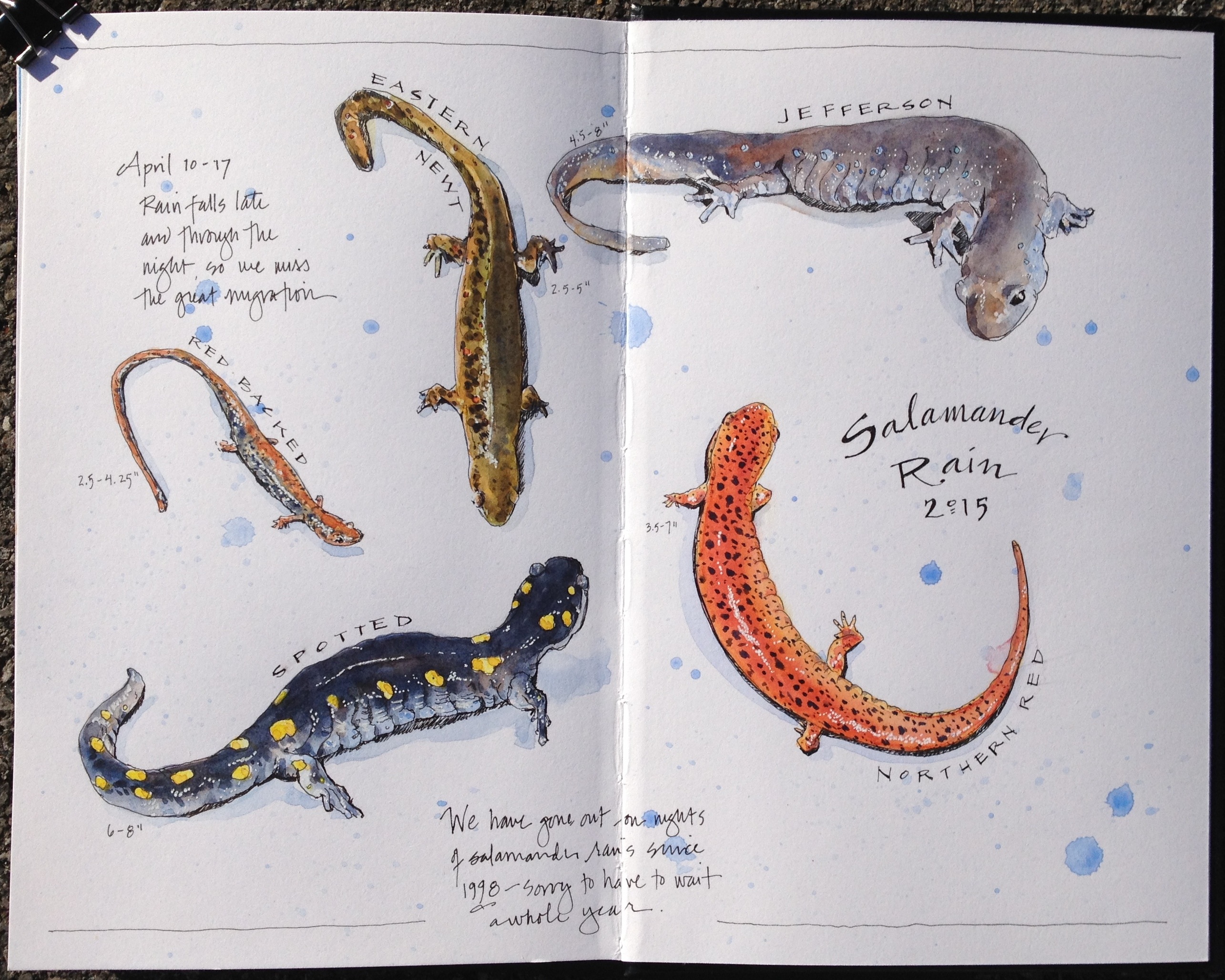
Every year, I wait for the first warm rainy night in April, excited as a kid anticipating Santa Claus. That’s because this is the night of the annual salamander migration. Under the cover of rainy darkness, salamanders come out of the forest en masse and crawl to wetlands and small ponds to breed. It’s the one night of the year when I get to see these ancient creatures doing what they have done for millions of years.
Click to view larger
I recruit a team of hardy souls and go to a spot where a road bisects woods and wetland. Salamanders have no choice but to cross. The traffic is light, but even a few cars can cause a lot of carnage. Flashlights in hand, we patrol the road, look for small waggling objects, and deliver them quickly to the other side. We identify and count the species we see— Jefferson, spotted, four-toed, red-backed, plus spring peepers and wood frogs. On a good night, we may find 20 or more in an hour.
Except this year… the only salamanders I get to see are the ones on this page. That’s because there have been no steady early evening rains, only rain after midnight (and I’m not crazy enough to trade sleep for rain and amphibians). Salamanders have crossed into a new season, and I’ll have to wait a whole year to see them again.
Sweet Consolation
I’ve been working on landscapes this week, which is why you are seeing this painting of a jelly donut. Enjoy!

Easter Eggs!
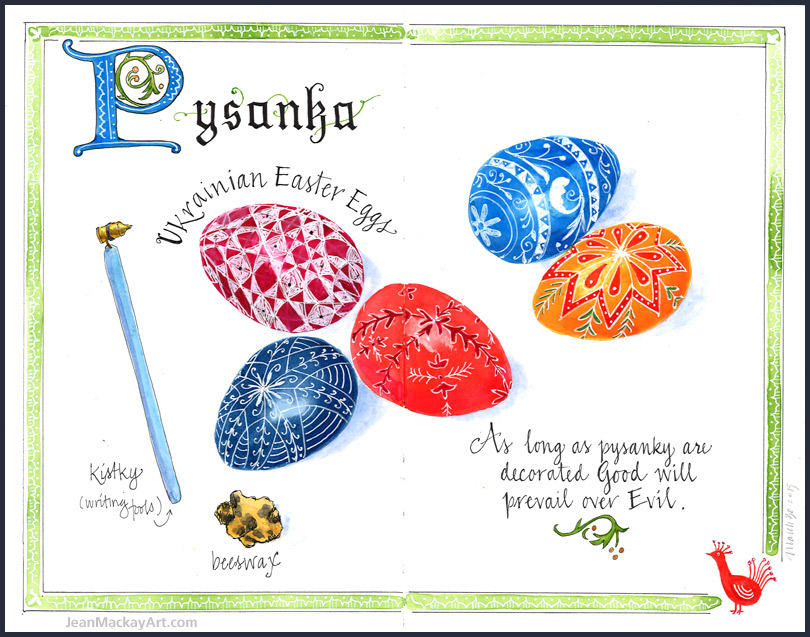
I had a wonderful opportunity to try my hand at decorating eggs using traditional Ukrainian methods last week and have been inspired ever since. It wasn’t just the intricate and beautiful designs that drew me in, but the incredible patience and focus required to make them. I spent 3.5 hours in the company of several friends decorating eggs and produced just two. Back at home, I decided to capture the experience and replicate the intricate egg patterns in my journal. The detailed eggs seemed to beg for a more elaborate border and lettering than I would typically do—but, I’m quite pleased with the end result.
click to view larger
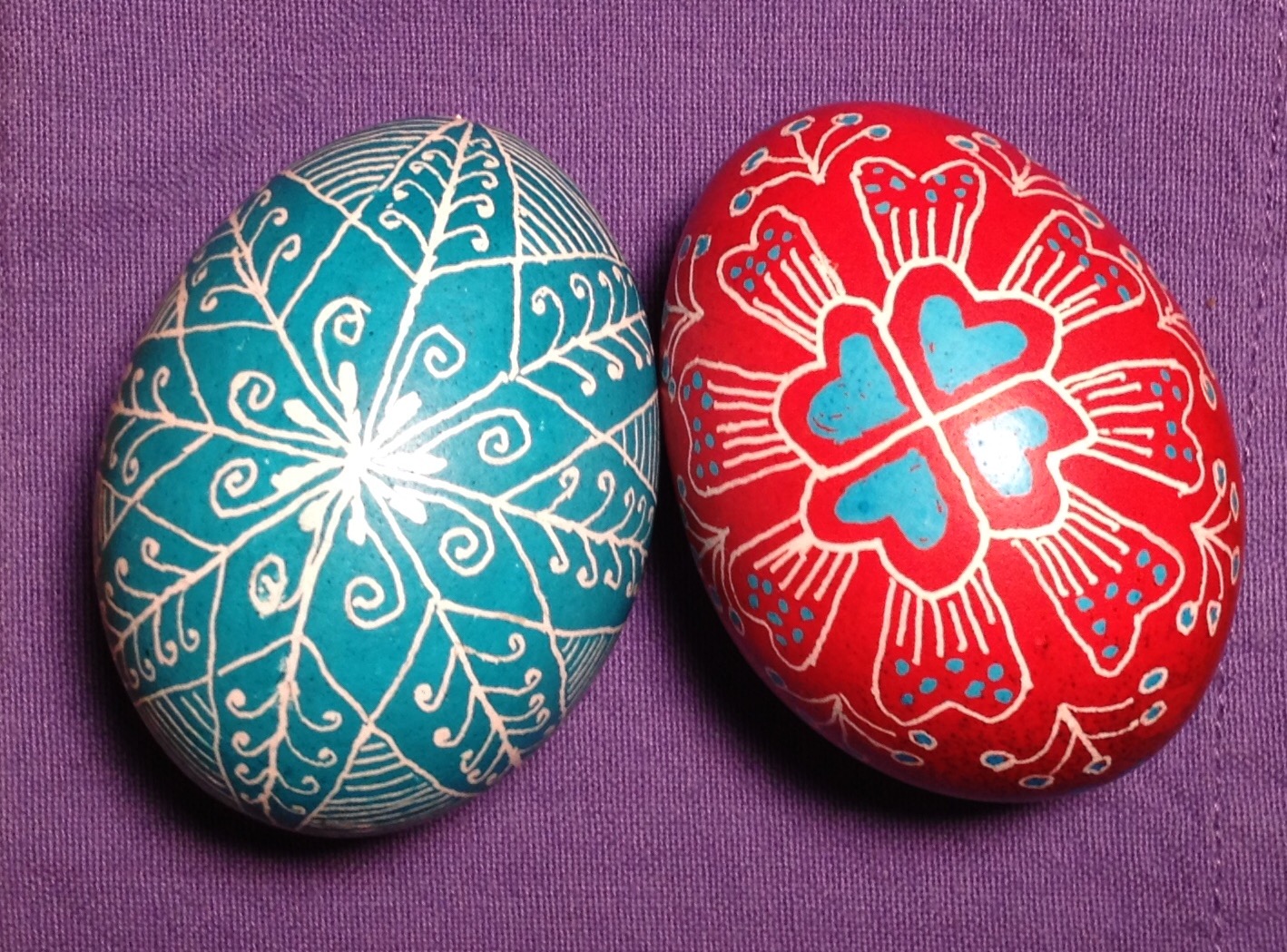
Here are the eggs I made.
About Pysanka– This ancient art form dates back thousands of years and is steeped in legend and symbolism. Ukrainian eggs are made by writing with beeswax on the egg using a tool called a kistka. The patterns are made by adding successive layers of wax and dye. In the final stage, the egg is held close to a candle and the wax is slowly melted and rubbed off to reveal the beautiful pattern.
About replicating the eggs in watercolor– I started by lightly drawing the egg shape and then building up a couple of layers of watercolor to create a range of light and dark areas. This leaves the final egg with a bit of shine and starts to give the egg a dimensional appearance. I used Dr. Ph. Martin’s Hydrus watercolors for most of these eggs because I wanted an intense background color. Once the egg was fully dry, I added the designs using a fine white gel pen. I tested a number of white inks, pencils, and crayons to see if I could replicate the resist method used on the actual eggs, but none gave satisfactory results. Additional details were added to the orange eggs using paint. The trick is to add the design as if on a dimensional object, so the lines must follow the imaginary curves of the egg.
March, March, March
Every year it happens. I arrive at March needing so much more than the month can give. After a long winter, I am desperate to explore and draw and BE outside. I am desperate for the fuel of discovery and growth that sparks my creativity. March never delivers. It is too cold and too wet. I am tired of brown. I am tired of gray. The only thing to do is to forgive myself this artistic low point and wait.
I went back through my journals from the last few years to compare Marches. The pages are thin and mostly the same– each year a record of small gains: pussy willows in bud, the woodcock’s return, a wooly-bear caterpillar in the driveway. And though spring is behind this year, I am glad to have these pages to remind me that incremental progress will take us out of this March too.
After Audubon
Wings, skulls, feathers, skeletons, legs, specimens, live birds, bird paintings. I’ve got birds on the brain! To prepare for several upcoming workshops I am teaching on drawing birds, I’ve been brushing up on bird anatomy and biology, drawing skulls and bones, and watching and painting birds. Best of all, I made a trip to the New York Historical Society to see Audubon’s Aviary, John James Audubon’s original watercolors for the print edition of The Birds of America (1827–38), engraved by Robert Havell Jr.

At the New York Historical Society, NYC
Though I’ve seen reproductions of Audubon’s engravings many times, I was thoroughly taken by the beauty and mastery of the original paintings. Audubon used a combination of graphite, watercolor, gouache, pastel, and glazing to create hundreds of life-sized birds, each one rendered in minute detail. Among my favorites was a simple painting of a male and female dark-eyed junco and a clay-colored sparrow, rendered with no background.
Back home, I decided to finish a small study of an Eastern Phoebe using the highly detailed approach that Audubon used in his paintings. I applied layers of very dry watercolor with the smallest brush in the arsenal— a size 0 — to complete the details. Thankfully, the phoebe is a very plain bird– I can hardly imagine painting intricate feather patterns on hundreds and hundreds of birds, as Audubon did.

Compare this sketch with the much looser painting (below) of a phoebe and nest that I did several weeks ago. In this painting, I was trying to convey subtleties of color and light, rather than paint every detail.

Both styles have merit. I like knowing how birds are built; I like being detailed and accurate; but I also like the idea of jumping off from there, of letting some of the details go and allowing the wet paint to do the work. The later approach seems to be more evocative and engaging — and yet, just as elusive and hard to achieve as painting every feather.
Kiwi
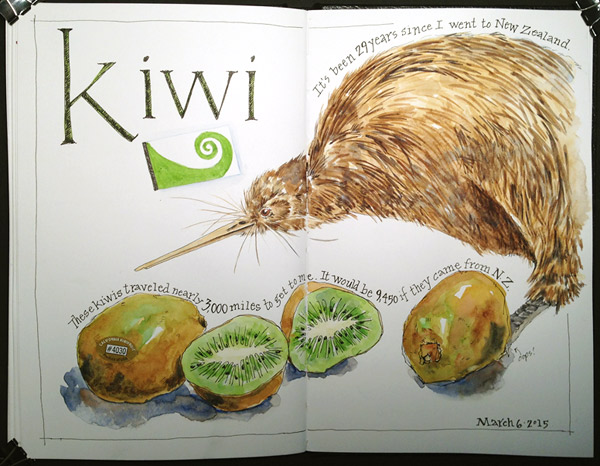
I was initially drawn in by the fruit, but how could I resist the ungainly bird? It’s been 29 years since I went to New Zealand, tasted my first kiwi fruit, saw the national bird, and explored North and South Islands for nearly three months. I thought I’d get back there sooner, but the years and the miles have not allowed it. Isn’t it funny how a simple taste, smell, or touch can transport you to places and release memories from long ago? Is it any wonder that drawing (and eating) a kiwi after a prolonged winter and too much time close to home brought me nearly 10,000 miles to the other side of the globe?


 Drawn In