
My Mother’s Essentials
M&Ms, Diet Coke, butter, and a pharmacy of prescription drugs keep my mother going these days. But after drawing her kitchen table while doing an overnight shift to care for her this week, I quickly realized that my drawing would be incomplete without the addition of the other essentials that keep her alive. In spite of physical decline and hardship, her 70-pound, arthritis-riddled body is no match for her indomitable spirit and force of will.

Drawn with Micron 02 and 005 black pens, watercolor in Stillman & Birn “Beta” sketch journal. Click to view larger
Admittedly, it’s strange to share a page like this one. But it’s also the honest reflection of my life at the moment, which is what I like to capture in my journal. And hopefully, my mom won’t mind too much…
Moods of Autumn
I met Connecticut artist Jan Blencowe last week and we headed to Hammonassett Beach State Park to sketch together. The Connecticut coast is on the Long Island Sound, rather than directly on the Atlantic, so there is no surf. Instead, stretches of quiet beach and boulders dropped by glaciers some 17,000 years ago line the coast. Hammonassett also preserves 460 acres of salt marsh and that’s where we headed to try to capture the color and mood of Autumn.

click to view larger
The day was bright, but windy and cool. After sketching the salt marsh for awhile, I retreated from the wind into an upland area of oaks and, sheltered behind a boulder, I did some quick and admittedly sloppy sketches of leaves directly in ink. Back at home, I added color, keeping the washes loose to mirror the quality of the sketches. At that point, the page looked rough and unfocused and, disappointed, I set it aside. Several days later, in a fit of frustration over something I couldn’t find, I decided to use the page to record things I had discarded in my recent move to Connecticut that I wish I’d kept. That gave the page the focus it needed. It also helped me see how small and insignificant those things really were. And like so many leaves in the wind, I let them go.

click to view larger
Life and Pears
The allure of supermarket pears is real: perfectly shaped, beautifully colored, promisingly sweet. Pears grown wild are not like that. They come warped and blemished; who knows what’s inside. Life and pears…not the way they’re supposed to be, but how they are. Sometimes sweet, sometimes rotten. “It’s how we cope that makes the difference.”

watercolor and ink, Stillman & Birn “Beta” journal
Beautifully Poisonous
I found a ring of impressive mushrooms in the lawn outside my son’s apartment in Lexington, Virginia last weekend. It had been raining for several days, which brought on the fall bloom. Curious, I picked these samples, drew them, and then did some research to identify them and learn more. How fun to discover something so beautifully poisonous!
I’ve done many pages like this over the years. I love finding something that I don’t know much about, sketching it, taking notes, reading and researching, and combining it all on the page. The result not only records my experience, it also advances my awareness and understanding as a naturalist. If you are interested in art and nature, I highly recommend creating your own field sketches and notes. Pick up something of interest and see where it takes you!
No Rules
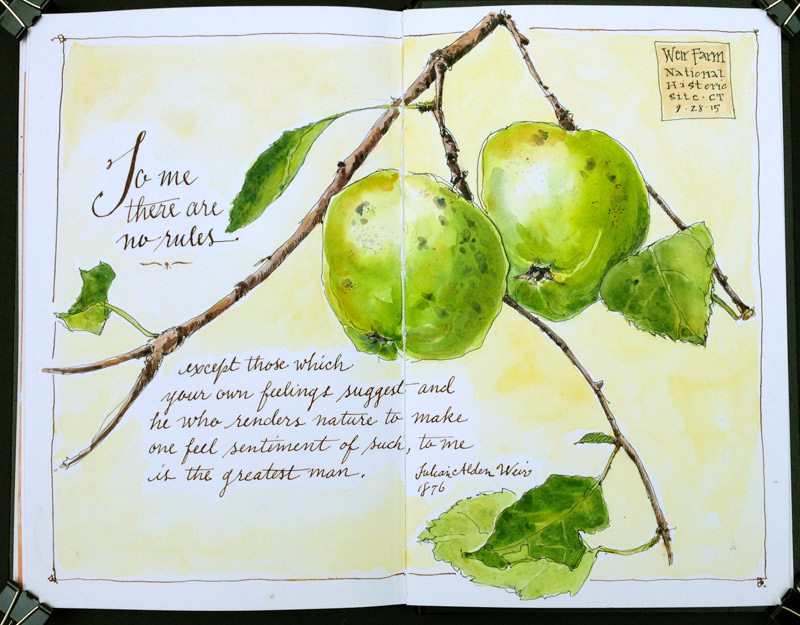
“To me there are no rules…except those which your own feelings suggest and he who renders nature to make one feel sentiment of such, to me is the greatest man.”
— J. Alden Weir, 1876
As a pioneer of American Impressionism, J. Alden Weir set aside the artistic conventions of his day to explore new ways of painting. His words are a good reminder to me to take risks, connect with a subject, and express what I see and feel. While visiting Weir’s former home, now the Weir Farm National Historic Site in Connecticut, I had just a short time to sketch, so I don’t think I was altogether successful in illustrating his words. They really should be paired with the spreading oaks and maples, stone walls, red barns, and scenic landscapes of his farm. But who knows– maybe Weir would be forgiving, telling me to forget what “should be” and keep putting brush to paper.
Well Protected
Sharp spines, thick shells, noxious odors — the lengths a tree will go to protect its seed! I found these while exploring a local cemetery in my new hometown.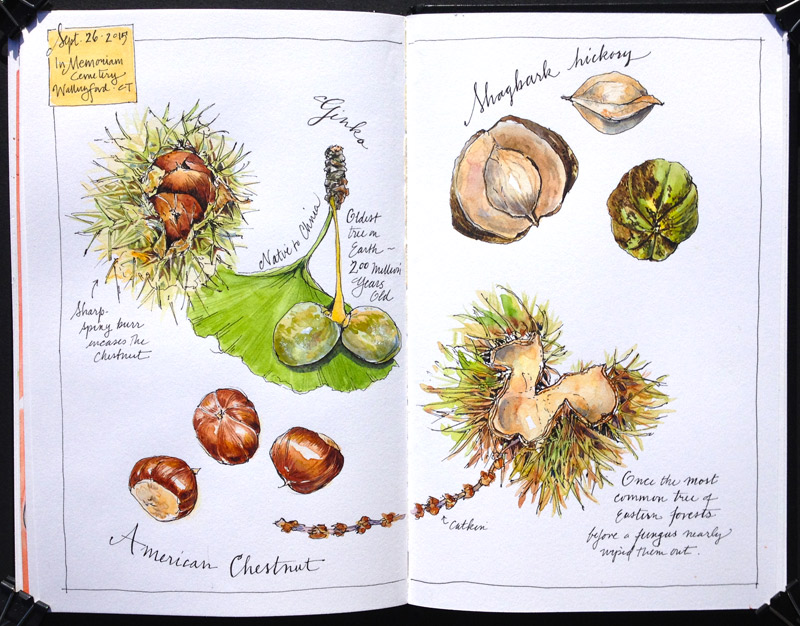
Alive among the dead, the American chestnut really caught my attention. Once the predominant tree of Eastern forests, they are a rare find today. A fungus nearly killed off the entire species by 1940. In contrast, the ginkgo is an ancient survivor. Native to China, but planted widely in cities, ginkgoes have been on Earth since the days of the dinosaurs. I had never seen the nut before and, as it turns out, for good reason. The female, seed-bearing trees are not planted frequently because of the noxious odor given off when the nut drops to the ground and is crushed. Hickories are widespread in the mid-west and eastern U.S., so they are not hard to come by. The thick husk and hard nut protect an edible seed inside.
This page was done a piece at a time, starting with the chestnuts. I drew them directly in pen on location because the spines were so sharp I could not carry them home. I collected the ginkgo and hickory nuts and sketched them at home. Much of the watercolor was done with a very dry brush to get the detail. I added the text last with a micron 02 pen. (Stillman & Birn Zeta journal)
In Between
At Slocum’s River Reserve near Dartmouth, Mass, I found myself drawn to the quiet beauty of the salt marsh on an overcast day— all gold and green, tinged with red. In between land and sea. In between one place and another. There is a silent ebb and flow; life in flux each hour, each day, each season. My time here is a gift at the end of a hectic summer, made possible because I too am in between. This place, painting it, is my own calm between seasons, between moving out and moving in.
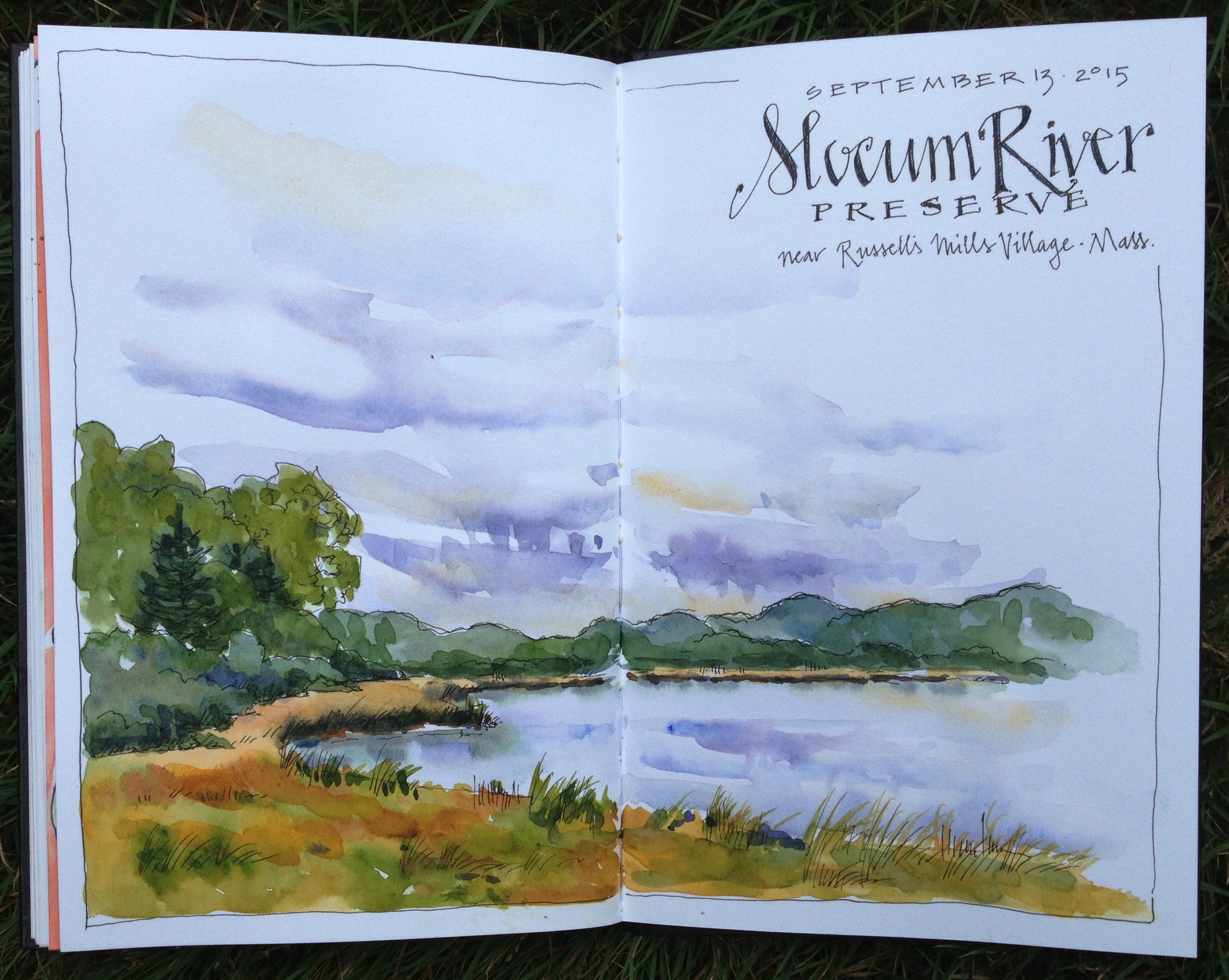
Watercolor in Stillman & Birn Zeta sketchbook
Organized Chaos
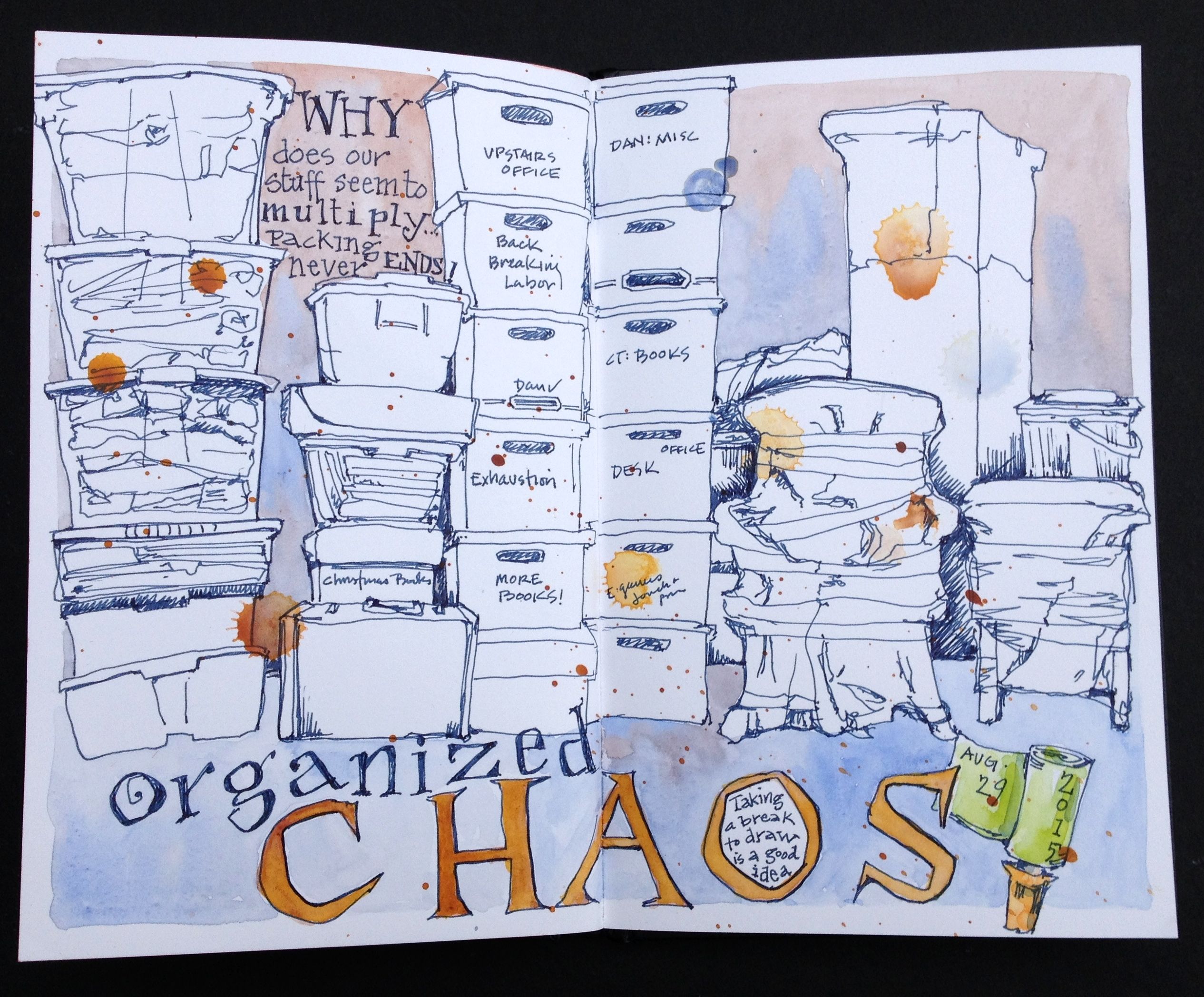
What a mess! This page, my life! Boxes and bins multiply through the house as we make our final push to pack for our move from New York to Connecticut. My desk, my art supplies: dismantled, boxed, and wrapped…for now. And so no lovely birds, no gardens, no carefully observed scenes until the chaos subsides.
Home Grown
It’s very satisfying to grow your own tomatoes. Not just cherry or grape tomatoes, which are fine, but full-sized Brandywines or beefsteaks. While other gardeners have been harvesting their tomatoes for a few weeks, my late-maturing heirlooms are just beginning to ripen. And I suppose that’s good. The slow yield has given me one or two to eat and more on the vine to paint.
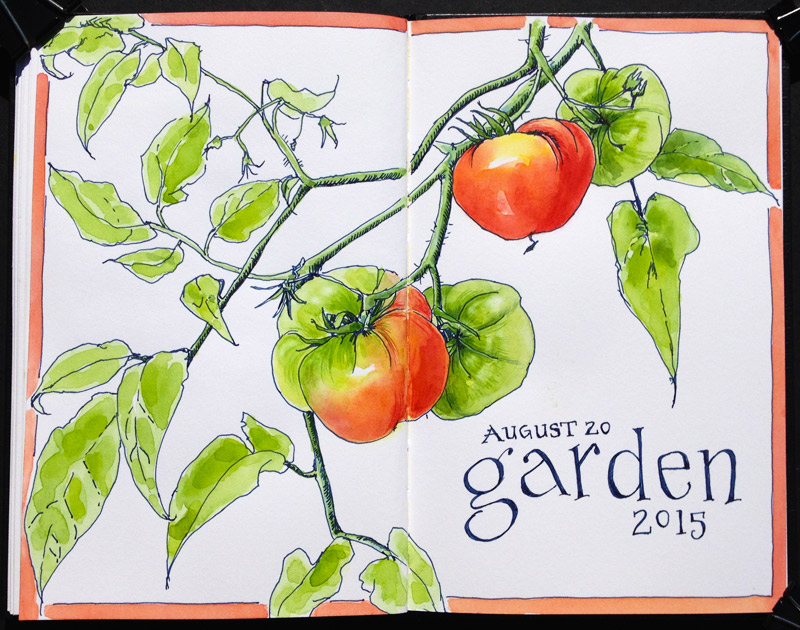
This page is a bit of an experiment. I recently bought a new fountain pen—a Lamy Safari—and I tested it with a deep blue-gray waterproof ink from De Atramentis called Fog Gray. The extra-fine pen nib is still much, much thicker than my go-to Micron 02 pen. Although I loved the smooth line, I’m not quite used to the bolder stroke. I found it hard to get much subtlety, especially when shading, which I tend to add in ink before beginning the watercolor. I look forward to more testing!
If at first…
Why is it that so many artists, including me, think we’re going to get it “right” the first time? I know that producing good art requires practice, trial and error, and problem solving. But I still get frustrated when things don’t turn out to my satisfaction.

Cohoes Falls- 1st attempt
So it was this week when I tried to paint Cohoes Falls in upstate New York. On my first go, I just didn’t get the drawing right. I found it hard to simplify the landscape into shapes that I could tackle. And I didn’t really figure out the values before trying to add color. The result: a piece that’s blobby and confusing.

Cohoes Falls, done in micron pen and watercolor in Stillman & Birn Zeta journal, 5.5×8.5
So…turn the page and try, try again. Here’s my second attempt:
It was challenging to capture the magnitude of the falls and landscape in my small journal…to get the full width of the falls requires reducing the height. An accordion fold journal might work best. But that would take a third try!
About Cohoes Falls: New York’s second largest waterfall (behind Niagara Falls), Cohoes Falls is 1000 feet wide and 75-90 feet high. Several dams divert water from the falls, so the volume is of water over them is not full force, especially in summertime. Still, they are mighty impressive. There is a terrific park overlooking the falls and, when conditions permit, a stairway and trail that allows access at the base of the falls.


 Drawn In