King Tide
While visiting southern California last month we took time to explore the tide pools at Cabrillo National Monument. This is one of the best protected rocky intertidal areas in California and our timing was perfect. Sun, moon, and Earth aligned during our visit to create a King Tide, a twice-yearly occurrence in which the low tide is nearly two feet lower than normal. This exposes far more of the rocky shore and reveals a greater diversity of the fascinating creatures that live at the edge of the sea.
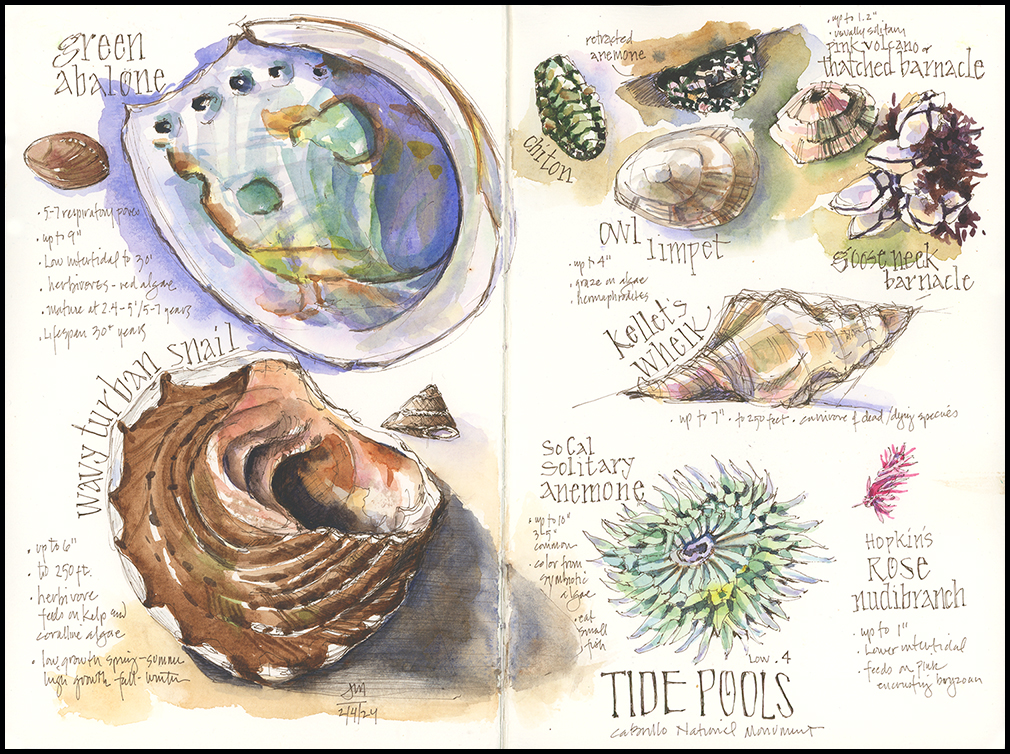
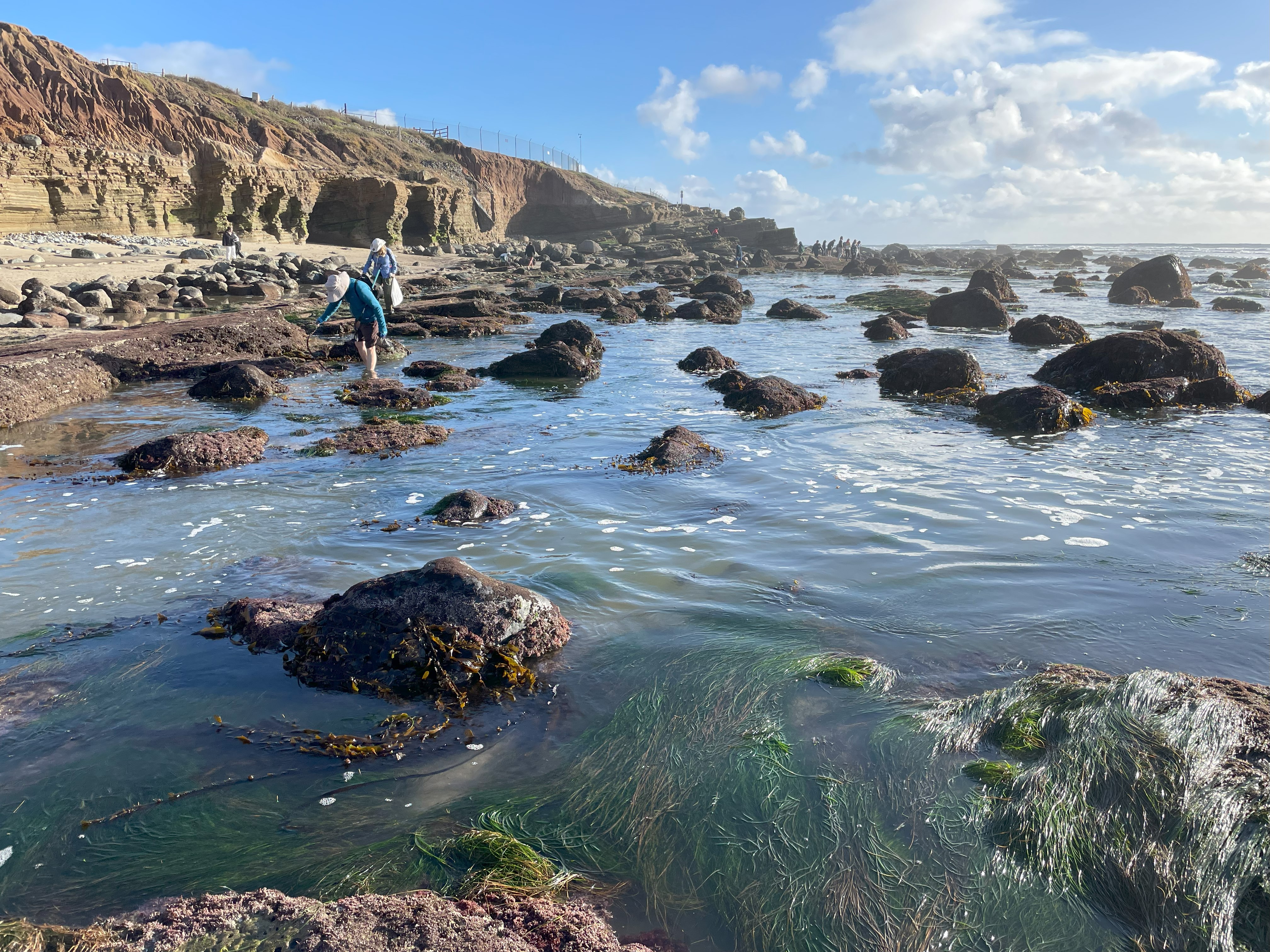
Tips and Techniques– I love sketching while exploring tide pools and encourage you to try it if you have the chance. Though conditions are challenging, the sense of discovery and immediacy is exciting—and those qualities often come through on the page. The rocks are slippery, the water frigid. Creatures are hiding to try to stay damp and safe until the tide returns. And if you explore the outermost pools where sea and land meet, you need to watch the waves and the time to be sure your route back isn’t covered in water from the incoming tide. I carry my sketchbook and a pen in a plastic bag in my backpack, along with a small ruler, and a bandana for drying my hands. I accept that my sketches will be messy—that comes with the territory—and I add text and watercolor later from photos and memory.
 Drawn In
I always enjoy your sketches, but this is especially fun because I grew up in Point Loma and I did some tide pooling there. But sketching while tide pooling seems like a challenging idea!
It’s a beautiful area– and I imagine it’s quite different from when you grew up there. I’ve done a lot of tide pool sketching– mostly on the East coast, so this was a treat. There is far less seaweed to scramble over to reach the pools in CA and the species are generally much larger. I enjoyed seeing the differences.
Very interesting and exciting indeed. Nothing like challenging conditions to stimulate the sketching muscles! Your sketches are beautiful, and in a terrific composition. Truly delightful.
I’m curious, why the ruler? To measure?
Yes. I use a ruler to measure, which helps with identifying and distinguishing between similar species.
…and the flip side of a King Tide is extremely high tides, giving us a hint of what warming climate & higher sea levels may bring as new ‘normals’. Tide-pooling at minus tides is the silver lining!
We did see the flip side that week with atmospheric rivers and coastal flooding. The tragedy is how much flood damage is caused by coastal development in places where building should be avoided in the first place.
Tide pools are amazing whether capturing in your sketchbook, or just with your eyes. I was at Cannon Beach, OR a few years ago during a king tide. I could walk carefully to the edges of the Haystacks. Starfish in abundance – so many colors and sizes. Great pages, Jean.
Lucky you! We saw a few starfish, but they weren’t well positioned for me to sketch them safely. They are always among my favorite discoveries.
I can’t imagine you doing a messy sketch, yours are always so well planned and executed.
Actually, many of them just sort of grow as I go. I started this with the small things in the upper right. Then I found the whelk and later the two large shells. It’s a bit like putting a puzzle together until all the pieces fit.
Lovely sketches. The abalone shell brought back fond memories (1953) of going to the “old” Redondo Beach pier on Friday’s with my mom and sister and buying fish for Friday night dinner. By far, my favorite was abalone. I still have shells to keep the memory alive.
I was delighted that we found several abalone shells of various sizes. It’s nice when a shell can bring back found memories.
beautiful
Thanks!
SO beautiful and inspiring to me, Jean. I would recognize your work anywhere and I treasure these emails as they provide fresh vision for my own growing nature rendering abilities! I was born and raised a little further north at Cabrillo Beach in San Pedro in a time of unspoiled and open tide pools and wide open beaches. Late night family romps on Cabrillo Beach during the grunion runs (with phosphorescence in the waves), all manner of squishy seafood brought home by my dad’s snorkeling adventures, and countless walks with my sister and friends to the rocky cliffs, shoreline, and tide pools 2 blocks from our home. Anyway, this makes me want to take a trip to our Oregon coast soon, and the tide pools there. THANK YOU for your beautiful art, Jean! What a gift.
Janet- Thanks for sharing those lovely memories. I saw several historic photos of the coastline and can only imagine a less developed coast. How great that you had that as part of your growing up experience. My son it at Scripps and he has gone out to see the grunion run, as well as taken up diving, so I get to see some of what he discovers from afar. I hope you’ll make the OR coast trip for some exploration!
Hello, Your pages are always so beautiful!! Thanks for the inspiration.
Thanks Avery!
what a gorgeous setting, Jean! I had to chuckle when you mentioned that you “ have to accept your sketches will be messy.” Considering the shifting tide, and with the distraction of water moving constantly within eyesight and around your feet, you did an amazing job sketching all of the creatures and shells! Hopefully you weren’t captured by the incoming tide.
your abalone sketch and painting is stunning! Wow! Always, always thanks for sharing Jean!
Thanks Barb! First time I had my feet in the water and a down coat on. I’m not used to winter tide pooling. I always watch the incoming tide– haven’t been caught out yet.
Has anyone ever drawn you in their nature journal? The image of someone tiptoeing about tidepools in a down coat would be a priceless story to tell!
The joy of discovery! I love the photo of the tide pool next to your beautiful sketches of the creatures that are hiding beneath!
Thanks! Yes to the joy of discovery!
Tide pools on on my list of things I would love to see and explore. Not living near on ocean does make that difficult! Your work is always so beautiful.
Oh, Lisa– Definitely try to do it one day. Thanks for checking in!
I love this! Truly beautiful! I especially like the Green Abalone.
Thanks Peggy. It was a treat to see those species.
Hi Jean…the trip must already seem like it was a long time ago but what a treat! Your abalone shell’s colors are outstanding! The Turban shell came out beautifully, too – such nice depth and contrast. We don’t have many of these creatures up here but I’m still looking forward to minus tide days when I can poke around and enjoy the wide beach. In the winter, all the minus tides occur at night but it gradually switches to daylight hours. I bet you’re already out sketching buds – or you will be soon! 🙂
Only the red maples and pussy willows are budding here– progress.
That’s something! 😉
Beautiful!
Thank you!
Beautiful, Thanks for sharing
Thank you!