
Searching for Dragonflies
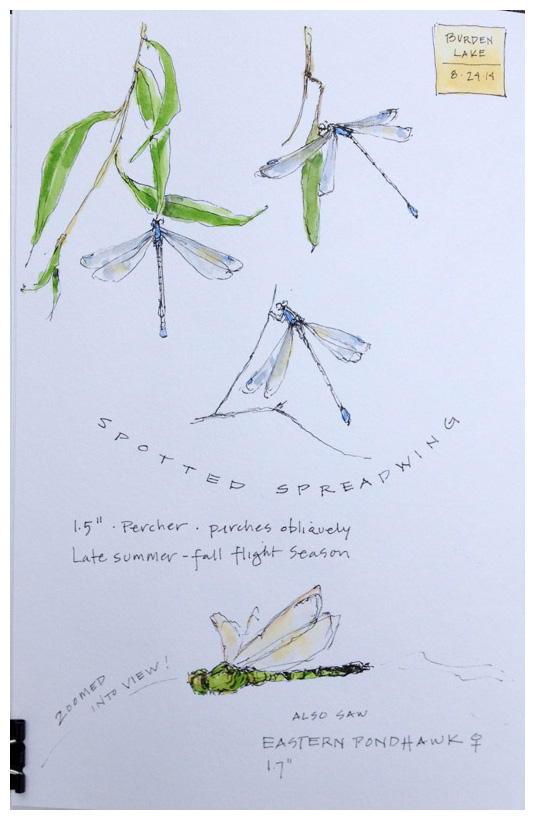
OK, I admit it…I’m a dragonfly geek. While most people enjoy a boat ride or swim at my mother’s summer cottage, I’m often out rowing around in the hot, mucky backwater shallows in search of dragonflies. Sketching them is a highlight of my summer.
Dragonflies are exceptional flyers, which makes it particularly challenging to identify and sketch them in the field. But, like birds, dragonflies perch for short periods, often returning to the same spot between patrols. Some species perch longer than others and the position in which they perch– horizontal, at an angle, teed up, or straight down—is distinctive for each species…which helps with identification.
I got lucky last weekend when I rowed out in the late day sun in search of dragonflies. A number of Spotted Spreadwings—a new sighting for me– were perched at the water’s edge, hanging from willow leaves or small twigs. Spreadwings are more delicate than other types of dragonflies, and finding one feels like discovering a small jewel in the weedy margins of an August pond.
I also was treated to a fast flyby of a remarkably bright green and black female Eastern Pondhawk. A beauty!
Resilient
 I love the sheer mass of this old cottonwood, towering above younger trees in my neighbor’s abandoned field. Less than a year ago, its hollow trunk still supported most of its aging, weighty limbs. But summer storms recently brought a good portion of the giant to the ground.
At first sight, I was struck by its brokenness in the late day sunlight. Only later, I realized my shortsightedness. Trees, like people, can weather many storms—their character often enhanced by years and trials. Sending greenery skyward, they go on living—aged and scarred, but resilient.
Sketched on location in ink; watercolor wash and text added later.
Urban Sketching
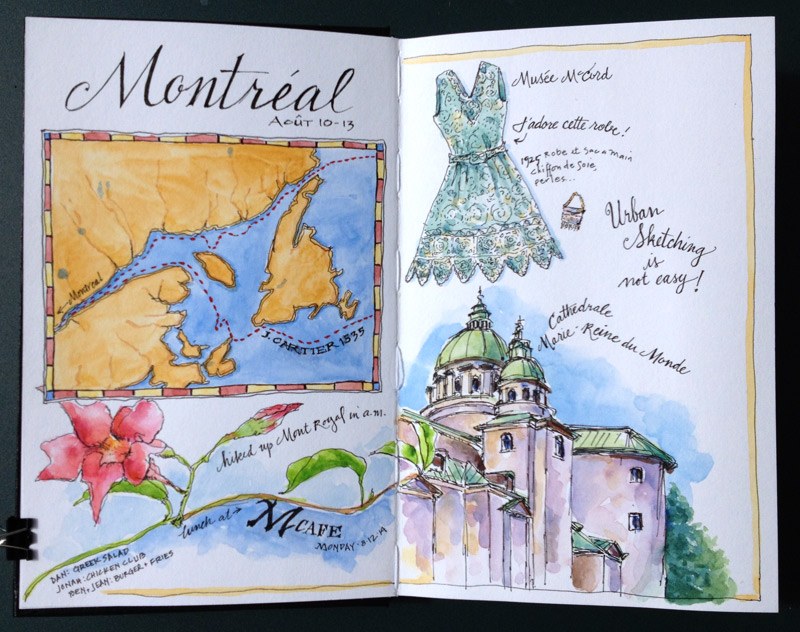 Hail to the urban sketchers! I don’t know how they do it.
I recently spent three days in Montreal and was eager to try my hand at sketching buildings and cafes and street scenes. Instead, I found myself challenged at every turn. With so much going on—so many people and so much activity—I hardly knew where to begin. My family had a full schedule of activities, and I thought I’d just sketch along the way, but that proved harder than I anticipated. I stole five minutes here and there—a pause while hiking, a moment before lunch, a few minutes at museums. The result, as you see, is a fairly random mix.
And so, I wonder, what’s the secret to urban sketching? No fuss? Work fast? Travel alone? Sketch anything? Sketch everywhere? Dedicate time? Or, perhaps, just stick with a camera next time!
 In the interest of speed, I jettisoned my paints on the second day, in favor of a fountain pen and water brush. Both of these pages took less than 10 minutes and I added the colored background later.
August Moon
 I was fortunate to grow up with a grandmother who I adored. Though she took up painting in her later years, what she did best was nurture other people’s talents. She praised accomplishments, encouraged her grandchildren to explore the world, find things we liked, and pursue them.
When I was thirteen, she enrolled me in a plein air painting class. Everyone else in it was grown up. I painted a willow tree, struggling to see the red my instructor wanted me to add to the green leaves. My finished painting was not good, but it didn’t matter. My grandmother had planted a seed. She believed in me as an artist.
Now all these years later, I look at the August moon and she is back with me…looking up and out into that vast universe of possibilities, and encouraging me still.
(Watercolor, Stillman & Birn Beta 5.5 x 8.5”)
Tomatoes!
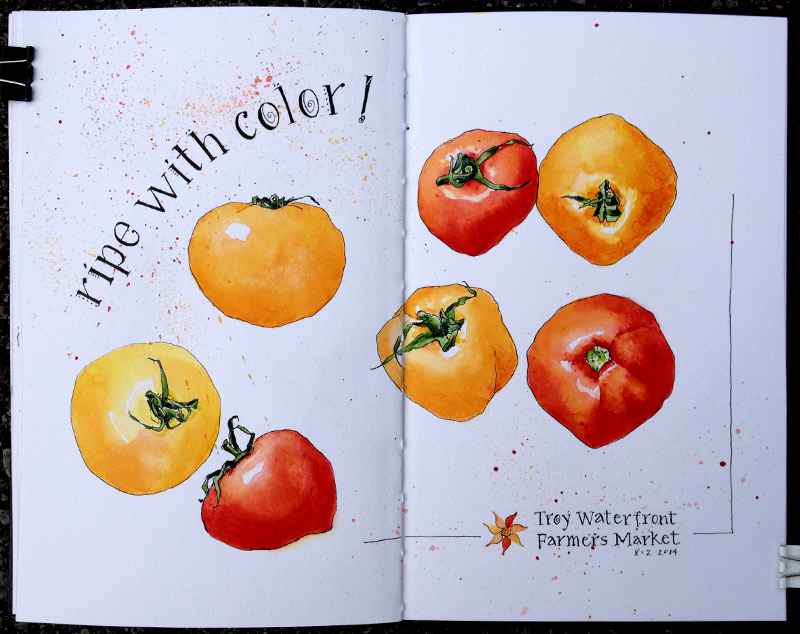 Farmers markets are an extravagant display of color and form at this time of year– the sheer abundance of summer’s harvest is astonishing! I went last weekend in search of both culinary and artistic treasures, and found a wealth of choices. Though tempted by the deep red-purple of beets and onions, I set those aside knowing that they would keep until winter. Instead, I selected some of August’s finest– ripe tomatoes, succulent apricots, and several varieties of the year’s first apples.
Fortunately, my family is well trained– they know not to delve in until the painting is done. But with this page complete, we can begin to enjoy one of the season’s simple pleasures.
(Watercolor and ink, Stillman & Birn- Beta journal)
Comb Jellies
 (click image to view larger)
What a find! My son and I recently hit the jackpot while exploring the tidal Slocum River on Massachusetts’s southern coast. There in the brackish water, among feeding barnacles and clam siphons protruding from the muddy bottom, we spied them: floating, iridescent, pulsating jellies! At first one, then two, and when our eyes adjusted to deciphering clear bodies in the water column, twenty or more. They ranged from dime-sized to golf-ball sized and we watched them, mesmerized, until hunger sent us in search of lunch.
I later learned that comb jellies are not jellyfish. Though they share some characteristics—like gelatinous bodies made of two major cell layers—these ancient creatures hail from distinct phyla: comb jellies are ctenophores, jellyfish are cnidarians. Comb jellies are propelled through the water not by propulsion, but by the action of thousands of tiny cilia that line their bodies. When light is refracted by the moving cilia it results in a beautiful rainbow of pulsating light.
This journal page is my attempt to capture the experience and also serves as field notes for learning about comb jellies. (Stillman & Birn Beta journal, 5.5×8.5, watercolor, ink, and alcohol to create the textural effect.)
Sketching on the Go
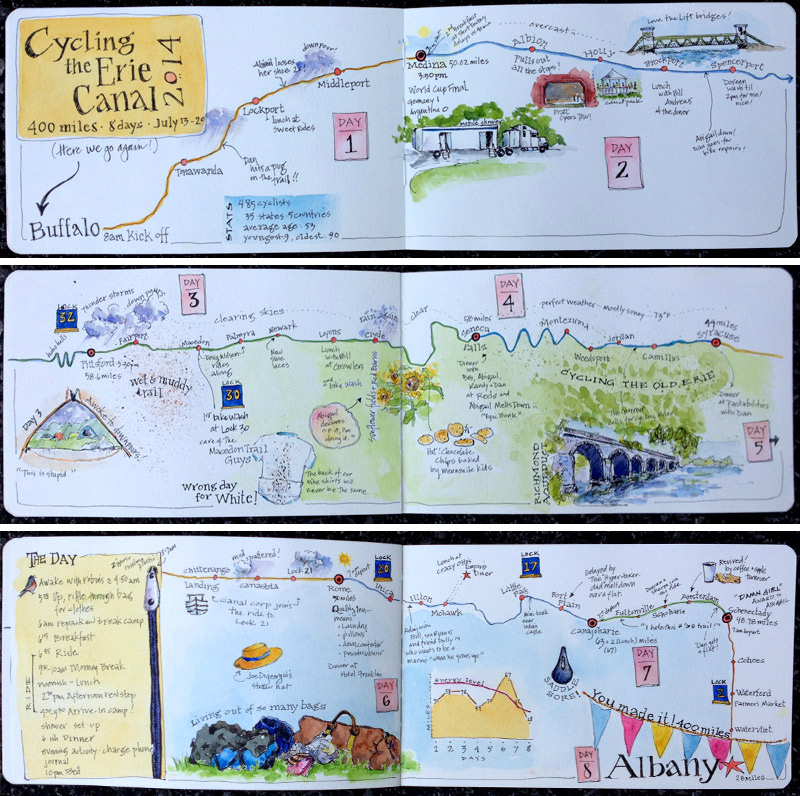 It’s tough to keep up a sketchbook when traveling by bicycle! But here’s the result of my recent 400 mile, 8-day cycling trip along the Erie Canal in New York State. (You can click on the image to enlarge it a bit.) Because I needed to cover 50 to 60 miles a day, I found it impossible to sketch until the riding was done. No matter how tired, I made a point of extending the schematic map eastward each evening, filling in some of the day’s adventures in words or pictures.
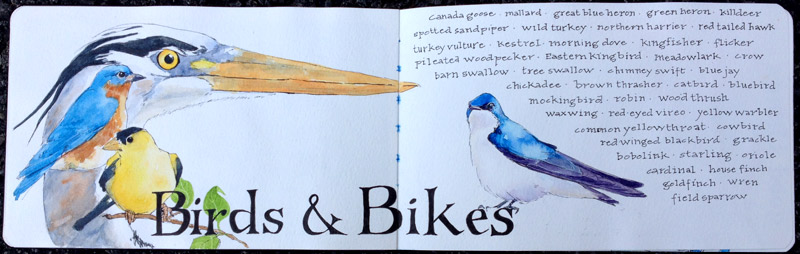
Packing light was essential! I brought a black Micron 02 pen, a small watercolor kit, water brush, and 5”x8” Moleskin watercolor sketchbook packed in a ziplock bag. The birds and bicycles page (below)– a record of all the birds I’ve seen while cycling– was completed back at home.
In Camille’s Garden
 Having creative friends is wonderful thing—especially when they invite you over for an evening of sketching! I’d been eying Camille’s garden for awhile and I was glad for the chance to look at it more closely. Unfortunately, the sun was fading fast, so I chose just a small part of the flower bed to paint. I especially liked the way the hedge bindweed threaded through the lilies and daisies. The wren is nesting in my own garden, but he fit that space quite nicely and so became the final element to the page.
Hour by Hour
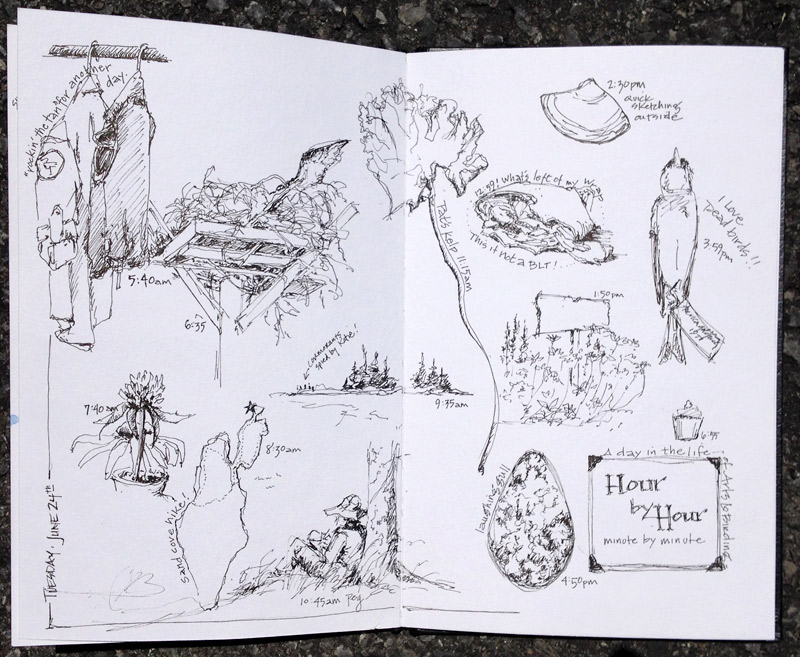
What if you had to draw something every hour all day, but each drawing could take only one to five minutes? That’s the challenge I issued to participants at a recent workshop on Arts and Birding in Maine…and this page is my own result. Starting at 5:40am with the clothes hanging in my closet, I found that sometimes I knew what I wanted to draw (the osprey nest), but more often, I just stopped at some point during each hour and drew whatever was in front of me (flowers on the breakfast table at 7:40am, my half-eaten turkey wrap at 12:59pm).
My aim with the challenge was to encourage participants to work fast to get something down on the page, without worrying so much about how it turned out. I also wanted people to see that it is possible to make time for sketching, even if it’s just a few minutes each day. By getting into a habit of regularly putting pen to paper, drawing skills improve!
Since it’s impossible to convey “a day in the life” on this island in just minutes of sketching, I thought I’d also give you an expanded view. Join us in 2015!
Arts and Birding 2014, Audubon Camp on Hog Island, Maine
Specimens!
 I love dead birds.
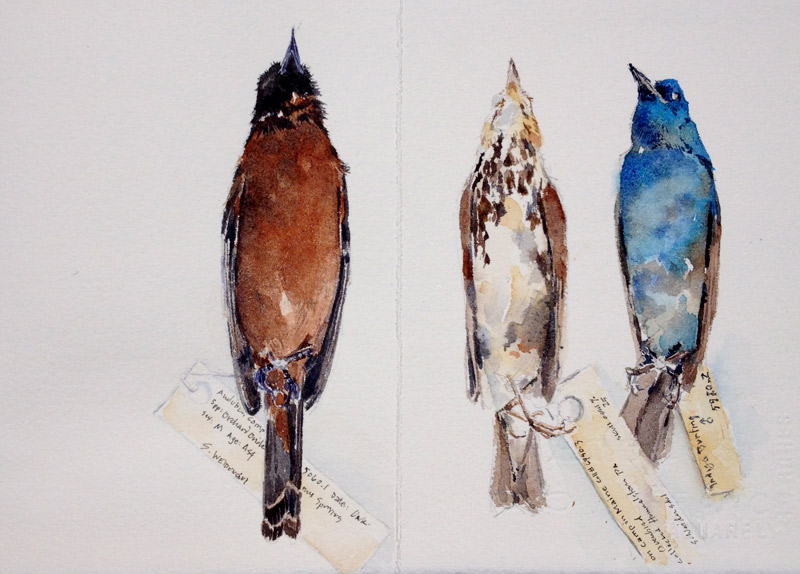
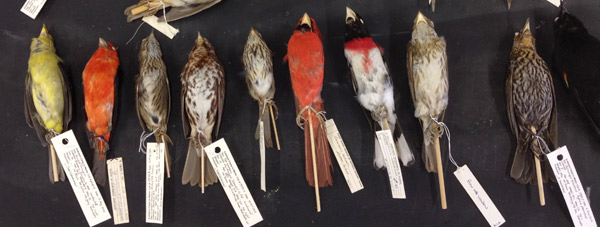
Don’t get me wrong: I love living birds, too. It’s just that living birds are harder to draw and paint. So when I have a chance to study and sketch specimens, I seize it! Bird “study skins”—as these un-posed, stuffed birds are called—provide a close-up view of anatomy, feather groups, and coloration that is often hard to decipher when birds are alive and moving. By sketching bird skins, I’m better prepared to capture the right placement and shape of a bird’s wings, feet, and bill when sketching birds that are alive and fleeting.
These specimens are part of the collection at the Hog Island Audubon Camp in Maine, where I recently spent a week teaching “Arts and Birding”…and encouraging participants to take a closer look at both living and dead birds.


 Drawn In