
Celebrating Skunk Cabbage
Why is it that the first native wildflower to bloom each year in the Northeast gets so little fanfare or attention? Could it be its unappealing name– skunk cabbage? Or the fact you have to search for it in wetlands and bottomland forests or along damp streamsides in late-February and March? Or could it be that it doesn’t really signal the end of winter, able, as it is, to thrive when there is still snow on the ground?
Still, I think there is much to recommend skunk cabbage: it’s mottled deep maroon hood which conceals a pineapple-like flower head; it’s ability to generate its own heat; and, best of all, it’s bright green, tightly-rolled leaves that begin to unfurl in April. And now, having dug up a skunk cabbage to study it more closely, I would add to the list its massive root system, which anchors the plant deep in the ground. What more praiseworthy spring wildflower could there be?

Tips and Techniques– Follow your curiosity. Without it, I would not be out in the woods in February or studying the roots of skunk cabbage or painting many of the other subjects that intrigue me. Find what spark’s your interest and follow it.
Wishful Thinking, March
I could have titled this post: Ready for Color, or Envious of Those Experiencing the Desert Wildflower Bloom, or simply Tired of Brown. Rather than painting what’s outside this week, I decided to create my own poppy field. This piece is bigger and bolder than I typically paint. I’m still not sure what I think of it, but it has been nice to experiment with some brighter colors and assuage my wishful thinking.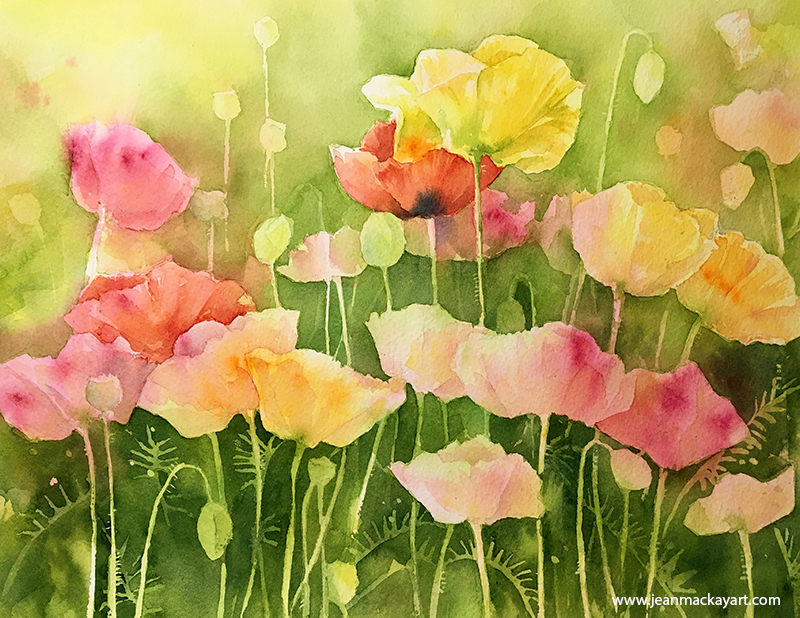
Tips and Techniques– I created this piece using negative painting techniques, starting with a wet-in-wet wash of QoR Nickel Yellow Azo, Quinacridone Magenta, and Transparent Pyrrole Orange. I let the colors merge on the wet paper and, when dry, began adding graded washes of sap green (sometimes with Ultramarine Blue), painting around the flowers and picking out stems, buds, and seed pods. There are a number of layers here, each one adding depth. I could have kept going, adding more darks, but at some point, it was best to quit, rather than risk the piece getting too fussy and overworked. (The paper is Fabriano Artistico, extra white, cold press, 300lb/640 GSM, 11×14”)
Lost in Greenery
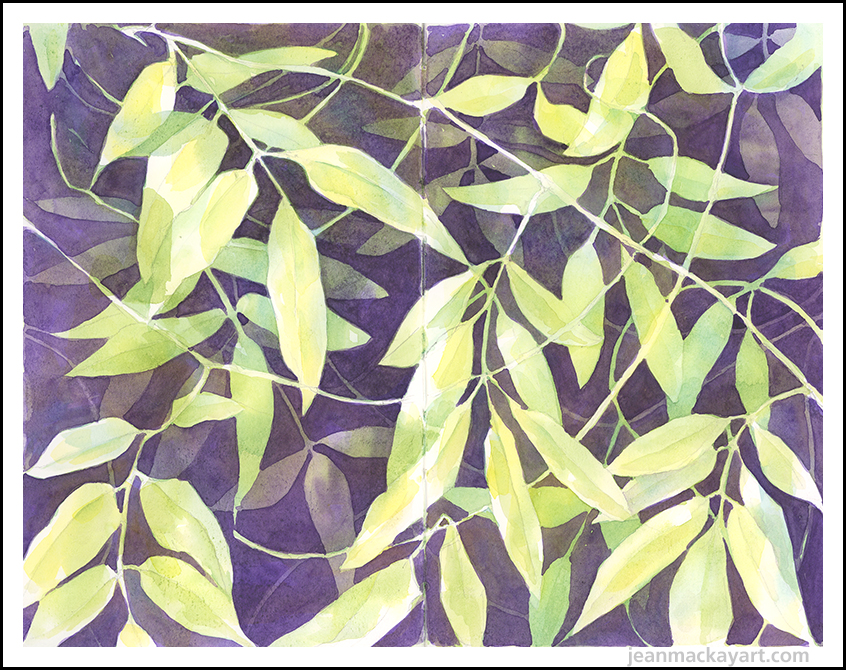
Note to self: avoid painting at the Lyman Conservatory during the spring bulb show. Truth be told, I only glanced into the rooms that displayed a grand spectacle of colorful tulips and daffodils. They were so crowded with winter-weary visitors that sketching there was impossible. I did, however, eke out a small corner of a greenhouse where a tangle of vine wound its way from floor to ceiling. And, as crowded as it was, I wouldn’t have traded a day lost in that greenery for anything.
Return
Sometimes it’s February, sometimes March when the red-winged blackbirds return. Regardless, it’s a welcome and exuberant racket of wingbeats and squawking from the marshes and treetops. It doesn’t necessarily mean that spring is here; indeed, today, a flock swarmed over our yard and flew off just as it began to snow. But it means we’ve turned the corner: more light, more days above freezing than below, and more good things to come.
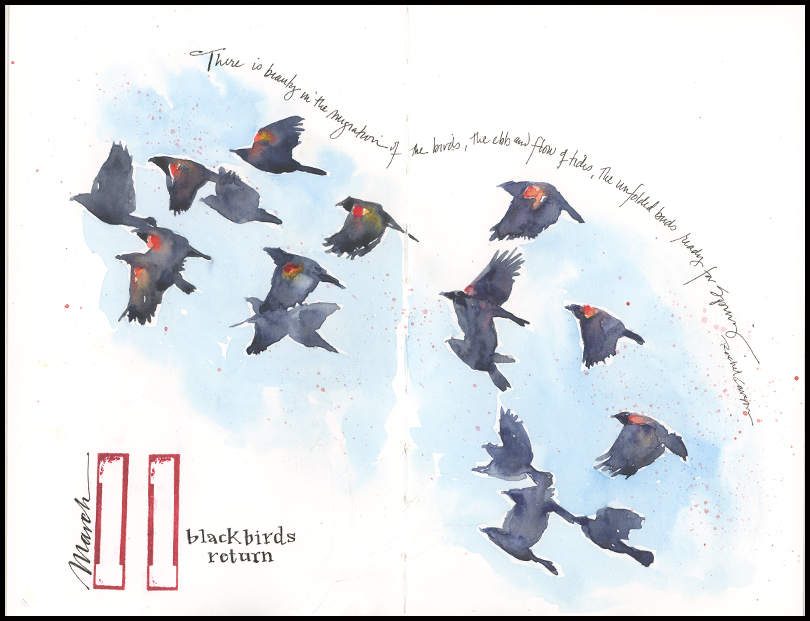
Tips and Techniques– I wanted to zoom in on the shapes of the birds in flight, rather than the details, and let some of the birds merge, the way they do in a flock. To do this, I used a loose wash of ultramarine and burnt sienna to create the black, and tried to drop in a bit of yellow and red before the birds got too dry. I like the way the red merged into the dark mix, creating a dusky purple on some of the wings. I suspect this would work better at a larger size, where you could really get some nice color variation and more mixing right on the paper.
Reds
My previous post on tulips left me eager for more reds, though this week, I’m back to birds and words. What better choice for reds than the Northern Cardinal, the most colorful bird at my feeder in winter? But isn’t red just red, you ask? Well, absolutely not. You can see that I’ve experimented with different reds (and yellow) here— mixing combinations of transparent reds in a range of warm and cool tones. Other than alizarin crimson, these aren’t colors I use frequently, so this was a worthwhile experiment.
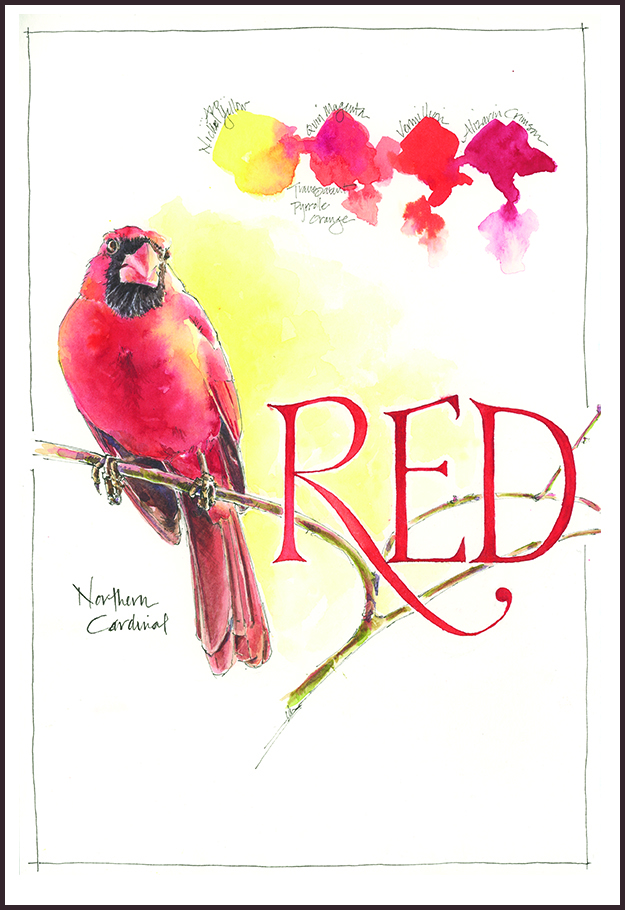
Tips and Techniques– Here’s the line up of colors at the top: Nickel Azo Yellow, Quin Magenta mixed with Transparent Pyrrole Orange, Vermillion, and Alizarin Crimson. The Vermillion looks heavy because it’s Dr. Ph. Martin’s Synchromatic Transparent Water Color, an intense liquid watercolor that I’ve had in my desk for years, but rarely use. The point here isn’t to go out and buy any of these colors, but to experiment with your own. Try mixing the ones on your palette (or in your drawer) to see how much they will do for you.
Tulip Herbarium
A spark of red. Bold color after months of winter. Unfortunately, my poor bouquet of tulips drooped within hours of when I purchased it, and well before I had time to paint it. Alas, the grand wilt gave me the perfect opportunity to create this herbarium page inspired by Wendy Hollender’s wonderful book, Botanical Drawing in Color: A Basic Guide to Mastering Realistic Form and Naturalistic Color (2010). It turns out that Emily Dickinson, too, kept an herbarium. Her poem, numbered 978, conveys the essence of may be missed when you think you have another chance, another day, but don’t.
It bloomed and dropt, a Single Noon—
The Flower—distinct and Red—
I, passing, thought another Noon
Another in its stead…

Tips and Techniques– Precision, accuracy and beauty are the hallmarks of natural science illustration. Botanical illustrators like Wendy Hollender, who works in colored pencil and watercolor, provide great insight into techniques used to make highly accurate renderings. While a journal hardly needs to be so detailed, I find it instructive to paint this way on occasion. I began the tulip with a pencil drawing, followed by a very loose wash of watercolor. From there, I used an increasingly dry brush (sizes 2 and 0) to apply more layers of watercolor. Getting a full range of values from light to dark is essential to making the petals take shape.
The Next Best Thing
February in upstate New York is typically cold and cloudy. With two months of winter already past and another two on the horizon before spring arrives, it’s time to head to the tropics or the desert for a midwinter getaway. Except when you can’t. Then, we have to settle for the next best thing: a trip to a greenhouse. I spent yesterday afternoon at the Lyman Conservatory at Smith College in Massachusetts and it felt like paradise. Warmth. Light. Rooms full of greenery. Art supplies in hand. What could be better?
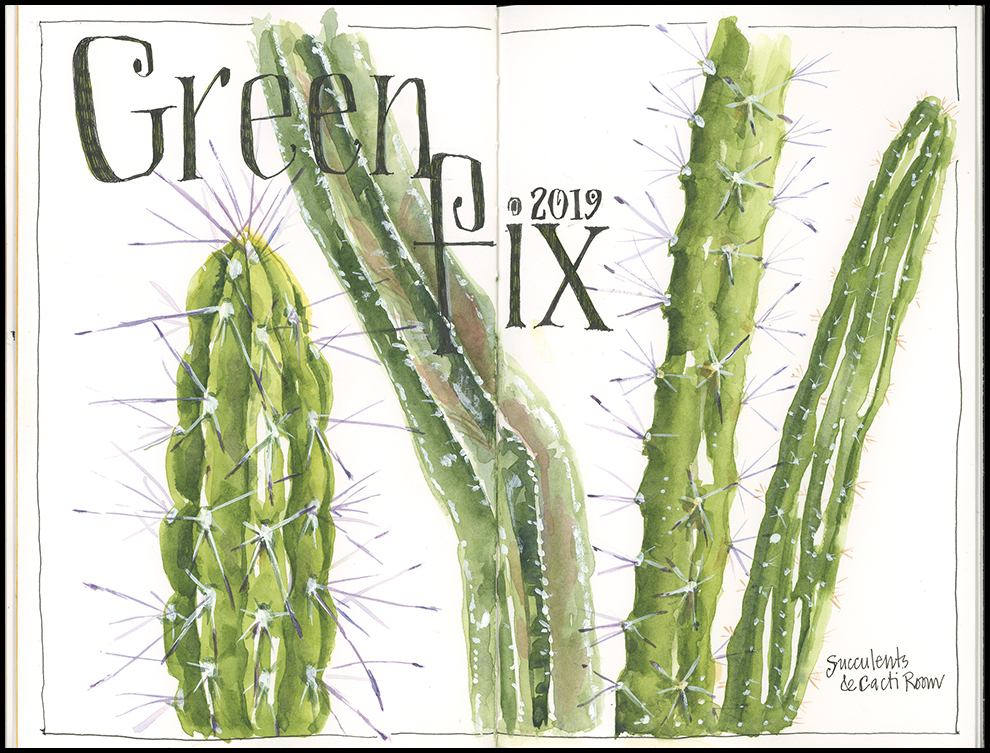
 Tips and Techniques– Based on my experience at the conservatory, my tip this week is: don’t give up too soon on half-baked sketches. Painting conditions at the greenhouse were difficult—tight aisles, lots of people, and no way to spread out or relax while painting. I painted both of these pages standing up, and believe me, they were very rough watercolors when it was time to leave. Nevertheless, I had the concept and basic colors down, which enabled me to add details and text when I got home. How many times have you found yourself in the field without enough time to finish? I say: at least get started. Take some notes or a photo and finish later.
Perching Birds #4: Yellow Warbler
Warblers: those ever elusive, but much beloved sprites of the tree tops; flitting about, dashing out and then back again, catching insects on the fly or just daring you to find them amidst the greenery. Capturing the yellow warbler on paper proved challenging, too. Perhaps it is because these perky little birds rarely sit still, so making them pose on paper seemed unnatural. Or maybe it’s that paint pales in comparison with the stunningly bright yellow of this warbler in sunshine. Nonetheless, #4 in my perching bird series is complete and, after several weeks of painting birds, I’m planning to turn my attention to other subjects for a while. (Click image to view larger.)

Tips and Techniques– Yellow can be a devilish color! It seems so light, yet, like other colors, there is a whole range of values from light to dark. Shadows on yellow are also tricky. They sometimes appear greenish or purple or gray. It’s easy to get murky laying shadows on yellow in watercolor. My advice when painting yellow (think daffodils, or lemons, or warblers), is to start lighter than you think. Leave the white of the paper for the brightest areas. Do a few washes to deepen values as needed. Experiment with different shadow tones on a separate test sheet– again, you may not need to go too dark to achieve variety and form.
American Robin
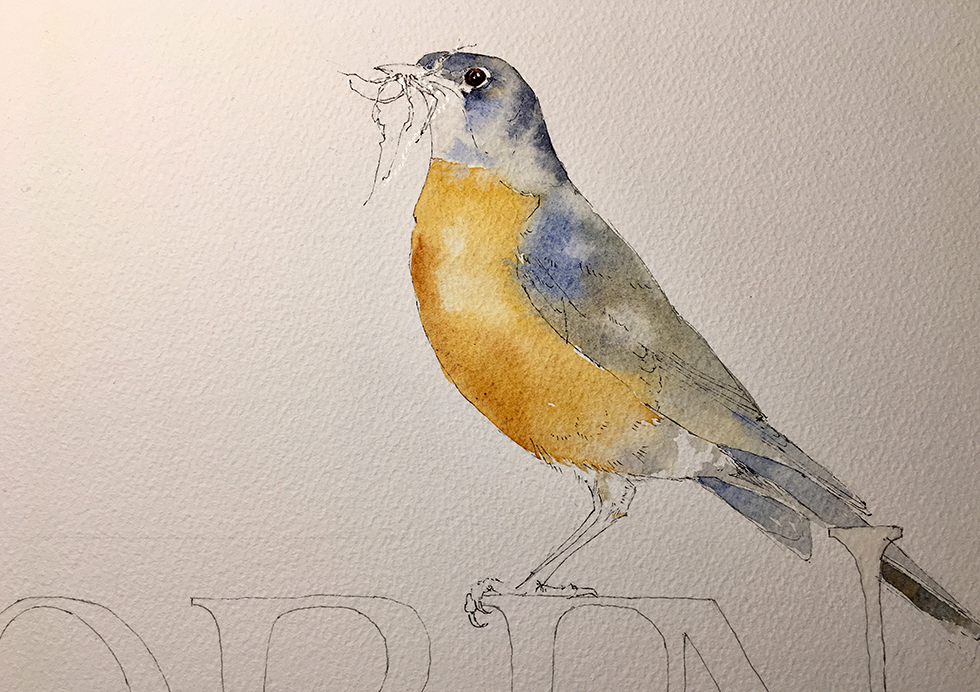
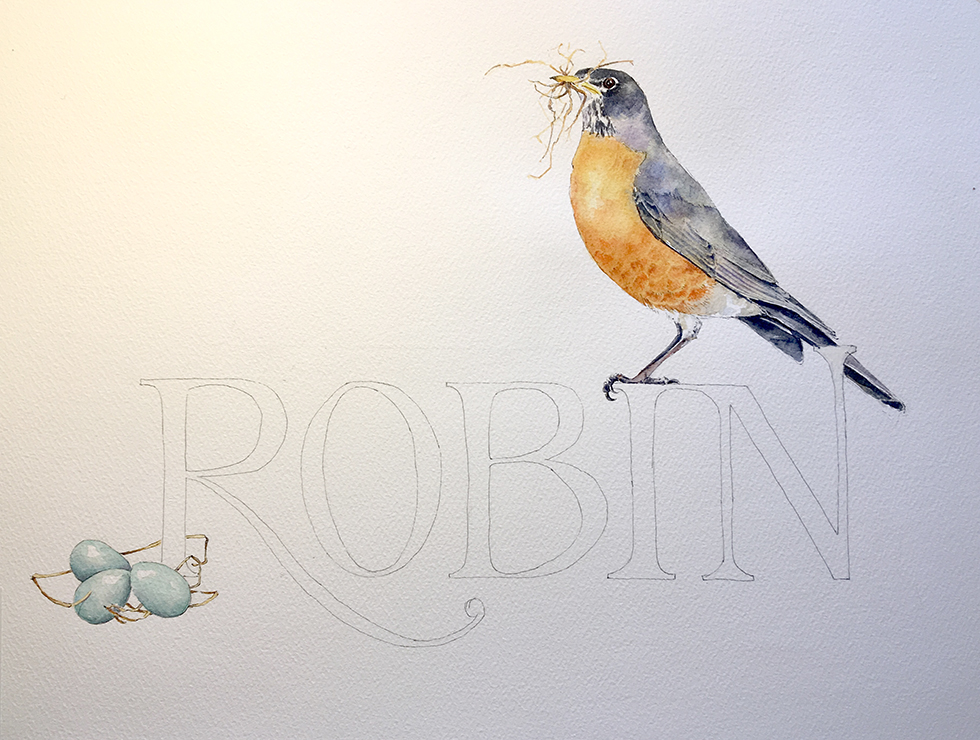
Sketchers place a lot of emphasis on being about to work fast to quickly capture what they are seeing. I work with the same time pressures when working outside or when sketching on the go. However, I find the exact opposite is needed when I sit down to do a detailed painting. Then, there is no substitute for taking my time and working slowly and carefully. Here’s the third painting in my perching bird series. It took me several days of drawing in fits and starts to get the bird’s position the way I wanted it, and then I painted it over the course of a week, stopping to breath, observe, think through color choices, and take things one step at a time.
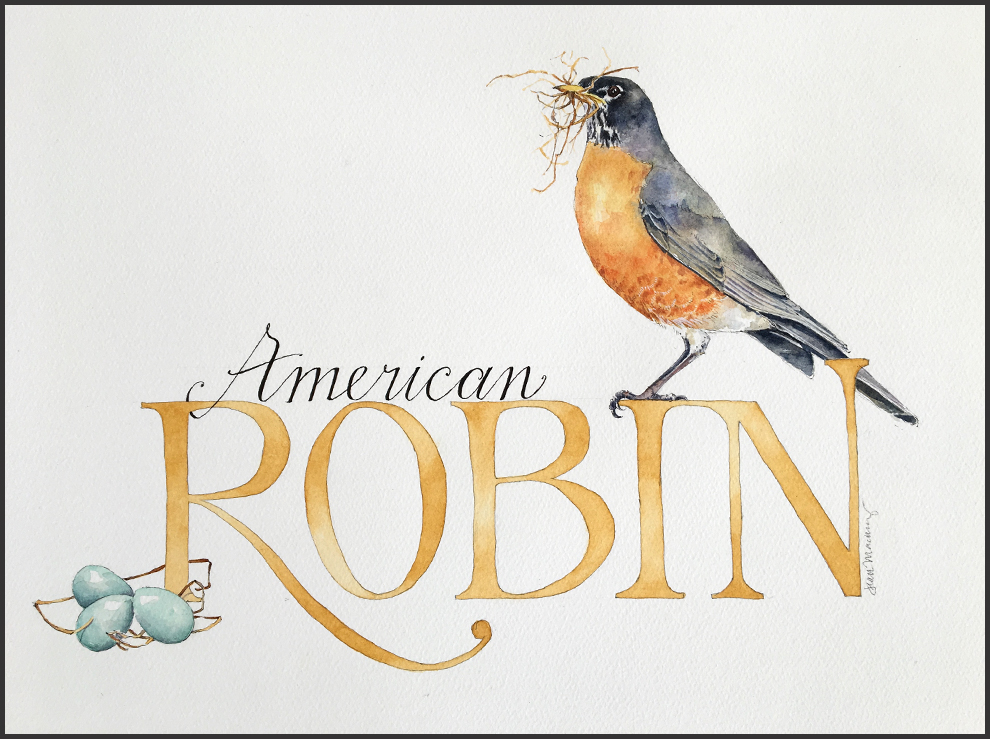
Tips and Techniques– Here are two images of the American robin in progress. You can see the underlying loose wash on the robin that helps make the colors interesting and lively. The initial wash on the gray back and head is a mix of ultramarine blue and burnt sienna. Second washes included more of the same mix, as well as washes of ultramarine with alizarin crimson to create purple tones. The breast began with burnt sienna, but later washes included a mix of aureolin yellow and pyrol scarlet, which gave it a warmer orange color. My choice to paint the word Robin in yellow ochre came after taking a hiatus in order to think through possibilities. I made some color swatches of other contenders before settling on ochre, but I think it makes a perfect complement to the eggs and the bird. (Click to view larger; sorry the image quality isn’t better)
Upcoming Exhibit and Workshop
This has been a week of little painting and much preparation for an upcoming art exhibit and workshop at the Art School of Columbia County, located near the New York/ Massachusetts border. I’m thrilled to report that I’ve recently been invited to join the faculty of the Art School, which will give me a “home base” for offering workshops throughout the year. Though the school is small, it casts a wide net, and is situated in a place that is steeped with art, artists, and plenty of rural beauty and inspiration. If you live nearby, drop in or sign up!
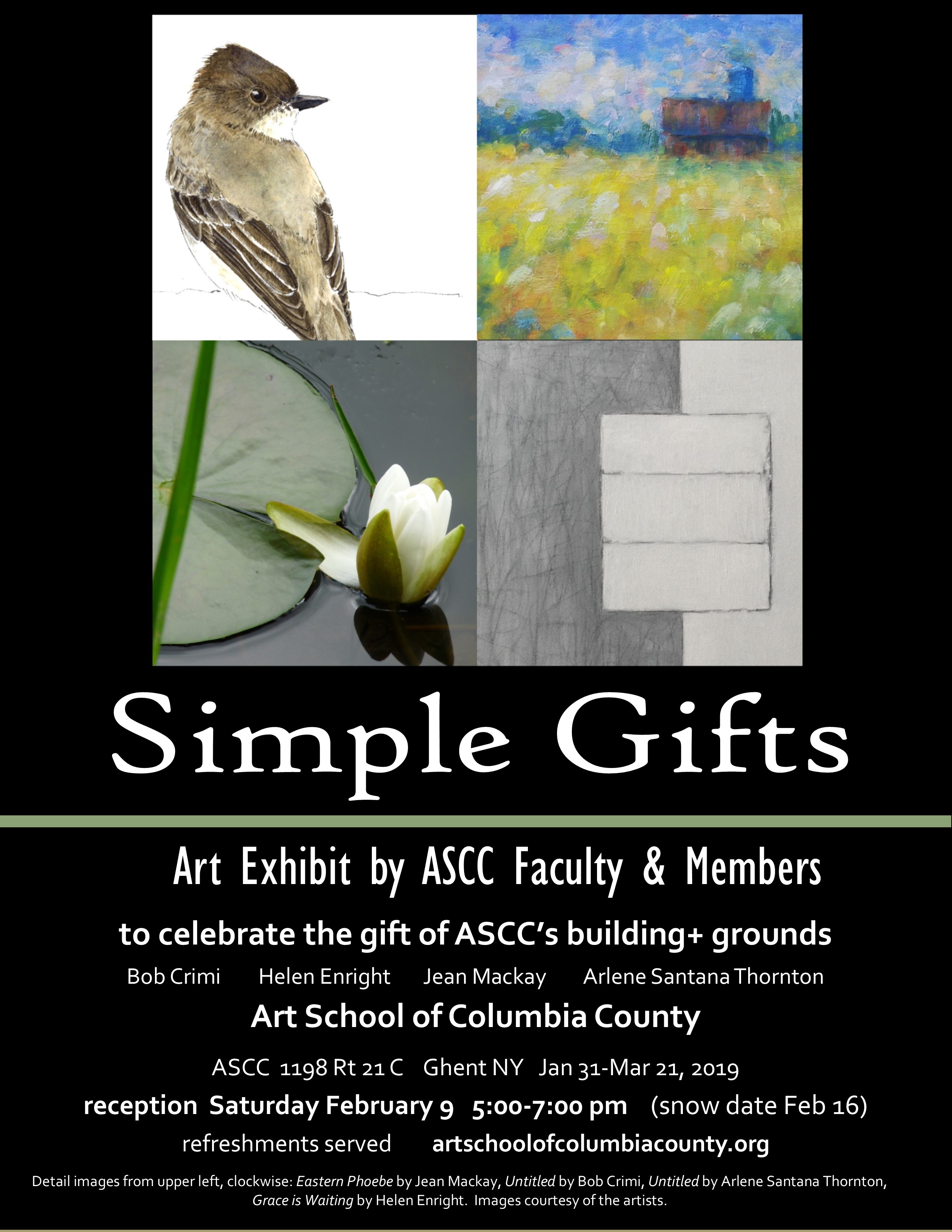 Simple Gifts
Opening Reception, February 9, 5-7pm
Art School of Columbia County
1198 Rt 21 C Ghent, NY 12075
(30 min from Lee, MA; 40 min from Albany, NY; 1 hour from Poughkeepsie, NY)
Sketching Nature in Pencil, Pen and Paint
Saturday, March 2, 2019 (snow date March 3)
Art School of Columbia County
1198 Rt 21 C Ghent, NY 12075
Learn More…


 Drawn In