
A moment in the shade
After a hectic week in which I did no artwork, it was a pleasure to pick up my pen and paints and sit under two old maple trees to sketch wild columbine growing in the shade. The nodding delicate flowers, like tiny silent bells, are a welcome sight in spring woodlands and gardens. The flowers attract hummingbirds, bees, butterflies and hawkmoths to feed on their nectar, while the leaves serve as a host plant and food source for the eggs and caterpillars of the duskywing butterfly. A child could well imagine fairies dancing among this spring beauty in the May woods.

Tips and Techniques– I’m often asked whether I use a water brush (a plastic brush that holds water in its handle) for field sketching. These brushes can be especially handy when space is tight or when you don’t want to carry extra supplies, but I find it hard to control the water to paint ratio and get the precise results I’m looking for. I used a water brush to paint this columbine but yearned for my regular brushes to capture some of the details. Once I had 90-percent of the painting done, I returned home to finish, using my regular brushes for a few additional details on the flowers and for the duskywing and hummingbird.
Keep in mind that you have many tools in your toolbox—use what you have on hand and what’s right for your working conditions, paper, time, and subject. Don’t be afraid to refine at home if needed to complete a field sketch.
After seven years and nearly 400 posts, I decided it was time to give my website a refresh. I hope you like the new look and I welcome your comments or suggestions. Check your calendar– I also have a few new workshops coming up.
Fortunate Find
How many mushrooms can claim to have multiple websites, several online forums, numerous books, and various t-shirts dedicated solely to singing their praises? If that isn’t enough, how about an annual festival? The answer: only one, the morel. I didn’t know this until I stumbled upon a sizable patch of morels in our back woods this week. I knew they were morels, but until I went looking for more information on their natural history, I had no idea that they were such a highly prized and elusive delicacy. Because they cannot be cultivated, morel aficionados scour the woods each spring, hoping conditions and their luck are just right to find a motherlode. If you are a morel lover, I wish I could send you the genuine article from my woods; instead, my sketch will have to do.
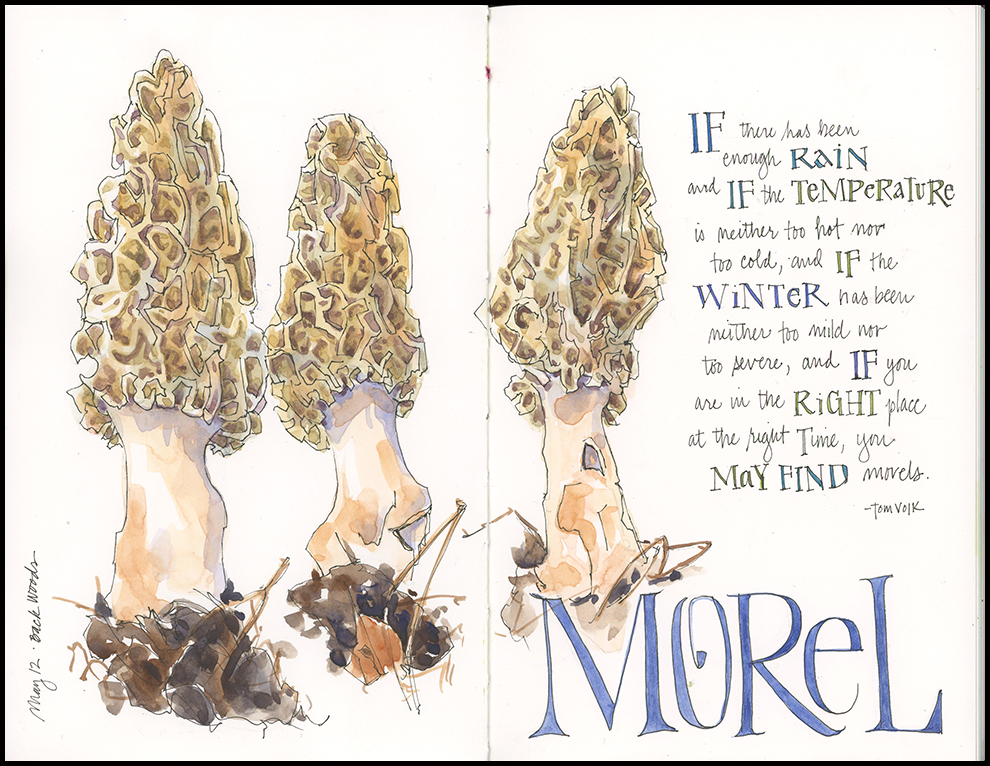
Text reads: “If there has been enough rain and if the temperature is neither too hot nor too cold, and if the winter has been neither too mild nor too severe, and if you are in the right place at the right time, you may find morels.” — Tom Volk, Tom Volk’s Fungi
Spring Gems
When you think of spring, what colors come to mind? Though red is not typically on my list, there are several species that wear shades of ruby and garnet that sing out amidst spring’s palette of greens. I went looking for Jack-in-the-Pulpit in a nearby nature preserve and, though I found a few, it was the display of red trilliums on the forest floor that was in its full glory. The following day, the rose-breasted grosbeak, one of my favorite migratory birds, returned to our yard. The male’s beautiful deep red breast is a showstopper. That sent me looking for a few other red standouts to add to this page. How glad I am to capture this priceless display of spring gems!

Tips and Techniques– Once you start looking at color – or looking for a certain color – it’s amazing what you’ll find. Try this: pick your favorite spring color and devote a page of your sketchbook to as many things as you can find that are that color. The subtle variations will help you get to know your paints and give you valuable practice in color mixing.
Song for a May Morning
Why does March seem to go on forever while May is so fleeting? Like ferns unfurling, each moment, each day, transforms woods, field, and wetland, ultimately bringing them to fullness. Today, warblers descend on their journey north, oaks and hornbeams and apples are in bloom; morrells push up through the forest floor; but not for long. A week from now, a fleeting moment from now, they too will be transformed. So, Hail bounteous May as John Milton urges in his Song on a May Morning. Celebrate its fleeting sweetness.

Tips and Techniques– Consider different ways to paint your subject. What’s in focus? What do you want to convey? Although I started this page with the Solomon’s seal and ferns, when the black-throated green warbler appeared, I decided to simplify the ferns and make the birds stand out. Painting the negative space around the plants, rather than each plant individually, helped to unify the page, highlight the greenery, and draw attention to the warblers.
Chickadee Update– Two weeks ago I shared my enthusiasm for chickadees excavating a nest cavity in an old fence post. Sadly, they seem to have selected another nest site. It’s not unusual for birds to consider several locations for nesting before selecting one. I’m disappointed that I won’t be sharing eggs, nest, or young with you. But, it’s still early in the nesting season—I’m sure I’ll find others to sketch.
WORKSHOP THIS WEEK! Ink and Watercolor Basics for Sketchers
Friday, May 14, 2-3:30 PST / 5-6:30 EST
Hosted by Winslow Art Center- Technique Takeaway Series
Virtual via Zoom $40 REGISTER
If you struggle with getting satisfying results with watercolor sketching this workshop is for you. We’ll talk about the most common problems and ways to fix them, and practice various approaches to combining ink and watercolor to build your skills and confidence and produce more satisfying results in your sketchbook.
New Life for an Old Post
An old and increasingly rotted split-rail fence lines the side of our driveway and, as long as you don’t look closely or lean on it, it adds character. Replacing the whole thing is “a project” which, as any homeowner can appreciate, means money, time, and labor. Alas, it’s staying put for now. This week I was delighted to spy a pair of chickadees excavating a nest cavity in one of the posts that no longer has a rail. They’d slip inside, hammer away at the soft interior, and come out with beak-fulls of wood chips. By today, the cavity looks about as deep and wide as they can go without breaking through the walls. I can’t wait to see what comes next and to continue working on this page as the story unfolds.

Tips and Techniques- When you know you have more to come to flesh out a page, it’s worthwhile to think through your layout. You don’t have to plan everything, but you need to give yourself options. Over the next few weeks, I hope to be able to add more to this page, including a nest with eggs, a second chickadee, and dates from excavation to fledging (if they make it that far). By putting everything on one side at the start, I’ve left a lot of room for what comes next. But I’ve also carried a touch of spring green across the page to create a connection right from the start. I look forward to sharing this with you as it progresses.
A Host of Golden Daffodils

Ten thousand saw I at a glance, tossing their heads in sprightly dance...
Wordsworth’s classic poem of daffodils, “I Wandered Lonely as a Cloud,” seems timeless. Who doesn’t appreciate a host of golden daffodils or, later, the memory of them fluttering and dancing in the breeze? They are in their full glory this week in my yard and I am enjoying the show.

The trouble with daffodils– I can only imagine that Wordsworth’s poem flowed more easily from his pen than this painting sprang from mine. The trouble with daffodils is not only that they can be tough to draw but figuring out the shadow colors and getting a full range of values is hard with such a light color. I have spent the last two weeks taking up the challenge, trying all sorts of approaches (with and without backgrounds, grouped and single, loose sketches, detailed sketches) and numerous yellow pigments—with frustratingly little success. But my 14th daffodil was promising, and I pressed on. Below, you can see my color swatches for testing yellow shadows. I found it useful to mix a small amount of violet with various yellows for the shadows and to apply the shadows first, before adding yellow to the flowers. If you have had success painting daffodils, do share your tips and techniques…I’d love to hear them!

Check out upcoming workshops: Spring Into Nature Sketching- For Ages 8+ in April, Ink and Watercolor Basics for Sketchers in May, and Arts and Birding in June.
The Gift of Magnolias
How we covet the first big flowering of the season! An explosion of white against still-gray trees.
“…The whiteness is a gift.
Soft, and slow, it opens
on the limbs. Watch it so.”
— The Magnolia, Richard Lambert
Magnolias are among the most primitive flowering plants, dating to 90 million years ago. I like to think of them blossoming among dinosaurs and, millennia later, emperors and ordinary folks in their native Japan. We should have a holiday to celebrate them, or at least a picnic under a canopy of petals.

Tips and Techniques- I must admit that when I started drawing these blooms, I wasn’t sure where this page was headed. Only after I put in a pale background to pop out the flowers, did I realize that I was headed for a more involved negative painting with additional layers of blossoms and paint. So my advice this week is to be open to different ways of handling your subject. Go where the painting tells you to go. Experiment every now and then. Sometimes you’ll end up with a mess. But you’ll just as likely learn something new or end up with a gem.
A Welcome Sight
Whether it’s their sweet song, colorful breast, or way of bobbing across the lawn, seeing robins in springtime is a welcome sight. They spend the winter in small flocks feeding on berries and sheltering in nearby woods, where they blend in well with russet-colored oaks leaves and gray bark. But as the grass begins to green, robins are frequenting my yard more often, probing the soft ground for worms and other insects. They are common birds, yes, but no less deserving of attention, gratitude, and a sketch.
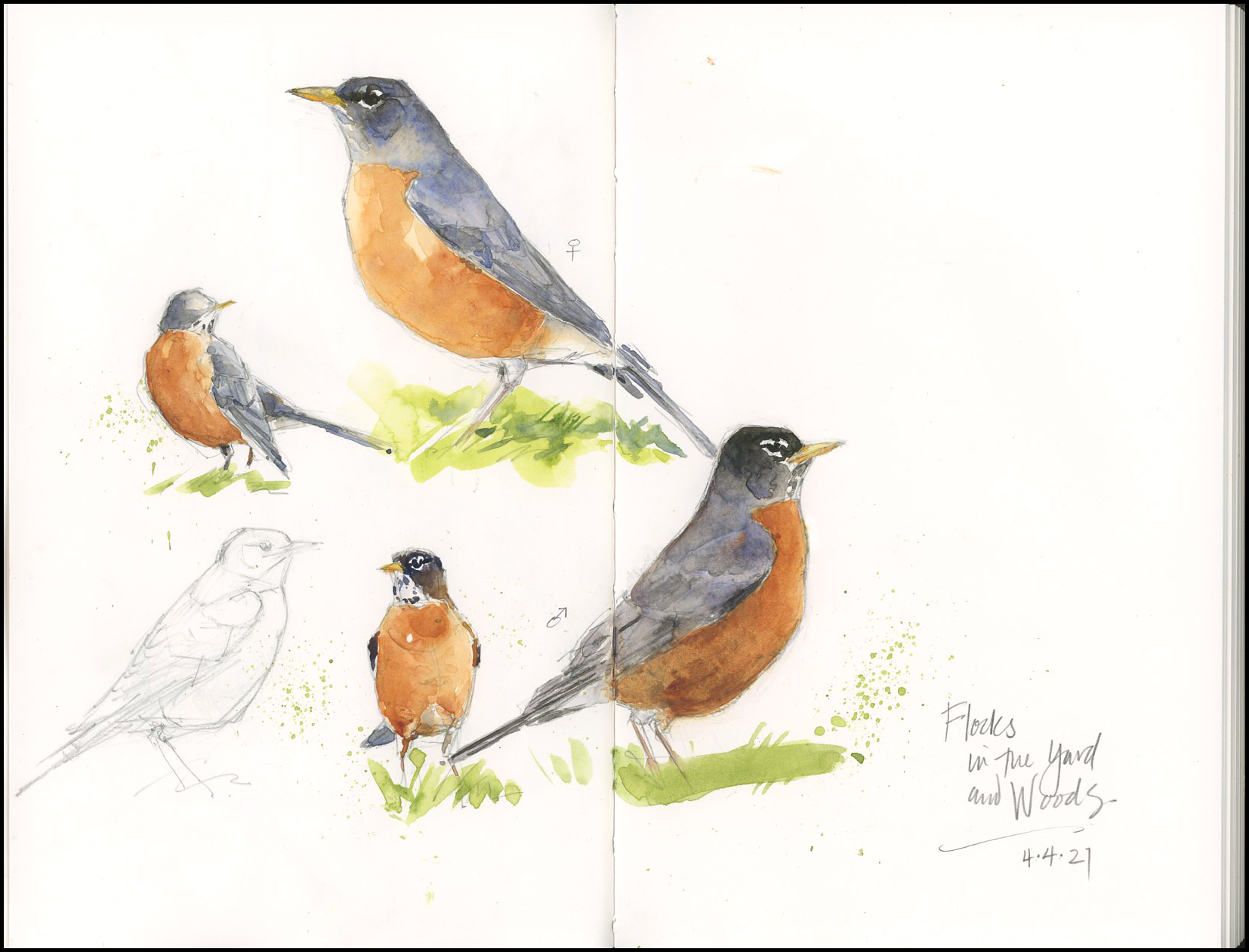
Tips and Techniques– I enjoy doing sketchbook pages like this, where I pick a bird and study it in different postures. I always learn a lot, both in the pencil sketch stage and when painting. My goal is to get the essential shapes and features down, preferably without too much fuss, so that the sketch stays fresh. Repeating the same species forces me to look more carefully. Here’s what I think about: What makes a robin look like a robin (and not another bird of similar size)? How can I get at least a basic amount of information on the page while the bird is moving? How can I use a photo reference without simply copying a photo? How can I let the paint do more of the work—mixing and blending on the paper to add interest?
Spring Begins
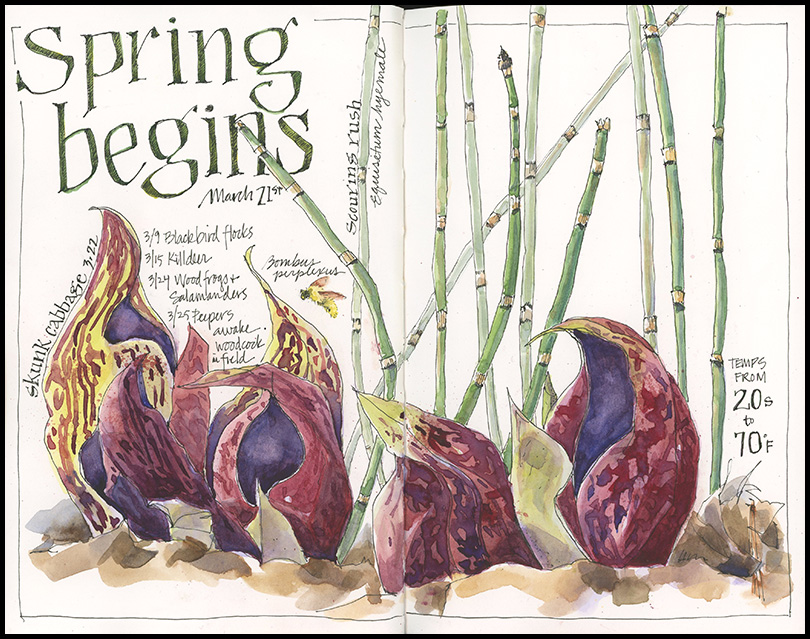
Before it unfolds in a grand show of color and song, spring is all subtlety. I go looking for it first in wetlands. There, blackbirds returning from the south are greeted by last year’s matted cattails and the reddening stems of dogwood. The odor of skunk cabbage is pungent; its maroon streaked hoods emerge from the mud, hiding small flowers that feed newly awakened bees. I sketch skunk cabbage every year, but this time I also discovered a patch of scouring rush (Equisetum hyemale), a leafless, hollow-stemmed primitive plant that has survived since the mid-Devonian, 350 million years also.
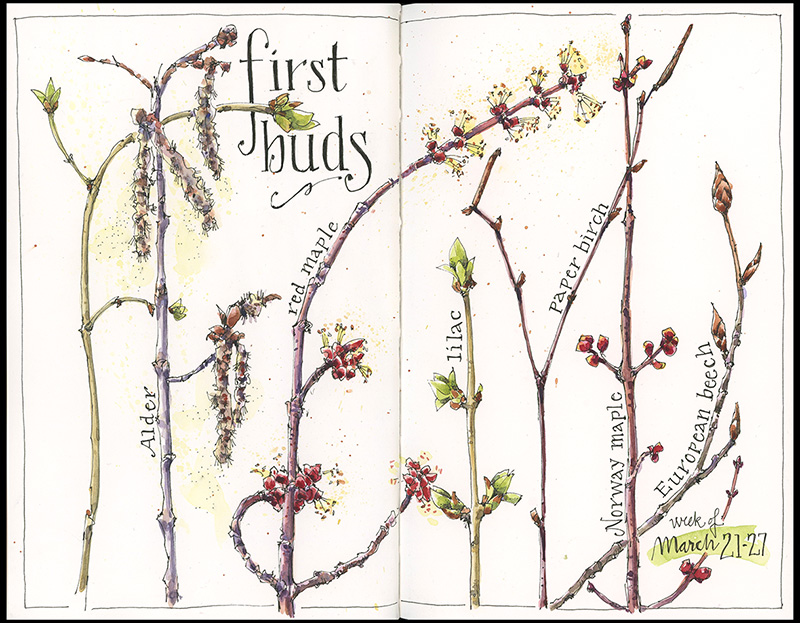
High temperatures rose into the 60s this past week and a few trees began to bud. From a distance, there is a welcome hint of color in their branches. Up close: tiny flowers and catkins have dusted my desk with a fine yellow powder of pollen, my reward for bringing a few stems inside.
And so, I bring you the first blush of spring in New York, minus the pollen and the odor of skunk cabbage.
I am excited to announce that I am offering a new Technique Takaway at the Winslow Art Center: Ink and Watercolor Basics for Sketchers, Friday, May 14, 2-3:30 PST / 5-6:30 EST. This session is virtual via Zoom, $40. Find out more and REGISTER HERE.
Needing Green
It’s a perennial theme come March: the need for green. The hunger usually drives me to visit a greenhouse for a day of warmth and chlorophyll. Barring that this year, I’m stuck with my houseplants. A poor substitute, to be sure, but it’s nice to paint something that isn’t brown for a change.

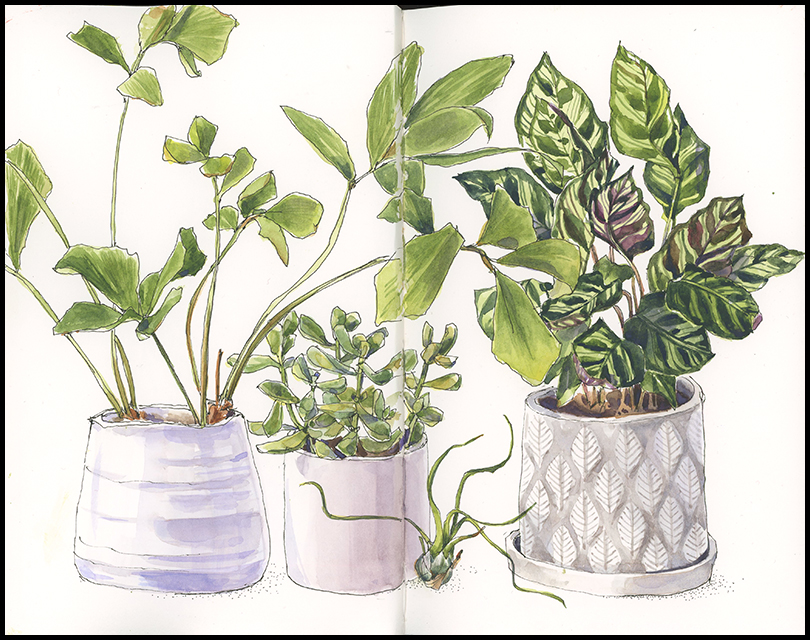


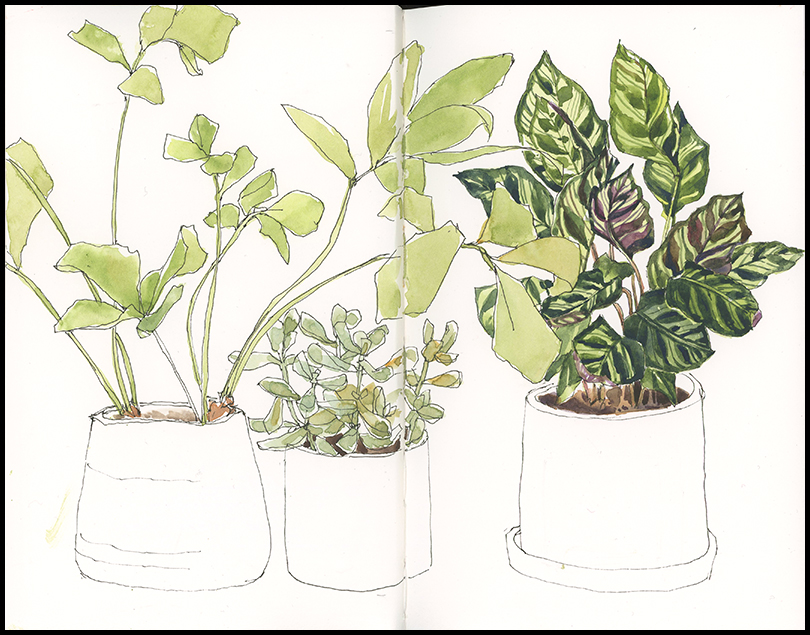

Tips & Techniques– How do you know when you’re finished? That question was posed to me by one of my class participants last week and it gave me pause. I have an intuitive sense about it, but the question forced me to define what I do at the final stages more specifically. In addition to watching this page evolve, consider these questions to evaluate your work at the final stages:
- Have you developed a full range of values?
- How’s the composition? Do you want to add anything to strengthen it?
- Do you want to add text?
- Would a border pull things together?
- Did you convey what you set out to?
The Green Palette: Sap green, yellow ochre and Prussian blue are the main colors I used to mix these greens (Prussian and yellow ochre make some nice gray-greens). The darker greens are sap green and ultramarine. The grays are mainly violet and yellow ochre. I added a light wash of aureolin in places to brighten the other greens.


 Drawn In