
Vinalhaven Sketchbook 2021
Islands all along the east coast are invaded each summer by lovers of sun, beaches, and beauty. DownEast Maine islands are no different, except that the beaches are rocky, the water is cold, and you’re likely to get a healthy dose of fog as well as sun. If you go far enough out to sea, you can add solitude to the list of attributes. We’ve found all of that on the island of Vinalhaven, which sits at the margin of Penobscot Bay and the Atlantic Ocean. Here are a few pages from my recent retreat. You can find past Vinalhaven sketches here and here.
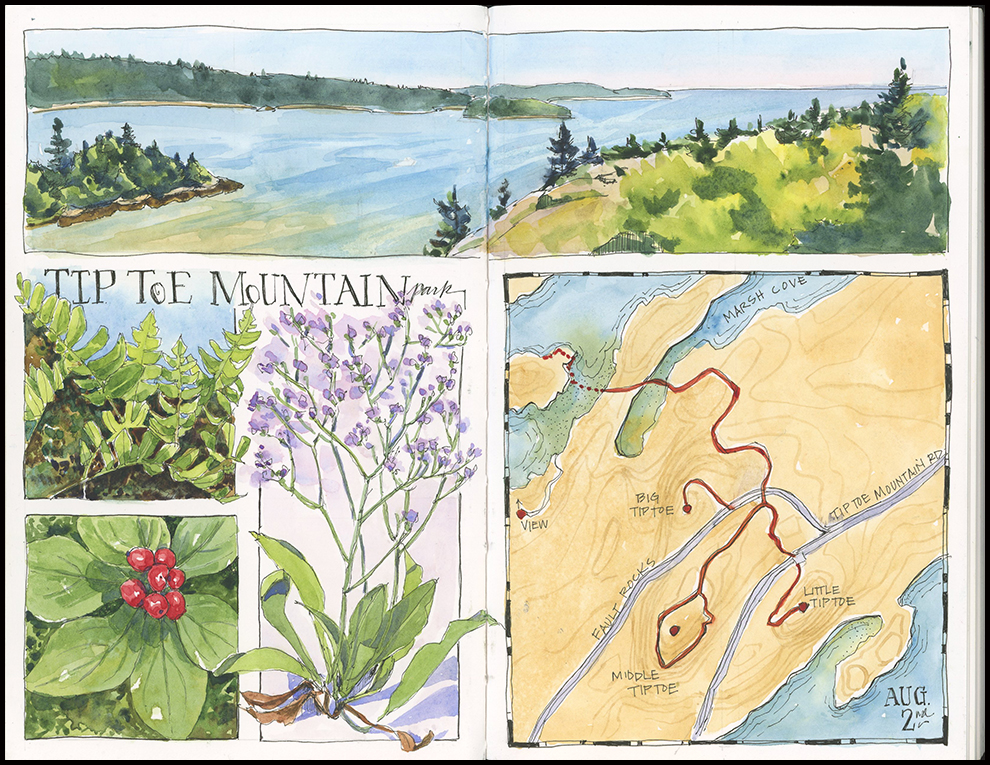
Tip Toe Mountain Park combines moss-carpeted spruce woods, rocky beaches with fascinating geology and seaweed draped rocks, and granite ledges with spectacular views. The occasional song of the hermit thrush or cry of the osprey overhead punctuate an otherwise silent forest.
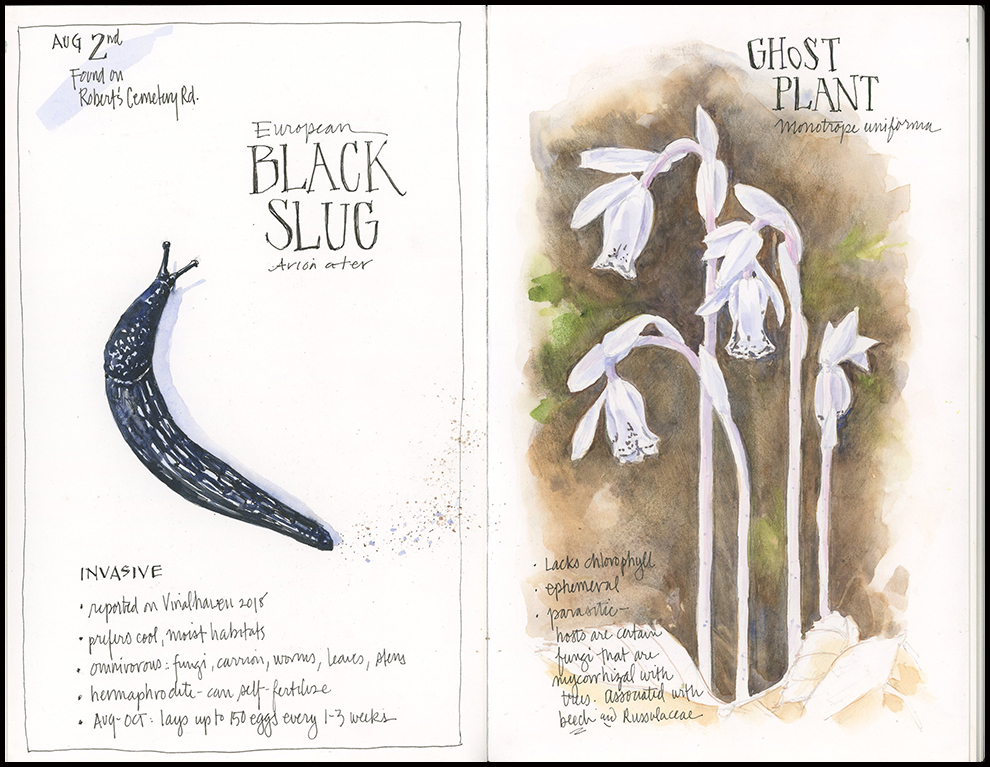
Locals vs. Outsiders– There are tensions on any island between locals and summertime outsiders and the strain they place on finite resources and services. Demanding, entitled “summer jerks” as they are known on Vinalhaven are not appreciated. There are also insidious plant and animal invaders that can quickly damage ecosystems. I was dismayed to find this new outsider, the European black slug, which arrived only in 2018. I found it both fascinating and repulsive and I hate the thought of seeing more of them on the East coast in the future.
On the other hand, I was delighted to find the flowering ghost plant, Monotrope uniforma (you may also know it as Indian pipes) sprouting in the forest. This native species lacks chlorophyll and takes its sustenance from certain fungi which, in turn, are co-dependent on beech trees.
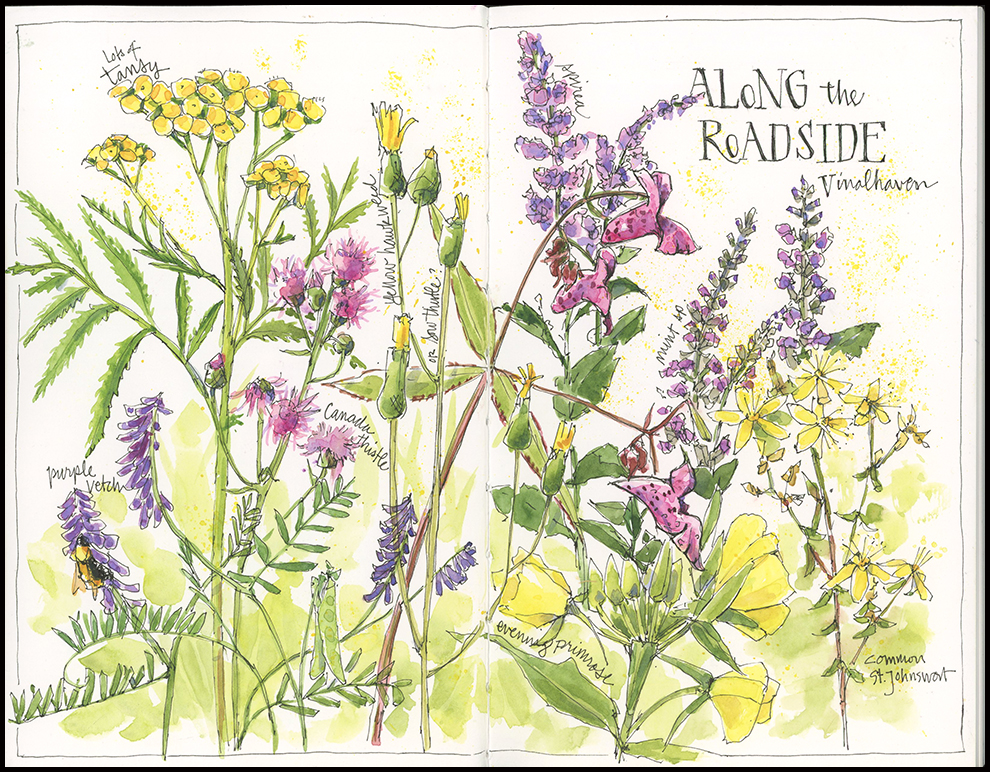
Along the Roadside are lots of hardy and familiar outsiders along with a few native eastern wildflowers that co-exist where poor soil or disturbance favor only the tenacious, as all islanders tend to be.
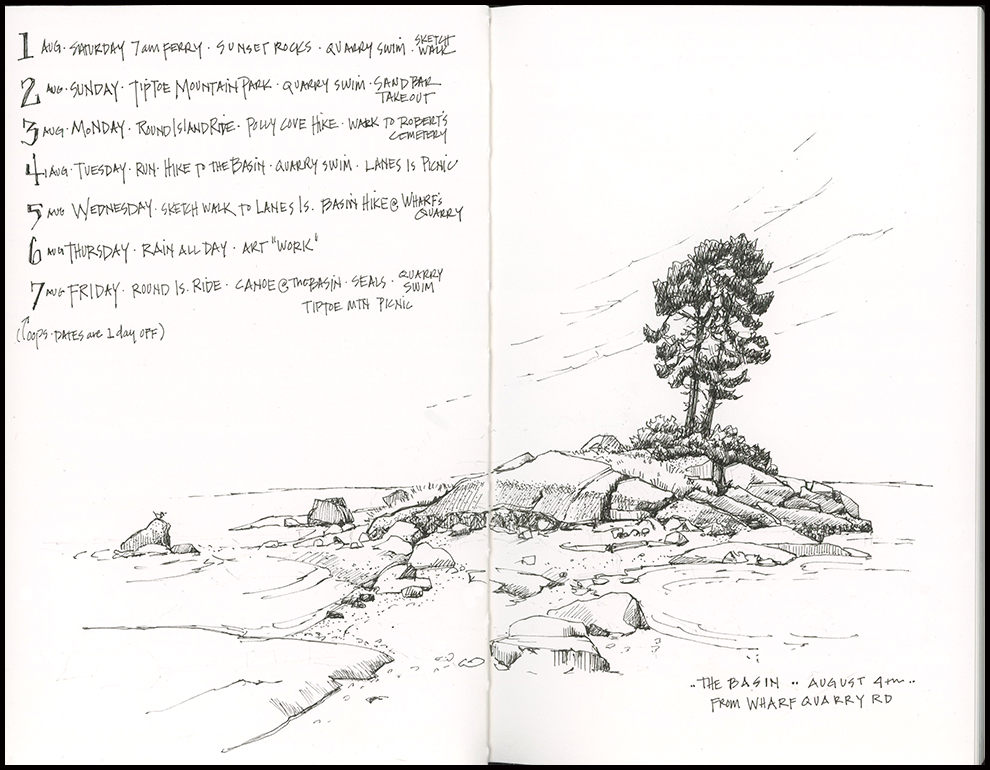
The Basin is a large and stunningly beautiful protected tidal basin, surrounded by rocky granite outcrops and spruce forest. We hiked and canoed there, and I’ll have some sketches of harbor seals to share when I finish them in the coming days.
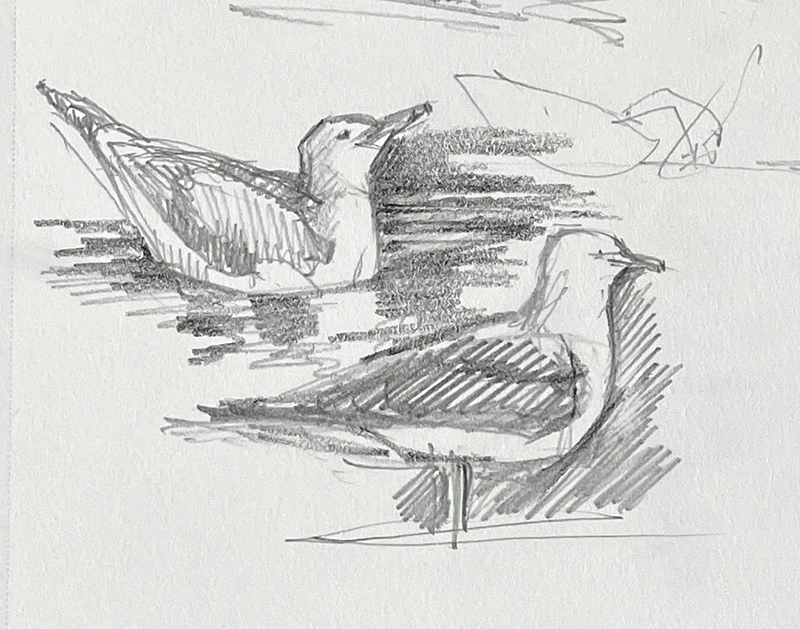
Tips and Techniques– Mix it up on your next vacation. Try a variety of approaches, materials, and layouts to capture parts of your journey. I like having closeups mixed with maps and landscape views to convey my experiences and an overall sense of place.
Enough Already!
Two weeks ago, I wrote about the near daily rain we’d been experiencing in Upstate New York, which had been a boon to mushroom growth but not much else. Since then, it’s been more of the same: rain, humidity, and mushrooms. I want to stop sketching them, I really do. But with more colors and varieties sprouting by the day, I just can’t seem to stop. When opportunity arises, I find myself wandering the grove of oaks on our property, looking for the latest species to emerge, and adding them to my sketchbook. So enough already—I promise I’ll try harder—and look to my garden or what’s happening along the roadside in the weeks ahead. But first…more mushrooms.
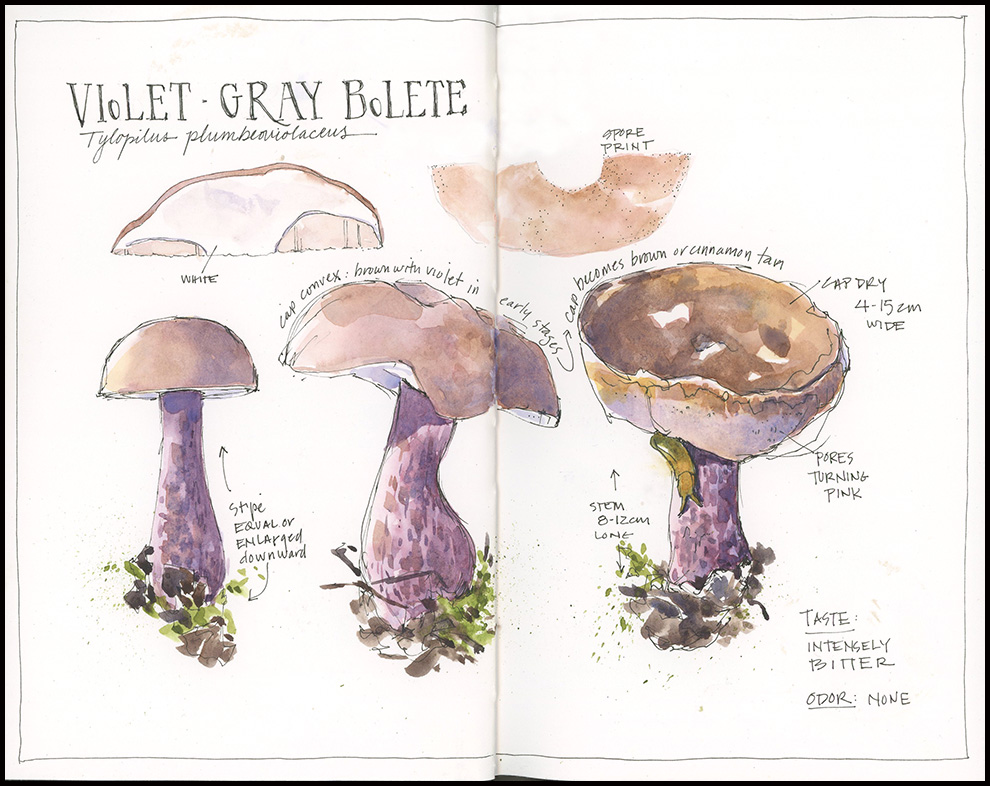
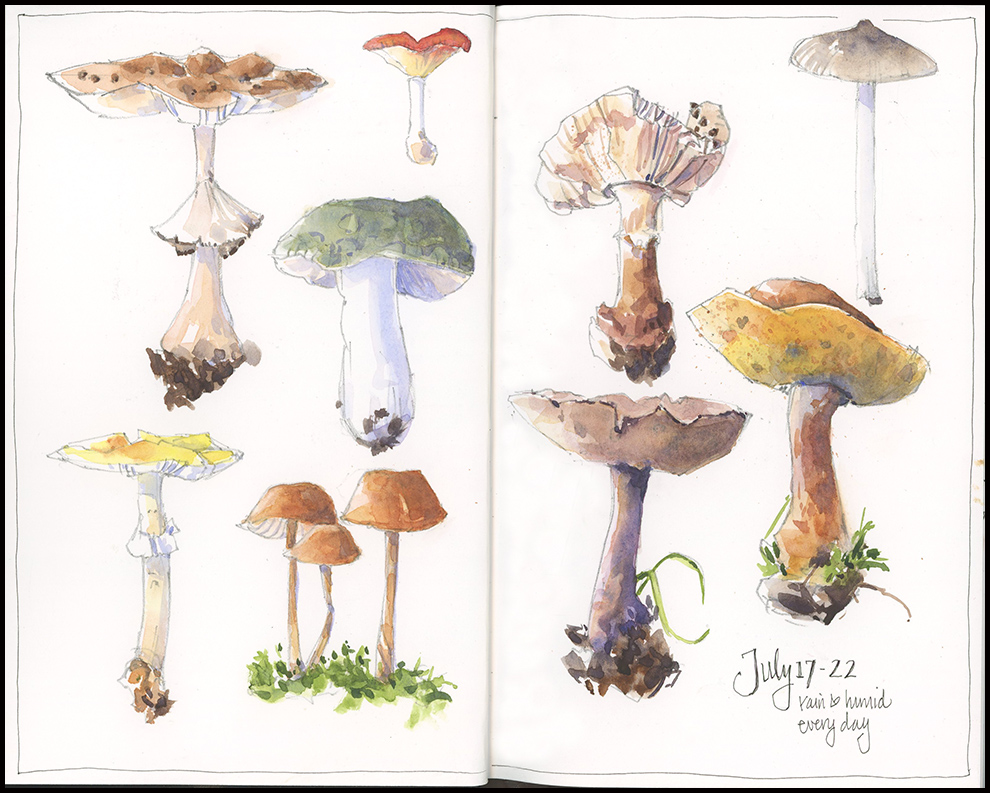

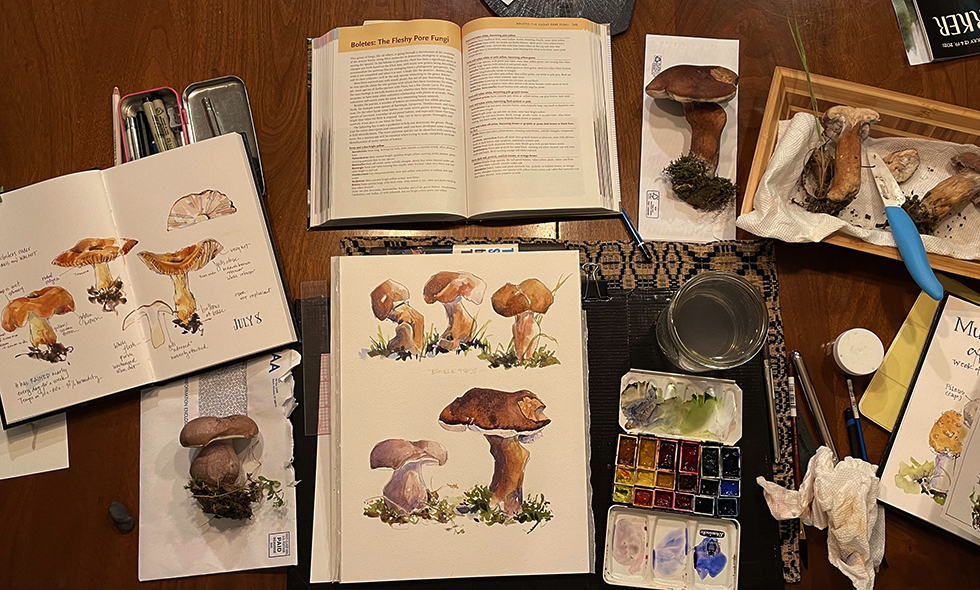
Tips and Techniques– Experiment with different approaches to the same subject. Initially, I wanted to do a deep dive into each mushroom species so that I could try to identify and learn more about them. But with so many varieties coming on, I lost the ability to do spore prints and keep up with the research. Instead, I decided to just get them on the page using pencil and watercolor and ink and watercolor. I thought about doing a mushroom map to diagram my route, but then I discovered the massive bolete and ran out of space.
A Magnificent Structure
“What I see in Nature is a magnificent structure, that we can comprehend only very imperfectly, and that must fill a thinking person with a feeling of humility.”
Albert Einstein
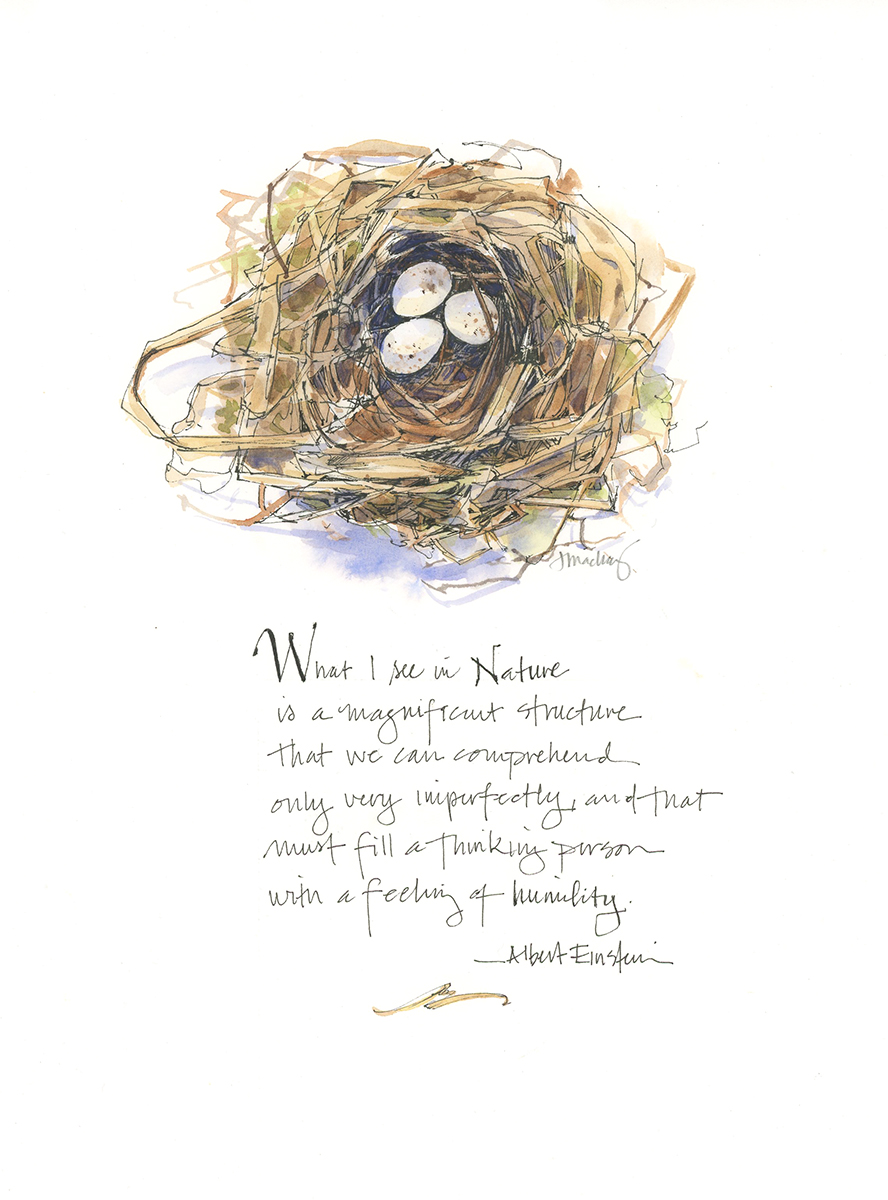
Tips and Techniques— I sketched and painted this nest and quote as a demonstration for an online class that explores ways to capture the essence of a subject. While I find research and scientific information invaluable for field sketching, I also appreciate how a few spare lines of poetry or a quote can cut to the chase, helping to express what drew me to a subject in the first place. Try it. Next time you sketch a subject in nature, see if you can find a quote or poem – or write a few words of your own – to express what it means to you.
Mushroom Rains
It has rained nearly every day for a week straight. This is not good if you like summer or swimming or outdoor dining or if you want to cut the lawn every now and then. It’s not good if you like painting outside or if you want your watercolor paints to dry inside without using a hairdryer. What all the rain and humidity is good for is mushrooms. They are fruiting like gangbusters in a myriad of colors, forms, and variety. I went out to sketch them during a blessed break in the rain and managed to get a first layer of paint on before another round of storms rolled in. Alas, there are more to discover, but since it is raining again I will have to be content with these.
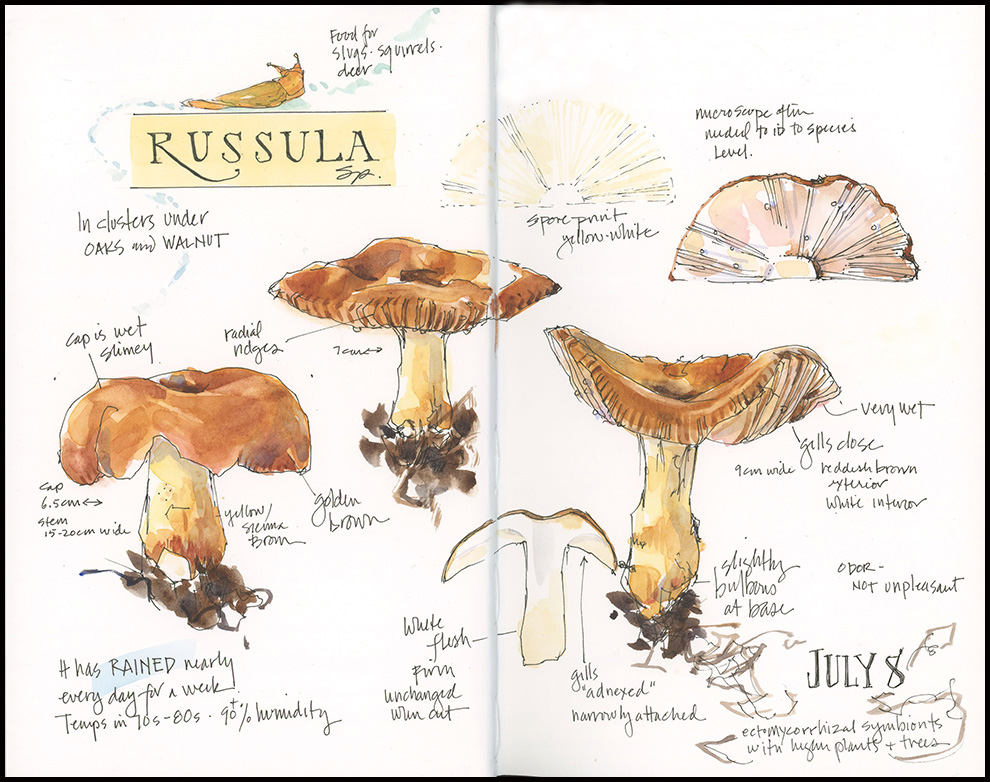
Tips and Techniques– When you are sketching mushrooms, making field notes right on the page is a useful way to capture some of the information you will need for identification. Mushrooms are bafflingly difficult to identify to the species level, even with a decent field guide. Note the size and shape of the cap and stem, type of gills or pores, and the texture. Making a spore print and cutting the flesh to see what color is inside is also important. Or you can skip all that and simply enjoy the shapes and colors of these fascinating fungi.
Notes from the Coast
What could be better than a week spent outdoors on the beautiful rocky coast of Maine with a group of people enthusiastic about exploring, sketching, and painting nature? Hmmm…. not much. Directing the Arts and Birding program at the Hog Island Audubon Camp near Damariscotta is a highlight of my year. Although I don’t have time to do much artwork myself, the time I spend teaching others and seeing what they produce is inspiring. I do manage a few sketches, or at least I manage to start them even if I need to finish them later. Here’s a peek inside my journal from the week with a few notes and observations.
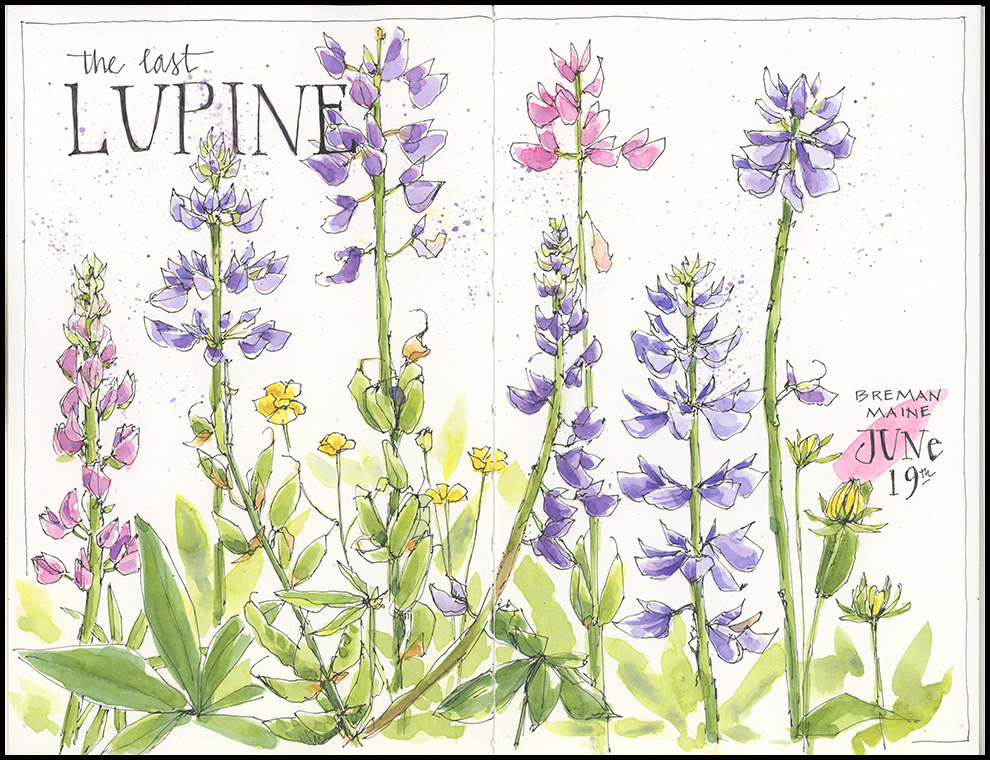
I was excited to head to Maine in June instead of later in the summer so that I could see lupine in bloom. Alas, I was nearly too late (or the blooms came and went early), as most of the plants had already gone to seed. I searched these out in a large roadside meadow on my way to the island, before my hectic schedule kicked in.
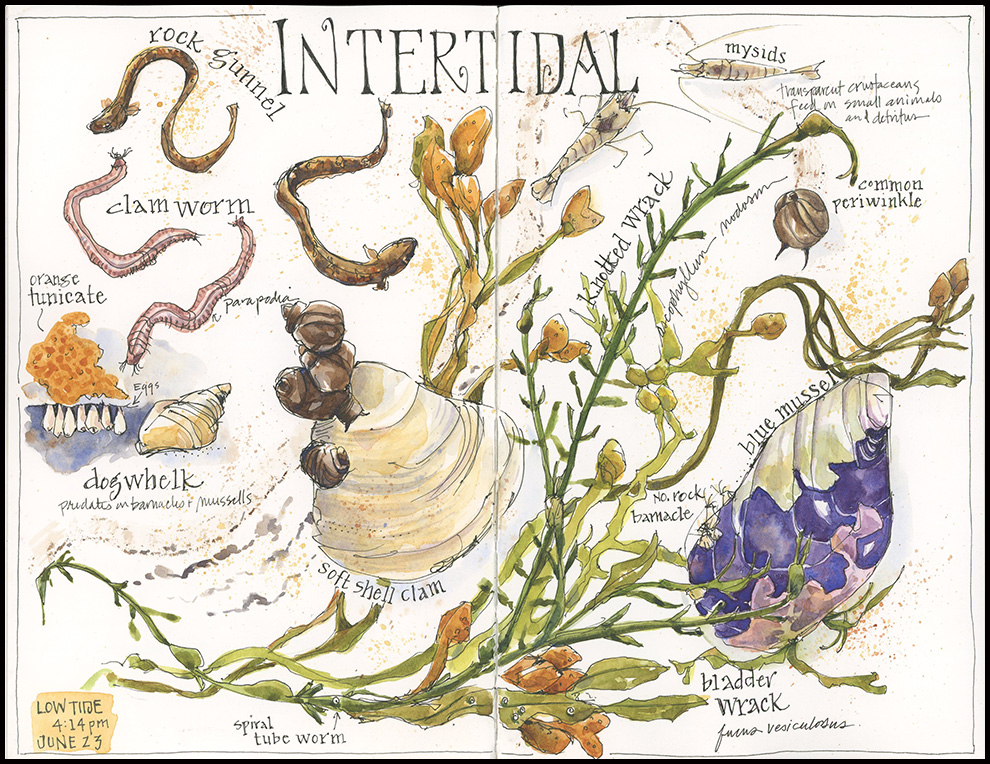
Arts and Birding is not all about birds; the island provides a chance to explore deep spruce forests, rocky shores, mosquito-laden bogs, and salt marsh meadows. This page began as a very loose and sloppy mess of ink sketches made while standing over basins of collected creatures. Thankfully, I managed to pull it into a coherent whole while painting.

Northern Parula warblers are common on the island, but they are more often heard than seen. Their nests are equally well hidden. Veiled in beard lichen and hanging from a high branch, this pendulum nest was so well camouflaged that even when you knew where it was you could barely find it.
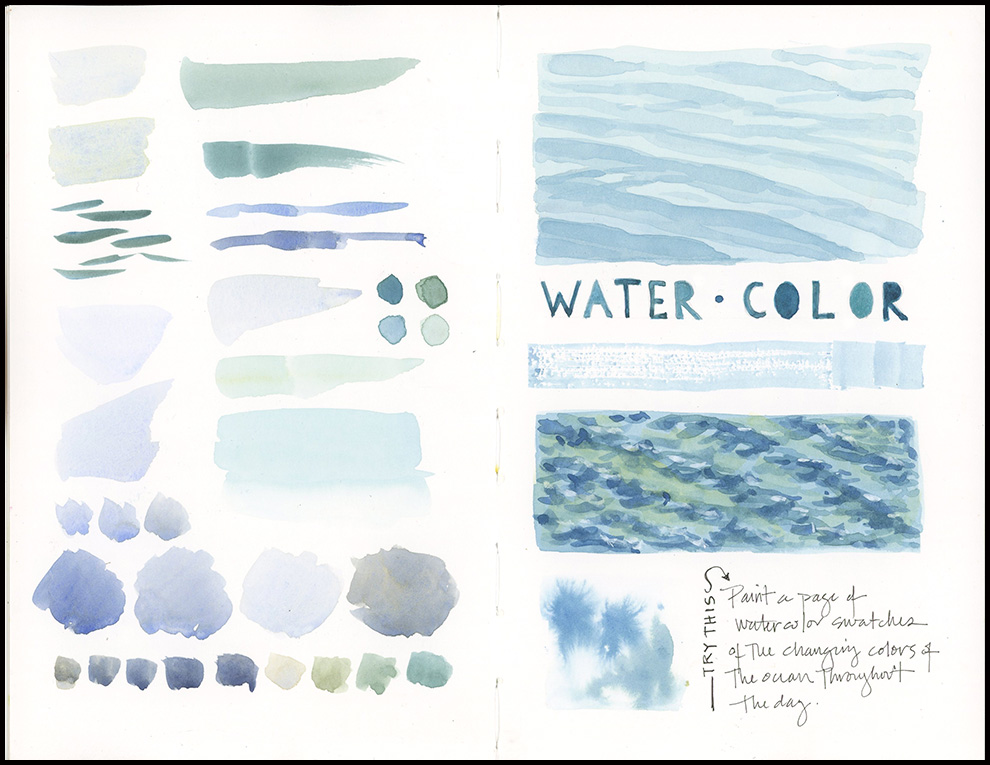
This was an exercise in observation and color mixing that I suggested as a sketching prompt: paint a page of watercolor swatches of the changing colors of the ocean throughout the day. You could easily do it with greens in a forest, colors in a garden, or almost any subject.
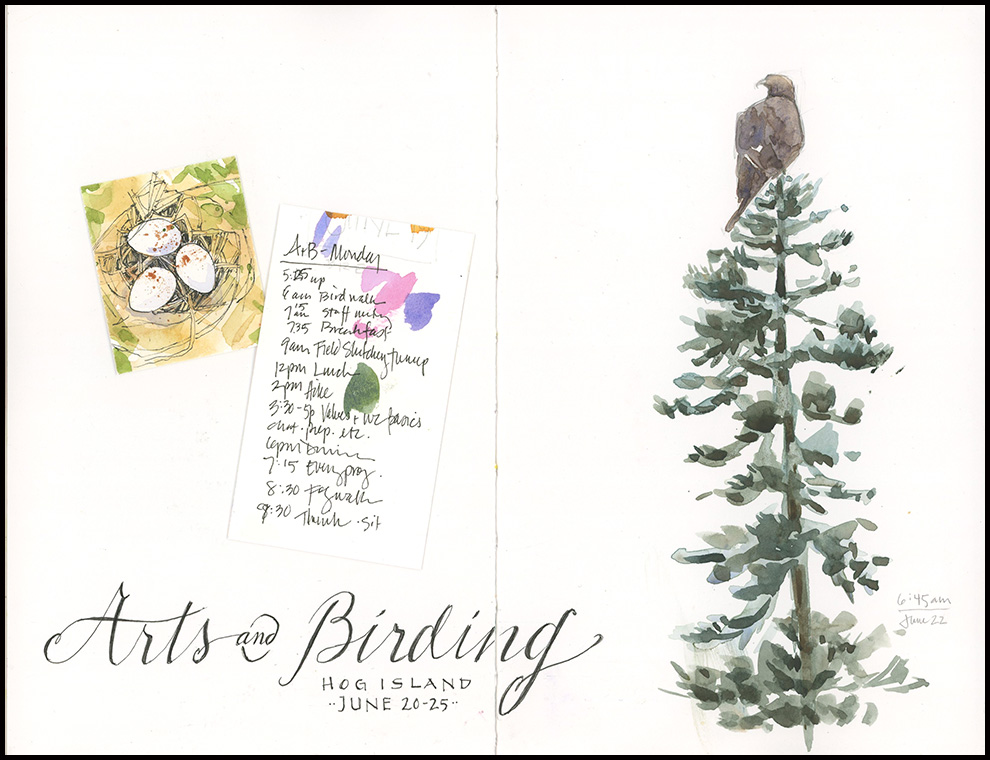
Bits and pieces. I sketched an immature bald eagle early one morning but then didn’t have a chance to return to the page. The daily schedule explains why.
COMING UP: I’m excited to share these two upcoming workshops…
IN WORDS AND ART: Sketching In Harriet’s Garden
Saturday, July 10, 3-5:30pm (in person)
The Stowe Center, Hartford, CT
TAPPING AUDUBON’S PASSION: Sketching Birds in Watercolor
Thursday, August 12, 2-5pm (via Zoom)
Currier Museum of Art, Manchester, NH; REGISTER
Burning Twice as Bright
I have been waiting for my Oriental poppies to bloom for two years. I am not disappointed. Their papery thin, flaming orange-red petals are outrageous in the garden. Still, some of the blossoms lasted only days. A few were knocked out by heat. Others by heavy rain. Only two of eight remain. Alas, I’ll content myself with these, plant more perhaps, and paint them again next June.

Tips and Techniques– For the strong warm reds and depth of color poppies demand, I tapped the intense colors of Dr. Ph. Martin’s Hydrus Fine Art Watercolors. I have a small set that I rarely use but were perfect for this. I chose permanent red, Hansa deep yellow, and alizarin crimson along with two yellows that are in my regular watercolor set, Hansa yellow and aureolin. I love aureolin because it is highly transparent and you can layer it easily to add warmth to reds or greens. I suspect cadmium red would also work well for poppies, though I don’t own it because it is more opaque than I like.
New Hampshire Getaway
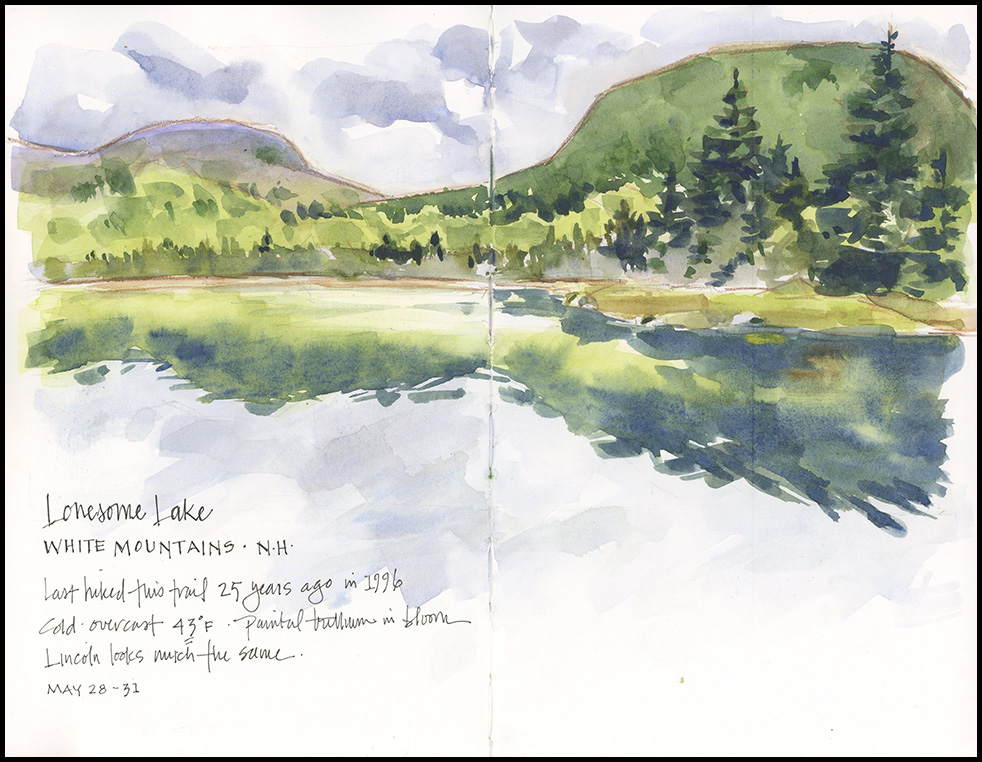
Twenty-five years ago, my husband and I carried our one-and-a-half-year-old son up a mountain to a clear, quiet lake in New Hampshire’s White Mountains. It was a blue-sky November day; fall colors lay on the ground; my son wore a blue sweater that his grandmother knit for him. I loved that hike and I remember the details because we took a photo at the water’s edge, mountains tinged by an early frost in the background. And then—life happened. We had a second child, my husband’s family sold their property in the mountains, we chose the Maine coast for vacations and, suddenly, 25 years passed.
Last weekend, we finally returned to those ancient granite peaks. Our first hike closed the gap of all those years. And while I loved being surrounded by mountains and returning to Lonesome Lake, what I loved, perhaps, best of all, was hiking behind a young couple carrying their young son in a backpack up that same mountain. I couldn’t help but think: they have no idea.
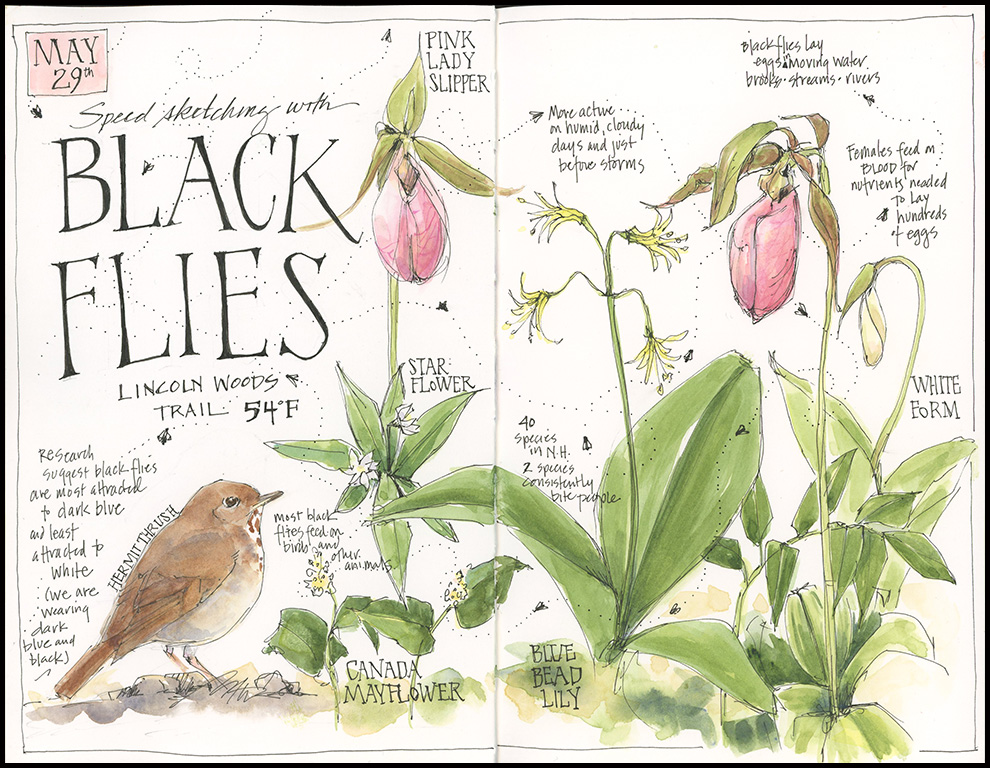
Tips and Techniques– Go with what you’ve got. I was eager to sketch the many beautiful wildflowers in bloom during our hikes. But it was so cold that I couldn’t do so comfortably until the temperatures warmed into the 50sF. By then, black flies emerged and mercilessly attacked. I tried to “embrace the place,” but after speed sketching orchids, I decided to skip the trillium. Ultimately, what was the sketch about? The damn black flies.
Oh, how beautiful
Rudyard Kipling was so right when he wrote, “Gardens are not made by singing ‘Oh, how beautiful,’ and sitting in the shade.” Except in this particular garden, that’s exactly what I did. With the sun casting a warm golden light at the close of the day, I sat in the shadow of a large maple tree and surveyed a lovely field of grasses and allium. I had no hand in their planting or care. The only finger I lifted was the one that carried lines and watercolor across this page. An unknown cadre of volunteers made this garden at a local park into a thing of beauty, and they deserve all the credit.
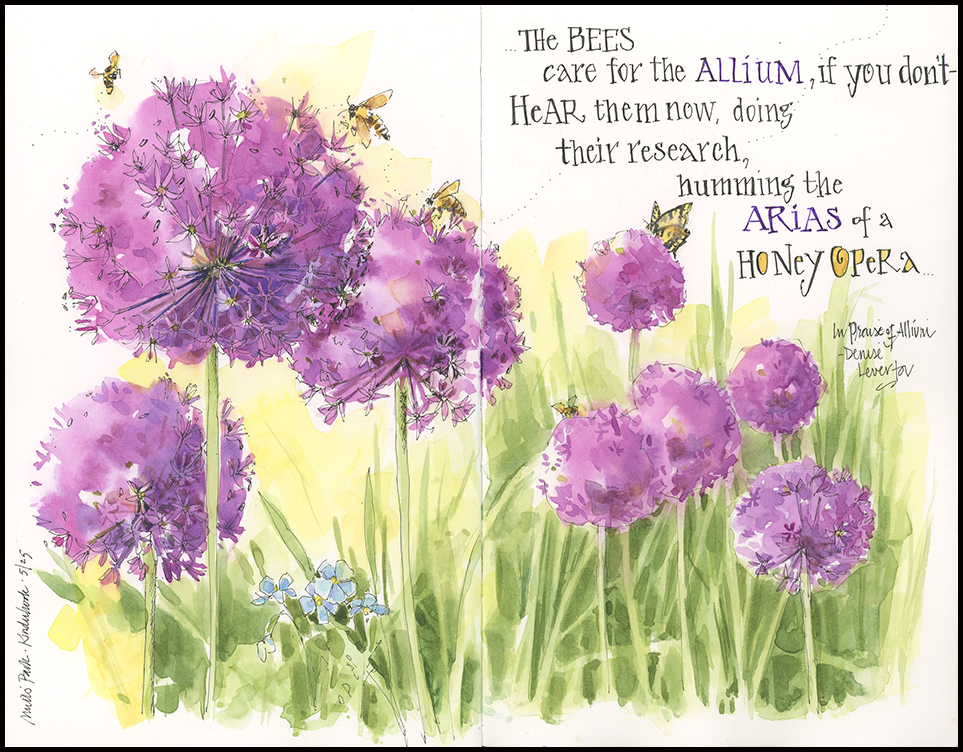
Tips and Techniques– I’ve been thinking a lot about the different ways sketching can help us deepen our understanding and appreciation of nature. Doing a traditional field sketch and recording facts and data is one approach. Another is exploring the poetry of nature. This type of sketch tends to be more evocative, getting at the essence of our subject. I often go looking for what poets have to say and, as with my sketch of alliums, I add part or all of a poem, quote, or phrase to the page. If you keep a nature journal, try a variety of ways to express what you are trying to convey. Our subjects are so much more than a collection of facts.
A moment in the shade
After a hectic week in which I did no artwork, it was a pleasure to pick up my pen and paints and sit under two old maple trees to sketch wild columbine growing in the shade. The nodding delicate flowers, like tiny silent bells, are a welcome sight in spring woodlands and gardens. The flowers attract hummingbirds, bees, butterflies and hawkmoths to feed on their nectar, while the leaves serve as a host plant and food source for the eggs and caterpillars of the duskywing butterfly. A child could well imagine fairies dancing among this spring beauty in the May woods.

Tips and Techniques– I’m often asked whether I use a water brush (a plastic brush that holds water in its handle) for field sketching. These brushes can be especially handy when space is tight or when you don’t want to carry extra supplies, but I find it hard to control the water to paint ratio and get the precise results I’m looking for. I used a water brush to paint this columbine but yearned for my regular brushes to capture some of the details. Once I had 90-percent of the painting done, I returned home to finish, using my regular brushes for a few additional details on the flowers and for the duskywing and hummingbird.
Keep in mind that you have many tools in your toolbox—use what you have on hand and what’s right for your working conditions, paper, time, and subject. Don’t be afraid to refine at home if needed to complete a field sketch.
After seven years and nearly 400 posts, I decided it was time to give my website a refresh. I hope you like the new look and I welcome your comments or suggestions. Check your calendar– I also have a few new workshops coming up.
Fortunate Find
How many mushrooms can claim to have multiple websites, several online forums, numerous books, and various t-shirts dedicated solely to singing their praises? If that isn’t enough, how about an annual festival? The answer: only one, the morel. I didn’t know this until I stumbled upon a sizable patch of morels in our back woods this week. I knew they were morels, but until I went looking for more information on their natural history, I had no idea that they were such a highly prized and elusive delicacy. Because they cannot be cultivated, morel aficionados scour the woods each spring, hoping conditions and their luck are just right to find a motherlode. If you are a morel lover, I wish I could send you the genuine article from my woods; instead, my sketch will have to do.
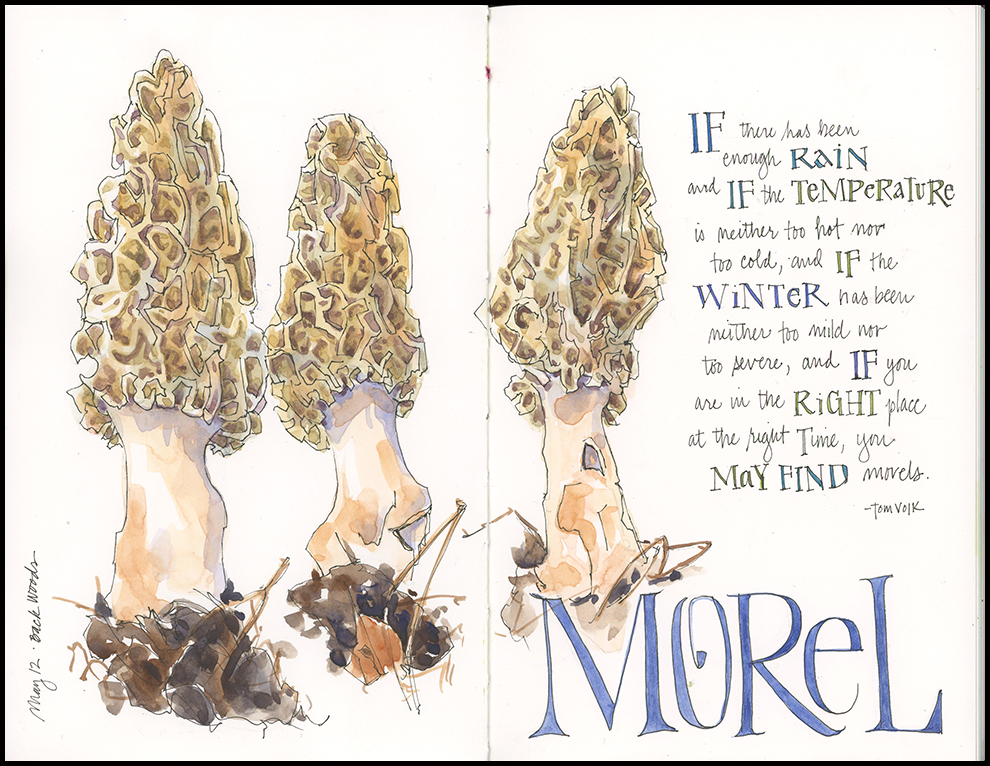
Text reads: “If there has been enough rain and if the temperature is neither too hot nor too cold, and if the winter has been neither too mild nor too severe, and if you are in the right place at the right time, you may find morels.” — Tom Volk, Tom Volk’s Fungi


 Drawn In