A Deeper Dive
Nearly 20 years ago, while researching tide pools, I came across Rachel Carson’s 1941 book Under the Sea Wind. The book includes a fascinating chapter on American eels, and I was hooked. Eels begin their lives in the Sargasso Sea, a vast area of the Atlantic Ocean near Bermuda. Their tiny, leaf-shaped larvae drift on ocean currents for a year or more before metamorphosing into clear glass eels as they approach the coasts of eastern North and South America. When they reach river mouths, they transform again, shifting from ocean travelers into young freshwater fish known as elvers. Elvers head upstream and grow into yellow eels, which spend six to 20 years or more living in rivers, streams, and connected lakes and ponds, hunting at night and hiding by day.
Then, one night in late fall, the mature yellow eel feels the urge to return to the ocean. Along the way, it transforms again, becoming a sleek black-and-silver silver eel adapted for the ocean and ready to breed. These eels swim thousands of miles back to their birthplace in the Sargasso Sea, where they spawn and die.
That journey still feels almost impossible to picture: an animal that changes bodies, habitats, and instincts as it moves between sea and stream, only to find its way back across the open Atlantic.
There’s far more to the story—and to the research that revealed the eel’s complex life cycle. What fascinates me most is knowing that creatures beyond our wildest imaginings exist. They fill our world with beauty and mystery, and they are part of the interdependent webs of life on which we depend.
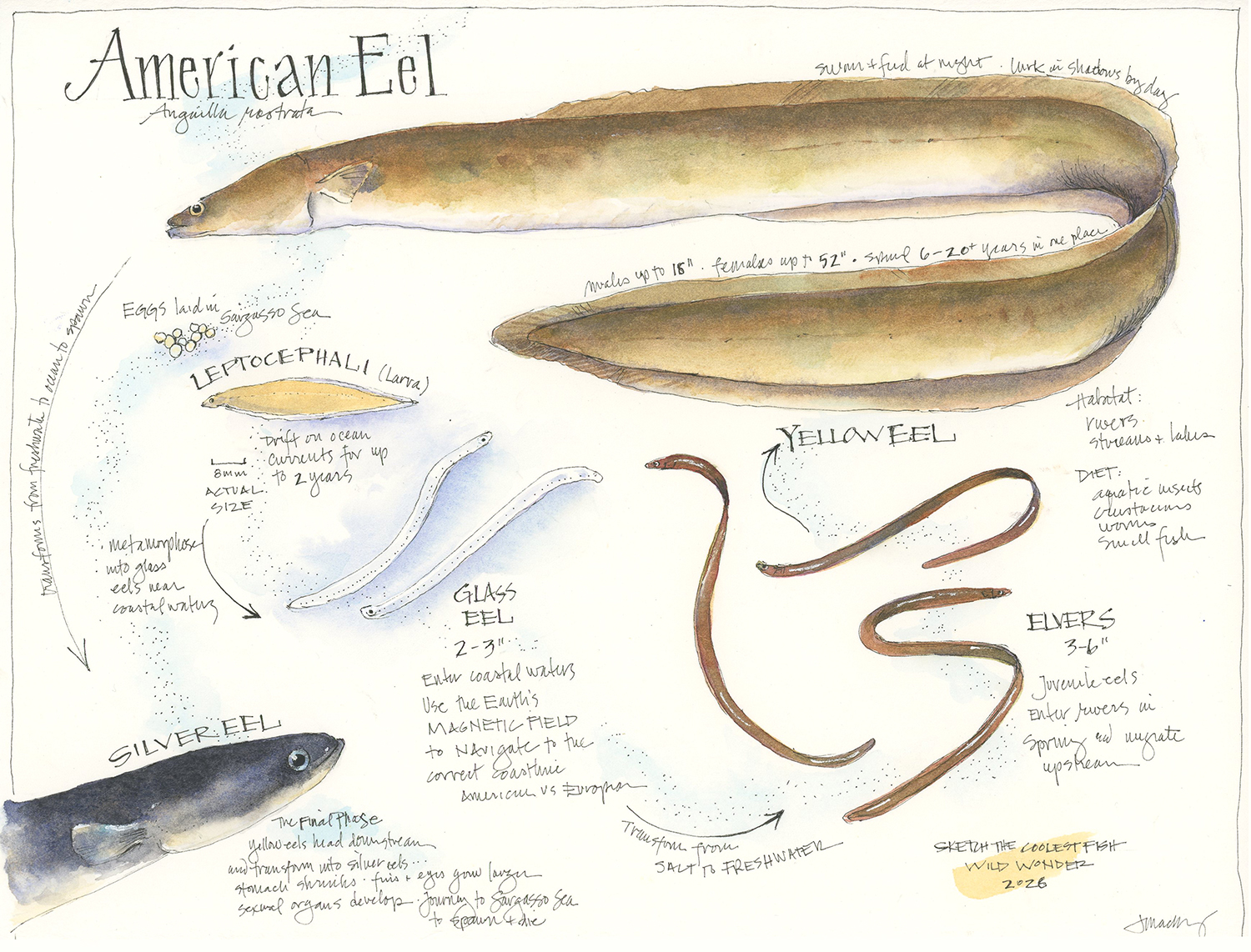
I did this piece during the Wild Wonder Nature Journaling Conference, which took place this week. Thanks to those of you who took the deeper dive with me!


Absolutely amazing lifecycle! Eels are truly fascinating, and I really appreciate you sharing the story of their lives and the painting you creating for the Wild Wonder group. Thank you Jean! Makes me wonder about the lifecycles of moray eels and the other eel species that I’ve encountered while ocean diving. Hmmmmmmmm!
Fascinating, but do they bite?
No– they don’t. They are harmless to people.
My brother gave me this book several years ago and I was as fascinated by the eels’ life cycle as you are. I’m absolutely delighted that you have illustrated it so beautifully and sent it to all of us! Thank you, thank you, thank you!!!Janice
Fun to learn a little about this life cycle. I knew they traveled but did not know about the color change. I am signed up to get the recorded talks from the Wild Wonder group. Looking forward to watching so many of the artists and speakers. I think the link comes mid October. Thanks for sharing. I have several books by Rachel Carson but not this one. I will have to go looking for it.
That is so interesting what a life they have. I sure miss your classes hope to see you again soon.
Georgia Ratcliffe gratcliffe4@mac.com
>
I read about this eel in a book that I believe was co-authored by David Attenborough. The natural world is a fascinating place! Thank you for teaching an art lesson on these amazing creatures. I’m looking forward to your Wild Wonder class when I receive my video pass. I should read Rachel Carson’s book.
Amazing creatures. Here in Australia’s east coast the eels breed in the waters of New Caledonia. And of course those that live in dams and ponds must travel across land. Thanks for this thought provoking post.
Astonishing! You did an amazing job of capturing their changes in one sketch. Eels always remind me of the unfortunate king of Scotland who allegedly died from eating spoiled eels (but that is not accurate)… so I looked it up, and found that the eels found in England also spawn in the Sargasso Sea, and follow the developmental cycle you described here for the American Eel. Amazing!
Pingback: wwc26: the coolest fish – hashiworks