Madeline Island Sketchbook
“The lake is the boss.” – Julian Nelson, Commercial Fisherman on Lake Superior
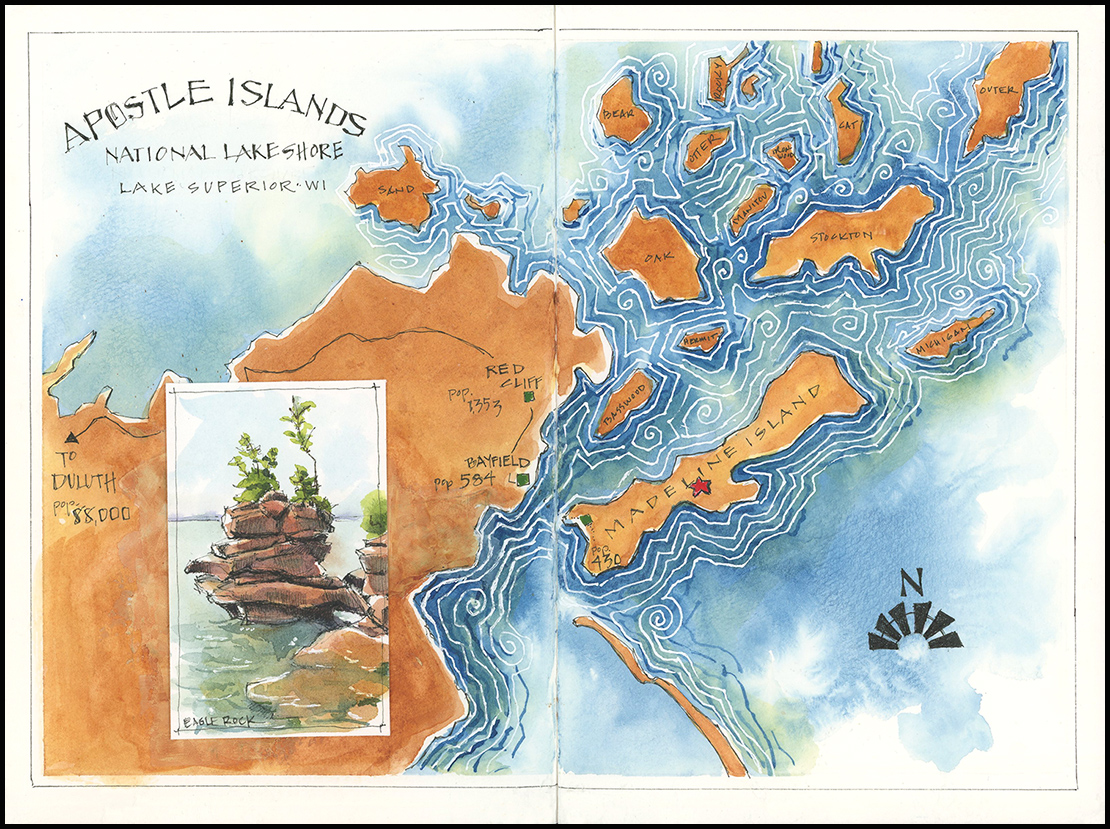
When I read that statement in the National Park brochure for the Apostle Islands, it gave shape to everything I would see and learn during my week on Madeline Island, Wisconsin. I was there to teach a workshop for Madeline Island School of the Arts, and my class outings took us to forests, cliffs, and dunes on the lakeshore, and to the local historical museum in the tiny town of La Pointe. The lake—big, cold, deep, and windswept—influences it all. Nature and culture, people and place, have been bound to one another and to the lake for centuries. These pages reflect some of my experiences and a few ways a new place can be understood—and sketched.


I love all the unique ways you come up with to design your sketchbook pages, so creative-and, of course, so beautifully painted!
Thanks much! I like figuring it all out.
These sketches are really wonderful, Jean!
Regards,
Marsha Brown
I’m so glad you enjoyed them Marsha!
Love it! And the colors feel so natural 🙂
Thanks Kim!
Morning from west coast, Vancouver BC area. I so enjoyed reading your newest email and seeing some of the sketches from Madeline Island. I always appreciate seeing your sketchbook layouts. I haven’t tried doing a map, and I’m definitely not good at page design, but considering doing similar idea as I’m heading to east coast next month, first to Halifax to visit family then down to Bar Harbor, Maine to do a MISA workshop.
FYI, I also teach sketching with ink and watercolour (amongst other drawing and painting classes). Sketching nature and the urban garden are my favourite subjects. I’ve mentioned your name in class, as an artist to follow.
I look forward to your next post! Happy sketching! Peri
Peri— I hope you try a map! Maybe in advance of your travels to Maine as you could record some of your experiences there. Bar Harbor is beautiful in September. That should be a wonderful trip!! Enjoy!
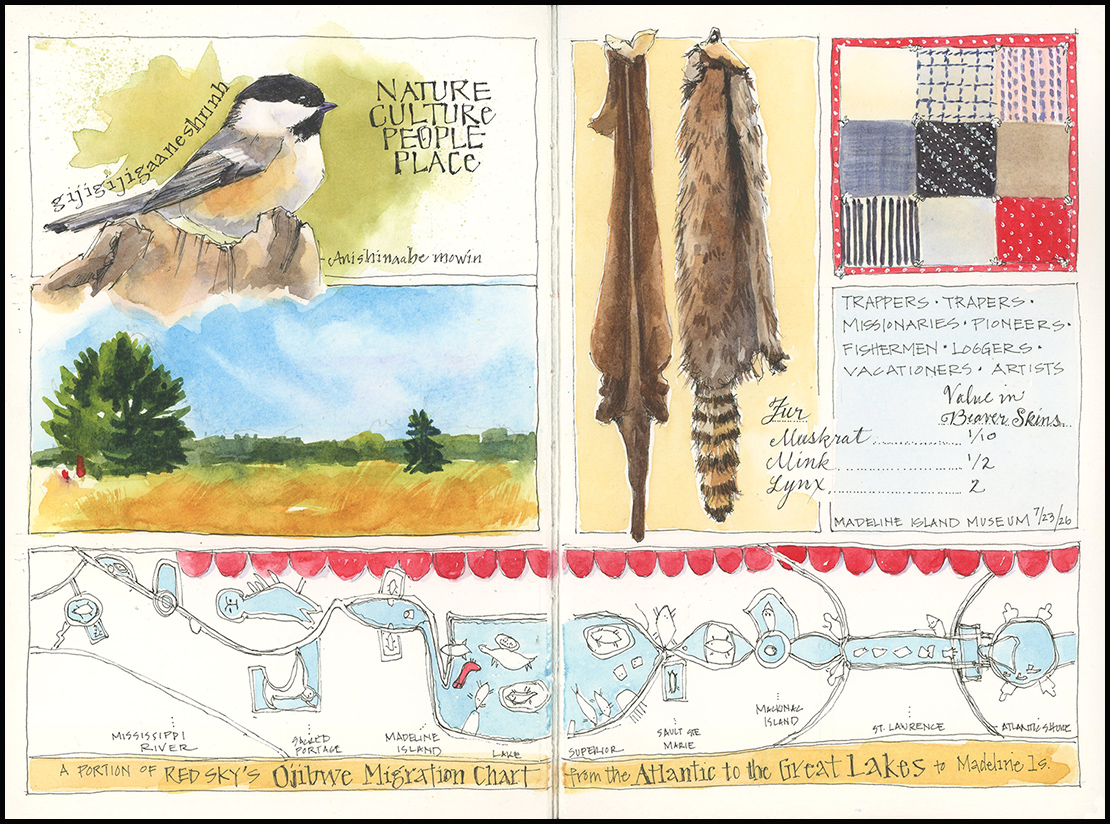
This is fascinating. I looked up Red Sky’s map online, and found images of the original… which doesn’t appear to include the red circles along the top edge. Were those added by a map drafter, or did you add those? They might indicate days spent on the journey…
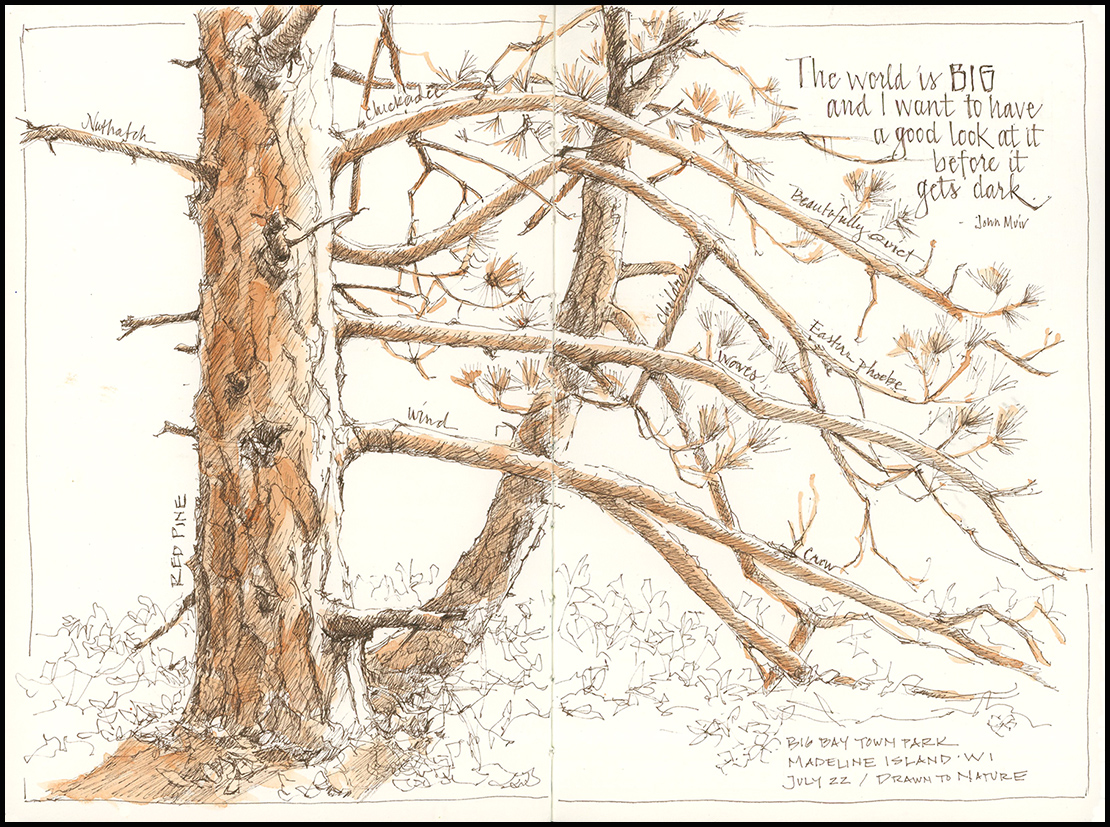
I found your painting of the branching red pine with its nested ideas (e.g., chickadee, waves) to evoke the map, with its branching waterways and places of interest. Wonderfully done. I really have to try mapping trips in this manner, I think it would really help remember what we saw and experienced along the way.
Hi Sam— The red scallops were on one of the Objibwe canoes at the museum. That pattern appears on a replica canoe that is being made on site as well, so I added it here.
Try a map! It’s really fun to do and you wouldn’t need to paint it if you didn’t want to. It’s just a nice way to learn about a place and record your experiences.
One of those works of art I could look at again and again, and never get tired of looking at it. Beautiful.
Thanks so much Cindy!
inspiring as usual!
Thanks Marilyn! I like when I can share several sketchbook pages together to give a fuller flavor of my travels.
The whole map thing is interesting and not sure how to go about it for a longer car trip. I just turned from a trip so will play with this a bit and see waht I can figure out!
Love your ideas and work!
Joanne- You could try zooming in on just a portion of your trip or do several smaller maps of the places you visited. Good luck!
As always, I love the way you incorporate “nature, culture, people, place” into your posts…and the maps that help me to visualize the terrain! Always a treat to see your posts — thank you!
Great to hear, Carol! Thanks!
So many great ideas for sketching “a place”! I, too, like sketching in local museums to capture some of the history. These small museums are real treasures!
Agreed. There are always interesting artifacts and it’s not hard to find the stories that they tell. We only spent 1.5 hours at this museum, but I could have used much longer. It really helped to round out our experience.
What you did on the Muir quote page is intriguing – the great quote paired with a bare tree and almost-hidden words describing a host of sensations from that place. Really cool!
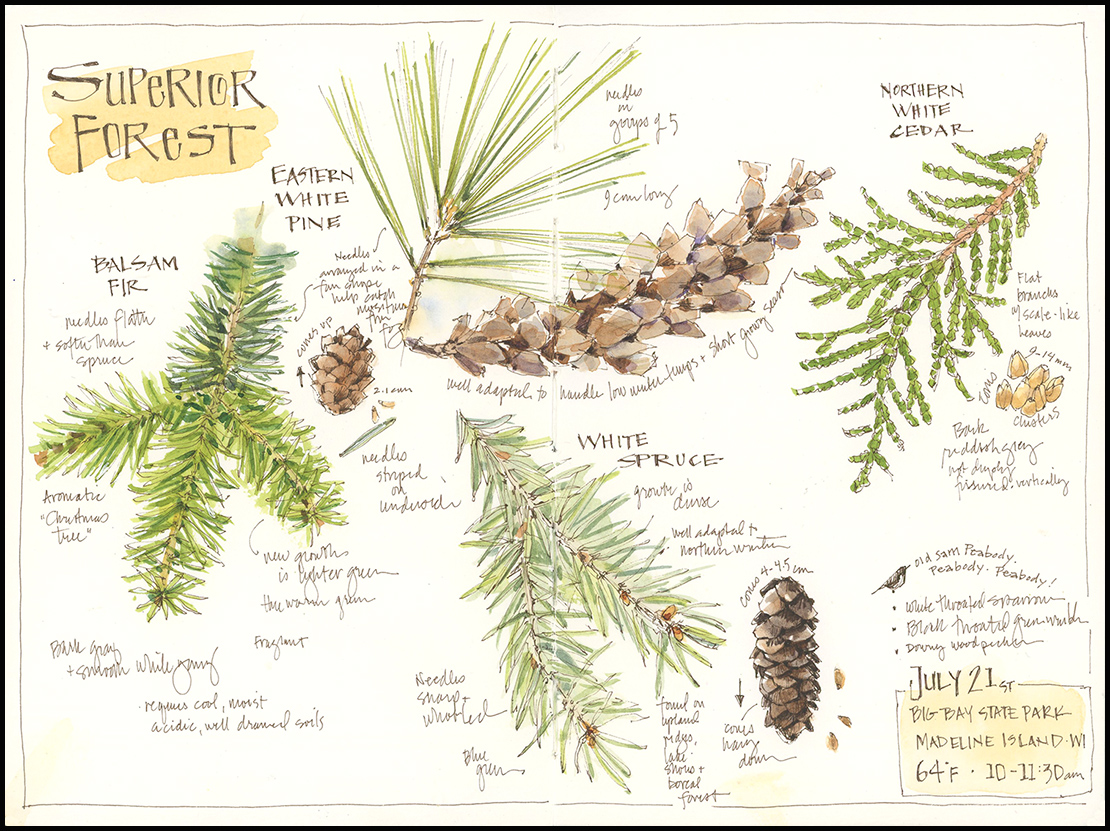
The conifer page has perfect parallels in our conifers: White spruce with its sharp needles and oval cone like our Sitka spruce, Balsam fir with softer needles and small cone like our Douglas fir, Northern white cedar with scaled leaves and tiny cones like our Western Red-cedar. Our Lodgepole, or Shore pine is different from the Eastern white pine but it’s interesting to see the connections. Is that the Anishinaabe name for the Black-capped chickadee? !!
Yes– that is the Anishinaabe name for the chickadee. It is pronounced in such a way that it sounds like the song. Not all the consonant sounds are the same as ours.
We explored the forest both from a “field notes/learning” perspective and from a feelings/sensory viewpoint. Hence the different pages reflecting those approaches. It was interesting to see how some people were more drawn to one approach over the other, and we all learned a lot.