
In the Bleak Midwinter
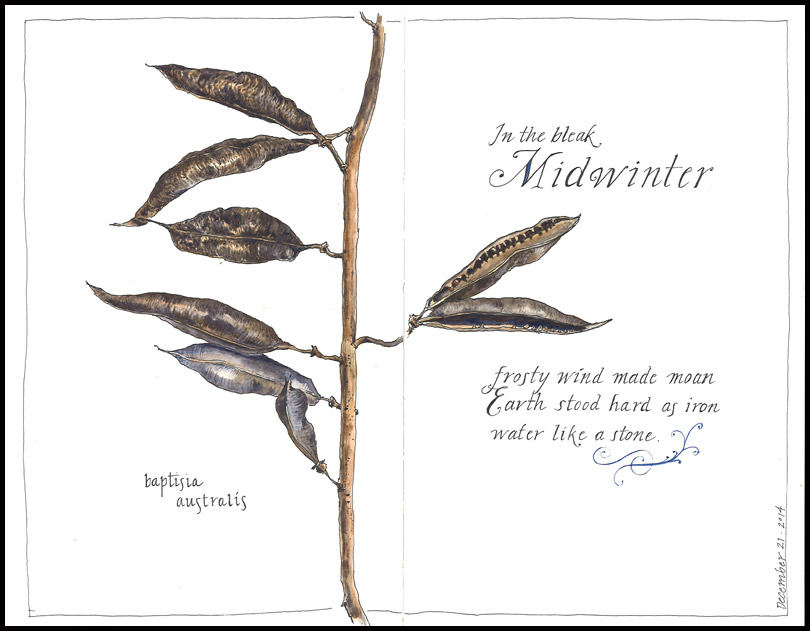
I finally cut down the last of my baptisia pods, which were attractive in the fall, but had become bent over and forlorn since the last snow. Still, I liked the shape of this stem and decided that a stark portrait might be fitting for the first day of winter.
Christina Rosetti penned In the Bleak Midwinter as a Christmas poem in England sometime prior to 1872. The entire poem was later set to music and published as a Christmas carol in 1906. The script is based on Italics from the Treatise on Hawking by Italian scholar Francesco Moro, penned in about 1560-1570.
Note: I’ve finally updated my blog header and added a few new sketches to the journal section. Check them out when you have a chance and let me know what you think.
Nest & Eggs
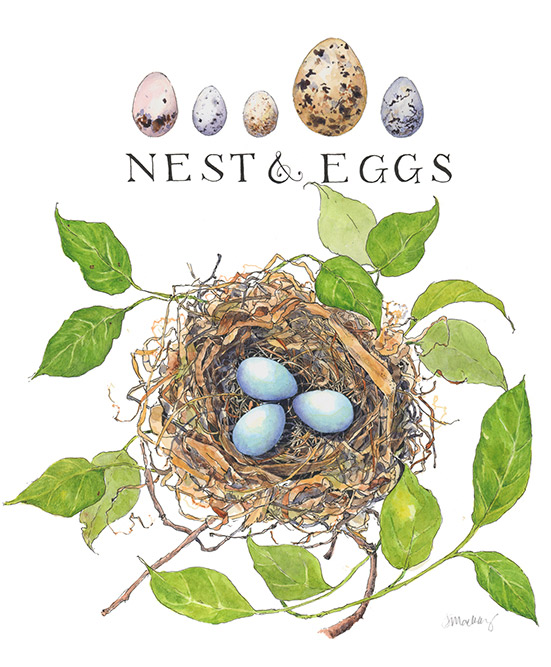
Yes, this is a completely unseasonal piece given the temperature outside (36F), the snow and barren branches, and the fact that the wood thrush that made this nest is far gone to Central America for the winter. Still, it’s good to remind myself in the year’s darkest days that we are riding on a fantastic, revolving planet– which, after a little more travel around the sun, will bring us to spring once more.
Appreciating Craftsmanship
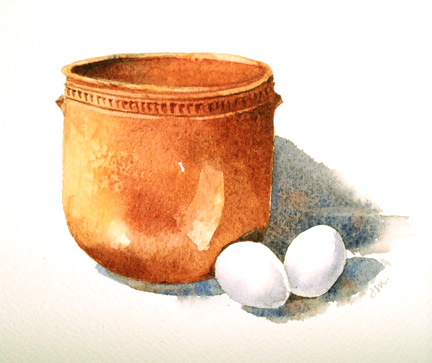
New Hampshire craftsman Peter Sabin has been making pottery for more than 40 years. His exquisite stoneware is simple, elegant, functional, and flawless. I consider myself fortunate to own several pieces. But after a recent visit to a shop where he sells his work, it occurred to me that he isn’t getting any younger. The day will come when he is no longer making pottery. I’ve never met Peter, but it seemed high time to say thank you. After all, I take pleasure in using the result of his labors and craftsmanship nearly every day.
I painted this as a small gesture of appreciation and mailed it off with a note of thanks. It isn’t much, but I hope it conveys my gratitude for things made well and made beautifully.
Undesirable Beauties

Click for larger view
I was drawn to the golden orbs of the horsenettle while hiking last week in an old field on the edge of an orchard. Bright spots of yellow against faded, brown grasses and dried wildflowers, I decided to take a stem home to paint. Upon identification, I was not surprised to learn that the plant is invasive and unwanted, as are many plants that grow in the weedy margins of fields.
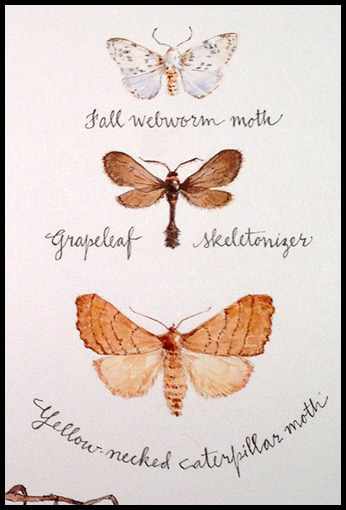
Still, I love the way the fruit drapes from the tendrilous vines and there is something ironic, yet masterful in a poisonous plant that protects itself with thorns. Once I painted the horsenettle, I wanted to round out the page with other undesirable beauties of fields and orchards. This trio of moths is found in the Northeast: the yellow-necked caterpillar moth is destructive to apple trees, the larval grapeleaf skeletonizer does just as its name implies, and the fall webworm caterpillar, while not particularly damaging, forms unsightly nests on tree limbs.
Sketchbook detail
Sage Advice

“Day after day never fail to draw something which, however little it may be, will yet in the end be much.” — Cennino Cennini c. 1390
It’s comforting to know that people have been struggling to draw and paint well for centuries. Cennini’s advice is just as true today as it was 600 years ago. I’ve spent the last week watching, drawing and painting chickadees, trying to capture the shape, color, and spirit of this little songster. It isn’t easy.
Chickadees are not very cooperative subjects. Unlike finches, which will perch at a bird feeder and eat, chickadees never stick around. At my feeders, they flit to a nearby branch, survey the feeder, swoop in–pause for a second—grab a seed, look up and fly off to eat elsewhere. The whole maneuver takes about six seconds. But to their credit, chickadees are bold. When I stood three feet from the feeder to photograph them, chickadees were among the few birds that continued to feed.
I did these sketches and the small painting below from life and from photos. I have more to do to really capture the bird to my satisfaction, but I am taking Cennini’s advice to heart, hoping that yet in the end, all this practice will amount to much.

The Best Intentions

Gray. Damp. Cold. It’s been a jolt to go from the brilliant warmth of autumn to chill snow-in-the-air November. Still, I was determined to get out and sketch birds today. I filled the bird feeders. Nothing came. I went to the nature center and walked the trails. Few birds appeared. Cold and defeated, I returned home and took consolation in cinnamon buns and coffee. But I couldn’t resist adding this chickadee to the page. I sketched him from an old photo, which made it a bit challenging to get him to sit just right on the rim of the pan. No matter. I realize that my favorite Sundays are filled with baked goods and art…and so I end the day satisfied.
Drawing Donuts
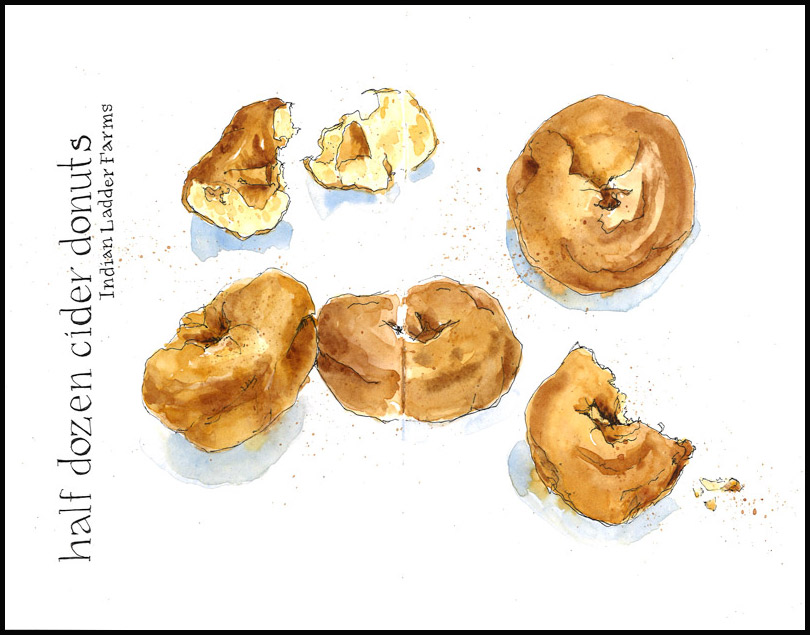
If donuts don’t immediately strike you as artistic subjects, you’re not alone. I got a few passing glances from the staff of the farm café and bakery when I sat down with my hot cider and bag of donuts and proceeded to paint them. Fortunately, it was an hour from closing time and the café was pretty deserted, so I sat contentedly savoring the quiet moment.
This page illustrates what I like best about keeping an artist journal. Freed from the pressure of making a “finished” piece of artwork, my journal is a place to play and to practice. It’s a place where I learn about all sorts of things, or simply record day-to-day experiences and places. A page of donuts can follow a page of trees or birds or barns…and it’s all good.
Fresh from the Farm

Indian Ladder Farms is a much beloved place in our community. Few people I know haven’t picked the farm’s apples in fall, brought their kids to pet baby animals as a rite of spring, or eaten their share of cider donuts over the years. We’ve watched outdoor community theatre under the backdrop of orchard and escarpment, picked out our Christmas trees in winter, and frequented the farm’s gift shop for birthdays and special occasions. Indian Ladder Farms has been in operation since 1915 and it is treasured by generations.
Why I’ve never thought to sketch there escapes me. Maybe it’s that I’m always there for some other purpose, or maybe it’s that I like going when it’s raining and quiet. That changed this week, when I went to Indian Ladder twice—and solely for artistic purposes.
Here are the results of what I hope are many more sketching excursions at the farm. More barns, apples, vistas, and maybe a donut or two are in store.
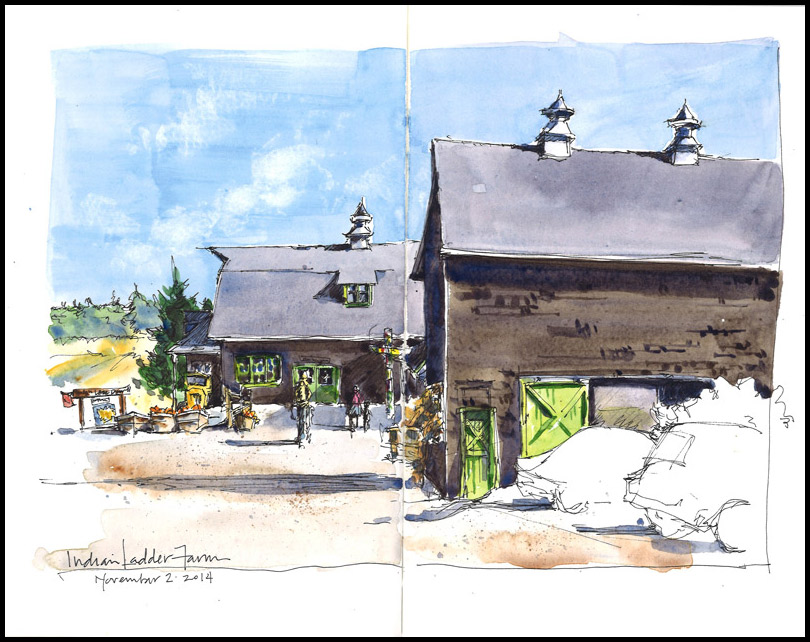
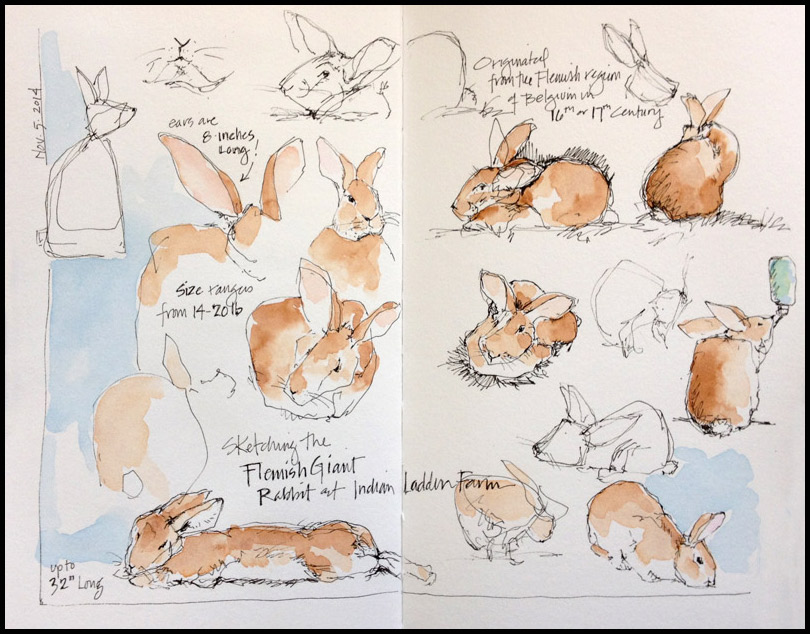
I wanted practice with perspective and Indian Ladder’s main barns proved a worthy challenge. On my second trip, I focused on the farm’s Flemish giant rabbit. The Flemish giant is a massive breed by any measure, standing about 2 1/2 feet tall, which it does, on occasion, when not bounding around its cage, grooming itself or nibbling at children’s handouts. This was my first time drawing a rabbit and you can see some improvement from left side to right.
Pear Portrait
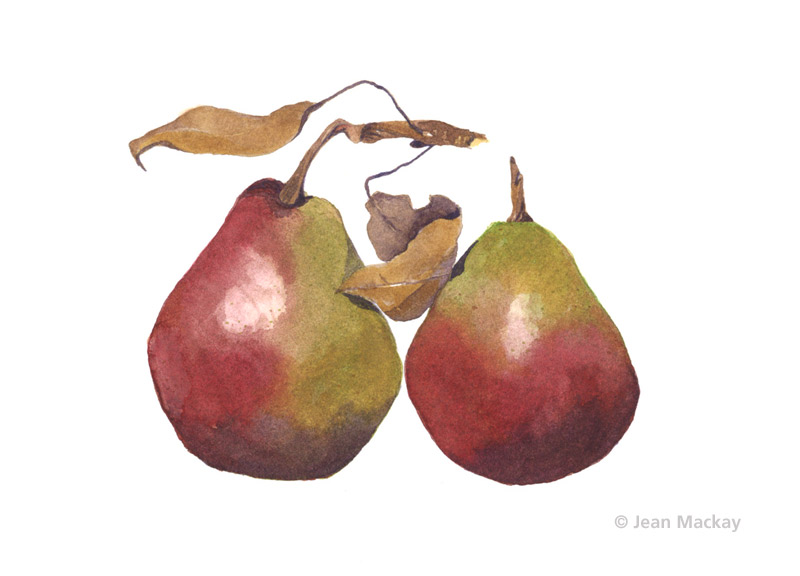
Beautiful form, beautiful color. Is it any wonder that pears have been artistic subjects for ages? From Roman mosaics to Renaissance religious paintings, from woodcuts and engravings of the 17th and 18th centuries to Impressionist paintings in the 19th century– the pear proves a worthy subject.
When I see pears at the market or a farm stand, I can’t resist buying them. I don’t care that much about eating them. Not that a good pear isn’t heavenly. I just feel compelled to paint them. But pears, like apples, are tricky. Seemingly simple, I find it hard to get the form to take shape on paper without overworking it. Like the real thing, one minute the fruit is fresh and the next it’s rotten. Stopping when you’ve got a good thing is key. This painting of seckel pears is right on the edge. And though this is no masterpiece, I’m happy to add my attempt to the fruit’s artistic legacy.
Grief and Glory

The last blaze of autumn’s glory is upon us in upstate New York. Gold, crimson, bronze, and green hang on, even after several days of wind and rain. Among the best places to see the show, I knew, would be in one of my area’s oldest and grandest rural cemeteries – Oakwood Cemetery in Troy, New York. Established in early 1848, Oakwood’s monuments are dwarfed by towering oaks, maples, beech, and hickories. How fitting, then, to paint there just two days after a longtime family friend died of cancer. In retrospect, I suppose it was no accident. It was the perfect place to contemplate a life now gone and to take solace in the radiant glory of fall’s last days.


 Drawn In