
One Glove

There isn’t a winter that goes by without losing a glove. Worst of all, I even saw this one lying on the ground as I got back in the car at a Thruway rest stop. “Geez, it’s too bad someone lost a glove. I hate that,” I thought, not recognizing that the glove was mine. Ugh! When I got home and realized my stupidity, it was too late. But for some inexplicable reason, I wasn’t able to throw out the orphan glove. It’s been sitting above our coat rack for three weeks—until yesterday. That’s when artist Laure Ferlita posted a fine tutorial on drawing garden gloves and it inspired me to memorialize my annual glove loss and move on. Thank you Laure!
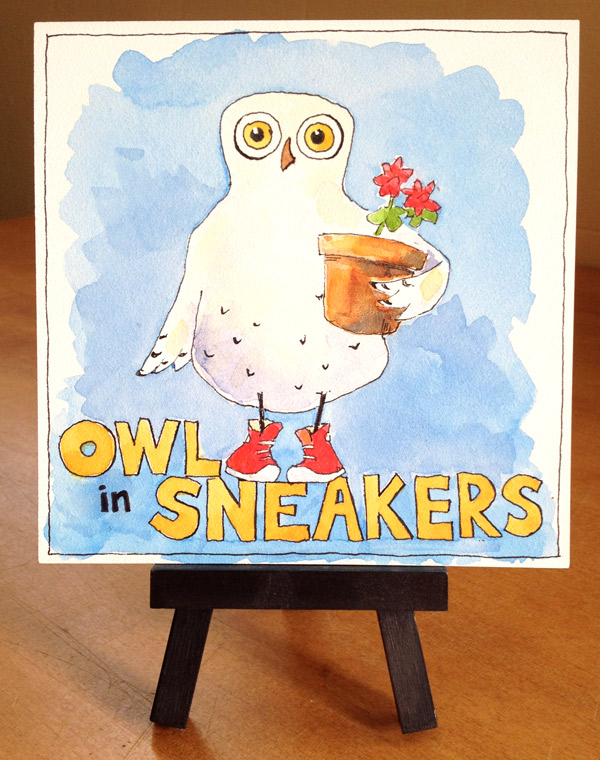
Owl in Sneakers
And now for something completely different…
click to view larger
I’ve been experimenting with developing this small, quirky character Owl in Sneakers. The basic features came to me late last summer, and I thought it might be fun to play around and see what he might become.
I figured out the body shape, eyes, pigeon-toed feet with red sneakers, and potted geranium fairly quickly. But making him move and do things and express emotion has been trickier. So far, I’ve been able to make him read and play hockey, and I’ve been test driving various concepts with my niece and nephew (who think he should play an instrument, like the tuba or trombone, and concur with me that he needs a red wagon and friend, perhaps an ermine). What comes next? I’m not sure. But I’m open to suggestions.
(Watercolor on aquaboard, 5×5”)
Painting in the Car
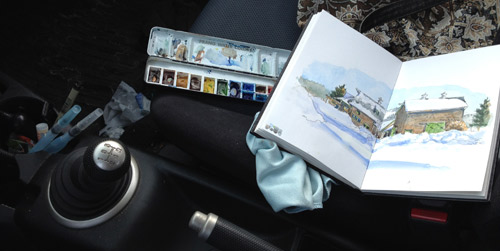
Outside: seven degrees, wind chill minus 15F, bright winter sun. Inside the car: warm enough so that I didn’t see my breath, warm enough so that the watercolors didn’t freeze, warm enough to take my gloves off. A temporary win. After weeks of being inside, I was determined to try my hand at painting in the car. It’s less than ideal by any measure, but not without merit. The end result is a little muddy and overworked, but not bad for an hour’s outing on a frigid day.

Great Blue Heron
A few years ago I found a great blue heron skeleton revealed under melting snow in a ditch near my house. I don’t know how it met its end, but the bird was almost completely decomposed and I decided to take the skull. As a specimen, it’s fascinating; as reference for painting, it’s quite useful. The colored pencil study here is life sized, based on the 9-inch skull.


I’ve also been doing gesture drawings of herons as a precursor to doing a larger painting. Since the ground here in New York is covered in snow and herons are long gone for the winter, I’ve resorted to the next best option: watching and sketching from nest cam videos. These videos offer a rare view of herons courting, mating, and raising their young. Come spring, you can watch them live, but for now check out the links below if you want a glimpse of these majestic birds.

Cornell Lab of Ornithology, Heron Highlights 2012
Behind the Scenes- Nest Cam
10,000 Hours
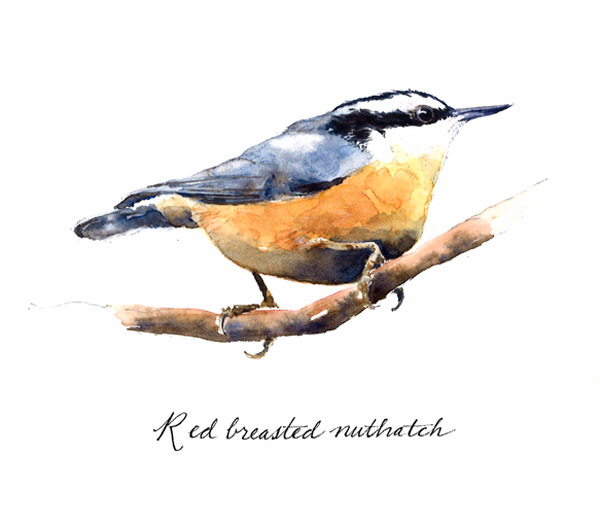
If the assertion that it takes about 10,000 hours to become an expert at something is correct, I’ve got a long way to go before becoming really adept at painting birds. Still, I’ve spent a good amount of time this winter studying and sketching and painting birds, and it’s good to see some progress. Painting birds well requires watching them a lot, studying anatomy, closely observing specific features like wings, feet, and bills and, of course, practice. After doing a number of quick sketches of red-breasted nuthatches at my feeder, I used my drawings and several photo references for this more careful study. Now if I can just find a few thousand more hours…
(Fabriano soft press 140lb watercolor paper; reference photo by Mick Thompson, 2014)
Experimenting with Tufted Titmice
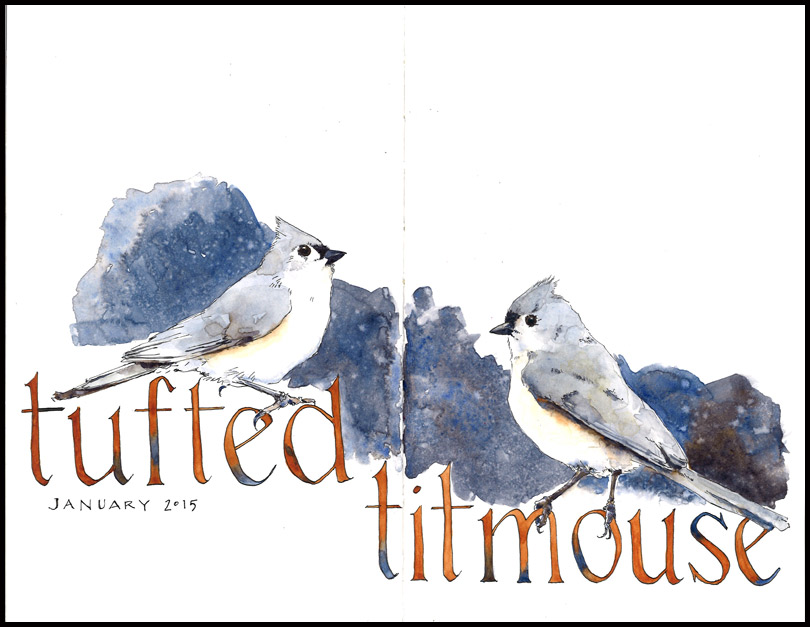
Click to view larger.
My journal proved a good place to experiment this week with tufted titmice, dark backgrounds, and text. These birds often visit my feeders in winter, providing good opportunities for study. I thought I would sketch a few birds in different poses as time allowed, but after painting the bird on the left, I decided to take a different approach. I wanted to add big text and see whether I could get a bird to perch on the letters. It’s a little tricky to substitute letters for branches, but the bird on the right seems fairly convincing. I also wanted to try a dark background, so I experimented with different shades of blue, making swatches on a test sheet and holding them next to the birds to see what worked best. In the end, this combination of ultramarine and burnt sienna with a bit of water sprayed into the wet paint created a nice wintry effect. The letters are the reverse color mix, with burnt sienna dominating and some blue floated in to add a little weight. My next step will be to try the same techniques in a more careful painting— stay tuned!
Collecting on Paper
I’m like a kid in a candy store when I step into the Pember Museum of Natural History in Granville, New York. Thirteen cherry and glass cases house more than 1,200 specimens of birds, 500 mounted mammals, and row upon row of insects, bird eggs, and nests. The collection is life’s work of a single man: entrepreneur and naturalist Franklin Pember (1841-1924). I love capturing pieces of this collection in my journal—but where to begin is always a challenge.

Click to view larger
As I wander from case to case, I look for things that strike my interest and add objects to the page throughout the day. Everything is so incredible that it’s hard for me to choose. I started this page with the ruff chick in the lower right, and then added the moths, followed by the eggs, and dragonflies. Except for the ruff, I sketched directly in pen to eliminate fussing and added a layer of watercolor in the museum, before running out of time. Later at home, I finished painting and added the catalogue from 1883 from a photo. It was easier to do the lettering at my desk than standing over a glass case.
In the end, the page is a tribute to a fabulous day spent with one of my favorite collections.
Unexpected Inspiration
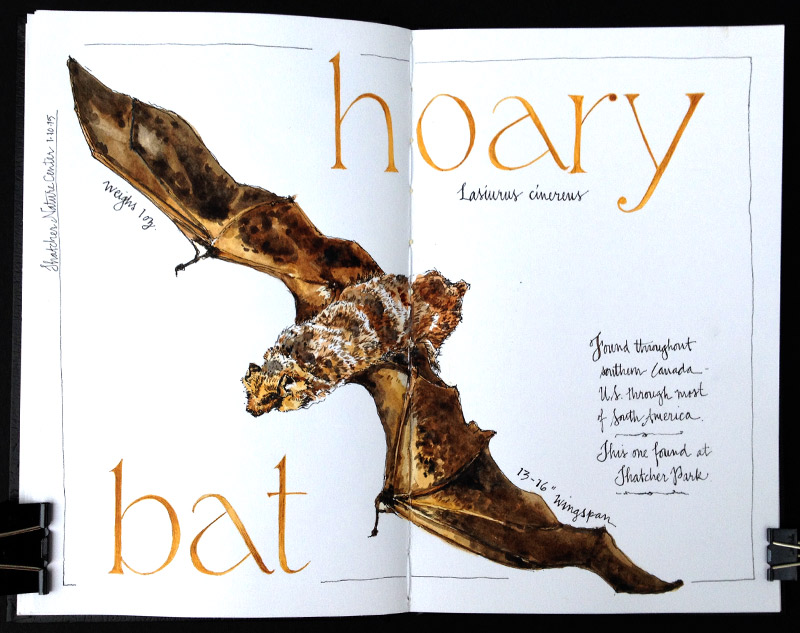
I went to my local nature center yesterday seeking inspiration for something to study and paint. I was hoping there might be something new in the collection—moths, butterflies, birds, nests. So when the staff said they had a hoary bat in the freezer, I had to admit it wasn’t quite what I had in mind. Though I appreciate that bats play a crucial role in pollination and insect control, the only bats I’ve ever seen have been the little brown bats I’ve wanted out of my house.
Still, how often does the opportunity to study a bat up close come along? I spent the next hour-and-a-half getting acquainted with this once living, breathing, flying creature. Incredible, really. The leathery wings, visible bone structure, fine markings, grasping thumb and tiny feet. Now, I’m happy to have it live on here between these pages, reminding me to keep seeking, seeing, and appreciating.
(Thanks to Thatcher Nature Center at John Boyd Thatcher State Park in New York for warmly welcoming artists.)
A bit more about hoary bats: Unlike a lot of bat species, hoary bats don’t hang out in caves. They prefer trees and tree cavities, flying out after sunset to catch insect prey. They tend to be solitary, except when migrating. Northern populations make long seasonal migrations to warmer habitats in winter. Females give birth to two pups from mid-May through early July. Young stay with their mother for about a month, until they are old enough to fly. Though widespread, these bats are seldom seen.
Winter Birding at Gooseberry

I had to great fortune to visit family in Westport, Massachusetts, over New Years— which gave me the rare opportunity to visit the ocean in winter. On two consecutive mornings, I headed for Gooseberry Neck Island, a small spit of land jutting out into Buzzards Bay.
Wind roiled waves crashed over the jetty at high tide, sending a spray of surf over the road. Fooled by the low arc of winter light brightening the day, I left the protection of the car to scope the beach for shorebirds. Gulls and sandpipers foraged in the wrack line, unearthing mole crabs and bickering over the scraps. Two resting sandpipers caught my attention, heads turned backward and bills tucked under feathers; they stood motionless for several minutes before returning to the waves. I soon retreated to the car, where it was easier to scan for birds while protected from frigid wind and blowing sand.
It’s hard to fathom how seabirds manage in winter. But there they are: gulls perched on windswept piers; tiny sandpipers dashing at the edge of each retreating wave; bufflehead, eiders, common goldeneyes, and grebes diving into heavy surf.
Though I sketched a bit on site, my down jacket, alas, proved no match for winter birds. So I finished drawing, painting, and research indoors. The map text is copied from a 1707 map and survey of the island.

Ode to Joy

I have many fond memories of sledding as a kid: steep hills, thrilling descents, and inevitable wipeouts were all part of the fun. Sledding is great, in large part, because it packs so much emotion: anticipation, fear, exhilaration, wild abandon. I felt especially challenged to capture some of that experience in this small painting, which I did as part of a Christmas book commissioned by my cousin for his daughter. Sledding is one of the things they like to do together– so although I don’t typically paint people or snow, I resolved to illustrate the scene. My reference was the view from their backyard; the rest I had to imagine.
Wishing you a sense of wonder and bit of wild abandon in the New Year! Thanks for following!


 Drawn In