
The Edge of the Sea
For many years now, I’ve clamored over granite ledges, slippery seaweeds, and sharp barnacle-laden rocks to explore the watery realm of Maine’s tide pools. When the sea retreats at low tide, a world of strange and tenacious creatures is revealed. I go in search of spiny urchins, orange and green sea stars, feathery anemone, scampering hermit crabs and slow moving snails, tunicates, blue muscles, dog whelks, sponges, lurking crabs and, always, the unexpected. I bring my sketchbook and a pen and draw until the tide turns.
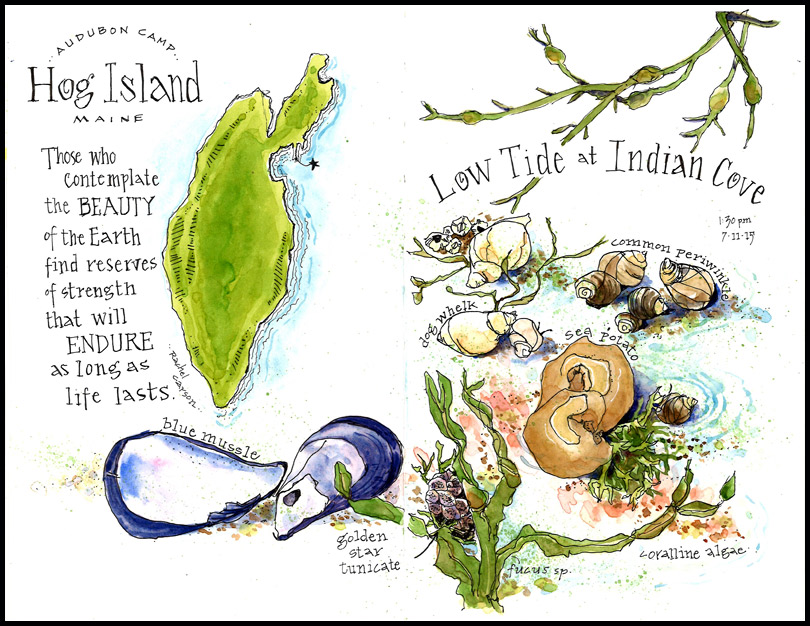
After this year’s adventure, I went back through my sketchbooks over the last 10 years to compare the drawings and the treasures found. Enjoy!
Out of the Blue
Of the 123 million pounds of lobster caught on the Maine coast each year, only one in two million comes up blue. I was among the lucky few to see this genetic mutation, hauled up by lobstermen in Muscongus Bay.

The lobstermen were nice enough to hail our boatload of artists and photographers from Hog Island Audubon Camp and share their catch with us. They couldn’t have picked a more enthusiastic audience. All camera’s were immediately focused on the prize before the lobstermen released it back into its watery home.
FYI: Regardless of the color of lobster when caught, all turn red when cooked.
Arts and Birding
I’ve just returned from the rocky coast of Maine, where I had the privilege and pleasure of leading a weeklong workshop on Arts and Birding at the Hog Island Audubon Camp. Our group of 25 consisted of artists, photographers, and writers from all over the U.S. (plus one from the Netherlands), who share a passion for birds and the arts. There were many highlights—and I’ll share a few in subsequent posts—but here is one:
Click to view larger
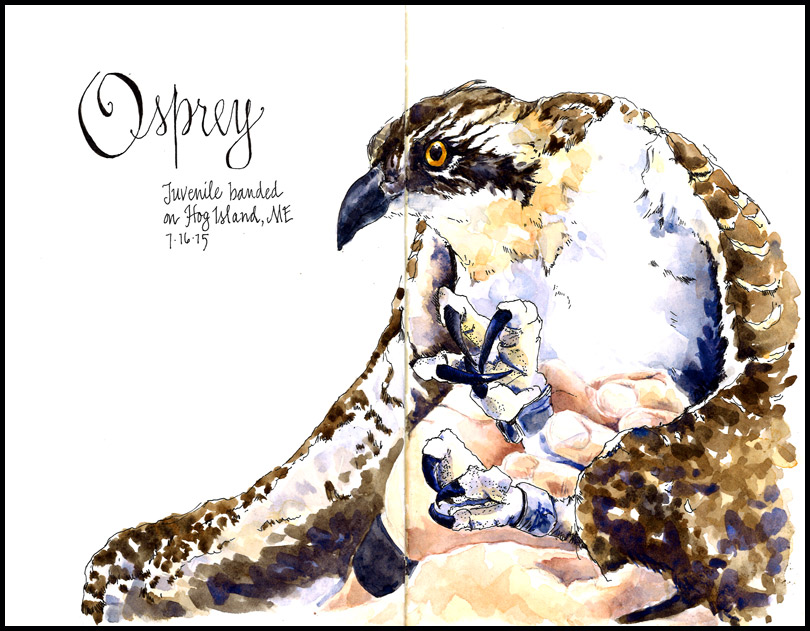
I’ve seen a good number of ospreys over the years, but never one so close. Hog Island instructor and osprey expert Dr. Rob Bierregaard and Chris Desorbo, a wildlife biologist at Maine’s Biodiversity Research Institute, banded this juvenile to the delight of camp participants. Ospreys are common on the Maine coast, thanks to the work of dedicated conservationists who brought them back from the brink of population collapse in the 1970s.
As countless cameras zoomed in, I decided to try my hand at sketching the scene. I had been encouraging participants to try quick ink sketches, so it was a perfect opportunity to practice what I preach. I went back in later with watercolor and painted only the osprey to highlight the star of the show. I did the first sketch (top) using a photo that I took after Rob and Chris finished banding the bird and its hood was off. I started with a pencil sketch, then outlined in ink, painted with watercolor, and finished the page with the text.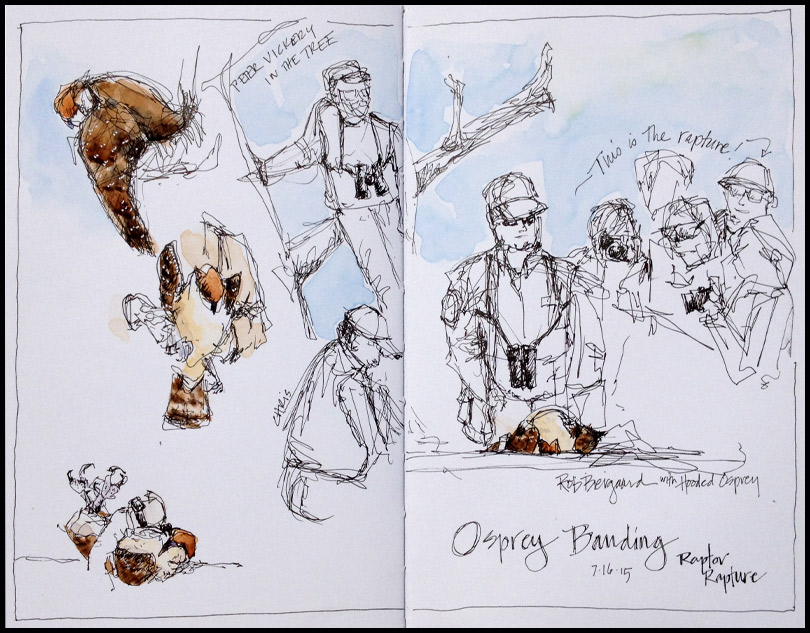
A bit more about banding birds
- Researchers outfit young osprey with lightweight aluminum bands on their legs. The bands contain identifying information which is later recovered. Banding studies reveal critical information about sources of avian mortality, where birds migrate, how they disperse, and how long they live.
- In 2000, researchers began tagging Ospreys with satellite transmitters that enable them to follow the bird’s movements around their nests and during their migration to South America and back. Learn more >
Savoring Summer
Taking a day off from cleaning, clearing out and organizing in preparation for moving at the end of August to enjoy a beautiful day. Hope you are savoring summer, too!

click to view larger
Five Days Later…
This page follows the one I posted on June 14, Things Worth Noting. A lot is going on in my life, which has made it hard to find time for art. I started this more than a week ago and I can hardly keep up– the daisies are now open; the iris unfurled; my son is leaving again. I need to paint faster!

click to view larger
Lighten up!
Though I work outdoors using a portable set of watercolors all the time, I realize that many people work almost exclusively indoors from photographs and a much larger set up. People often ask me how to get started working outside. Figuring out how to lighten the load is key; and once done, it opens all sorts of great possibilities for painting.

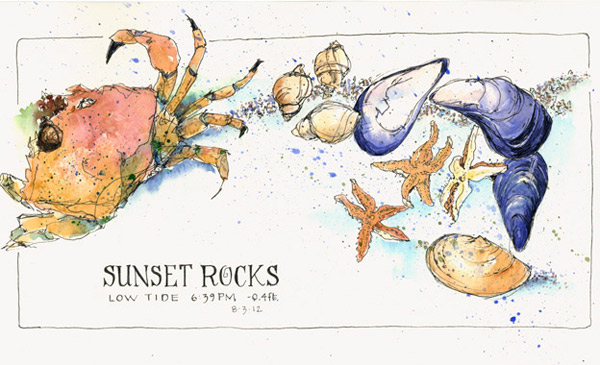
Immersed in drawing the tide pools of Maine’s rocky coast.
In preparation for my upcoming workshop, Arts and Birding, in Maine, I have been making a few small watercolor boxes for people to try. Here are a variety I’ve put together or revamped using standard half and full pans:

Clockwise from left:
Windsor and Newton Cotman box, small mint tins in various stages of transformation (inside spray painted white and outside spray painted red), Prang watercolor tin revamped with full and half pans (this is my current box).
Do it yourself:
I ordered the plastic pans online for about .69 cents.They’re held in place with Scotch restickable strips for mounting. Figure about $10 to configure a box of 12, plus paint. I use Windsor and Newton and Daniel Smith tube paints to fill them. To really travel light, I bring just a waterproof pen, a waterbrush, and a couple of paper towels or a bandana to clean the tray and wipe the brush between colors.
Let’s go!
Things Worth Noting
It’s been quiet on my blog and in my journal lately– these pages explain why. Big changes are in store as my husband and I not only become empty nesters, but give up the nest altogether and move from upstate New York to Connecticut. Amidst all the big things going on, I wanted to capture a few smaller things, too. Comings and goings; things that seem lasting, but, in the end, are ephemeral.

Expect some turbulence in the months ahead, along with new adventures and new places to explore. Thanks for being along for the ride.
Heard but not seen
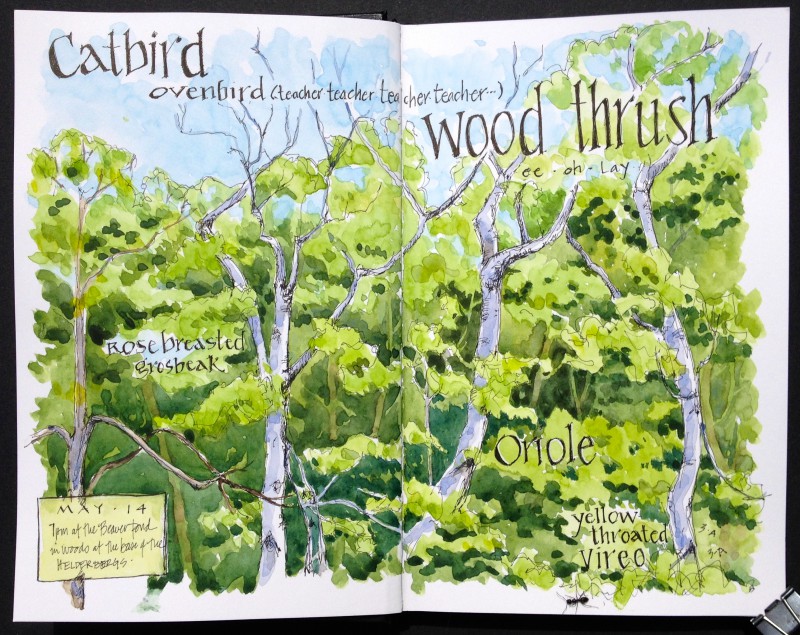
I went out with a friend one evening this week to sketch at a beaver pond. The water was dark and still, trees were lay crossways in heaps where beaver had felled them, and a large mud lodge rose on the far shore. But what struck me most about the place was not the pond itself, but the beauty and intensity of bird song in the surrounding woods. Other than a pair of catbirds and the flash of the rose-breasted grosbeak as it darted into the trees, I saw no birds. But I’m good enough at birding by ear to identify the singers. I decided to try to capture the ethereal experience of hearing these birds in the darkening woods.
Seen, but silent were birds of Connecticut on display at Yale’s Peabody museum, where I enjoyed a brief visit on Friday. I had time to do a pencil sketch of these two vireos, which are commonly heard, but seldom seen.

Moving Through
Spring bird migration is at its peak. Every day new birds are arriving. Carried by countless wing beats and winds from the south they come—some to stay and some just to rest and feed before continuing on their journey north. Among my favorites: a single white-crowned sparrow that spent just a few hours in the yard, a rose-breasted grosbeak that stayed three days, and a small flock of white-throated sparrows that skulked in our gardens and under our feeders for nearly a week. Today, they are gone…replaced by the oriole that will nest in my neighbors yard, chimney swifts twittering overhead and, with luck, a warbler or two in the days to come.

White-throated sparrow; watercolor on Fabriano soft press paper, 5×7”
Fast Takes
It can be hard to find the time for art when life gets busy. A whole painting or even an entire journal page can seem impossible to undertake. So I made a grid on these pages in the hope that I would be able to fill smaller spaces over the course of several days. As it turned out, I drew the entire two-page spread during an hour-long hike, pausing every so often to do a quick sketch when something caught my eye. Done directly in pen, each sketch took no more than a few minutes. I added color and text back at home.

Click to view larger
Some artistic tips:
- Making a grid is a worthwhile exercise, though it did leave me feeling a little boxed in. Make the rules, but feel free to break them, as I did, by going beyond the boxes as you see fit.
- Use the grid to your advantage. I found it especially useful in forcing me to put pen to paper without fussing, but I have seen other artists fill grid squares carefully, to excellent effect.
- Consider having a unified theme that ties the elements together. Your theme may be a particular place, experience, or even experiments with a single sketching medium.
- The risk of a grid is that if one of the elements doesn’t turn out to your liking, the entire page may suffer. That’s fine if you are experimenting and not a perfectionist in your art journal. I like some of the sketches on this page more than others, and I can live with that because my aim was to simply record quick impressions of a particular moment in time.
Page done in Stillman and Birn Zeta journal, with Micron black pen and watercolor at Indian Ladder Farms, New Scotland, NY


 Drawn In