
Ireland- Part 1
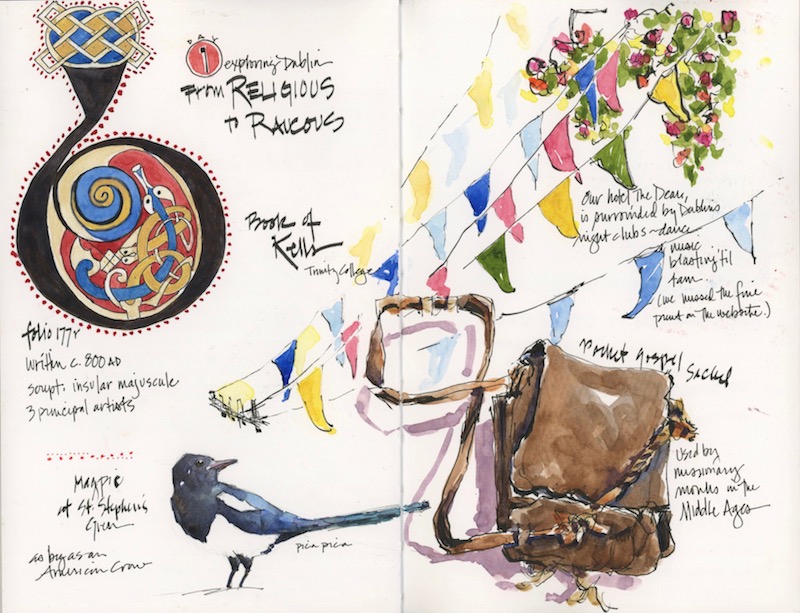
Two weeks ago, I flew to Ireland for the first time. I didn’t anticipate how profound it would feel to see the country my great grandmother left behind at age 16 for the promise of a better life in America. But as dawn broke from the airplane window and a patchwork of pastures spread out below, I saw connections stretching across miles and generations. The Irish lace that threaded through my childhood began here. It carried through my grandmother and great aunts; it spun stories, laid down values, forged friendships, and connected a large extended family.
Though I was traveling to Ireland for a conference and a week’s vacation, it felt like going home to a place I’d never been. My husband, son, and I spent our days exploring beaches and ruins, cities and towns, parks and cemeteries. It was an incredible journey. What follows is a first installment of sketches; I’ll post more in the coming days. Hope you enjoy the trip!


Tips and Techniques- The first rule of travel sketching is that there are no rules. Other than being committed to recording parts of your journey, you’re going to need to allow yourself maximum flexibility and a lot of room for sloppy, fast, imperfect sketches. I often drew on location and painted later. There was simply so much going on, so much to see, and so much time moving from place to place that there was rarely enough time for the kind of detailed and careful work that I prefer. I used both a graphic calligraphy pen and a size 03 Micron (both larger than I typically use) to try to restrict my tendency to fuss.
Preparing for Ireland
How to prepare for a trip to Ireland? Read guidebooks, re-read my family’s history, purchase a bird field guide and a travel adapter, prepare my conference presentation, pull out warmer clothes, and try to learn simple Celtic knots, fonts, and manuscript flourishes to add to my travel journal. That last bit has been the most fun, of course, but you really do need the patience of a monk to achieve the precision that makes Celtic art forms so beautiful. Here’s the beginning; I’ll fill in the white space during my travels. Watch for more in a few weeks.
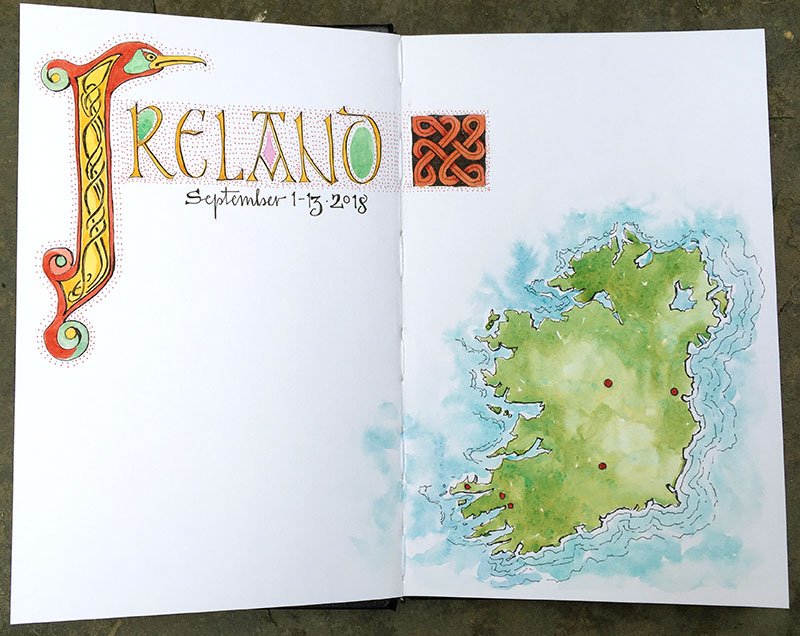
Tips and Techniques– A book I really like for learning calligraphy is The Art of Calligraphy, a practical guide to the skills and techniques by David Harris. The title doesn’t quite do the book justice. So much more than a practical manual, it also includes great information on the development of Western script and includes beautiful examples from some of the finest historical texts. The script above is adapted from Insular display capitals and illumination in the Book of Kells, which dates to the 9th century (and which I hope to see in Dublin) and the Lindisfarne Gospels, which date to 698 (located in London).
Summer’s End
It always sneaks up too fast. Dark creeps in earlier each evening; the woods go silent; swallows gather on the power lines, then vanish. I was happy to fit in a final weekend at the ocean, where it was still plenty warm for one last swim. A row of kites fluttered overhead. Yellow primroses bloomed at the edge of the dunes. But flocks of sandpipers chasing the waves amidst late-season beach-goers were a sure tell of the season’s turning, as were the multitude of bright orange-red rose hips ripening in the sun. Summer’s end is here.
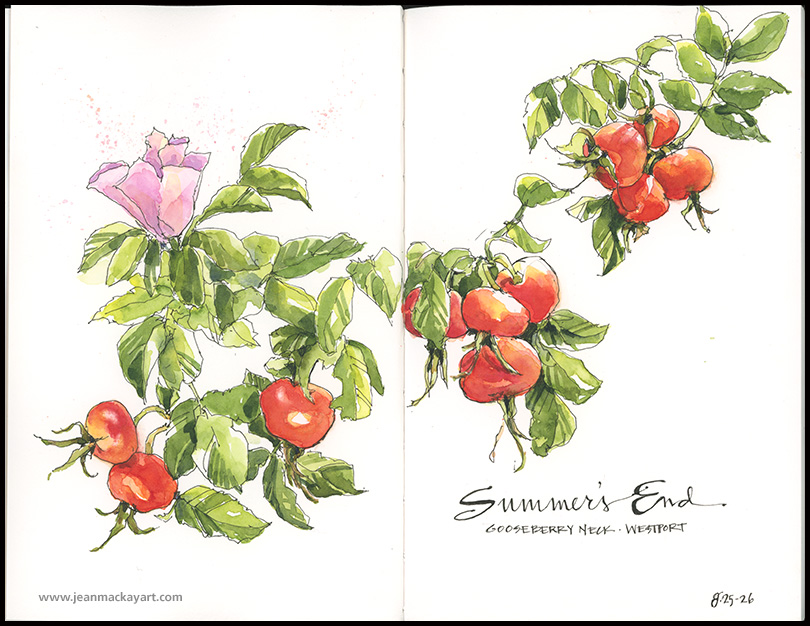
Tips and Techniques: When heading out to sketch, it’s helpful to think about what you can accomplish in the time you have. If you have 10 minutes, pick a 10-minute subject. This helps keep frustration in check, and you’ll avoid starting something you can’t finish or can’t capture sufficiently in the time you have. I’m fairly quick with drawing, but quite slow as a painter. I often choose subjects I can begin in the field and finish at later home, as was the case with the rose hips. Subjects like birds and trees take me longer to render well, so I don’t tackle them unless I have at least an hour. The more you work in the field the better you’ll become at picking subjects you can tackle well within the time you have.
Mushroom Explosion
Call me obsessed. I probably deserve it. I have spent nearly every evening this week painting nothing but mushrooms, buying field guides, making spore prints, and staying up late trying to identify my finds. In my defense, a treasure trove is growing before me– new species emerging each day under the grove of oaks that line our driveway. And I know that the intense humidity and rain that brings them out, all too quickly turns them to mush. In the end, my obsession stems from being astonished: I have recorded an impressive 26 different species in a single week: classic gilled mushrooms, large and colorful boletes, tiny coral fungi, and ringed polypores.


Consider this: several thousand species of mushrooms are found in the Northeast and upwards of 30,000 in North America. That’s more than all of the mammals, birds, reptiles, amphibians, fish, and plants combined. I found identifying them challenging, even maddening, but I learned to look more keenly at key features in the process. It’s likely that I misidentified some and I didn’t gather enough information to even begin to identify others. If you spot one you know from this collection, drop me a note so I can look it up.
Peach Season
It’s hard to exaggerate the extravagance of ripe peaches. Soft, striking, sweet, juicy…what fruits can rival them? Tomatoes, apples, eggplant, peppers? No match. Pears and cherries? Closer, but still second. Painting them is a pleasure, too. As is eating them, when the painting is done.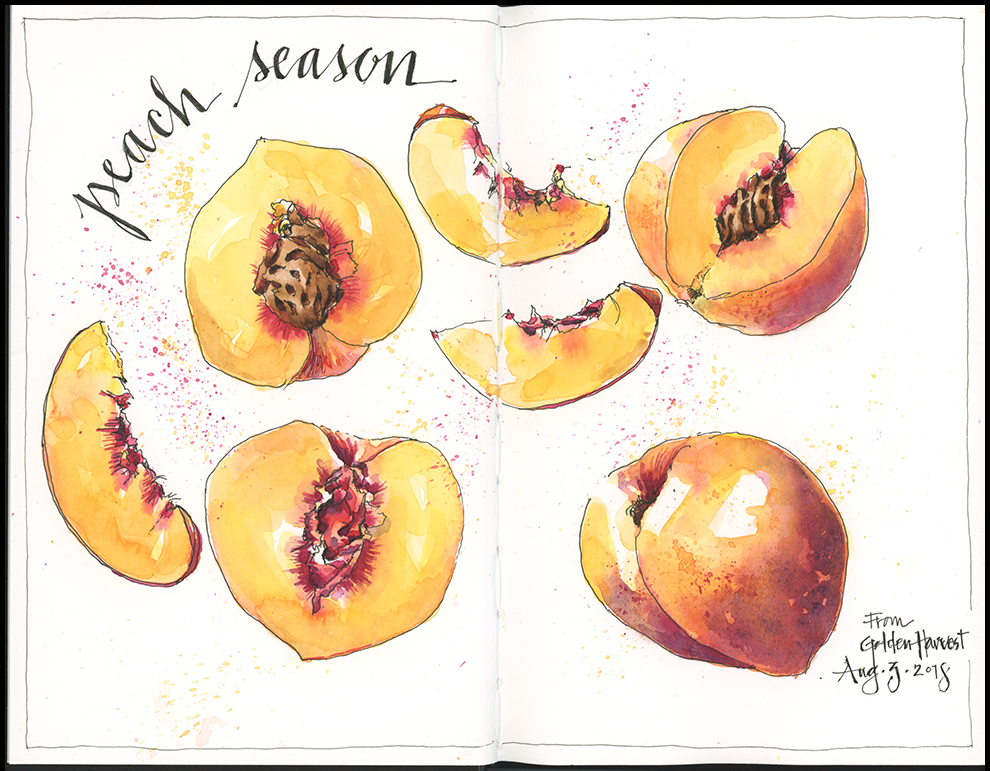
Tips and Techniques: First, I made it clear to my family, “Don’t eat the peaches until I paint them.” The previous three farmstand purchases disappeared before I had a chance at them. I started this as a simple ink sketch, and then painted multiple layers of Hansa yellow medium with quin rose, mixed with ultramarine blue for the darker skin. It’s important to let each layer dry thoroughly before adding the next. Building up layers allows the lighter tones to shine through, creating a more luminous effect than if you tried to get the color “right” in one go. I finished the page with a few details, spatter, and text (click the image to view larger).
The large and small of it
Big skies, sweeping vistas, far horizons. So much to see, too much to record. As an artist accustomed to rendering the details of small things—birds, butterflies, plants and such—I struggle when it comes to simplifying and capturing large landscapes or streetscapes in watercolor. So, I’m experimenting. My idea is to try working small on the premise that it will not allow me the space to get lost in detail. My goal is to get good in advance of an upcoming trip to Ireland, where I’ll have fantastic scenery and limited painting time. Here are my initial attempts, a few from the salt marshes of Westport, Massachusetts and two from Harbor Island and Franklin Light, Maine. (Click to view larger.)
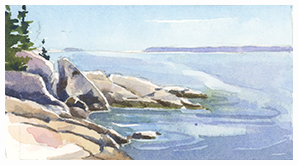


Granite Cliffs, Harbor Island: 4″ x 2.5″, Franklin Light: 5″ x 2″, Egret: 4″ x 2.5″; Salt Marsh and Osprey Nest: 2.5″ x 1.25
Tips & Techniques– You tell me! What works for you in translating complex landscapes to paper? How do you decide what’s important and what to leave out? How do you scale from small to large without getting too fussy?
Woven
I was invited to spend a recent Saturday basket making with a group of women from my old home town. What a treat! Good company, summery refreshments, and a lovely day outdoors dedicated to creative pursuits. Basket making takes patience, I discovered, both in the weaving and in waiting for reeds to soak until they are pliable enough to work. I was glad I brought my sketchbook to fill the soaking time. I came away with a finished basket and a sketch in progress, which I completed at home.
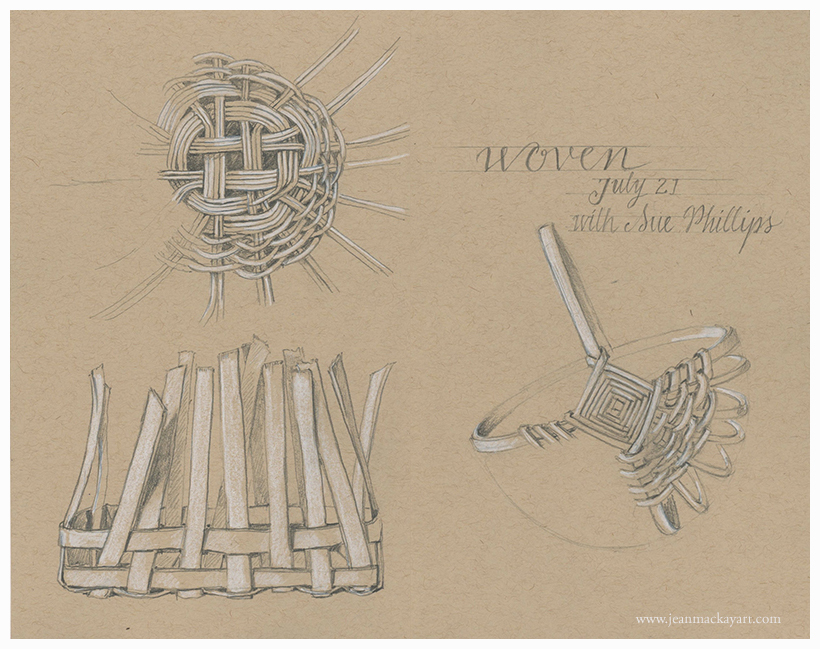
Tips and Techniques: Toned tan paper proved perfect for this detailed sketch of a monochromatic subject. I used two pencils: F and 2B and a white Caran d’Ache non-water soluble pencil on Strathmore, 400 series, 80lb. paper. The precision of the weave led me to precision in the drawing and the text, but I didn’t feel it necessary to complete each basket. I like seeing the ribs and the work in progress. No need to make the entire basket twice.

Essentials
Imagine a week on an island off the coast of Maine. No cars, no stores, no streetlights…just good company, good food, starry skies, blue horizons, and long days spent almost entirely outside. These are the essentials for Arts and Birding, a week-long program I facilitate each year at the Hog Island Audubon Camp. Because I’m teaching, I don’t have time to complete much artwork of my own, but I did manage a few pages. And as always, I came away inspired to keep observing, sketching, and sharing my work with the wider world.


Notes: (Clockwise from top) It’s not all birds! We also explore and sketch coastal scenes, plants, and life in the watery realm between high and low tide; Hog Island has a great collection of bird specimens, including a drawer of bird eggs; Young osprey nesting on the island are banded by wildlife biologists each year. It makes for fast sketching, but it’s a thrill to see these birds up close; Just the essentials for a week of Arts and Birding.
Arts and Birding is open for both sketchers/painters and photographers. Here’s a few photos from the week taken by photography staff and participants.
Registration for Arts and Birding 2019 opens in October; the session often fills quickly. Stay tuned here.
The world along the roadside
Were it not for relentless deer flies and record-breaking heat, it might not have taken me four days to complete this page. But it is hard to sketch on the roadside under such circumstances, no matter how determined, and so, one flower at a time, the page grew. Still, sometimes it’s good not to rush a painting. It lets things evolve; insights emerge. What started as a simple painting of flowers grew into a recognition of how much of the world is at our very doorstep.
I am reminded of one of my favorite quotes from the naturalist John Burroughs (1837-1921): “The most precious things in life are near at hand, without money and without price. Each of you has the whole wealth of the universe at your very door. All that I ever had, and still have, may be yours by stretching forth your hand and taking it.”
Note: I will be taking a break from posting for the next week or two as I head to Maine to facilitate and teach the Arts & Birding workshop at the Hog Island Audubon Camp. It’s a fully immersive experience for me, and life on an island is better without phones, computers or social media.
Firefly Nights
Oh, the warm nights of late June and early July, when the spectacular light show of fireflies flashes through the fields! Not just one or two, but hundreds of luminescent beetles signaling to each other in the gathering dark. I caught a single firefly that made its way into the kitchen the other night and watched it flash its bioluminescent message for several hours. But how to capture it on paper? That artistic dilemma led me to throw out my usual arsenal of watercolor techniques and try something completely different. Patterns, color, and abstract firefly fun.
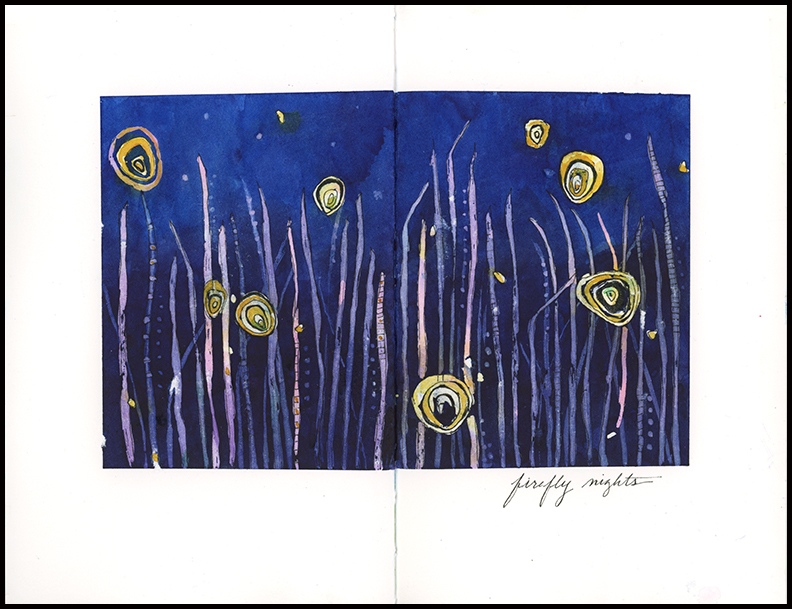
Tips and Techniques: I created this piece with masking fluid and a series of watercolor washes. First, I taped the area around the piece with blue painter’s tape to keep it contained, and sketched out the fireflies and grasses with a black Micron pen. After a wet wash of yellows and magenta, I masked the fireflies. Then began a slow process of layering darker washes, letting them dry, masking grasses, waiting for the mask to dry, and repeating. I probably did about six layers. Once I was satisfied that the blues were dark enough, I removed all the masking fluid and tape to reveal the finished piece. If I were to do it over (and I might), I would mask more yellow after the first wash for a bit more energetic glow.
Colors used: quin gold, aureolin yellow, quin magenta, dioxizine purple, phthalo blue, indrathrone blue, indigo.


 Drawn In