
Rare Treat
If I were to ask you to name the top five birds that you see most frequently and to make a list of birds that are your favorites, I suspect that only a few, if any, would make both lists. My favorites tend to be reserved for birds that are especially colorful (rose-breasted grosbeak), tuneful (wood thrush, winter wren), beautiful (American avocet), or that I see infrequently because they are associated with unique places or habitats. This weekend, I had the opportunity to enjoy two birds in that last category during a trip to the Massachusetts coast.
Bobolinks and least terns are rare treats not only because I see them only about once a year, but because populations of both have been in a free fall for the last 50 years. The number of least terns in North America has declined by 88% since the 1960s; bobolinks declined by 66% over the same period. For both, the loss of breeding habitat is the main culprit. Least terns nest on sandy beaches where they compete with beachgoers and encroaching development; bobolinks need large grasslands and undisturbed fields, which are also ripe for housing developments or where mowing takes place before young leave the nest. I was fortunate to see both least terns and bobolinks thanks to the work of conservation agencies and organizations who are working to protect nesting grounds and stem the downward spiral.
More rare treats ahead: I’m heading to the Maine Coast at the end of this week to begin my annual trip to the Hog Island Audubon Camp. There, I’ll teach Arts & Birding and see Atlantic puffins, which have been brought back from local extinction by the work of conservation biologists stationed at Hog Island. I plan to immerse myself fully in the program and the place, so you may not see another post for a few weeks. I promise to make up for it upon my return.
When Peonies Bloom
When peonies bloom, rain nearly always follows. And so it was that I lost my subject. Still, I am pleased to have June’s most elegant flower in the pages of my sketchbook, a few cut flowers on my table, and pink and white petals littering the garden.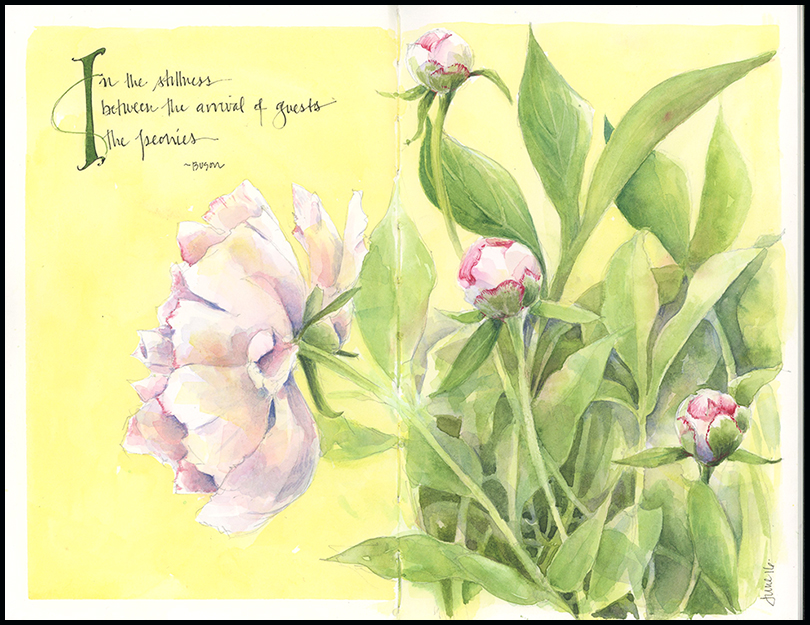
Tips and Techniques-
What you don’t see on this page are all the test sheets of greens that I’ve been working on this week: blue and yellow combinations, “convenience” green combinations (sap green, phthalo green, green gold), greens with browns, and greens with reds. I’m looking for highly transparent mixes that offer a good range of light to dark values. The trick is that when I’m working on a negative painting like this, I want to let some of the colors mix right on the page—and some greens are just too garish for that. What I (mostly) ended up with here is phthalo blue, nickel azo yellow, and a touch of quin magenta. If you struggle with greens, I highly recommend doing color tests of your own. You’ll quickly discover lots of combinations that don’t work and many that do. And you’ll gain confidence in your colors that will serve you well in your future paintings.
If you have go-to green combinations that you especially like, leave a comment so we can learn from each other!
Along the Roadside in June
Last year I made several sketching forays out along the country road where I live. I’m curious to discover what’s in bloom and find that almost nothing is native to the Northeastern U.S. Still, I have to give these invaders credit. They have traveled across continents and persisted in harsh conditions, yet still offer beauty and color where few other species would survive.
Tips and Techniques– When I head out along the road, I typically bring only my sketchbook and a pen. There isn’t much traffic, but what comes along is moving fast, so I have to be ready to move quickly. I walk along until I find something in bloom, sketch it, and move on to find the next roadside flower, filling the page as I go. I make mental notes about color and sometimes snap a photo for reference as well. When I come home to paint, I’m not just coloring in spaces, I’m also thinking about the mood and feeling of the day. This walk was sunny and warm; hence the overlay of yellow to tie everything together.
The Trials of Painting Outdoors
Leave behind the comfort of your home art space—whether kitchen table, corner desk, or complete studio— and you’ll soon find an immediacy and sense of discovery that come from working directly from nature. Granted, you’ll be trading comfortable seating, fixed light, and a full suite of art supplies for less certain conditions. But you’ll be able to observe details, see colors, and experience your subjects firsthand in ways that will make your artwork more vibrant and alive.

At least, that’s the ideal. This week, however, painting outdoors brought significant trials: bright sun dried my paint too fast in the garden and the most annoying and insidious bugs attacked me one evening while painting irises. Was it worth it? Of course. But I’ll forever look at these irises and see myself swatting bugs in vain with a paint brush.

Tips and Techniques- Try different approaches to painting. Here, I’ve used my go-to ink sketch followed by watercolor for In the Garden and then painted directly with watercolor with no initial sketch for the irises. The bugs forced me to work quickly and let the paint run freely, which led to some nice mixing on the paper. You can see that my session with the irises was cut short. This could use a bit more definition, but I wanted leave it alone and perhaps start over, without the bugs.
In the Woods
I headed into the woods last weekend to find mayapples in bloom. The flowers are hidden underneath large leaves, so sketching them required squatting at ground level. Within a few minutes, my knees sent me packing, which is, in part, why I only filled half the page with mayapples. I also wanted the white space as a place to rest the eyes and contemplate this thought on painting:
In painting, as in any art, persistent practice is not working on the object or the image or the performance alone, but rather, working on yourself, which is the constant behind all the “product” of your art. (From Learning to Look Carefully; the Art of John Morra by Ned Depew.)

Tips and Techniques– I painted this using negative painting techniques, and in trying to get deep darks to bring out the white flowers, I lost much of the light and transparency that I like to have in a painting. I would have preferred to convey a more dappled light, like that in the woods where mayapples grow. One way to avoid this is to select just a few colors — 3 or 4 — to work with for the entire painting. I started with just three, but they were too light to give me deep darks when mixed at full strength. So, I experimented with adding some dark staining colors, which gave me good darks, but began to muddy the page when added on top of the previous washes. In the process, however, I discovered why many artists have Phthalo Green (PG7) on their palette. It’s garish on its own, but when mixed with Transparent Pyrrole Orange (PO71) (and other reds) it produces a range of very nice dark greens. I plan to add these to my palette and continue seeing how they perform.
The Inside Scoop
Monitoring birdhouses gives you a rare glimpse into the often hidden world of nesting birds. It allows an up-close look at nest materials, delicate eggs, and birds at work. I have just two boxes on my property; bluebirds occupy one and tree swallows have taken up the other. In the week ahead, the bluebird eggs will hatch and, hopefully, the swallows will begin laying eggs; and I will have a chance to watch it all unfold.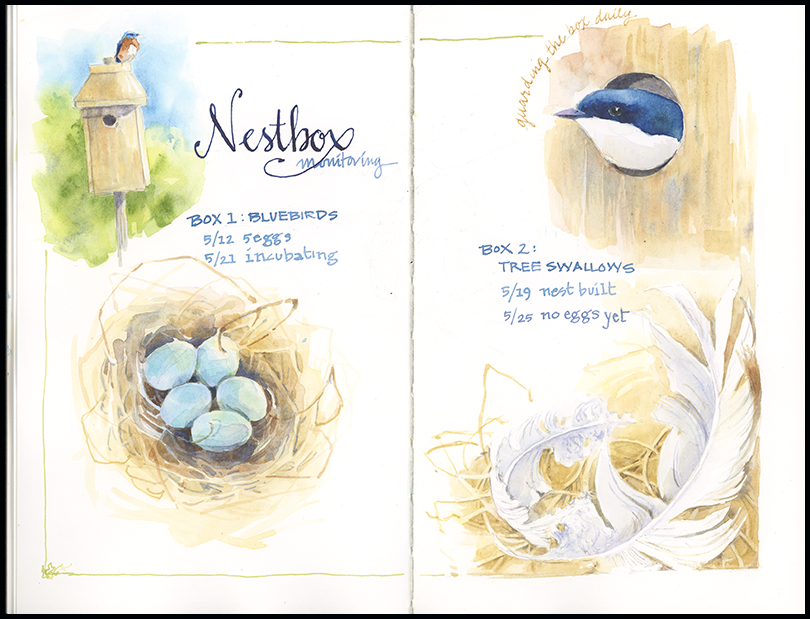
Tips and Techniques– I experimented this week with using watercolor loaded into a dip pen to write the text. Watercolor doesn’t perform as well as ink, but it certainly works, and it opens up a whole host of color options. If you want to try it, use a brush to create a pool of the color you want and then brush the watercolor onto the nib. You’ll have to reload frequently. Try starting with one color and then altering it with another to create color variation in the letters.
Find information on Nest Box Monitoring at NestWatch.
Fast and Fleeting
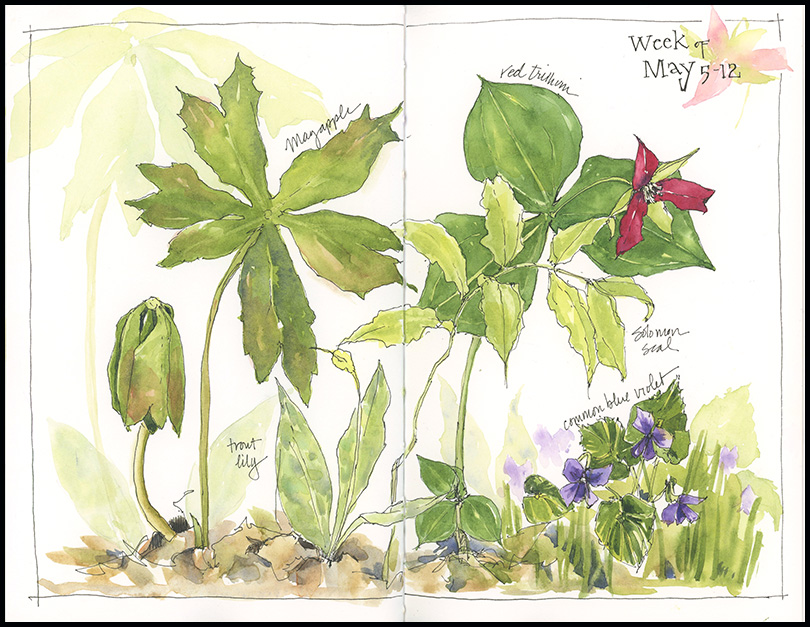
The glory days of springtime come fast and fleeting. Miss the trillium, and you have to wait a whole year to see it again. Migrating birds come, feed, and leave again while we sleep or work or are otherwise distracted. There never seems to be enough time in my spring; no way to capture it all before the symphony of greens gives way to summer. Still, I’ve managed some quick sketches in the woods and I was fortunate to be home when a pair of rose-breasted grosbeaks showed up at the feeder.

Green Giant
It’s good to see this old sugar maple in our front yard wearing a mantle of greenery again. Moss covered and with new leaves unfolding, it’s tangled mass of old limbs drew me in. After an hour or so, the black flies drove me away.
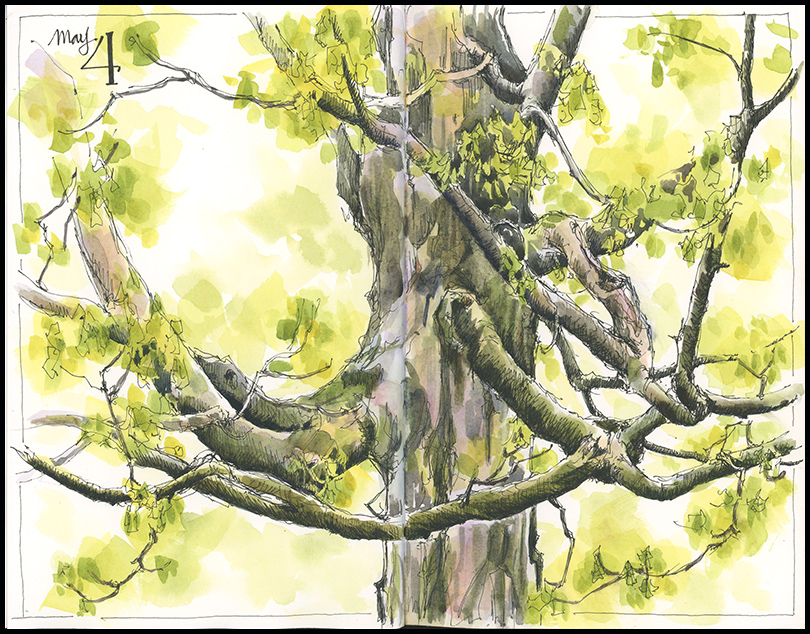
Tips and Techniques– I started this as an ink drawing and worked until it was quite detailed. I could have, and maybe should have, left it there, with just a light wash of bright green for the leaves. I had that “fork in the road” feeling—not sure whether to add more color or let it be. Sometimes I walk away at that point, coming back later with greater clarity of direction. Sometimes I leap, follow a hunch, take the risk, and hope for the best. What do you do when you reach that fork in the road with a painting?
Believer in Ferns
Come back
believer in shade
believer in silence and elegance
believer in ferns
believer in patience
believer in the rain
— W.S. Merwin (Empty Water)
How good to be out in the greening woods, despite the occasional rain and still cold spring day. Good to see ferns unfurling and mayapples reaching up out of last year’s leaves and a single ruby red trillium.
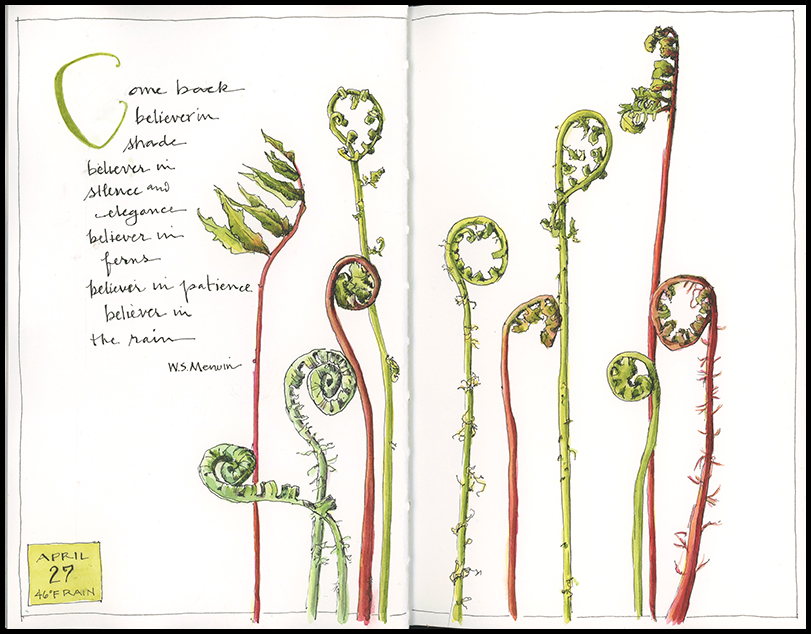
Tips and Techniques– My simple tip this week is to let observation and delight drive your sketching. Go out with no agenda and see what strikes you. I was drawn in by the variety of fiddleheads when I started looking more closely at them unfurling in the woods – some hairy, some smooth, some reddish-brown, others bright yellow-green. Had I gone out with a pre-planned idea of what I wanted to paint, I might never have seen them.
Small Signs of Spring
When art takes a backseat to the rest of my life, I find it helpful to use a grid. Setting up a framework of small squares in my journal allows me the flexibility to fill them as time allows over a period of days or weeks. I started this grid in March, knowing that a hectic schedule lay ahead. This grid started with a set of six squares per page but, as you can see, the squares can be combined vertically or horizontally to fit the subject at hand. I especially like how a grid page can capture so much of a day, week, or month in just a few small spaces.
Tips and Techniques: Set up a grid in pencil with evenly spaced squares and an even amount of white space between them. You don’t have to plan what will go in them. When you have a subject you want to sketch, choose a box and add it. If your subject is quite vertical or horizontal, combine boxes to suit the shape. You can combine as many boxes as you want, or none at all. I tend to skip around the page, based on the shapes, and outline each box at the end.


 Drawn In