
Small Miracles
This painting is a gift: a symbol of new life and the cradle that embraces its fragile loveliness. I painted it for my cousin to give to her daughter, who has two daughters of her own. One was born this summer, nearly four months early. Yet by the grace of many small miracles and the amazing skill of neonatal care, she recently went home, beautiful and healthy. Two blue eggs, so much to be grateful for.
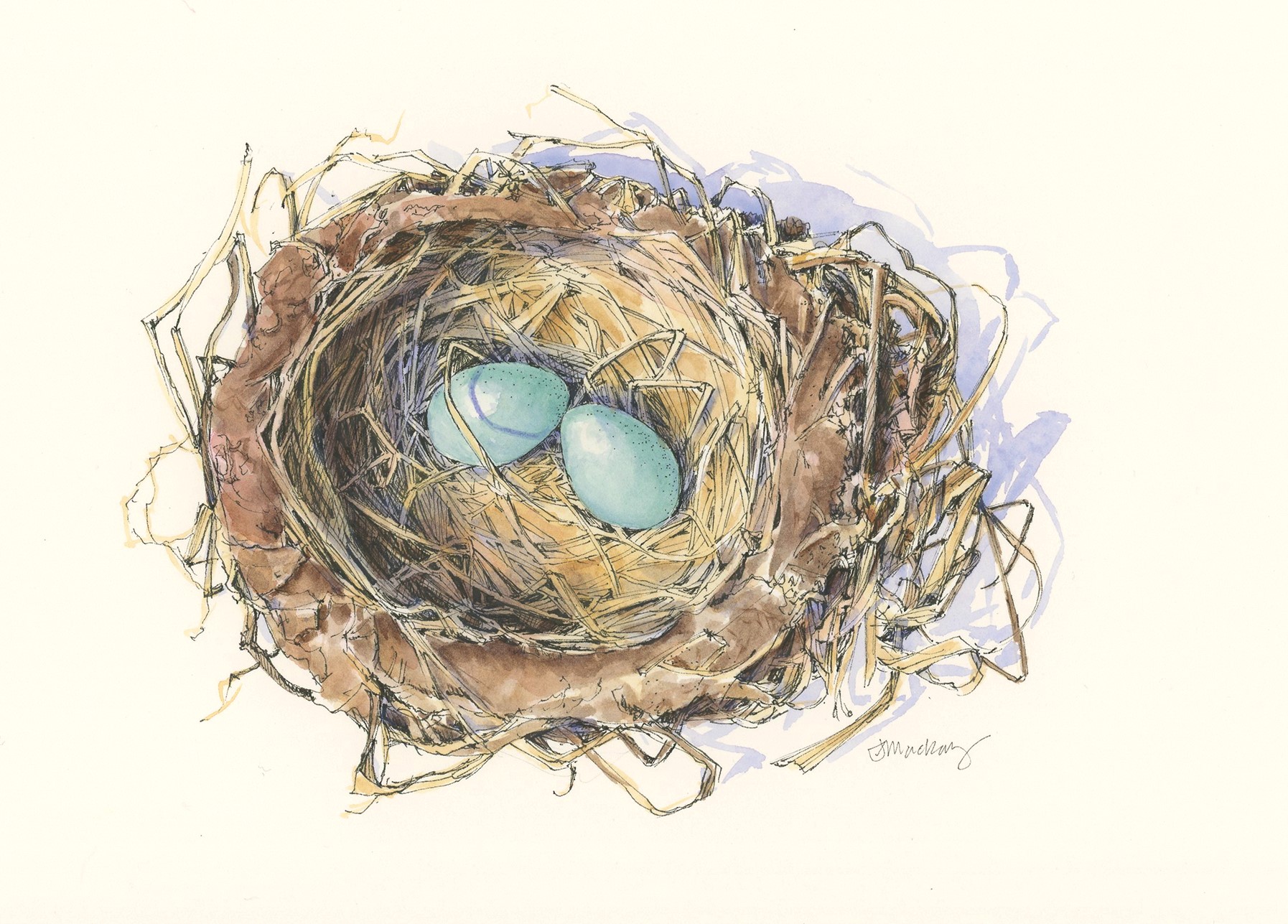
Tips and Techniques– I loved doing the shadows in this piece and, in fact, they are critical to getting any nest to look dimensional. The cast shadows are cobalt blue and Winsor violet with plenty of water, painted in one go with loose brushstrokes. It’s worth practicing shadows, as it will help you to learn how much water you need and will build your confidence in making marks without fuss.
Out of Season
Usually, I would bring you beach finds in summer, when freshly found and still holding a hint of sea and salt air. But here they are in November, a collection of small treasures that I pulled out for my latest Drawn to Nature class. I used them to illustrate ways to record discoveries and layout sketchbook pages when out exploring. Like a puzzle whose picture is revealed only when complete, these types of pages are built piece by piece and end up capturing a particular place or moment in time. So, though out of season, I hope this brings you a sense of wonder for the sea and for the otherworldly creatures that live in its watery depths.

Tips and Techniques– Unlike a precise natural history illustration, this type of page often requires you to sketch quickly, especially if you are working with time constraints, challenging conditions, or objects that you can’t collect. Practice doing small sketches where you try to capture what you are looking at in two to five minutes. Draw the basic shape and some of the darker values. You will soon find a flow as your eyes begin to really see and your pen or pencil meets the paper. This practice will prepare you for working in all kinds of settings and conditions and add a freshness to your work that you simply can’t get when working from photos.
Daily Bread
There is meditation in making bread. The coming together of simple elements, transformed by hands and patience into something sublime. In this season of slowing down and coming indoors, it’s time to appreciate the subtle aroma of yeast; it’s time for kneading dough into a smooth, glossy form; it’s time for breaking bread. Coming indoors also seemed like a good time for me to try something new and stretch my skills. You can read more about that below, or just indulge me in a new subject and way of painting this week.

Tips and Techniques– Instead of using transparent watercolors, I painted this piece with opaque watercolors known as gouache. Like traditional watercolors, gouache is mixed with water, but it differs substantially because it can be worked loose and wet or thick and heavy, more like acrylics or oils. Getting the right consistency takes practice.
Another difference is that gouache is painted dark to light, which bent my usual way of thinking and working. So did using white and black—colors I typically avoid– to tone colors lighter or darker. Still, gouache seems more solid and painterly to me; and that’s what I wanted here. There is a lot of subtle shading to this piece, which made it both challenging and satisfying. Where does white shift to pale gray to deep shadow to create folds in the towel? How does light create form and change the color of dough from tan to golden to tanish-gray? How does a tiny thread of white convey light on the rim of the bowl? Good challenges indeed for my week.
Grounded
After the grand display of autumn’s boldest colors, the leaves come down. One by one they fall, by day and night, in windswept flurries and slow-motion descents. I collect a sample of oak, maple, beech, hickory; trying to preserve the quickly fading splendor. But in the turning of the season, all is not lost. The Earth is grounded in beauty, change, quiet, and renewal…and so are we.
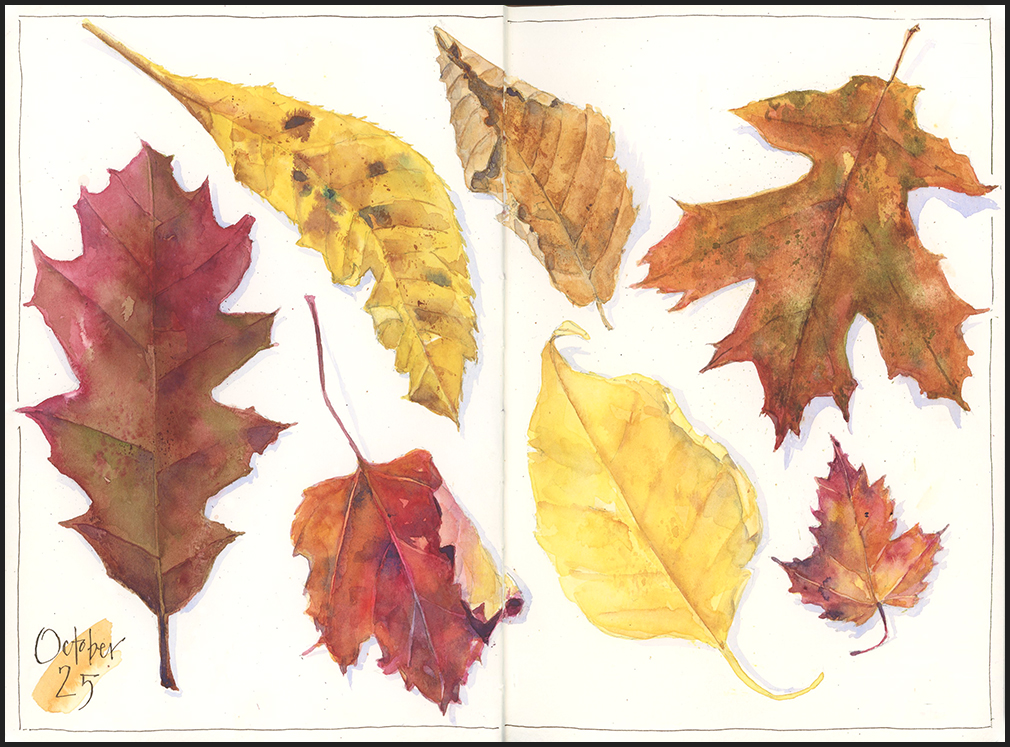
Tips and Techniques– I always think that painting leaves will be easier than it is. There must be a way to simply splash bold colors on the page, but I haven’t figured it out. Instead, I take the slow road: a pencil sketch, followed several layers of watercolor. I like starting with a wet-in-wet wash to let colors merge on the paper. Then I deepen the color and add details and shadows last. If you have not painted leaves before, you might start with just one or two. This will build your skill and confidence before tackling more.
Noticing
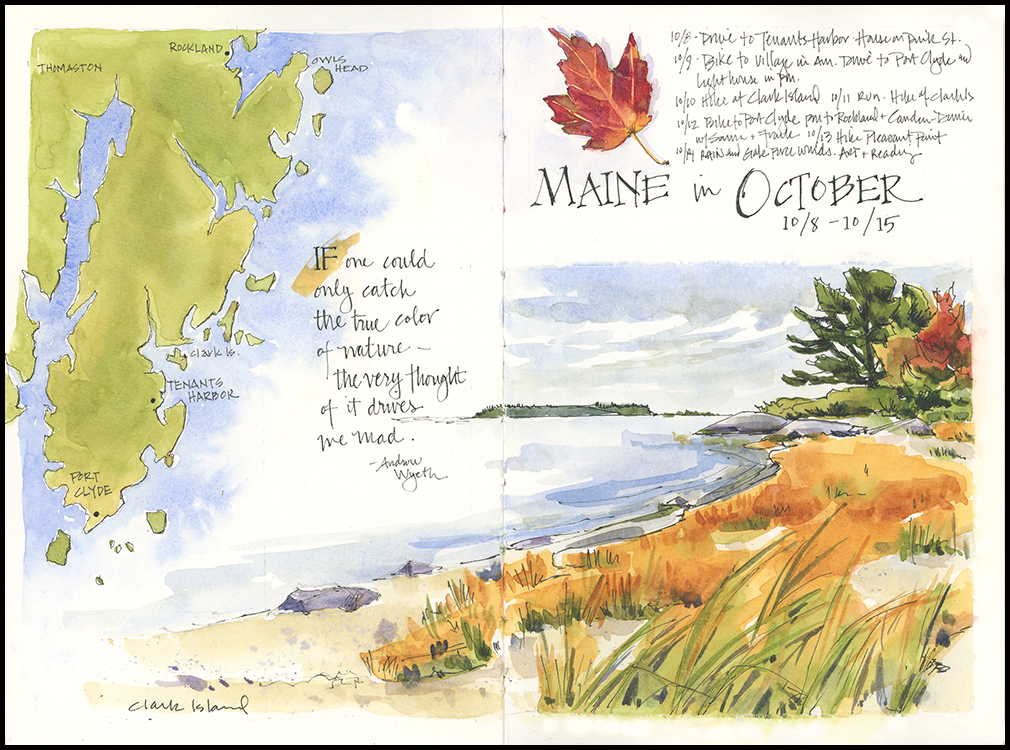
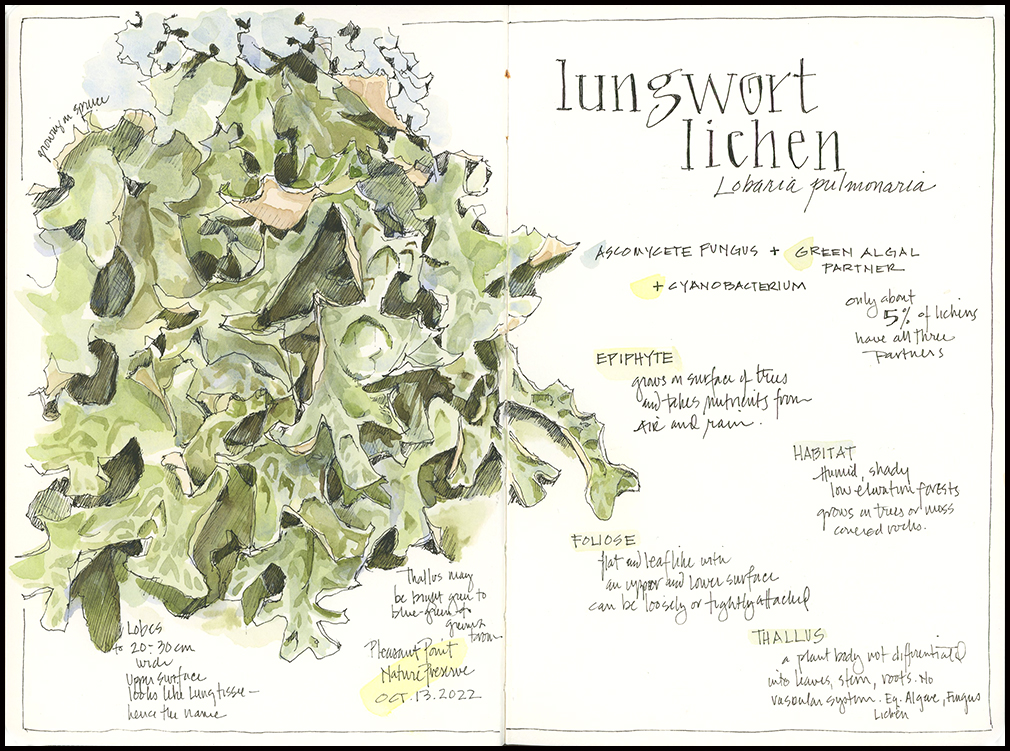
Sometimes, painting is about the obvious things: the beauty that’s right in front of you, bold colors, compelling light, big picture views. But more often for me, it’s about the things you might pass by: the subtle, the small, the imperfect. Learning to notice is more important than pencil, paper, or paint.
I had ample opportunities to sketch both bigger views and subtleties when in Maine recently. Which is more compelling to you?
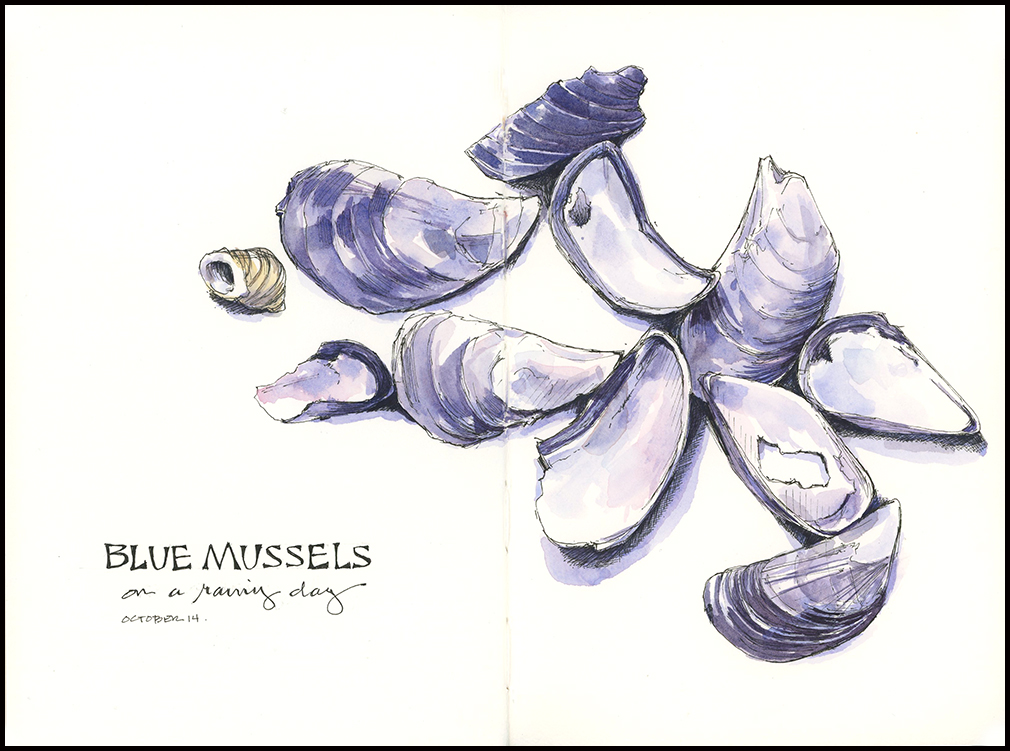
Blue Mussels on a Rainy Day
October in Maine: a gift. As lovely and as simple as blue mussels on a rainy day. As steady as the ocean lapping on shore, loons calling their lonesome cry from the expanse of blue. As surprising as a pair of kingfishers rattling in flight across a cove. As beautiful as flames of crimson and gold maples and burnt sienna salt marsh hay glowing in the sun. Today, I send you the mussels. More gifts to come.
Finally Fall
The season of brilliant reds, oranges, and yellows is upon us here in the Northeast. While the changing foliage of trees steals the show, those same colors echoed in roadsides and fields are just as lovely. I’d better get painting– the season’s peak doesn’t last long. Step out and enjoy the colorful show while you can.

Tips and Techniques– Don’t be intimidated by painting tiny flowers. They can be niggly, but keep in mind that you don’t have to draw every tiny shape and detail. Look at the overall structure of the plant and sketch enough detail to suggest it. Then paint the overall color loosely. You can go back in with a second wash to add a few details. The same is true for detailed leaves. You can sketch the main ones and then let your brush suggest the rest.
Not the Last Afterall
Whatever happened to posts about birds or flowers or trees? There will be more of those to come, I promise. But first, just a few more mushrooms which, as you will see, were worthy of paint. First, the pear-shaped puffball, whose smoky spores release when gently squeezed. And then the inconspicuous tannish-brown clitocybe. Who would have thought lavender gills would be hiding underneath that unassuming cap?
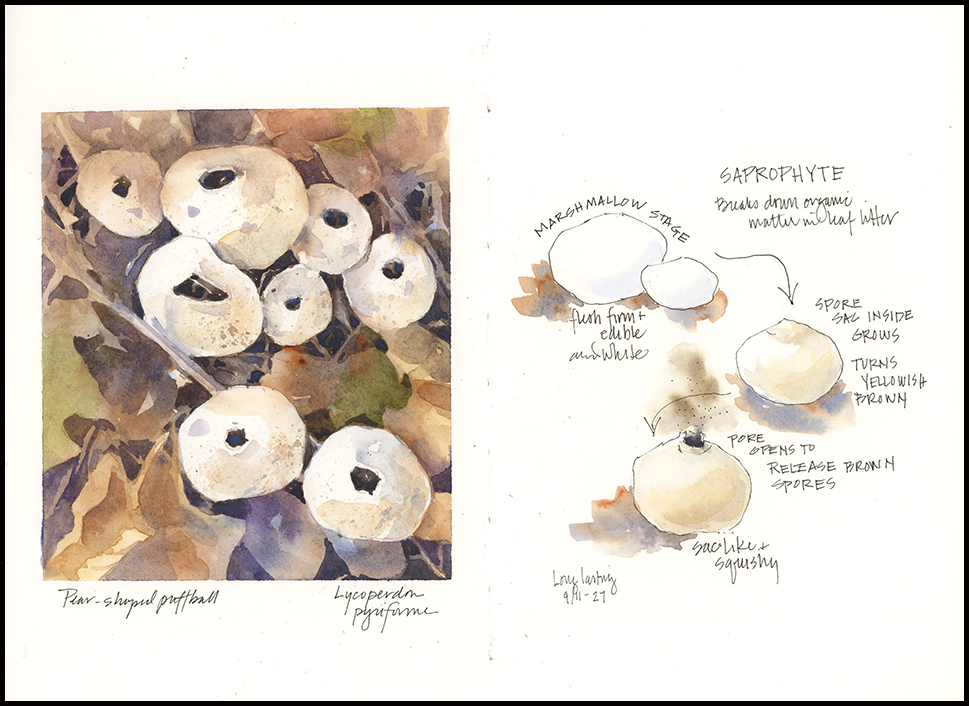
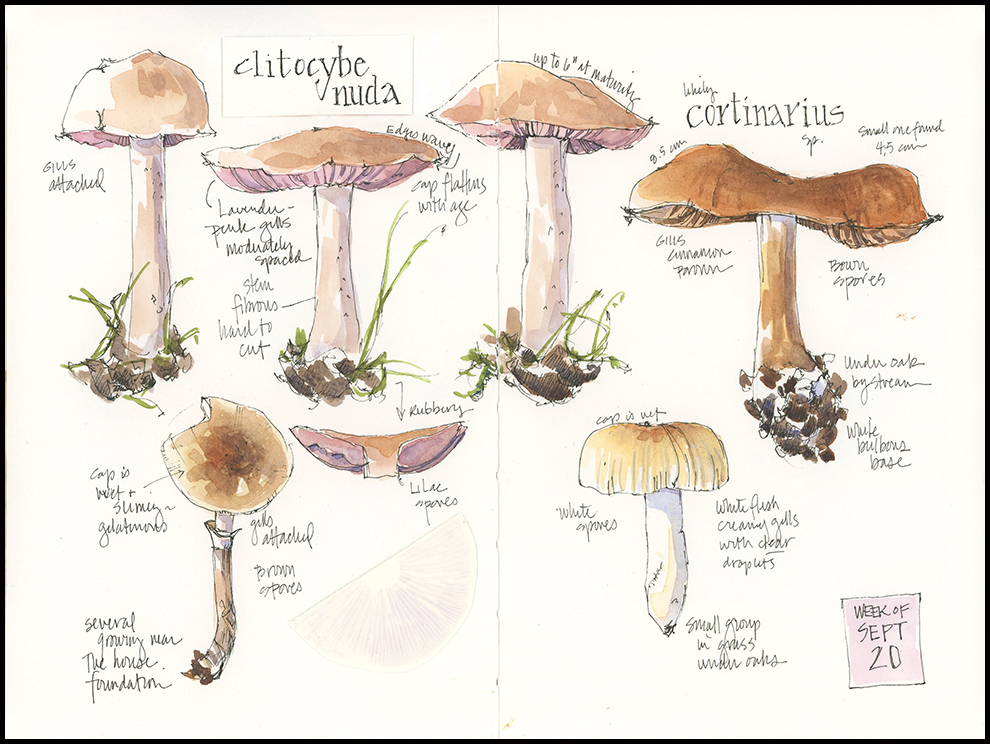
Tips and Techniques– Use your sketchbook to try a variety of artistic approaches. Part of what’s keeping me going on mushrooms week after week is not only the incredible variety, but also the challenge of finding new ways to paint them. The pale puffballs growing from leaf litter seemed perfectly suited to negative painting– a series of layers that move from loose to defined and light to dark. In contrast, the diagram on the right side of that page was simple and quick. The clitocybe and cortinarius page is my traditional pen and ink approach, which works well for fitting a lot of specimens on a page, noting key features, and trying to figure out what they are. I recently saw an artist who created a whole jumble of mushrooms on a page and I thought that would be fun…but maybe next year.
Coming up this week on 10/6: I’m looking forward to the second class in the DRAWN TO NATURE- SKETCHBOOK SERIES, Poetry of Nature at Winslow Art Center (via Zoom) 3-5PM Pacific Time, 6-8PM Eastern Time. REGISTER >
Until Next Year (maybe)
Okay. This is it! The last of the mushrooms for 2022. I don’t think I can paint any more, try to identify any more, read any more. I must clean my desk and turn a new page! But then, who knows, I haven’t gone outside yet today to see if anything new has come up.

Tips and Techniques– For this page, I thought it might be fun to try something different and just take a top down view of mushroom caps. This gave me a chance to look at patterns, texture, and composition, more than the previous pages of studying the whole mushroom.

Another way to capture an intriguing top down view is to make spore prints. Cut off the stem and place the cap on black paper (or white paper for dark spore mushrooms). The spores drop out, leaving a print. I used spray fixative to set and preserve the print.
Mushroom Time
After 48 hours of rain earlier this week: BOOM, it’s mushroom time. I’ve been cataloging mushrooms in our yard for several years (2018, 2020, 2021, 2021) and I am constantly amazed by the number and variety that appear. Most come up under a small grove of oaks along our driveway, but a few show up in the lawn, or in piles of mulch.
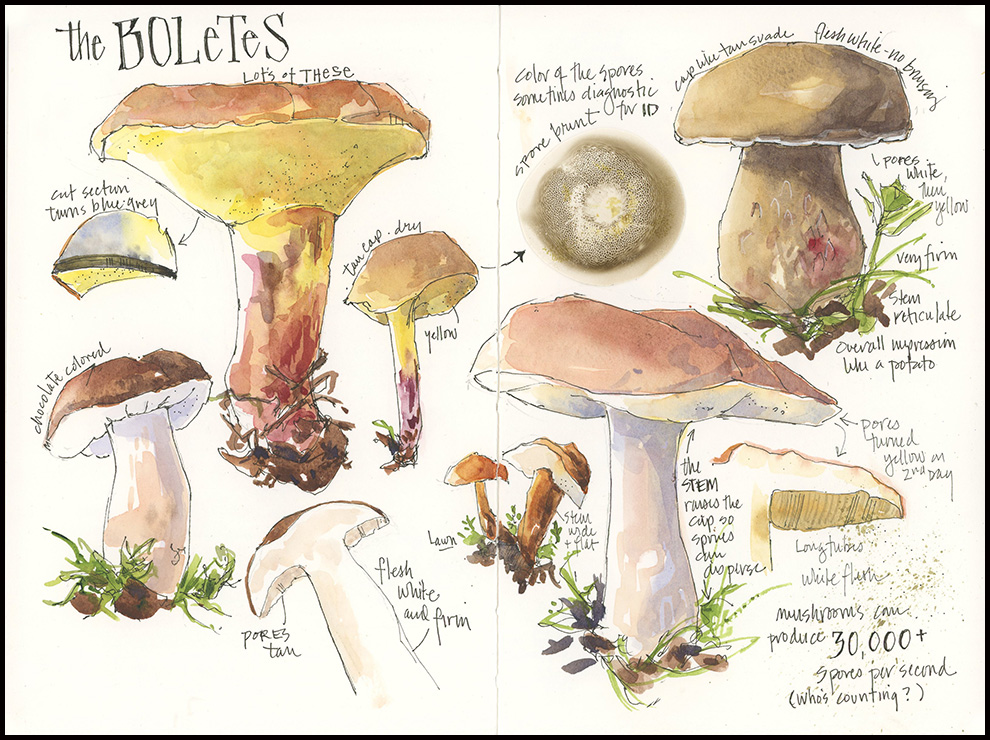
Mushrooms are the fruiting body of a much larger network of underground thread-like filaments called mycelium. This network is either breaking down and recycling dead stuff, feeding on weakened organisms, or contributing to growth of plants in exchange for carbon. Nearly 90 percent of all plants have a symbiotic fungal root partner!
Identifying mushrooms is a bear. There are several thousand species in northeastern North America, with lots of look-alikes. Sometimes it takes a microscope to make a positive ID. So mostly, I just paint them and take notes.
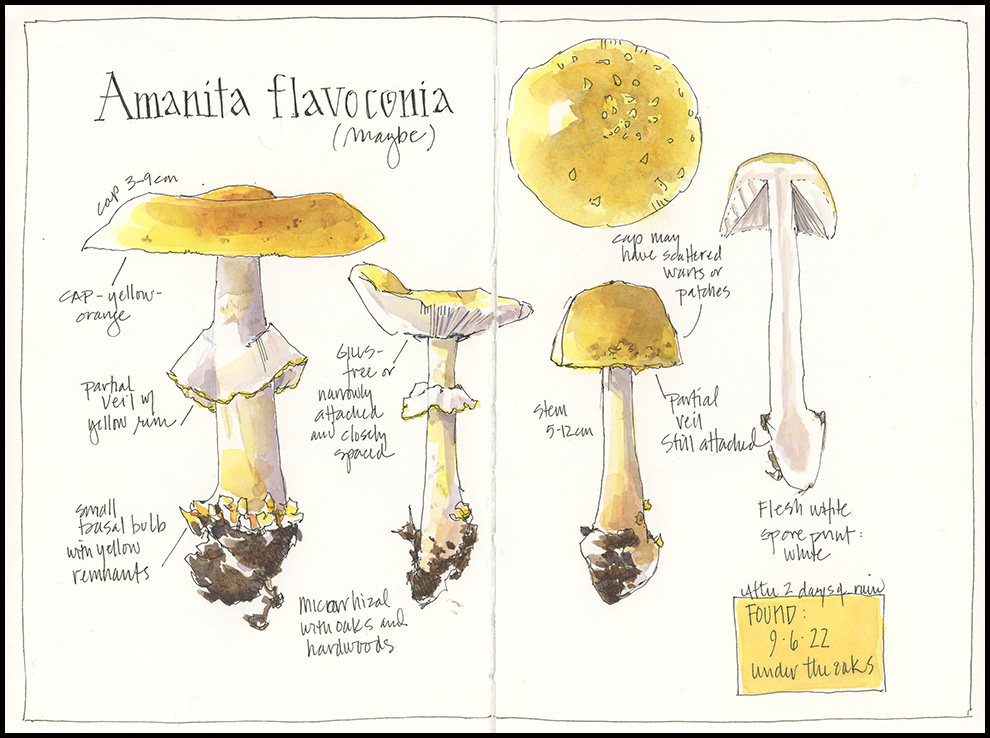
My desk is a wreck. There are trays of mushrooms both whole and cut open, spore prints, magnifiers, rulers, field guides, paints, and brushes. But now that I’ve started, I can’t stop. And there are more coming up every day, with more rain in the forecast. Look around where you live and a take a closer look at the mushrooms that come up there. See how many different ones you can find. But beware: you may soon get hooked too!


Coming up! I’ve got both online and in person workshops this month…check the workshops page for details.


