Otherworldly Stars
I’m back in the basement collection of the Scripps Institution of Oceanography’s Benthic Invertebrate Collection this week. Not literally, alas, but channeling row upon row of jars filled with bottom-dwelling spineless creatures from the world’s oceans and drawing upon photos from my visit earlier this year. I’m not striving to bring these brittle stars and sea stars back to life on the page, but rather to highlight their beauty and understand their complexity. Even though they have been “living” in jars for fifty years or more, I like thinking about how they once dwelled in the ocean, and I am glad they will live on for many years to come for researchers, students, and artists.
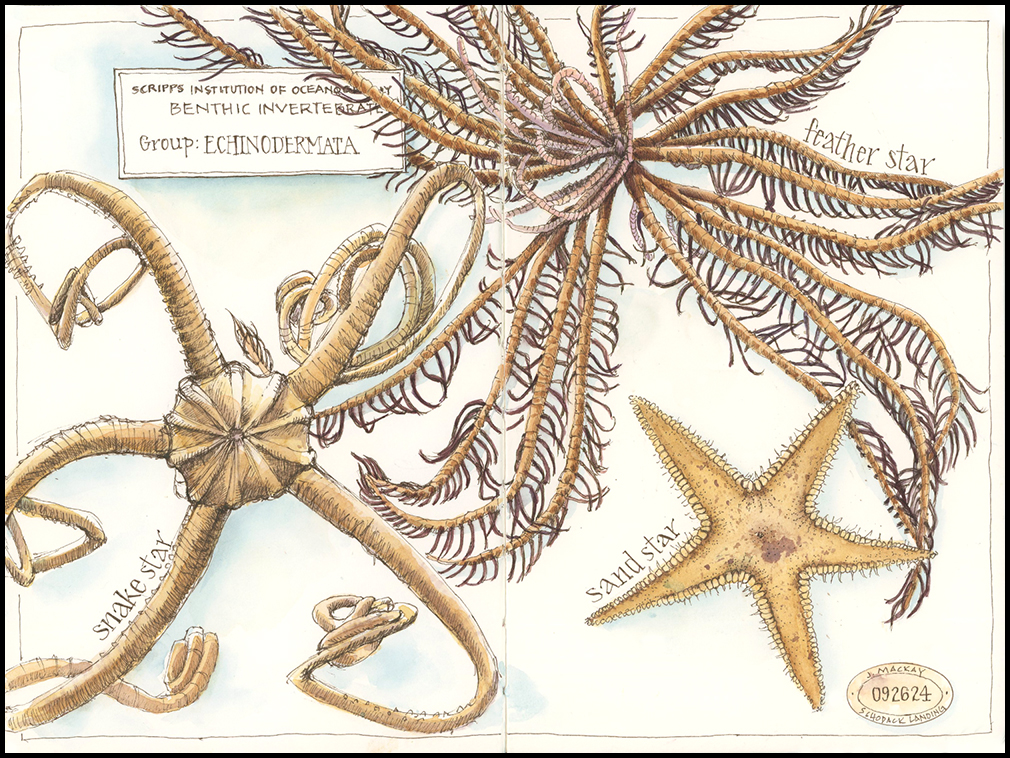
Tips and Techniques– Don’t overlook the dead stuff! Drawing specimens is a great way to study living species, to understand underlying anatomy, and to draw creatures that are not moving. Most museums will allow you to sketch in pencil or pen, nature centers may have kits you can take home, and university collections are sometimes available to artists. If you want to join me and get in on the action, check out Collecting Nature, Exploring Museum Collections.
 Drawn In
Once again another lovely page Jean. These creatures seem to be just dancing across the page. Your use of sepia adds a delicacy to these species. I’ll be registering for your Oct. 8 class. Unfortunately, I missed the registration for the Sep. 24 class but hope I can register for a recording at the same time. Sent an e-mail to Martha this morning.
Pat- It will be great to have you join in on Oct. 8. As you know, nests are always a favorite subject!
You’ve brought museum and institute collections to our attention many times – it’s one of your themes, if I can say that. It’s good to remember that live subject matter isn’t the only possibility. Here they are, in unnatural circumstances, spread out attractively with every little bump and cilium (?) revealed. Even the colors have a preserved look, like an old sepia photograph. They look very proud of themselves, these Echinoderms, having lived so long. 🙂
Thanks, yes, I like museum collections. They are particularly useful for subjects that are hard to find or study in the field. I like the way these creatures can live on and on in new ways.
🙂
Coming back to this work of art many times over the past few weeks, I’m overwhelmed with your ability to achieve a gre
Beautiful images and a great recommendation!!