Diving into Seaweed
How often have you walked along the seashore or a rocky beach and not given a second glance at one of the most important players in the ocean: seaweed. Seaweed, or marine algae, live in the marginal world between the tides and in deeper waters where sunlight still penetrates. Arguably, they are the key to life for the world’s oceans and the larger species that we notice and care about. But as an artist, the variety, color, and beauty of algae are just as fascinating.
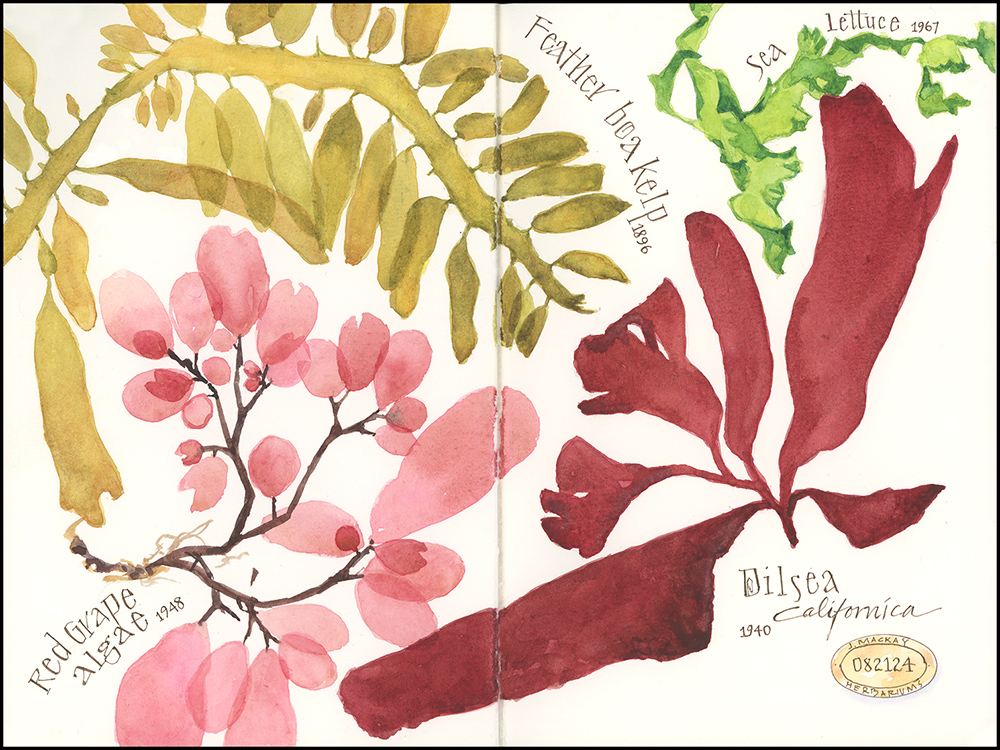
Seaweeds are identified and grouped by the color of their reproductive spores: green, red/pink, and brown. The color of their fronds varies widely but derives from just a few pigments in their cells. Green algae have green pigments only. Brown algae can range in color from golden to olive to dark brown with just two pigments, green and brown. Red algae have red and blue pigments, as well as green, which gives this group an incredible color range from pink to maroon to purple.
The algae on this page come from herbarium collections. The oldest dates to the 1890s, a time when algae pressing was not only done for scientific study, but also as a popular artistic pursuit.
If you would like to take a deeper dive and paint algae with me this fall, check out my new online class series Collecting Nature in Ink and Watercolor starting Tuesday, 9/24 at Winslow Art Center. The series also includes sea stars, butterflies, and nests. Visit the Workshops page for additional fall classes.
 Drawn In
Fascinating collection! It’s so interesting to see the names matching the various shapes of seaweed — grape, feather, lettuce! I’m curious if the herbarium specimens retained their oiginal color, or were they faded a little? Thanks for sharing!
Sorry to be so long before responding. The herbarium specimens do loose some of their color– especially the greens– so it helped me to have poked around in tidepools so that I am familiar with the color range of the major groups of seaweeds.
That is just lovely Jean. The transparency is beautiful, it really gives a sense of the delicacy and underwaterness of the seaweed. The forms are quite abstract, and you have linked them together to make a very satisfying composition!
Thanks Anna! I really enjoyed doing this page and I look forward to doing more in my upcoming class. There is so much variety of shape, color, and form in seaweeds. Watercolor for watery subjects always seems like a good fit.
Hi Jean,
Are you familiar with Ellen Hutchins in Ireland? Such an interesting life!
http://www.ellenhutchins.com
Thank you for your inspiring posts!
Starr DiCiurcio
Thanks Starr- I was not familiar with Ellen Hutchins so thanks so much for sharing this link. I love having historical background, especially on enterprising women naturalists/artists.
I love it, Jean. Watercolor, at least in your hands, seems to show off the translucent quality of algae beautifully. I wondered what the dates were until I read the text – cool! And I learned something; I didn’t know what the pigmentation colors are in the different groups, nor did I know the categories come from colors of reproductive spores. I do know that they are complicated when it comes to life cycle. What a splendid layout of shapes and colors!
You could spend a lifetime…and some people do…on seaweeds. I’m just skimming the surface, but I love the colors and varieties and “dipping my toes” into the vastness of the ocean realm.
Vastness is right! It’s another world….