Leap of Faith
With nesting season over and summer on the wane, birds have quietly started to leave us. Most go south, making incredible journeys across land and ocean. But others simply go out to sea, where they spend the winter riding the waves. The beloved Atlantic Puffin is one such seafarer. Along rugged coasts in the North Atlantic, young birds born just this year jump from islands and cliffs where they were reared and head out into the open ocean alone. Their parents do the same, spending the next eight months at sea. I love the thought of those young birds taking a leap of faith into unknown waters and living in that wild expanse of ocean in the months and years to come.

Tips & Techniques– This is the final painting in my Seabird Portrait series. The Atlantic Puffin joins the Northern Gannet, Common Tern, Black Guillemot, and Double-crested Cormorant. When doing a series, it’s helpful to carry some similar elements through each piece. It could be the text style, color palette, layout elements, or similar subject matter. As you can see, there are some variations here, but the series mostly hangs together. Have you ever done a series? What are your tips?


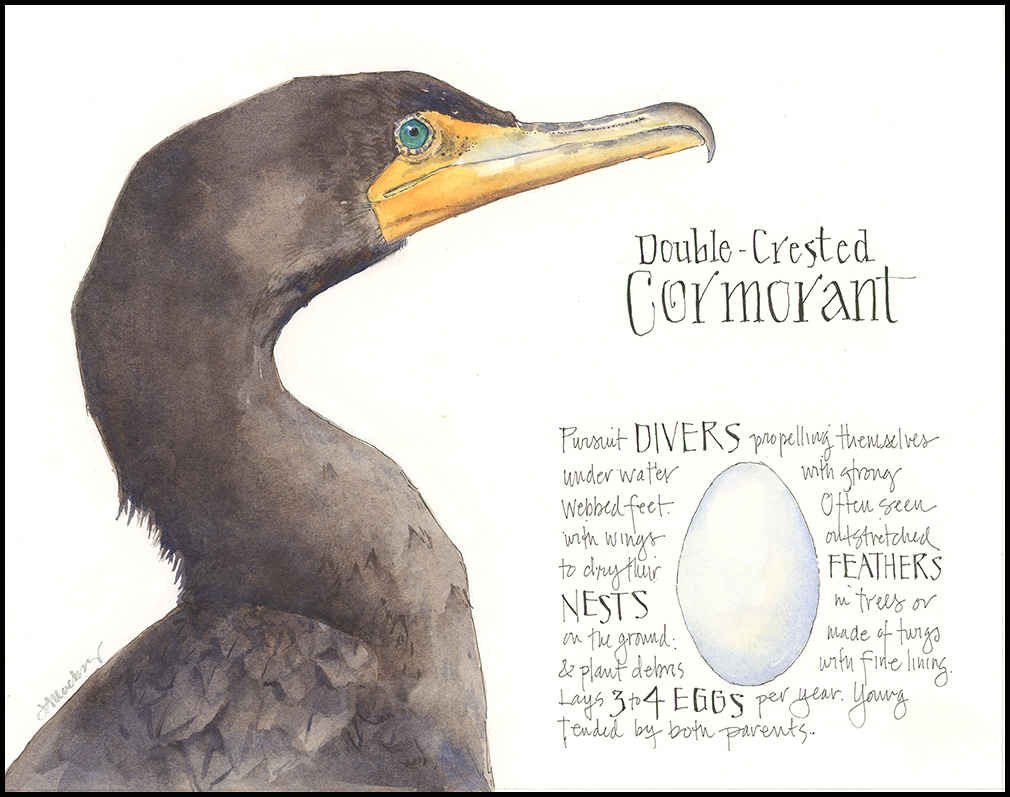
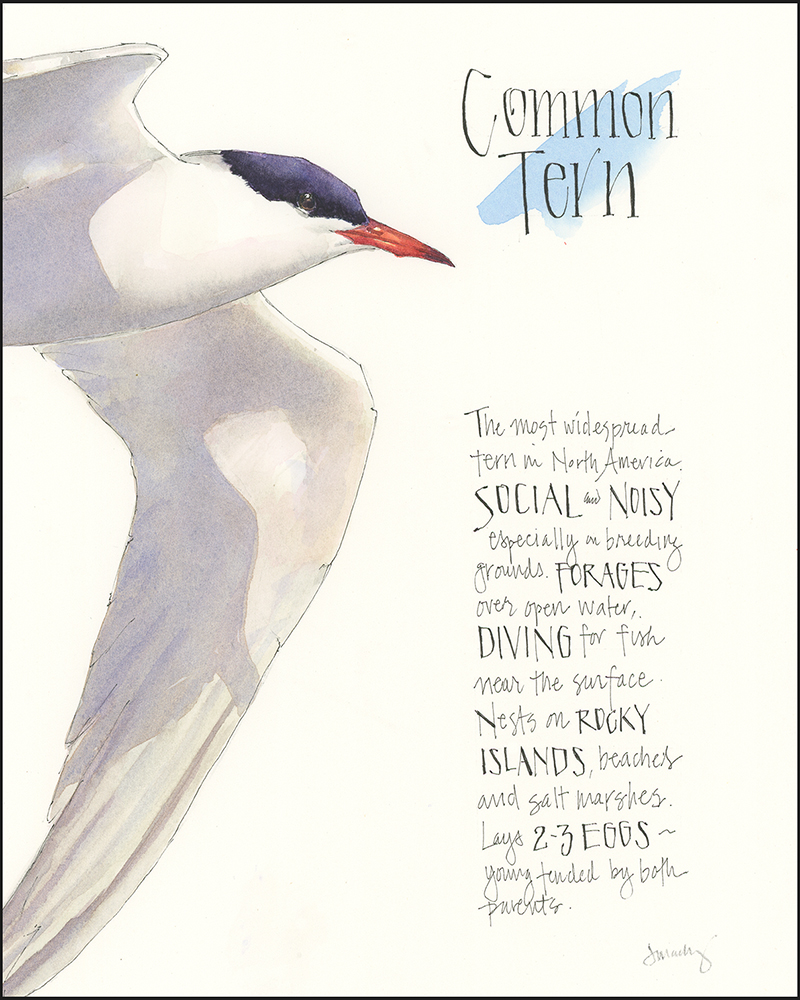
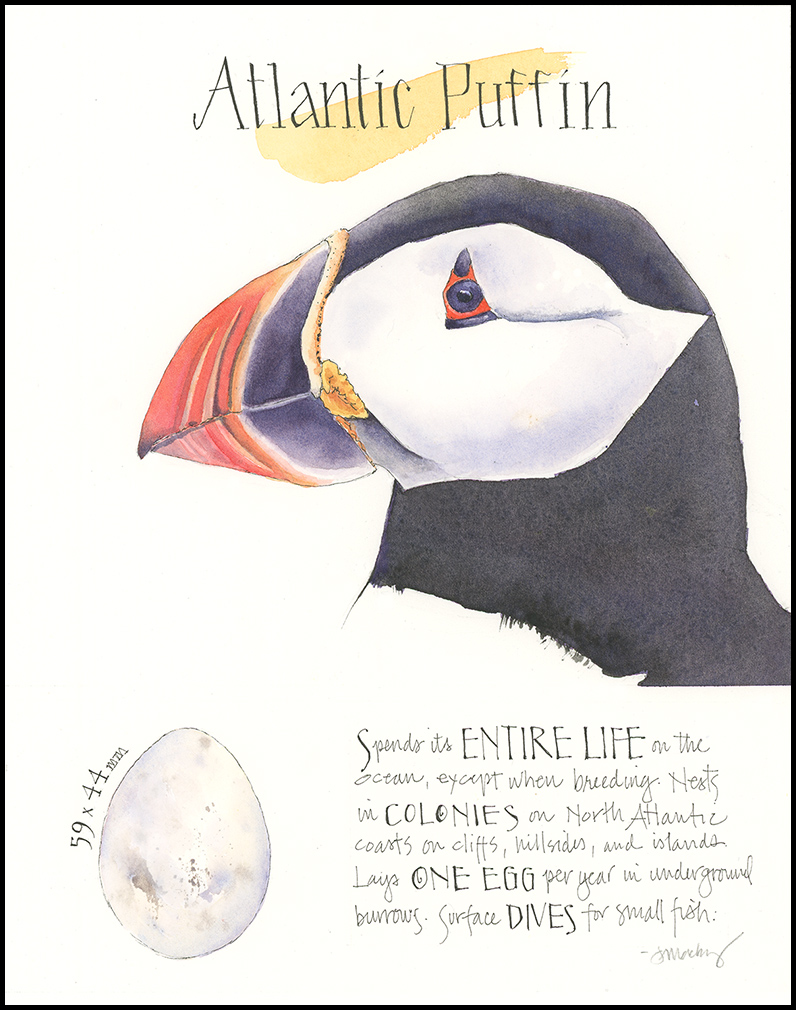
Coming up: I have new in person and online classes coming up this fall. I’d love you to join me!
 Drawn In
Just enough variation to keep it interesting, not so much that they don’t work together – you’re nailing it. 🙂 I remember that Guillemot sketch – love that one for making a rather plain-looking bird so attractive. I have several series on my blog and regularly scold myself for not being more consistent with them, style and content-wise. I need to work on that so thanks for the reminder.
I hadn’t realized or maybe hadn’t thought about all that time at sea for the young puffins – I’ve seen their leaps on TV but forgot what comes next. The wild thing is that it parallels the life cycle of the Northern elephant seal, one lovely representative of which is on our shores molting as I write. Her pup was nursed for the requisite 28 days when he was born 2 yrs ago, then she left for good. She went back out to sea, which wasn’t hard for her, but he had to do the same – alone. He had to learn to swim and feed by himself, then go at least out to the continental shelf, if not further, because they forage for fish, rays, etc. on the deep sea floor. The survival rate isn’t great for elephant seal newborns but he made it. He was tagged at birth so we know it was “Emerson” who hauled out on the shores of Victoria, BC, which isn’t very far from where he was born. That was over a year after he was last seen on land. Leaps and plunges of faith indeed! Thanks for telling the puffin’s story and prompting me to connect these two fascinating creatures.
You have to remind yourself that both puffins and elephant seals are just doing what they do. I started to think of them as brave or daring, but then I thought, maybe they are really no more daring than any other species (human’s included) living a life and facing the everyday challenges and perils. Still, being out at sea can’t be easy and I can hardly imagine setting off into that vast unknown alone. Enjoy “Emerson”!
Oh, absolutely. I know I’m applying human notions to them when I say that. What they do is amazing to me but life as usual for them. Still, it’s hard to fathom how they do what they do. 🙂
Do you draw from photos or from on site location?
For this series I drew from photos. Fortunately, I’ve also seen all of these birds in action, so I had that knowledge to draw upon too.
i love the series ! And btw , i feel anthropomorphizing is a good thing if it makes us humans better care and protect the fauna and flora around us. Besides every being small or large is a life worth saving 🙂
I love it!
Incredib