Hidden in Plain Sight
Most birds protect and conceal their eggs in carefully constructed nests, in tree cavities or underground burrows, or high on rocky ledges and sea cliffs. Not so with terns. These seabirds nest together in colonies and lay their eggs right on the ground on small islands and stony beaches. Terns make just a small scrape on the ground and the females add beach debris or dead vegetation, shell fragments, or stones to provide some camouflage. The beauty and success of this strategy lies with the eggs and chicks themselves, whose markings blend perfectly with their surroundings. Hidden in plain sight, you could easily walk right by– or on—them and never know it. Hence, the protective fencing on beaches where terns nest. This Common Tern hatched on an island in Maine monitored by the Audubon Seabird Institute and, to the best of my knowledge, is now out flying over the waves of the Atlantic.
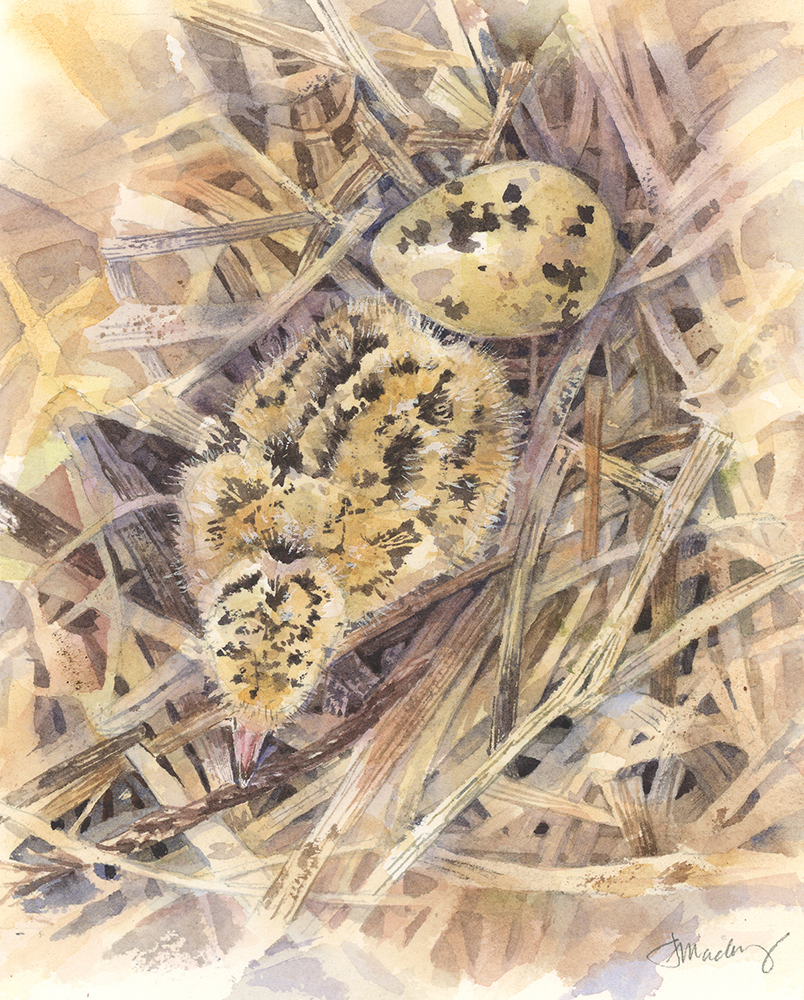
Tips and Techniques- Patience is a virtue, but especially so when doing a piece like this. Walking away and coming back can help you see things more clearly when painting a complex subject. I worked on this for an hour or two at a time over several days, chipping away strand by strand. Each time I returned to it, I had a fresh perspective on what to tackle next. Even if you just leave a painting overnight, you’ll often see things you missed when you return to it or feel confident calling it done when you take another look.
 Drawn In
Amazing work, your patience shines through, especially with the grasses. What colors did you use for this?
I mainly used yellow ochre, ultramarine blue, alizarin crimson, burnt sienna, and burnt umber. You can combine those in all sorts of ways — most of my washes were very light until I could start to pick out strands and define them with darker layers.
I love birds and so whenever you post nests or birds it is a thrill. I live
So nice to hear! I have more nests in the works so stay tuned!
What a beautiful painting! And I learned new information about terns! Thank you!
Glad to hear, Yulia!
Dear Jean, Thank you so much for this beautiful painting! It’s truly outstanding. I also appreciate your telling us how long it took you to paint. It helps me realize I’m not just slow or dense about getting things down as they really are.I love all your work, and this piece is among the best.With all good wishes,Janice Anthony
Hi Janice- Thanks so much! I am not a fast painter and, with a piece like this, I pretty much tell myself that it’s going to take a week or more to finish. The trick is not to lose interest or abandon it when the going is rough, but just keep chipping away. Enjoy your painting!
Your patience & eye for detail are inspirations indeed! I recently found an abandoned (unknown passerine) nest with 3 small eggs that I’m hoping to paint. (It was untouched for at least 3 weeks, so truly abandoned.) Will follow a ‘paint & leave’ strategy to avoid rushing & muddying it up.
Always so enjoy seeing your work.
Sounds like a plan! I recommend using the most prominent strands in the nest to guide you as you “build” the nest with paint. I takes most birds about a week to build a nest, so it might take you that long, too. Good luck!
This is extraordinary! It’s tender and beautifully painted. Fluffy feathers and all.
Thanks so much. It was a challenging piece to do and it nice to get good feedback on it!
Lovely work, Jean! I would be lost trying to paint all those detailed bits, so get it that the only way to work through the complexity is to take breaks and come back to it with fresh eyes. The colours work so well, with the softness of the chick next to the egg surrounded by its “camouflage” of dried grasses. Thank you for sharing! Peri
Thanks Peri! It is easy to get lost so I tend to alternate between looking at specific sections and looking at the overall piece. Eventually, it all comes together.
This is a remarkable piece of work and I so appreciate the reminder that there is no rush to complete a piece. I really love the way in which you depicted the way in which the chick camouflages similarly to the egg shell. It is a great lesson in how important negative space can be in the work.
I think the trick with a piece that takes awhile is to not lose interest by leaving it too long or rush through it because you are eager to get it done. I had extra time off from work last week and that was ideal.
Hello, I always enjoy your work!! This painting is so cute and well done!! A few years back, I was able to look with binoculars into a Least Tern beach breeding area at Cape May, NJ. I did some sketching too. I noticed also that the new borne chicks fluffy feathers had a pattern that matched the eggs! So interesting! Thanks for your many interesting blog posts! Avery Gunther
Isn’t it fascinating to get a closeup look like that! I’ve spied some Least Tern eggs on the Massachusetts’ coast. They blend in so remarkably well among the rocks and sand. Thanks for sharing your observation. — Jean
Hi Jean! Love your tern chick and matching egg. It’s no wonder both are perfectly camouflaged