
Sweet Sorrow
Ripe red strawberries, delicately patterned china cups, and a spread of sweets and small sandwiches fit for a queen. The table could not have been better set for a meeting of sketchers eager for camaraderie and a few hours of painting.
Out of the winter…out of my life…these hours spent in focused creativity stand starkly against the backdrop of my mother’s move this week to a nursing home. She—no longer able to hang on in her home in New York; me—sketching tea in Connecticut. Inexcusably incongruous…but there it is: a daughter’s respite and sadness contained in a few strokes of paint and bitter lemon. Sweet sorrow.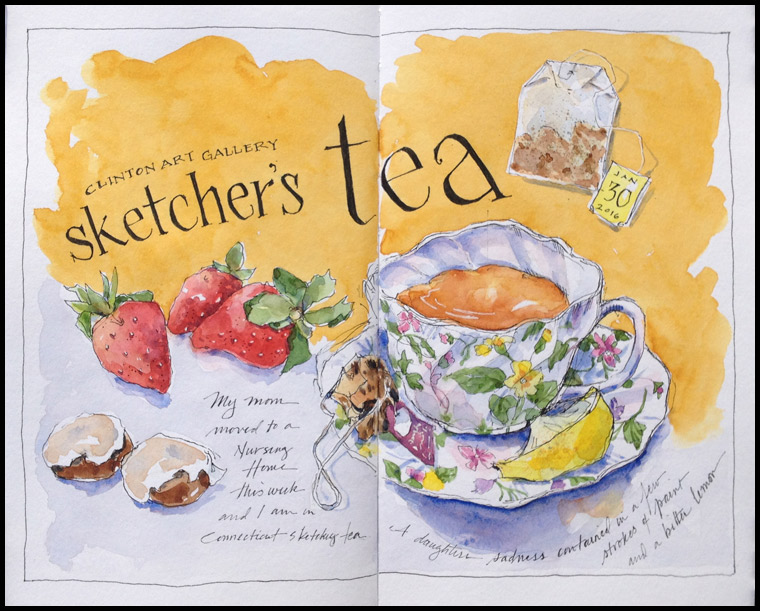
Ancient Seas
Sketching at a museum is a pretty fun thing to do—especially when the collection is as rich as the Yale Peabody Museum of Natural History. The place is a treasure trove: birds, gems, butterflies, objects from native cultures, and fossils of all kinds—from giant dinosaurs to tiny ancient plants. I decided to try two very different approaches to painting on a recent visit. See what you think…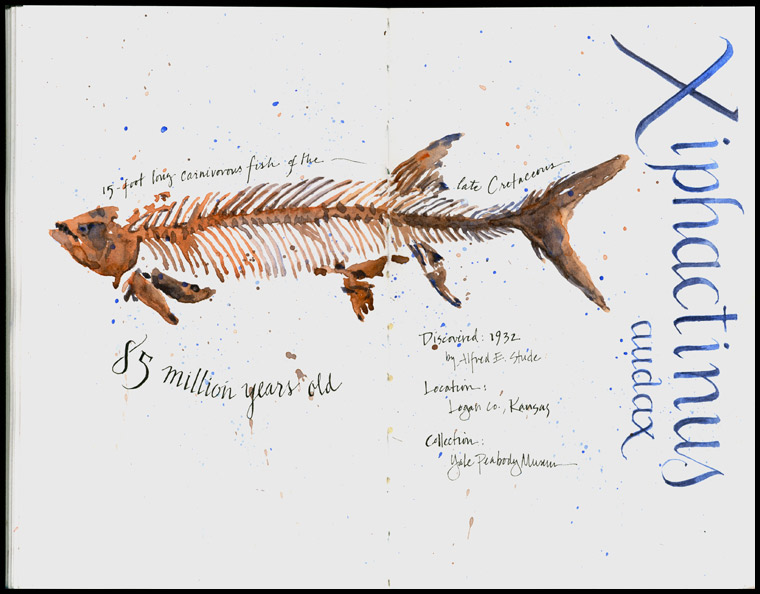 Inspired by museum sketches of Canadian artists Marc Taro Holmes and Shari Blaukopf, I jumped in with watercolor to sketch the ancient fish Xiphactinus audax. I used burnt sienna and ultramarine blue to float color from head to tail. It was important to keep the paint wet to facilitate the flow and enable the colors to bleed into each other. I added the text back at home to complete the page.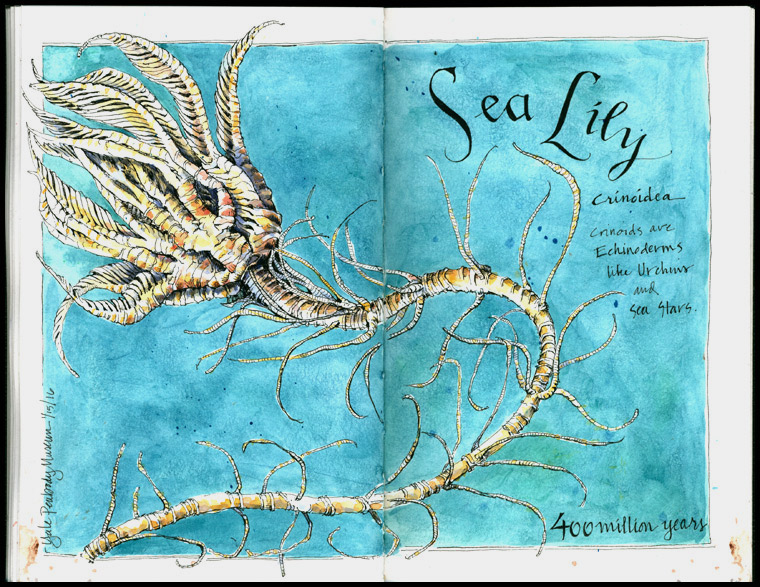
For the Sea Lily, I made a very detailed sketch directly in ink before painting. The arms and cirri are made of many small plates of calcium carbonate so I had to decide whether the draw them all or just suggest them. The museum specimen was bleached white, but living crinoids are quite varied, so I took some liberty with color. In the end, I wish I had kept it simpler, using only earth tones, to give it a more ancient look, though the blue is fitting for a creature of the sea.
Making Chili, Making Art
There’s not much to say about this one, except that sometimes drawing ordinary, everyday things ends up being very good to do.

Click to view larger.
A Beautiful Ending
I once lived in the shadow of the Helderberg Escarpment—a great sweep of limestone cliffs and slopes that rise west of Albany, New York. I hiked its trails, crawled inside its caves, rode my bike along its base, felt the fierceness of its winter winds, and ate the fruit of farms and orchards that spread out in the valley below. Needless-to-say, I miss it.
This page was inspired by my affection for the Helderberg landscape and a photo taken from a high altitude balloon. The balloon was launched last June by my son’s high school physics class, but due to GPS failure was retrieved only last week when landowners 25 miles away discovered the payload hung up in their woodlot. They contacted the school and reunited students– now in college and quite dispersed themselves– with the results of their grand experiment. And so, a beautiful ending.
For Artistic Purposes
I probably shouldn’t have mentioned to the farmer that I was selecting carrots for “artistic purposes” when considering the most colorful and interesting bunch at the farmers market. But I thought it might be a compliment. Instead, I got a thinly veiled, perturbed look that suggested she hadn’t toiled all season long for me to paint her carrots. I dug myself in deeper trouble when I asked for advice on prolonging the freshness of the greens. I saw the eyes roll and quickly agreed to paint soon or refrigerate. Alas, I think this bunch was well worth the effort to grow and paint.

A note about colorful carrots: Carrots trace their roots to Afghanistan, where cultivation is believed to have begun sometime before the 900s. A diversity of colors was the norm as carrot cultivation spread to Europe and Asia. It wasn’t until the 1500s when the Dutch selectively bred and then popularized the orange carrot. Visit the virtual World Carrot Museum for tons of information, including a gallery of carrots in fine art.
Never Weary
“Those who dwell among the beauties and mysteries of the Earth are never alone or weary of life.” – Rachel Carson
Thanks for joining me in the art of exploration throughout the year. Here’s to finding great places to explore, mysteries to probe, beauty to behold, and the company of others to share it with in 2016!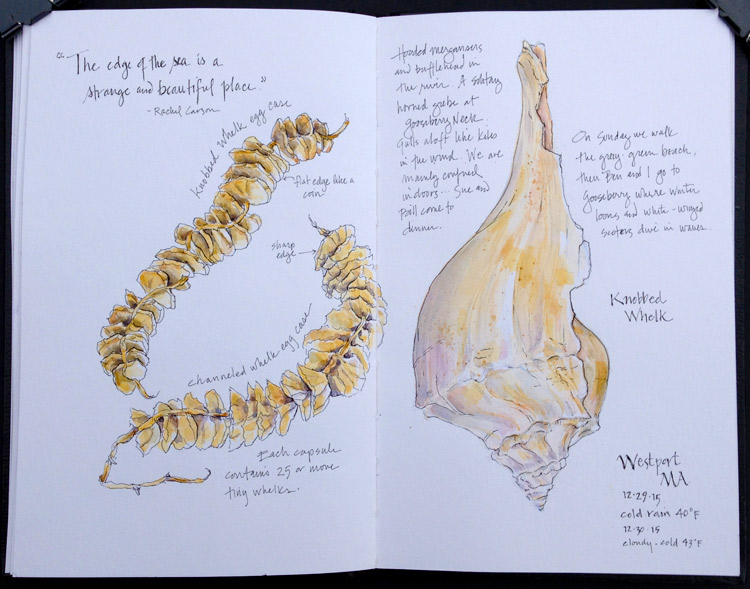
The Christmas Letter
Inspired by J.R.R. Tolkein’s The Father Christmas Letters and an antler I found one Christmas Eve, I began writing letters from Santa to my children in 2004. When my sons grew too old for such things, there was a lull in the letters—until three years ago, when I passed on the antler with a letter to my neighbor’s young boys. The letters are among my favorite Christmas traditions and so I am pleased to continue it for another year and to share the fun more widely here with you.
Click to view larger.

The first letter, 2004
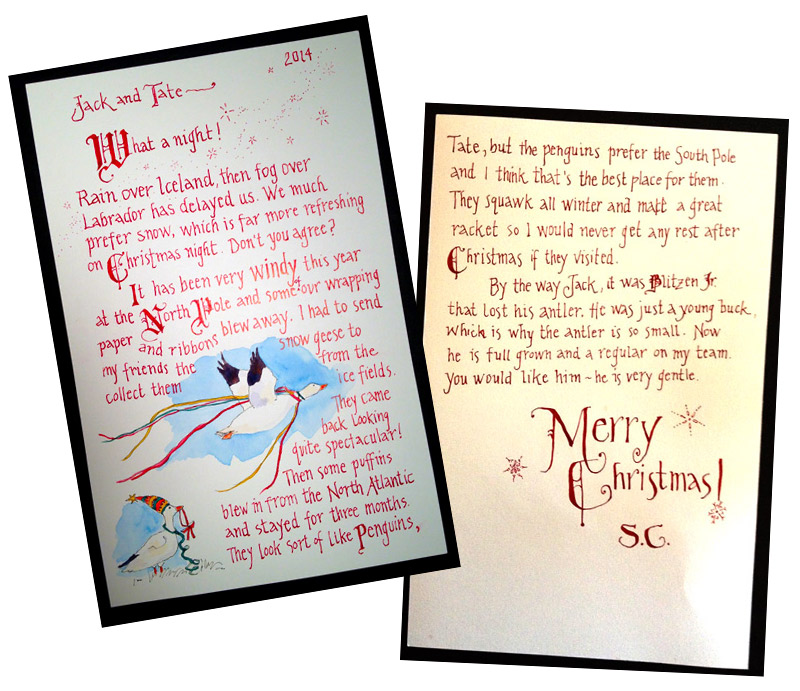
The letters often include responses to questions asked by the boys in their letters to Santa—in this case, “Do penguins come to the North Pole?”
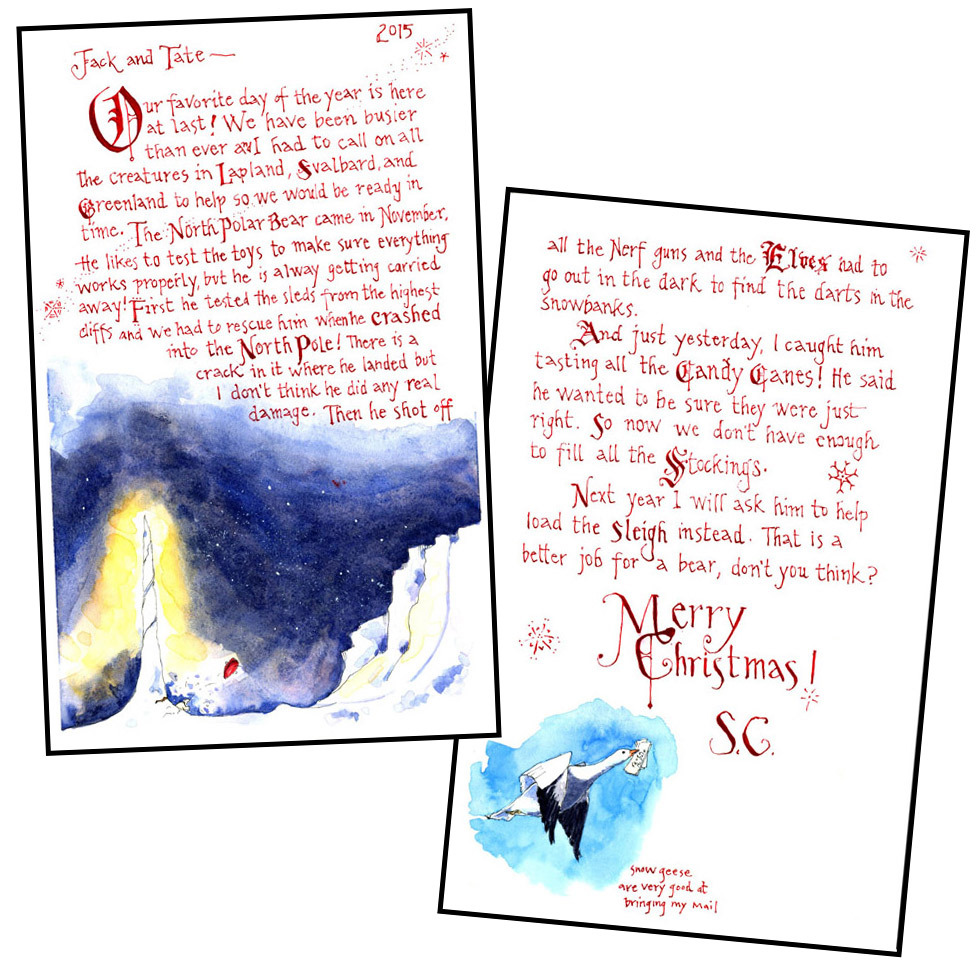
2015 Christmas Letter. Written with a traditional dip pen in Calli waterproof calligraphy ink; watercolor illustrations.
Hand Lettering
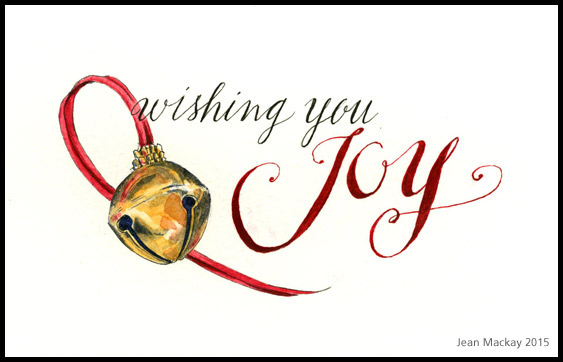 In addition to Wishing you joy this holiday season, I thought I’d do a longer post to answer some frequently-asked questions to this blog on how to improve hand lettering to enhance journals and artwork.
By way of beginning, I should say that I love adding text to my artwork and I’ve been at it a long time. My fascination with letter styles started when I was a kid, making birthday and holiday cards. By about fourth grade, I began to try out different lettering styles and by high school, I started teaching myself calligraphy scripts. Over the years, I’ve practiced illuminated letters, the Palmer Method, and various letter forms. But since you may not want to study the history of alphabets or practice for years, let’s cut to the chase. Here are a couple of ways you can improve the text in your artwork without a lot of study.
My first piece of advice: skip bubble letters! They are meant to be used by children only.

Enhance your own handwriting or printing.
One of the easiest ways to begin is to vary the stroke weight of your own handwriting or printing using a regular pen or pencil. Try this:
- Print a word.
- Go back over the letters and thicken all the vertical lines.
- Fill in the spaces between the lines.
You can leave the letters just like that, or add a “serif.” A serif is a small line at the top or bottom of a letter. Letters without those lines are called “sans serif” (“sans” in French means “without”).
Try a little variation on curved letters. First thicken the downstrokes at 90-degrees. Then try thickening the curves at a slight angle. You can vary the stroke weight on printed or cursive letters. Practice making the letters taller or thicker, or add a little flair.

Use a ruler or straight edge
If you want your letters to look neat on the page, use a straight edge to mark the top and bottom of your letters. If it’s your journal and you don’t want to fuss, skip it.
Add color
You can write your text in any color you want, or outline it in black and then fill the space with color. Colored pencils will give you a lot of control. Watercolor works well too. I use small brushes with fine points when filling letters. You can use two or more colors for variety, floating in the colors so they merge. With practice you can skip the pen and just use watercolor. I layout in pencil first if I’m going to do this so that I have guide marks on the page.
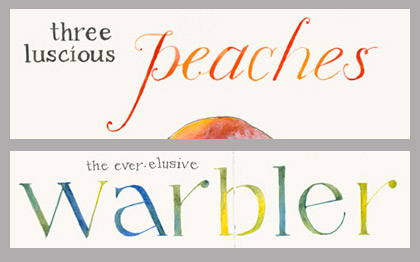
Two examples: combination of basic enhanced printing in black ink with fancier letters done with two- and three-color watercolor lettering.
Calligraphy pens have specially designed nibs that create the thick and thin letters. You can get calligraphy markers or use traditional dip pens with ink. Either way, they take some practice. I prefer pens with ink as the lines are finer and inks more beautiful than markers…but I’ll leave that for another post.
Practice!
Take some time to play and practice. Look at letters on cards, posters, and advertisements with a critical eye, try out some different styles, and have fun!

Practice page and finished product.
 A few favorite reference books:
- Speedball Textbook– widely available and has lots of different calligraphy styles, instructions, and samples. A great place to start.
- The Art of Calligraphy by David Harris- goes through the history of various letter forms, but also includes alphabets, techniques, and samples from historic texts.
- Illuminated Alphabets by Patricia Carter- techniques, design ideas, and sample alphabets
- The Bible of Illuminated Letters by Margaret Moran- This small book packs it in! Classic techniques for gilded letters, historic alphabets and information.
Universe of Stars
I love seeing a brilliant night sky, especially in winter when its cold and clear. It reminds me in the most glorious way that we are riding on a jewel of a planet in an unfathomably vast universe. A walk under the Milky Way quickly puts life in perspective, if even just for a moment. This journal page is both tribute and reminder. Tribute to a cold, clear walk in the shadow of Vermont’s Green Mountains, and reminder to make more time for stars.
Here’s wishing you a universe of stars during this dark and wondrous time of year.

About the night sky:
Are the stars more brilliant in Vermont than other places? Yes. That’s because there is less light pollution to block them out. Check out this map to see how dark it is where you live.
http://www.lightpollutionmap.info/#zoom=4&lat=4815709.82675&lon=-8149899.70971&layers=B0TFFFFTT
Many thanks to Mike and Barbara Young at Mountain Valley Retreat B&B in Killington, VT for sharing their little piece of heaven and their warm hospitality.
Illustrated Watercolor Journaling
I had the pleasure and privilege of teaching a full day workshop on Illustrated Watercolor Journaling at the Killington Arts Guild in Vermont last weekend. I’m always inspired by the creativity and enthusiasm that comes from gathering people together for a day of painting! I don’t usually paint much when I’m teaching, but I started this beet as part of a demonstration and then finished it back at home. I always aim to make my journal pages reflect something meaningful or interesting from my experiences, so I finished the page with some of the lessons and tips we practiced and a bit of my joy from teaching the workshop.

click to view larger and read the details
I brought a variety of props for people to sketch, including some beautiful beets with weary looking greens (they were gorgeous when I bought them!). And – wouldn’t you know, I spelled “journaling” incorrectly on the page—I hate that, but oh well!


 Drawn In