
January Birds
Subzero temperatures mean I’m inside, but birds are out in force at our feeders. They start at dawn and come and go or stay all day, eating as much as they can to fuel their survival against the cold. With this abundance of subjects, I have been focused on capturing bird shapes and postures with small, quick ink sketches. The beauty of this exercise is that you don’t invest in any one bird, you are simply training your eyes and hands to work together.
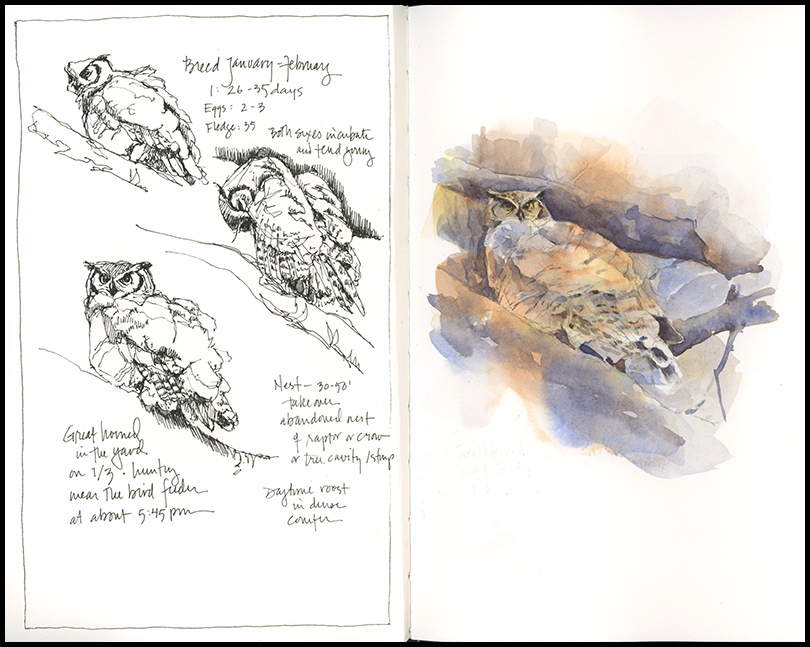
My second focus for the week has been owls, which I have not drawn much before. Barred owls have been calling in the stream-side woods next to our house for weeks. And we caught sight of a great horned owl nabbing a meal (likely a squirrel) near our feeders at dusk. Owls mate in January and February, so I expect to hear more activity in the coming weeks.
click to view larger
Tips and Techniques: I drew the owls from videos, which I tend to like because they convey a bird’s personality and movement better than still photos, yet you can pause and replay if needed. Try drawing directly in ink and not worrying whether you get everything right. Keep your eyes on the bird more than your paper and keep your pen moving. The painted owl is a small study I wanted to try to help me decide whether to do a larger painting. The proportions aren’t quite right, but the negative painting technique worked more or less as I had hoped.
Braving 18°F
After days of single digit temperatures, 18°F felt like it might be sort of manageable for sketching outside. And it was…more or less, given the challenge of sketching with gloves on and needing to work quickly to avoid frozen fingers and feet. Still, there is something fresh about working outside and I suspect this page will always bring to mind the chill of the setting sun and the unexpected sound of hundreds of geese overhead.
Today it is minus-4°F and I am not so brave. Happy New Year!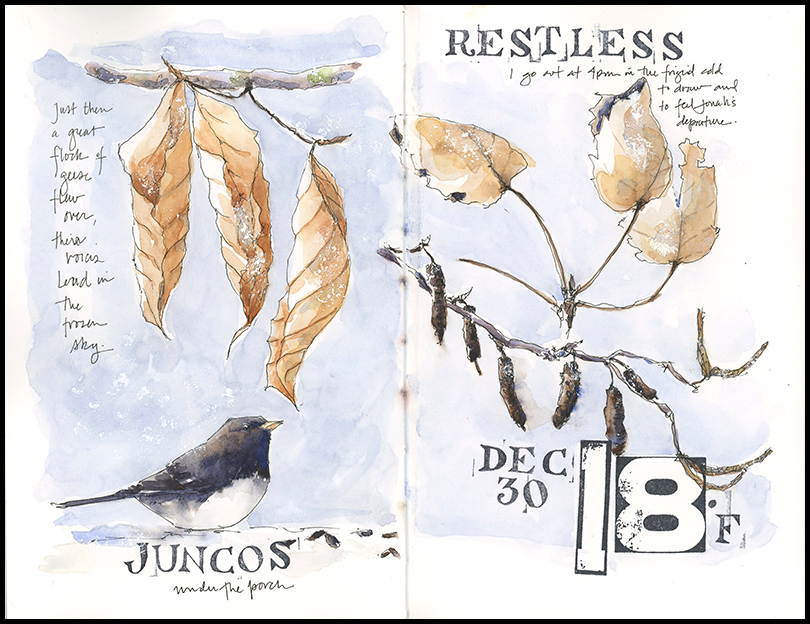
Tips & Techniques- Why not? Try making a very short foray outside this winter for a quick sketch. Don’t be too fussy about the subject– find something simple that you can capture in about three minutes and jump in. Keep your tools very basic too– a pen or pencil and sketchbook are all you need. I added watercolor later, and decided to try rubber stamps for a fun change of pace.
Two Swallows
No turtle doves here this Christmas, and no partridge in a pear tree. Just two tree swallows and a bird house I’m giving as a gift. I started the first painting on traditional watercolor paper and then decided to paint a second to test drive the new Nova series toned paper from Stillman & Birn. Doing the paintings side by side gave me a perfect opportunity to compare papers while painting the same subject using the same materials and techniques. Which do you like for the gift?

Tips & Techniques: The toned paper is 150gsm and labeled suitable for dry media, light wash, and ink. I used white gouache for the breast and regular transparent watercolor for the rest and was surprised at how well the paper took the paint. It buckled only slightly, so I kept the watercolors on the dry side. In contrast, the painting on watercolor paper (Strathmore 400 series 140lb) enabled me to work a little wetter. Here, I let the white of the paper serve as my white and added only pale shadows on the breast. Though the colors are cleaner on the white paper, I like toned paper for the impact of subjects like this that have strong whites. I wish the Nova paper was a little heavier, but I like it enough that I may do a series of birds on it.
Winter Blues
“The woods are lovely, dark and deep…”
Inspired by Robert Frost’s famous poem, I set out to capture a few favorite trees and darkening skies. I loved playing with the complexity of branches and shapes using the simplest of colors. There’s something about these deep blues that brings out the mystery and beauty of this time of year.

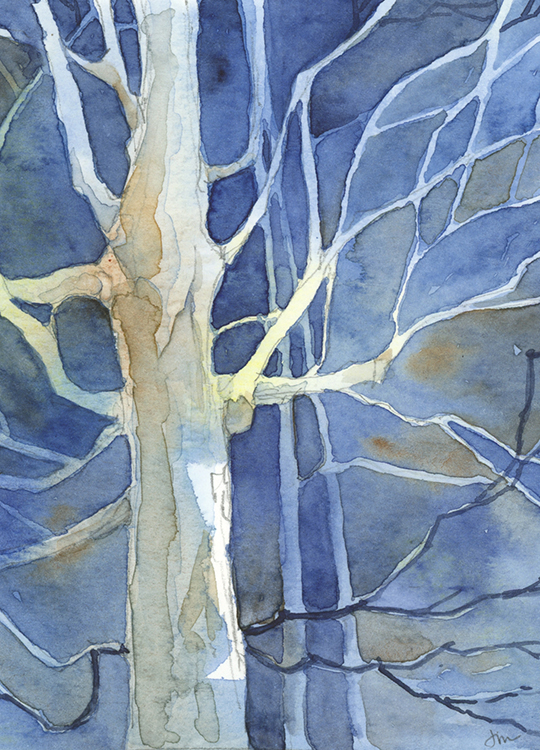
Tips & Techniques– These pieces started with at least six failed attempts to paint trees at night. I began by doing numerous small “test” paintings of silhouetted trees against various skies, but none proved evocative or beautiful. I was ready to throw in the towel when I hit on trying negative painting techniques and finally saw something interesting evolve. So, my tip this week: before investing a lot of time in a big painting, try a few small samples to work out the kinks and test colors. It’s also worth remembering—and I am especially in need of this – sometimes it takes a few failures to get to success. Keep painting!
Hanging On
There are many reasons to appreciate stately, solid oaks. Raking their late-dropping leaves in December is not one of them. Persistent and tenacious, they hang on despite autumn gusts and rain storms that shake other trees bare by October’s end. And yet, as I rake pile after pile, I think: maybe we should be more like oak leaves, resolved to hang on as long as we can. Savoring each day of sun, knowing that the dark and silent winter will come all too soon.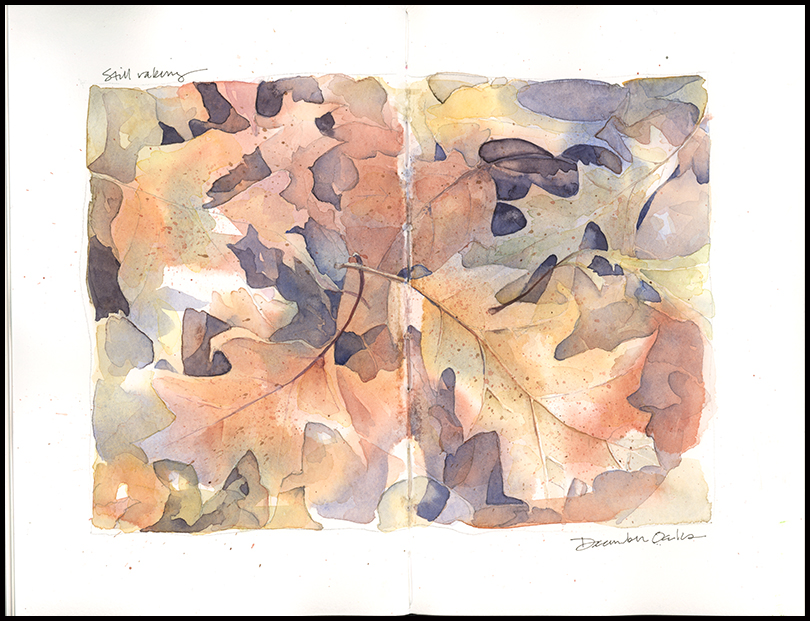
Tips & Techniques– I’m testing a new box of Schmincke watercolors, so I decided to use “negative” painting techniques with this journal page as a way to figure out the range of colors I could get with a triad of Ultramarine Blue, English Venetian Red, and Yellow Ochre. I began with a very loose wet-in-wet wash of those three colors. Once it dried, I began to pick out the shapes of the leaves with smaller, but still very wet washes. You can lay lots of layers on top of one another with this technique to build values, depth and interest. The trick is to stop before overworking it or losing the spontaneity of the original wash.
Here’s how it looked along the way (sorry I didn’t take more photos toward the end; I got absorbed and forgot)…
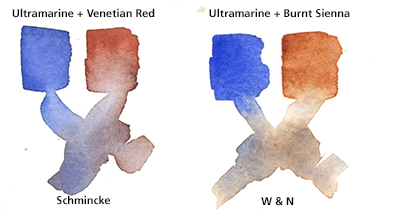 Get to know your paints! I haven’t used English Venetian Red before, and though it looks similar to Burnt Sienna, it is less transparent and mixes very differently. Look how it becomes more purple when mixed with Ultramarine Blue. Burnt Sienna creates beautiful browns and grays with Ultramarine, a mix I use all the time. The purple toned darks worked nicely for the oak leaves, creating a lively triad with the Yellow Ochre.
Finding Beauty
I was recently invited by Liz and Nigel at the blog Exploring Colour to provide a guest post for their series Where and What is Beauty? The blog hails from New Zealand, which is, incidentally, 9,000 miles from my home in New York State. I traveled to that extraordinary country way back in 1986 searching for adventure, beauty and local color but, as my post reveals, I am now Finding Beauty Close to Home.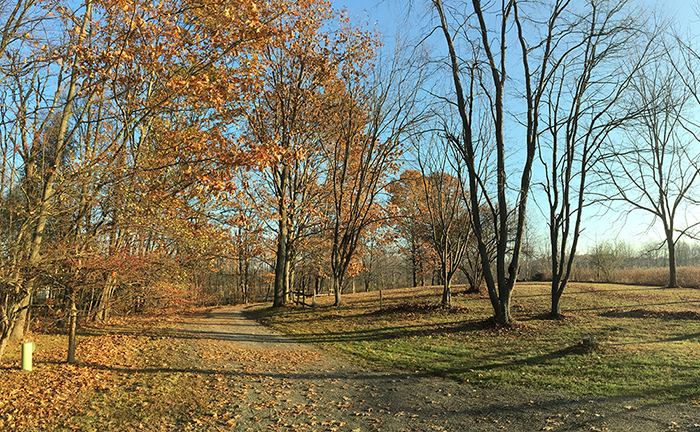
November Maple
It’s the perfect time of year for painting trees. Bare bones and branches, I like the unobstructed view, when limbs, bark, and shapes are revealed. This old maple in my front yard is interesting from almost any angle. I started mid-afternoon in glowing light but, because the sun faded quickly, it took me several days—and patience waiting for the right light again– to finish.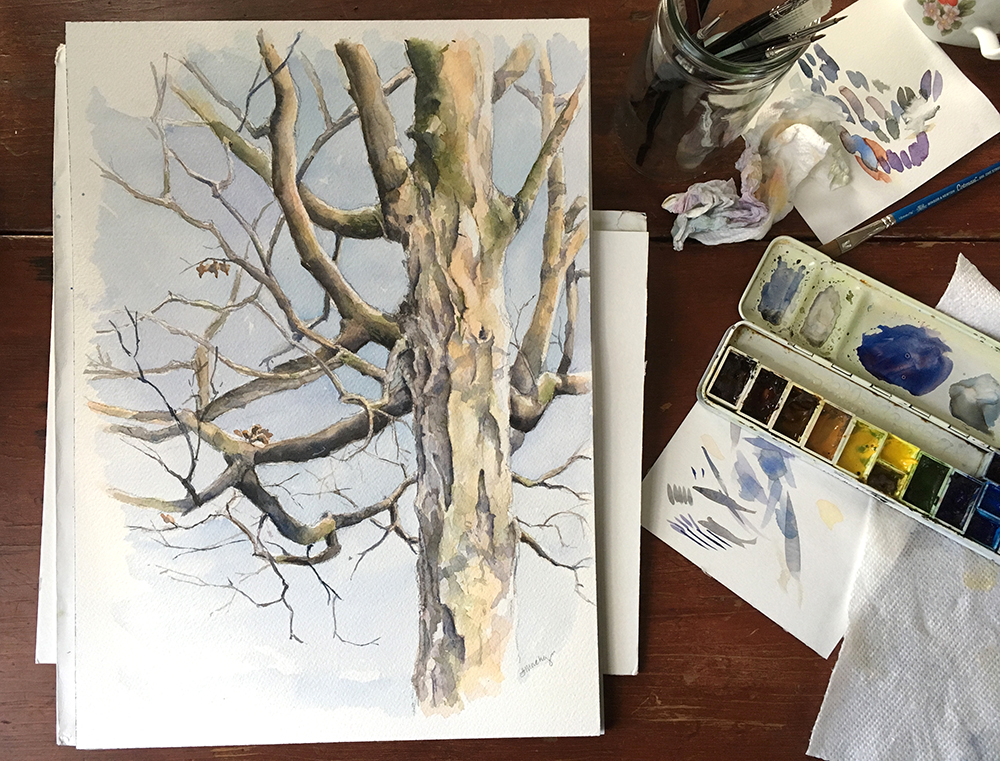
November Maple, 10″x14”, Watercolor on 140lb Arches cold press paper
Victorian Finery
How does a naturalist-artist find herself painting Victorian dresses? I’m not sure, except that I found the fantastic fabrics and fine details of the new exhibit Well Dressed in Victorian Albany quite irresistible. The gowns in the collection of the Albany Institute of History & Art are so exquisite, they make perfect artistic subjects. Unfortunately, the museum didn’t allow watercolor in the gallery, so I was restricted to pencil and pen, and had to paint later…which took away a bit of the fun. Nevertheless, this was a valuable exercise. Painting drapery requires mastery of line, volume, form, and value. I went for a fairly graphic look, with bolder blacks for the darkest areas. Had I been able to paint initially, I probably would have skipped the bold lines in favor of more subtle watercolor.
I was particularly drawn to the incredible details of collars and cuffs. I wanted to see what I could suggest without painting every stitch of lace or embroidery.
The Ripening Season
Seasons unfold, pages evolve. That’s what happened here as I sketched a variety of fall fruits and seeds from the trees in our yard over the last few weeks. It’s all part of learning what’s here on the rural property we moved to in July. There are nice old sugar maples, red and white oaks, black walnuts, cottonwoods, birches, and white pines, with well-placed dogwood, pin cherry, and apple trees. There are many year’s worth of sketches in the trees alone…and you’ll see more in the future, I’m sure.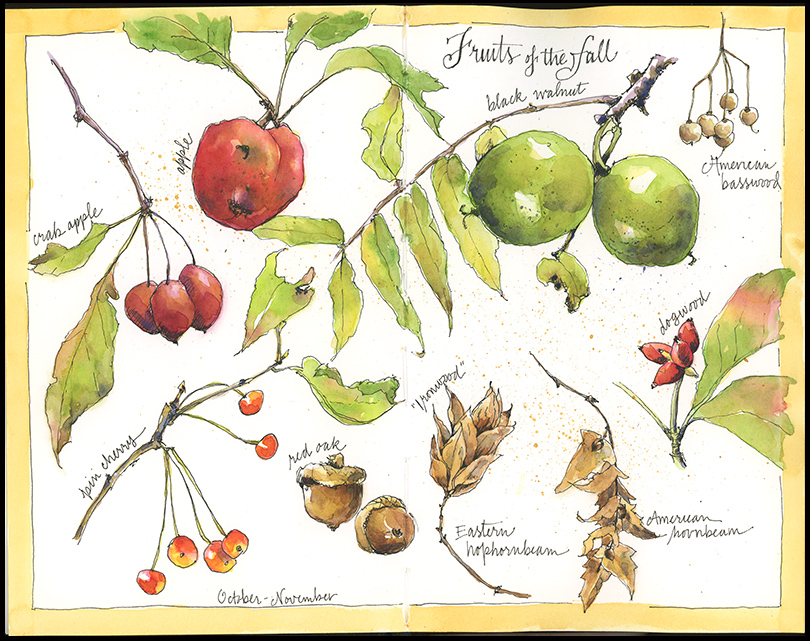
Tips & Techniques– Just as seasons evolve, your pages can too. While it can be nice to finish a page all at once, sometimes that just doesn’t work. Be patient. Do a little at a time, leave it, come back, and do more. Your most important decision is probably where to place the first object. Avoid the middle of the page, which tends to lead to a dull design and leaves only tight spaces around the center to fill. If you know you have a larger item (e.g., black walnuts vs. acorns), place it sooner than later. You can always find room for small things after the big ones are in place.
Bringing Hummingbirds to Life
The bird lay dead in my hand, a small and precious jewel given to me by a friend. Fully intact and still dressed in glittering green, it was a rare gift. I’d never held a hummingbird; never studied one so closely. An opportunity like this meant one thing: break out the magnifying glass, ruler, and pencil and get to work.
As an artist, I find observing dead birds enormously helpful when trying to bring them to life on paper. I love the ability to look closely at various features, to study proportions, and to look at feather patterns and feet. A bird in hand lets you see details that a photo and even live birds cannot— like the iridescent feathers on a hummingbird’s throat that appear black unless reflecting light or the length of the primary feathers. As you can see, I didn’t try to enliven my first sketches— these are strictly studies. The birds on the right take flight thanks to the motionless birds on the left (click to view larger).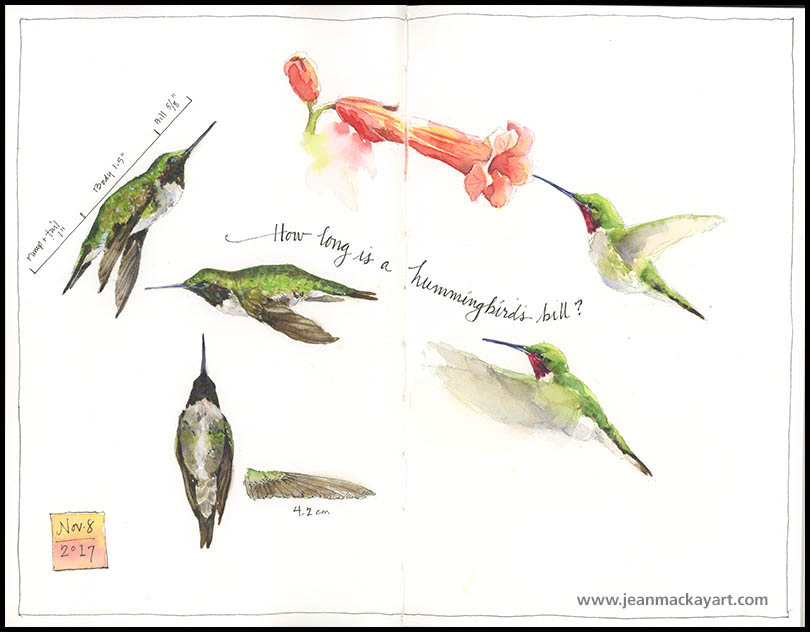
The Hummingbird Gallery
About Hummingbirds– Hummingbirds are pretty incredible creatures— they can fly forward, backward, and straight up and down, and buzz around at speeds up to 30 mph. Weighing in at just 3-4 grams, they never-the-less manage to fly more than 500 miles across the Gulf of Mexico each year on their annual migrations from the US and Canada to Central America. There are more than 300 species in the world, twelve in the US, and only one, the ruby-throated hummingbird, in the eastern US. Journey North tracks its annual trek (as well as monarch butterflies and other creatures)…check out the journey.


 Drawn In