
The Catbird Seat
I set out to trim the lilac, so tall and thick that its few blossoms are unreachable. But tucked deep in the greenery I found a catbird quietly perched in its bulky nest. I was not sorry to trade loppers and pruning shears for pen and paint.
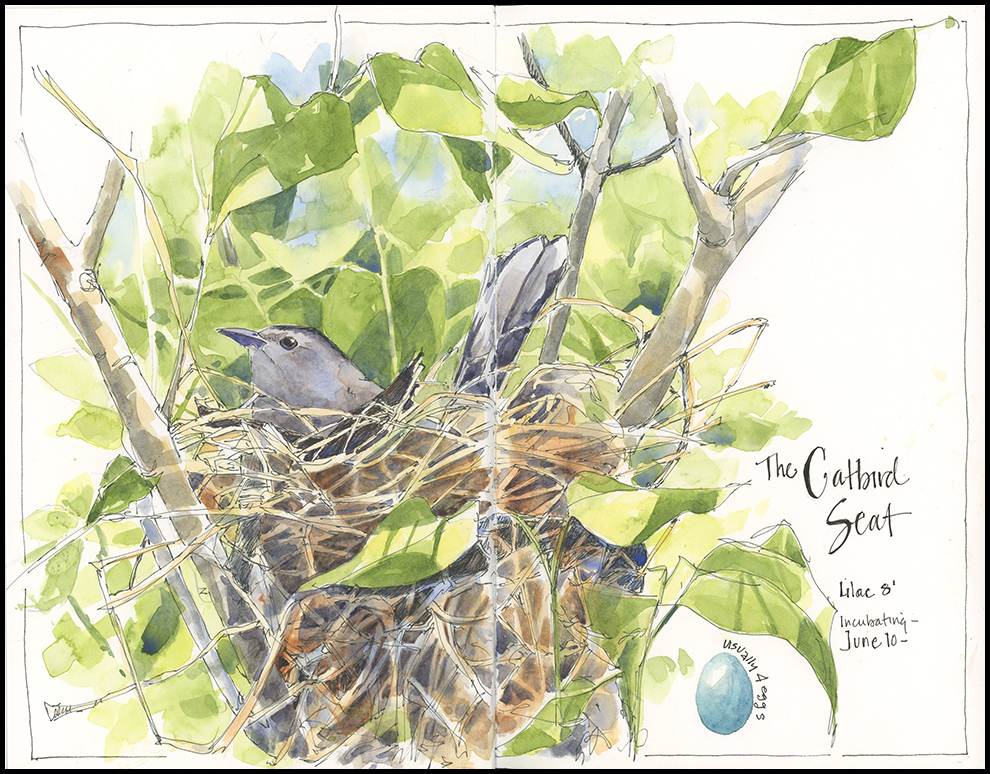
Tips and Techniques– It’s much easier to sketch nests after birds have finished using them. But it’s exciting to find them in season and capture a glimpse of nesting activity. The key is not to disturb the birds or call attention to the nest. I began this sketch from about 20 feet out, using a step ladder and binoculars to get a close-up view. I spent about 5 minutes blocking in the nest placement among the lilac branches and the position of the catbird. Later, when the bird was off the nest, I took a photo of the nest itself to use as a reference for the leaf shadows and nesting material. The young hatched a few days ago, so I will add dates for hatching and fledging (hopefully) in the bottom corner in the days to come.
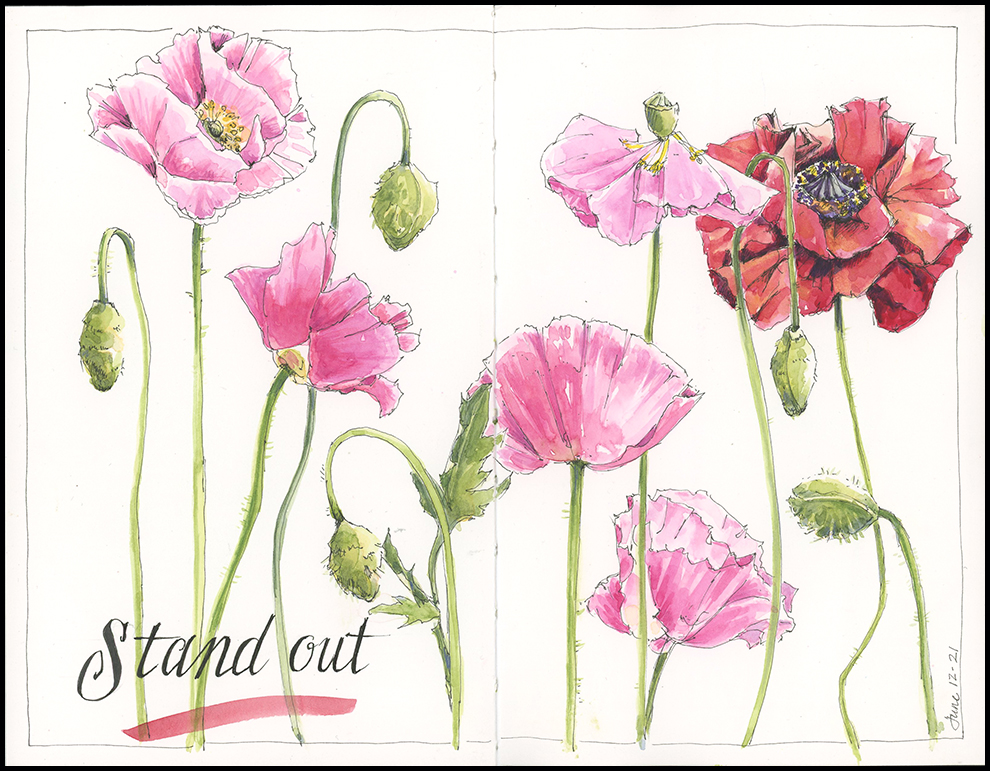
Poppies
For two weeks now, poppies have been opening each day in our garden. Light and airy as ballet dancers, their moment center stage is short, but oh so lovely. I started this page when the first pink flower bloomed and added more as they opened— plant after plant, all pink. And then, a single red blossom opened. Outstanding in its singularity, it seemed the perfect punctuation to a page—and to a garden in need of a bit of diversity to really make it shine.
I did this second painting of poppies while visiting the garden at Olana State Historic Site. These bold, frilly-edged perennial poppies were in full late-day sun, which forced me to work quickly. I like the resulting freshness and fullness of this one.
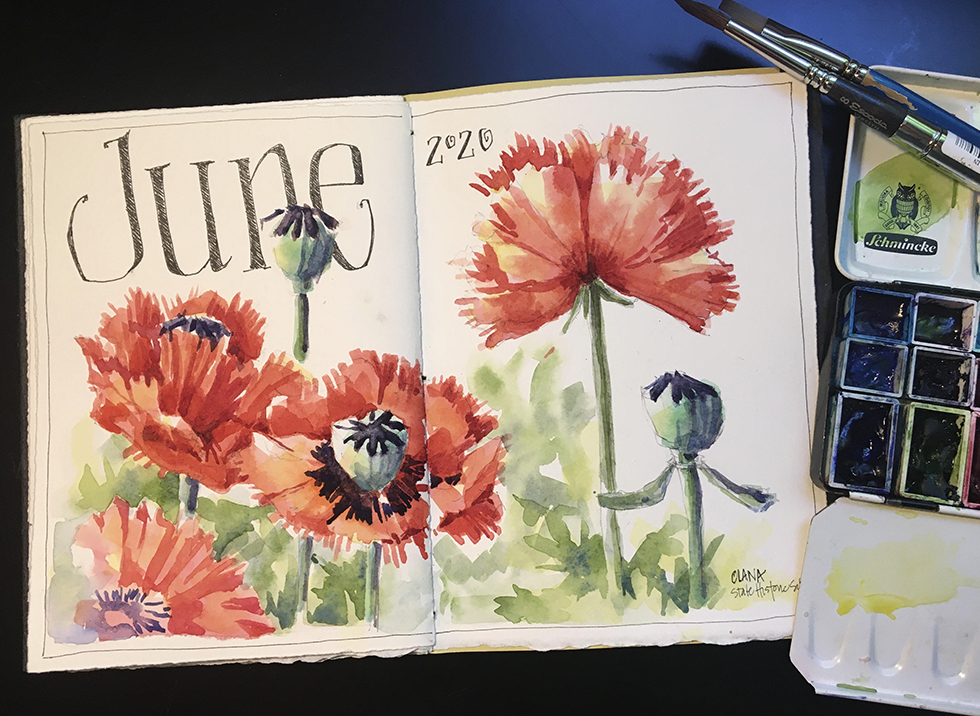
Tips and Techniques– Notice the treatment of foliage in these two pieces. In the pink annual poppies, I decided to leave out the leaves to to showcase the simple grace of the stems and flowers. In contrast, putting in a suggestion of gray-green foliage offers a useful compliment to the red poppies at Olana. Remember that as an artist, you are also an editor. Just because it’s there, doesn’t mean you have to paint it. Make choices about what’s in front of you to simplify and hone in on what you want to convey.
Hatch Out!
The hardened frothy glob attached to a goldenrod stem has sat motionless in our garden since the day I found it and brought it home from the meadow back in January. No change. Nothing happening. I had nearly given up on it. And then, it happened. Hundreds of mini praying mantises emerged from the ootheca. They crowded around the opening, marched up and down the goldenrod stem, and one by one dropped from their home base and wandered into the garden. By evening, nearly all were gone.
This is the first time I’ve ever seen this phenomenon and it was pretty exciting. I hope they find the aphids that are feasting on my poppies and grow up to devour other insects in the garden. Come fall, I’d love to find an adult or two hiding among the sunflowers or laying a frothy glob of eggs for next spring.
Tips and Techniques– Don’t miss the moment! If ever there was a time to have a simple painting set up, this was it. I sat uncomfortably on the edge of a wooden raised garden bed in the noon-day sun, sketchbook and travel palette in hand. I painted as the nymphs emerged, which gave me a long time to watch them and to study the ootheca from different angles. My palette and paper dried too fast in the full sun and I found it challenging to get the right amount of water/paint ratio. Still, I have no regrets. Had I waited for a better set up or a better time of day or a better day, I would have missed it altogether.
Home
Ten weeks of working at home has meant a lot of things, including isolation, quiet, and focus. It has afforded opportunities to more closely observe the unfolding of spring and the comings and goings of birds in and around our property. Every. Single. Day. As you can see from the Bird Map, there’s a lot to watch. We’ve recorded more than fifty different species– some are just passing through, but we see or hear the ones that made the map nearly every day.

There’s a lot of information on this map—too much maybe—but it serves as a useful visual record (click the map to view full size). Bird populations may change from year to year, globally and locally. For example, tree swallows didn’t make this map, though they nested here just last year. They haven’t disappeared, they have simply taken up residence in my neighbor’s nest boxes. Ten years from now, it will be interesting to look back at the Bird Map and see who is calling this place home.
Tips and Techniques– When making a map, I use Google Maps as a reference to get a good aerial perspective. It works whether you are zooming in on a single property or outlining a larger region or country. Begin by sketching a rough outline in pencil and then embellish it with ink or color as you like. Consider whether there are elements that you can add that would lend a unique flavor to the map. The color scheme of the place you are visiting, elements of local art or architecture, indigenous plants or wildlife, or a unique label will help to convey the place you are trying to capture.

NEW ONLINE CLASS!
The Artist Sketchbook, Mondays: July 13,20, 27 and August 3.
I am excited to announce that I will be teaching an online Zoom class through the Winslow Art Center in Bainbridge Island, Washington. Visit the workshops page or head to the Winslow Art Center site for details and registration.
Gardens Wild and Planted
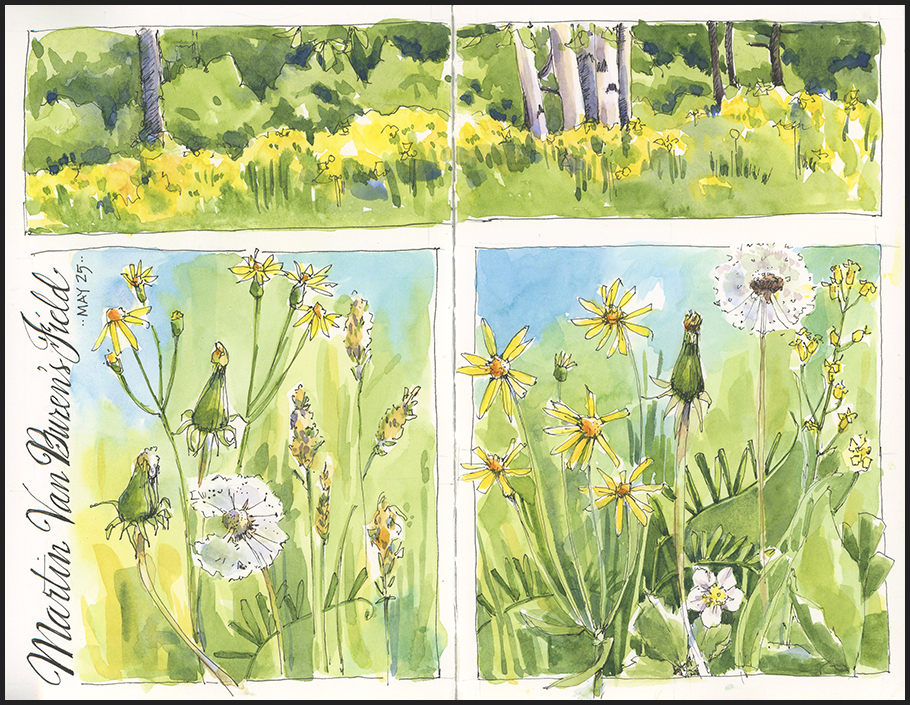
It’s hard to imagine a lovelier “garden” in May than the meadow I stumbled upon while hiking at the Martin Van Buren Nature Trail in Kinderhook, New York. The preserve is mostly woodland, with stately oaks and maples that Van Buren himself would have seen more than 150 years ago. But a small clearing in the forest was gloriously golden this week, with masses of yellow flowers that any gardener would be hard pressed to recreate.
My own gardening efforts began in earnest several weeks ago. Unfortunately, I think I jumped the gun in a restless attempt to get things growing. Either from planting when it was still too cold or lack of regular watering, few of my seeds sprouted. So, I replanted last week and recruited my husband to do the watering. Fingers crossed, you’ll be seeing scenes from the Art Garden in the weeks and months to come.

Tips and Techniques– Gardens offer so much to artists! While flowers in full bloom are favorite subjects for many, consider the possibilities of sketching in the garden throughout the season. From seeds to seedlings to blossoms to faded foliage—challenge yourself to come up with creative ways to showcase what’s happening each month. This year especially, when so many of us are staying home instead of heading out to favored vacation spots, having a garden—or a few pots of flowers—may prove to be just the subject matter you need.
A Prayer in Spring
Oh give us pleasure in the flowers today;
And give us not to think so far away
As the uncertain harvest; keep us here
All simply in the spring of the year.
— Robert Frost
 Under massive oaks and maples: dappled sunlight and hundreds of Jack-in-the-Pulpit. Oh give us pleasure in the flowers today. I had come to the woods feeling heavy-hearted, weary, needing spring. And give us not to think so far away as the uncertain harvest. How well Frost understood his time and ours. Drawing kept me in the moment; later it brought me pleasure again when finishing this page at home. Keep us here—all simply in the spring of the year.
Wishing you the pleasure of flowers.
Close Inspection
The first mowing of the season gave me a close look at our lawn, which any agronomer would tell you has issues. Fortunately, we live in the country where no one cares whether you are growing a monoculture of turf or a diverse mixture of grass and weeds. From a distance, it all looks green. The more I mowed the more curious I became. How many different plants could I find? Hence, this Field Guide to Things in the Lawn That Aren’t Grass.

Tips and Techniques– Follow your curiosity. You may not end up with a grand painting, but you will discover all sorts of fascinating things around you.
Surrounded by Magenta
After a winter of painting with brown and earth-toned pigments, it feels extravagant to use so much magenta. But this particular variety of magnolia had magnificently deep-colored blossoms and I found myself dipping into paint pans that I rarely use. With the tree in full bloom and fallen petals on the ground it was a delight to be surrounding by so much color.

Tips and Techniques– When you are using a strong color like quinacridone magenta, it helps to tone it down. I used yellow ochre and aureolin yellow, which produce some lovely warm shades of pink. Mixing with cobalt blue gave me cooler and darker tones for shaded areas. Test out the reds in your paint box. Red plus yellow doesn’t always give you orange, especially when using cooler reds like alizarin crimson or quinacridone rose. Red plus yellow can produce excellent flesh tones and subtle pinks.
The Lovely and the Lowly
I broke my home-bound suspension yesterday just to paint magnolias in bloom. I went to a nearby cemetery where I’d seen them previously. I was not disappointed; several large trees were in their full glory. Amidst the quiet of gravestones, their display was enjoyed only by birds and a few passersby.
 Later at home, I inadvertently dug up an acorn just starting to sprout in my garden. Though lowly, it struck me that this unfolding life was as lovely as the magnolia. And, thankfully, right in my own backyard.
International Nature Journaling Week is coming up, June 1-7. The week aims to bring together a world-wide community to celebrate and document the beauty and diversity of the natural world. As a lead up, artists and bloggers are sharing their perspectives and artwork each week at NatureJournalingWeek.com. I am grateful to be featured this week with a blog post “The Art of Discovery.”
At Home
Being at home day after day (after day) is hard. I wear the gravity of our times like added weight. How grateful I am for our only visitors, who sing their way into spring with airy lightness. I leave my sketchbook by the window so I can draw birds at the feeder and take it with me on my post work rambles. So, today, I offer you a few birds from my yard in hopes that, for a brief moment, they might bring you the cheer that they have given me.
(Click to view larger: blue jays, goldfinches, bluebirds, palm warblers)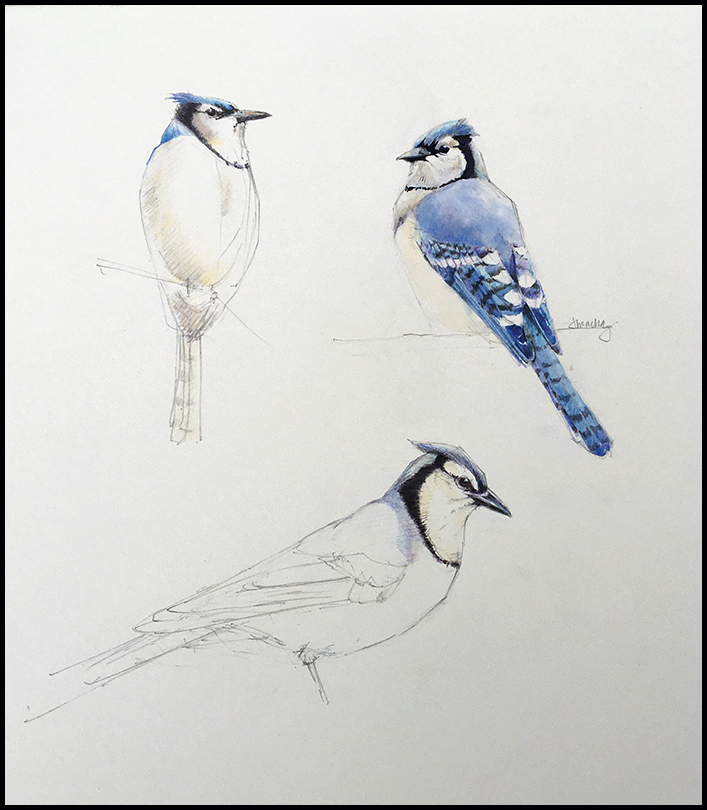
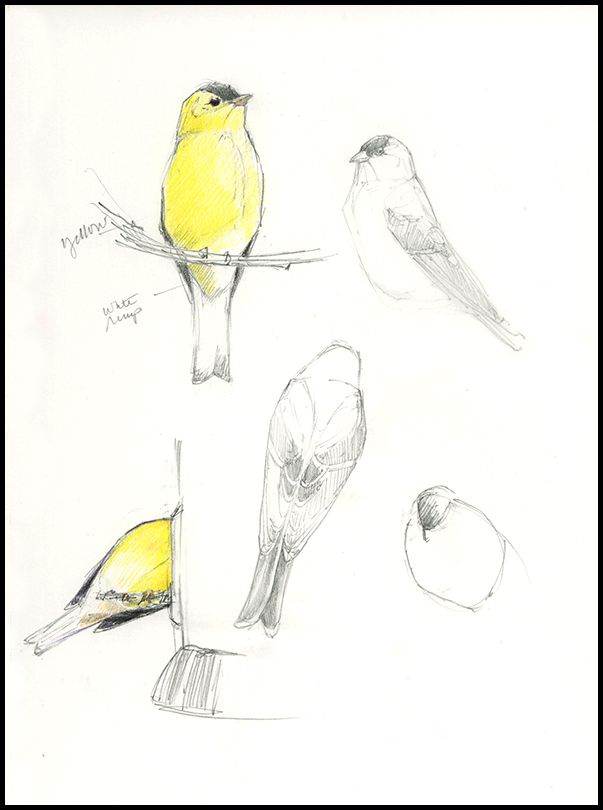
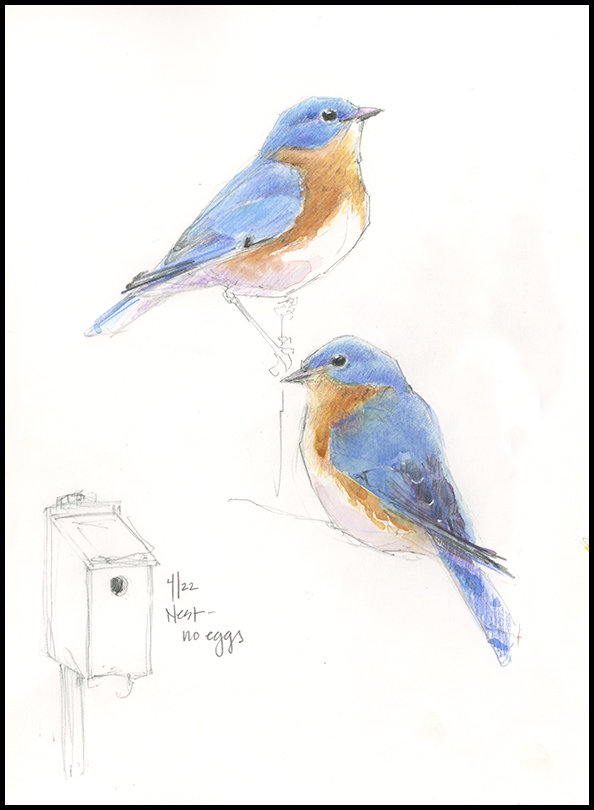
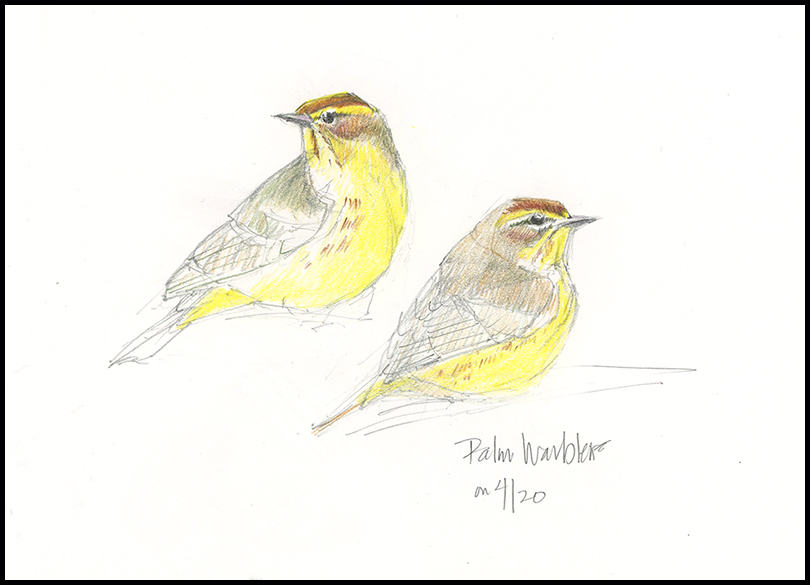
Tips and Techniques– For me, sketching birds from life feels a bit like entering a spinning jump rope. Even though the birds are moving, you have to jump in at some point and commit a pose to paper. Once I’ve done that, the bird has likely moved. So, I either wait until it strikes a similar pose or use binoculars to see markings in greater detail. Little by little, I add to the bird, paying particular attention to the beak and eye. I find that if you get those right, the rest of the bird, even if unfinished, is more convincing. Once the initial sketch is down, I use photos as reference for additional details. I sketched these with pencil (yes, I erased a lot) and colored pencil, with a bit of watercolor on the jays and bluebirds.


 Drawn In