
Artistry of the Blackbird
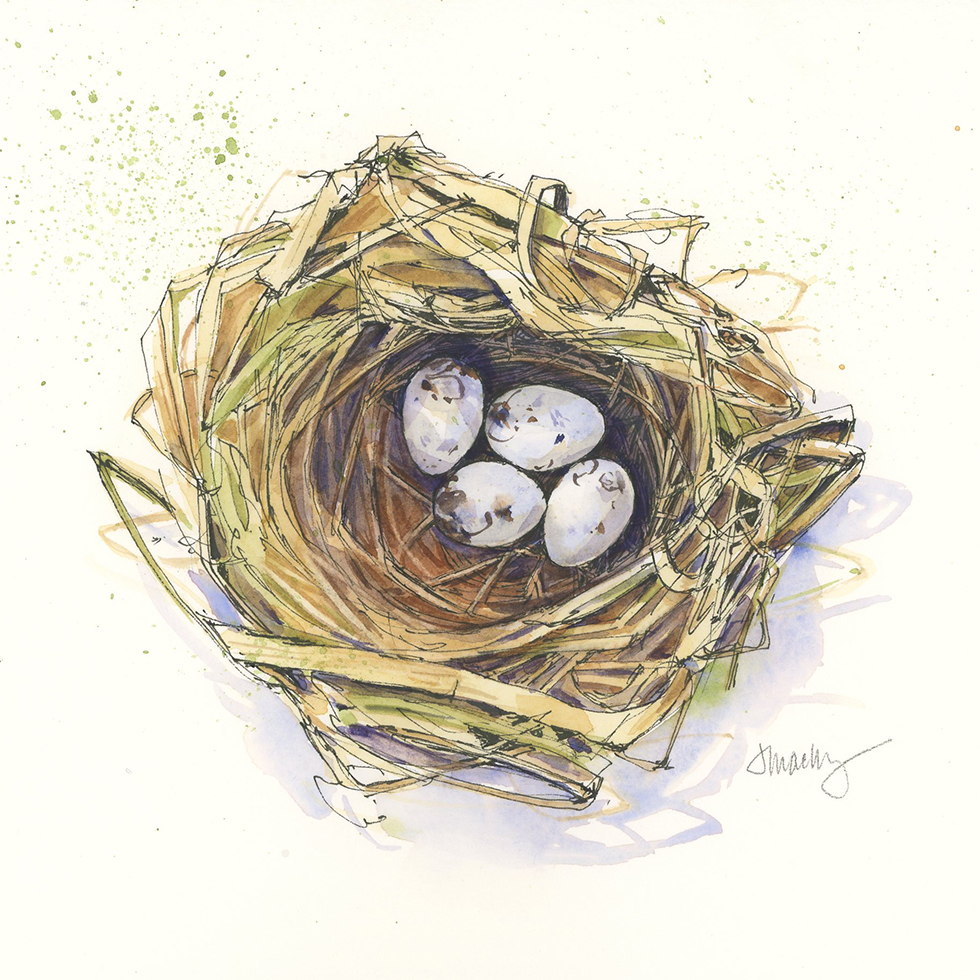
Red-winged blackbirds hide their nests of woven sedges, grasses, and cattails deep in marshes, wet meadows, and swamps. Females weave the structure low to the ground, finding perfect hiding places to lay their eggs and raise young. Sometimes several females will nest in close proximity and even share the same mate. Because of their wet locations and perfect camouflage, I have never found a blackbird nest in the field. The ones I’ve seen and painted are from natural history museums and nature centers. Sometimes they are recently collected and sometimes, as with the one here, they are more than 100 years old. What a pleasure it is to glimpse the secrets of the nest and share the beautiful artistry of the bird.
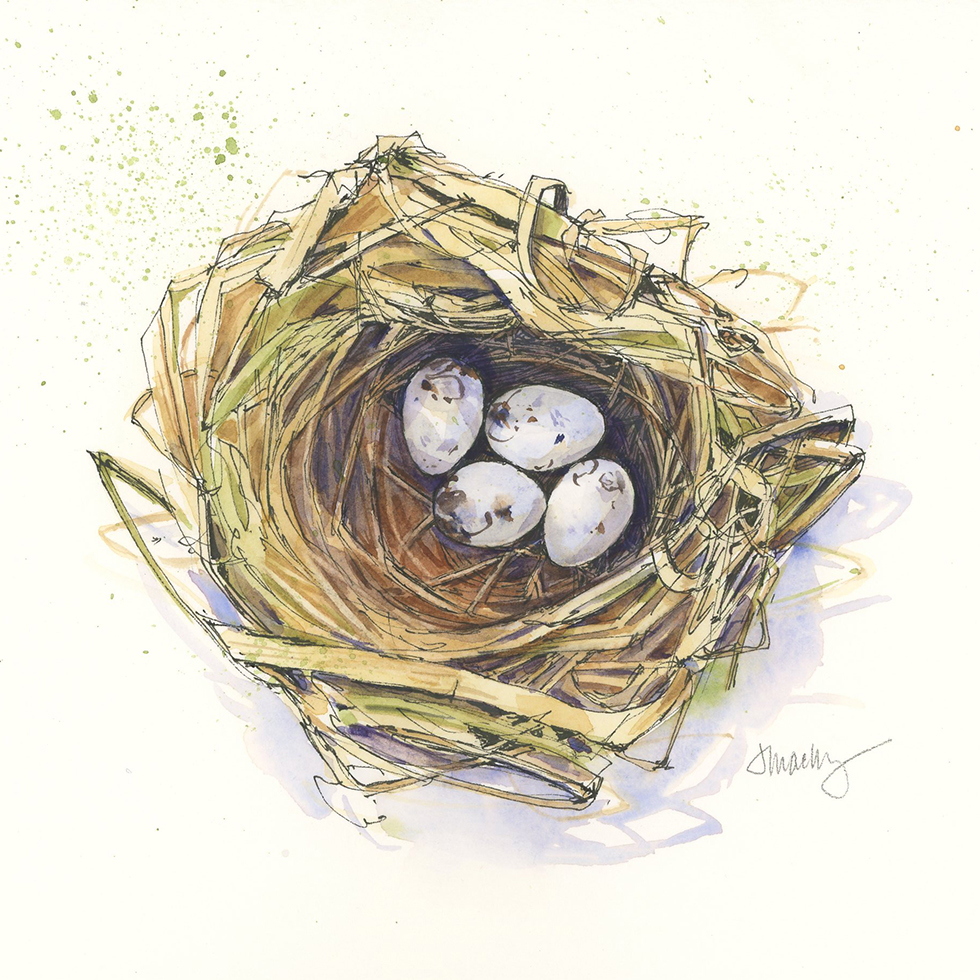
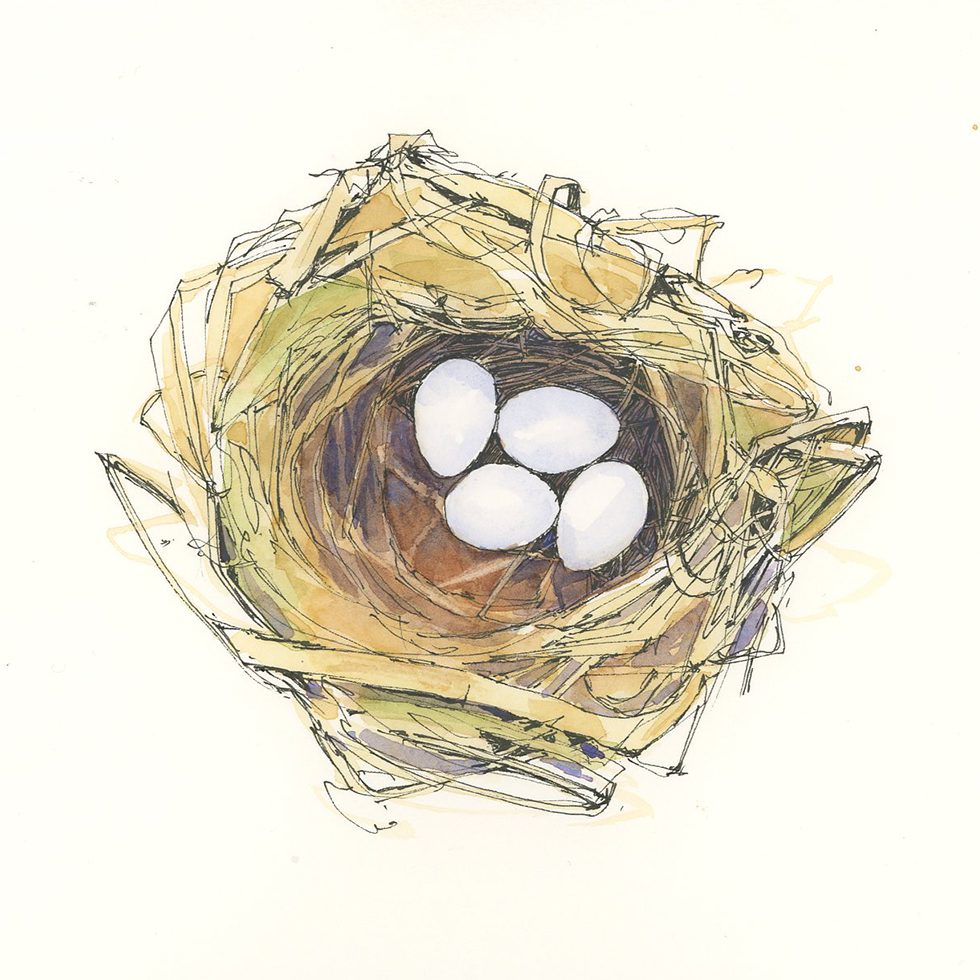
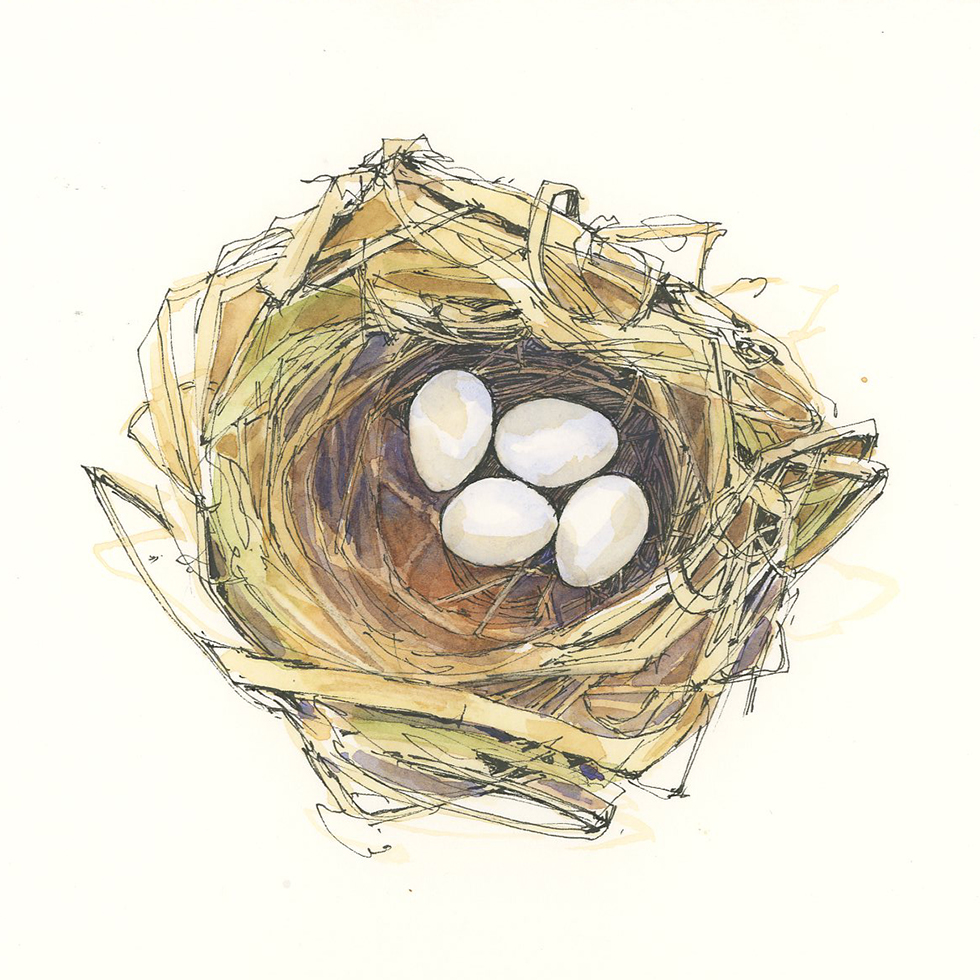
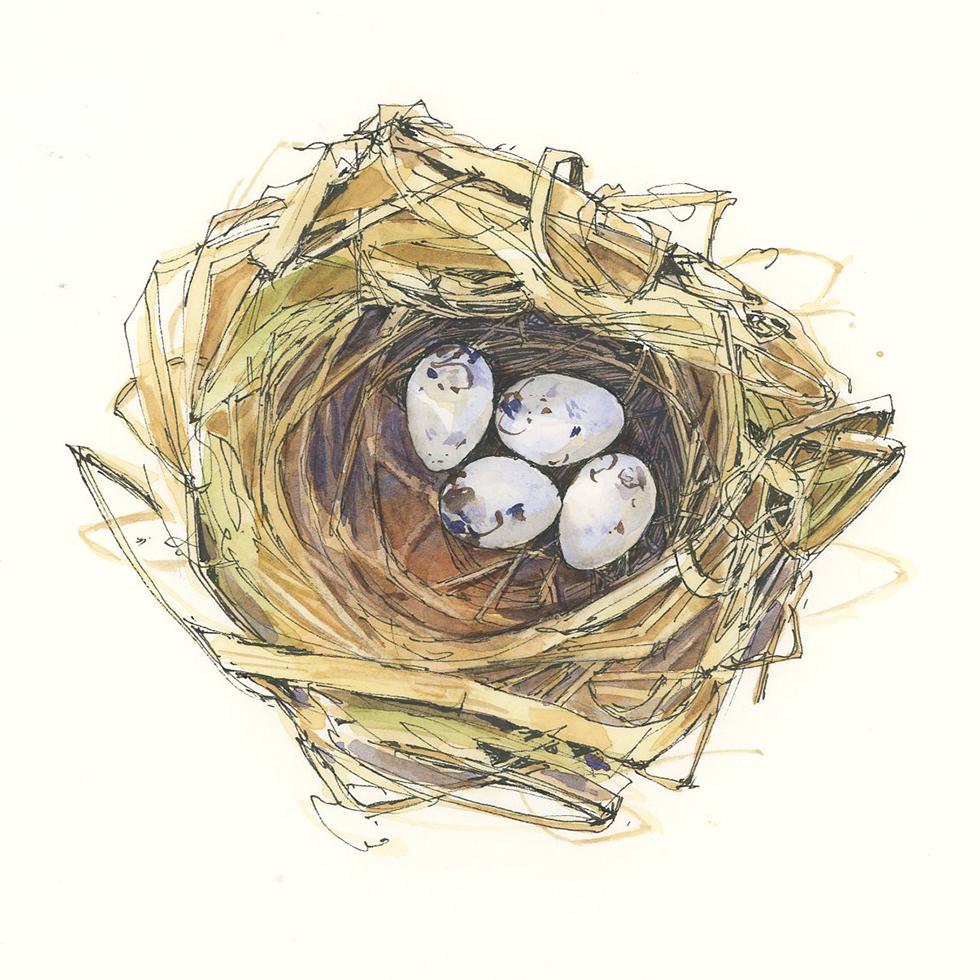
Tips and Techniques– When painting a nest, I pick out major strands that can become “guideposts” for the structure. These are typically larger strands of nesting material that I can use as reference points for all the small stuff around them. When I get lost in the complexity, I return to my guideposts and work the sections behind and between them, adding more detail with each pass of paint. Follow the work in progress to decipher some of the stages of developing this nest.

Seeds for the Next Generation
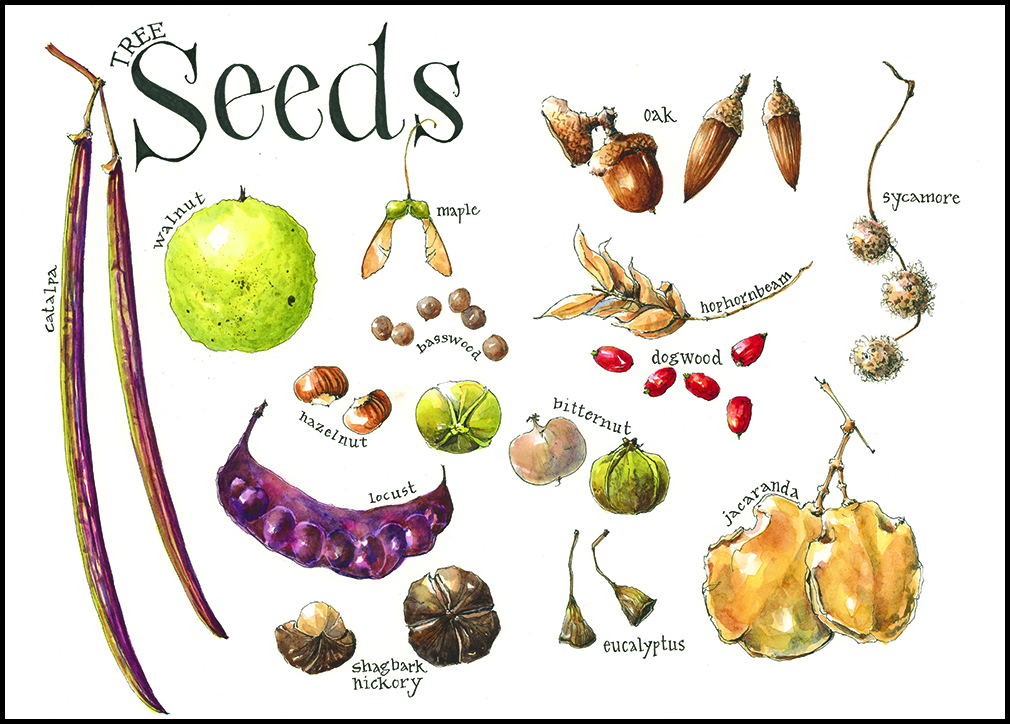
Autumn is the season of trees here in the Northeast. It’s not only the vibrant foliage that makes it so, but also the magnificent structure of trunks and branches revealed as the leaves fall. And then there are all those seeds dropping to the ground—so much promise for regeneration; so much sustenance for wildlife preparing for winter. This piece celebrates that promise, while also marking the one-year anniversary of the release of The Nature Explorer’s Sketchbook. In many ways, the book is my attempt to sow seeds of wonder and enthusiasm for nature with the next generation. I’m grateful for the positive reviews it has gotten, new doors and relationships it has opened, and a ranking in the top 400 drawing books for kids on Amazon. To be sure, books on drawing Pokemon, Anime, unicorns and mermaids far outsell it. But perhaps that makes it all the more needed.
As always, thanks for your support.
New workshop: Drawn to Nature, Tuesdays, January 4-25, 2022, Winslow Art Center >>
This class will focus on multiple approaches to capturing nature-related subjects with an eye toward deepening our understanding, appreciation, and connection to the places we live (or visit). Class via Zoom and limited to 14 participants.
Anticipating Italy
One of the best parts of travel is anticipating it. I will be spending a week in Italy in May 2022 teaching a small group travel art workshop—what an awesome thing to look forward to! There are so many things I am curious about; so many things I want to learn now before going. My travel preparations typically begin by making a map. From there I can start to understand the geography, landforms, plant and wildlife communities, and heritage. This base knowledge helps me understand what I’m looking at and dive deeper when I’m on the ground. And then there is the language. How much can I learn in six months? As you can see, there’s much to do and I’m off and running. I hope you will indulge me in my illustrated preparations. And should you want to join me next spring—all the better!
Learn more about Sketching the Nature of Italy in Watercolor, May 2-9, 2022 at the Winslow Art Center >
Io sono così eccitato!

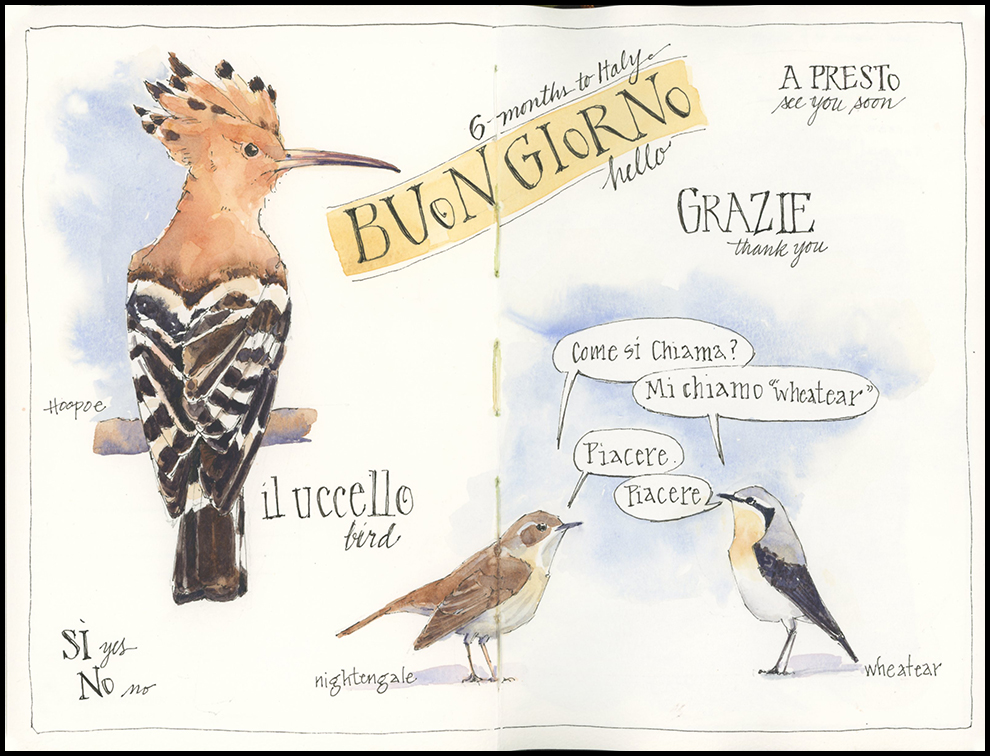
Tips and Techniques- I’m trying out a Hand Book watercolor sketchbook, portrait size 8.25×5.5” for my pre-trip journal. I’ve been reluctant to buy one of these because the paper is only 95lb, but an artist friend recommended it and I took a leap. I’m glad I did- so far so good. When considering what goes into a travel journal, I like to include elements from the place. This may be colors, lettering styles, architectural details, or wildlife. Because I want to become more familiar with European birds, I bought a field guide and plan to sketch some of the birds I’d like to see. Number 1: the Hoopoe– what a crazy, amazing crest and feather striping. More to come!
Adirondack Birches
If you have never been to northern New England in the fall, you must put it on your bucket list and go. Blazing red and orange maples, yellow birch and aspen, and russet beech trees, set off by evergreens paint an extraordinary canvas. This is just about the end of “peak” season, as rain and wind subdue the palette each week. I consider myself lucky to have seen New York’s Adirondacks in a blaze of glory this weekend while at my nephew’s wedding. What a treat—on both counts.

When Work is Done
Our list was long last weekend: paint the back porch railing, fix windowsills, repair broken glazing, prime bare trim, rake leaves, mow the lawn, mulch the gardens, brush hog the field edge, clean out the gutter, mount the rain diverter…you get the idea. It was a beautiful fall three-day weekend, perfect for a hike or bike ride, or for getting stuff done. That’s why you didn’t see a blog post and I didn’t pick up my sketchbook until the sun was sinking low on Monday afternoon. I went to a local conservation area, where the recently mown meadow glowed in the late-day light. In the margins that escaped the reaper, I was drawn to milkweed pods, now split open and brittle, their work done too, casting seeds on the breeze.

Tips and Techniques– I’m sure I’ve said this before, but don’t overlook the small stuff. There are so many times when just looking at a single plant proves fascinating. I sketched the milkweed directly in ink with a Micron 02 pen and then added a couple of watercolor washes of yellow ochre, burnt sienna, and cobalt blue. I used a bit of ultramarine, alizarin crimson, and burnt umber for the darkest shadows, stems, and seeds. Sometimes keeping the palette and the subject simple are what make the difference between completing a page or not.
Gone. Forever.
Though the news this week that the Ivory-billed woodpecker, Bachman’s warbler and 21 other species were classified as “extinct” may not have come as a surprise, it was nonetheless disheartening. I pulled several old field guides from my shelf and found these prescient passages: “When man appears, the Ivory-bill disappears. This is not alone due to the destruction of the bird’s haunts but the bird’s shy, retiring nature. Its days are numbered even more surely than are those of the forests it inhabits” (What Bird is That? by Frank Chapman, 1941). “Many of its [Bachman’s warbler] former haunts are gone, and the demand for further lumber and drainage bode ill for what is perhaps the rarest of North American warblers” (Audubon Bird Guide, 1949). As these birds join the ranks of species gone forever, it seems right to not only mark their loss, but to pause for a moment to contemplate their once magnificent presence in a wilder America.
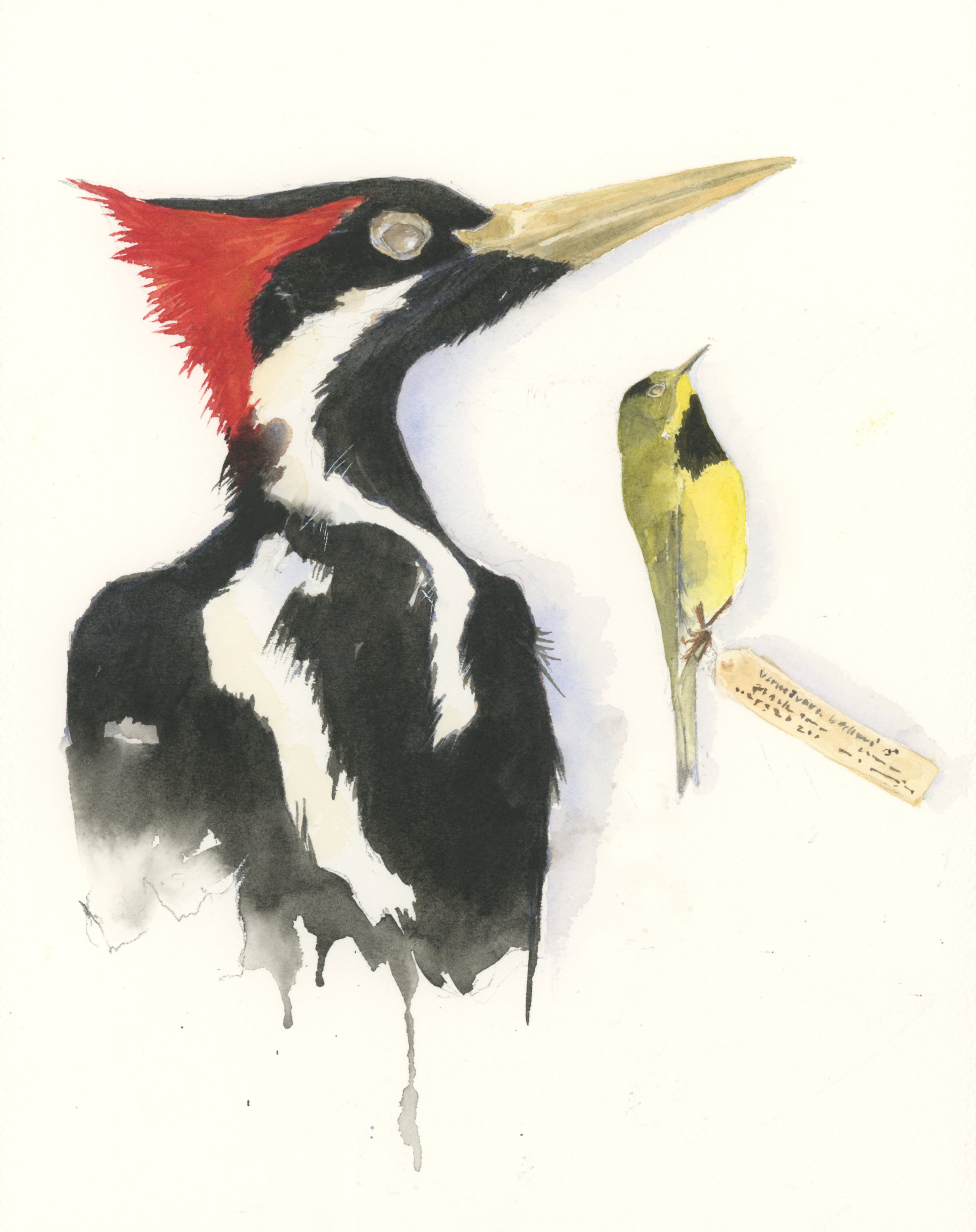
Tips and Techniques– While the idea of depicting these birds alive was appealing, I decided to convey their loss and the fact that seeing study skins and mounts is the only way we’ll ever know them. Bird skins (stuffed, unmounted dead birds) exist in many natural history collections and present an incredible way to look closely at bird anatomy, feathers, feet, and beaks. If you have the chance to work from skins, take it. What you learn will help you immeasurably when you paint birds from life.

Did you say Italy? Book the castle and join me in Italy for an incredible, immersive experience of art and exploration, May 2-9, 2022. Get details and come along! Winslow Art Center >
On My Desk
I should never have opened the seed pod. My desk was already littered with a growing fall collection, art supplies, field guides, and books I hadn’t put away. But it had been years since I opened a trumpet vine’s bean-like pod and I had forgotten what the seeds looked like. Of course, as soon as I split the case I remembered, just in time for an explosion of paper-thin seeds to scatter everywhere, as nature intended. I can also attest that the tiny round seeds of the yellow foxtail successfully dispersed, and I suspect I will be finding them for many weeks to come.

Tips and Techniques– Clean up your work surface every now and then so that you can enjoy a fresh start. Ha! That is my takeaway this week. But the other is to just go with what’s in front of you. You don’t need fancy subjects or perfect compositions. There’s beauty in the small and mundane, too. That’s one of the things I love about nature sketching. There is so much to discover right in front of you.
The Last Golden Light
The field next to our property is in its full glory lately. Bees are buzzing in the goldenrod, asters are blooming in shades of white and purple, and tiny orange jewelweed dots the greenery. Numerous walnut trees border the field and frame the view. The chest high thicket is so dense that I won’t be able to walk in it until January, when the stems are brown, brittle, and matted from heavy snow. But for now, it is at its best, especially as the sun descends in the late afternoon, casting a golden light that reminds me in the most glorious way to pay attention.

Tips and Techniques– This piece takes advantage of an underlying grid to give it structure. I laid it out as a 4 x 3 grid of equal sized boxes and then combined boxes to suit the subject at hand. A limited palette of Hansa yellow medium, Prussian blue, quin gold, and a touch of violet and quin rose also create cohesion among the major elements. You can learn more and see other examples of this technique here and here.
The Shimmer
Did you know that a group of hummingbirds is called a shimmer? Hummingbirds don’t “flock” together, the way many bird species do, so several names have come to describe them as a group. You can also call them a charm, a glittering, a tune, a bouquet, or a hover. Truth be told, I have only seen hummingbirds individually of late, but painting several in different positions seemed a better way to capture their movement, beauty, and vitality.
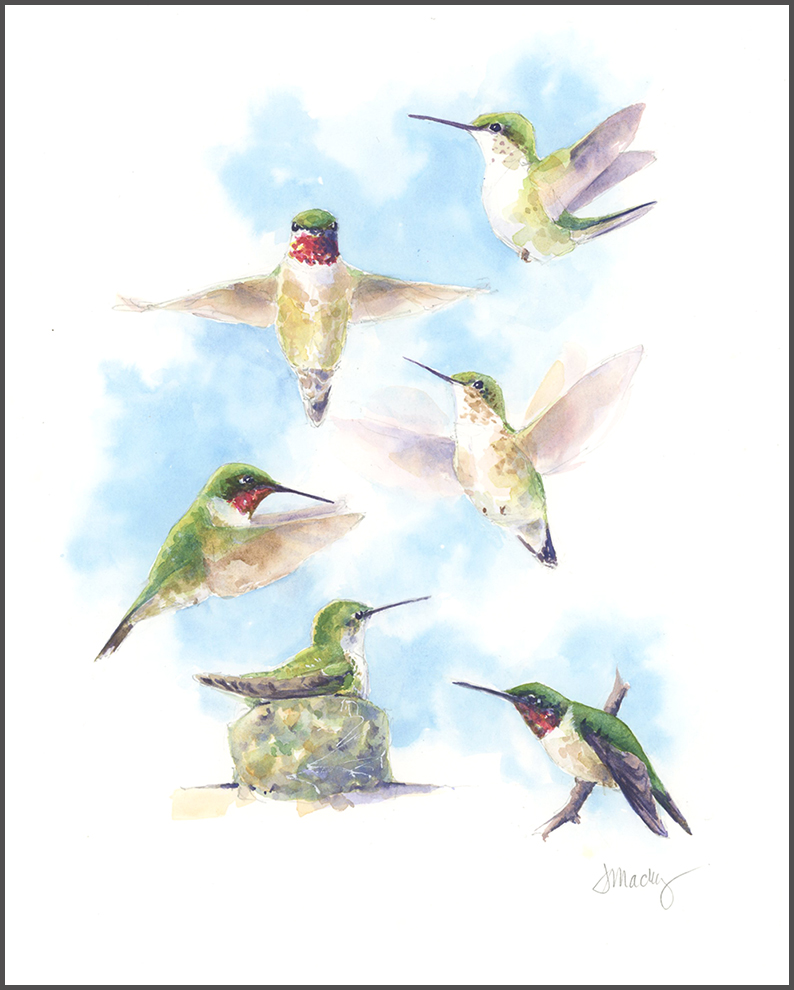
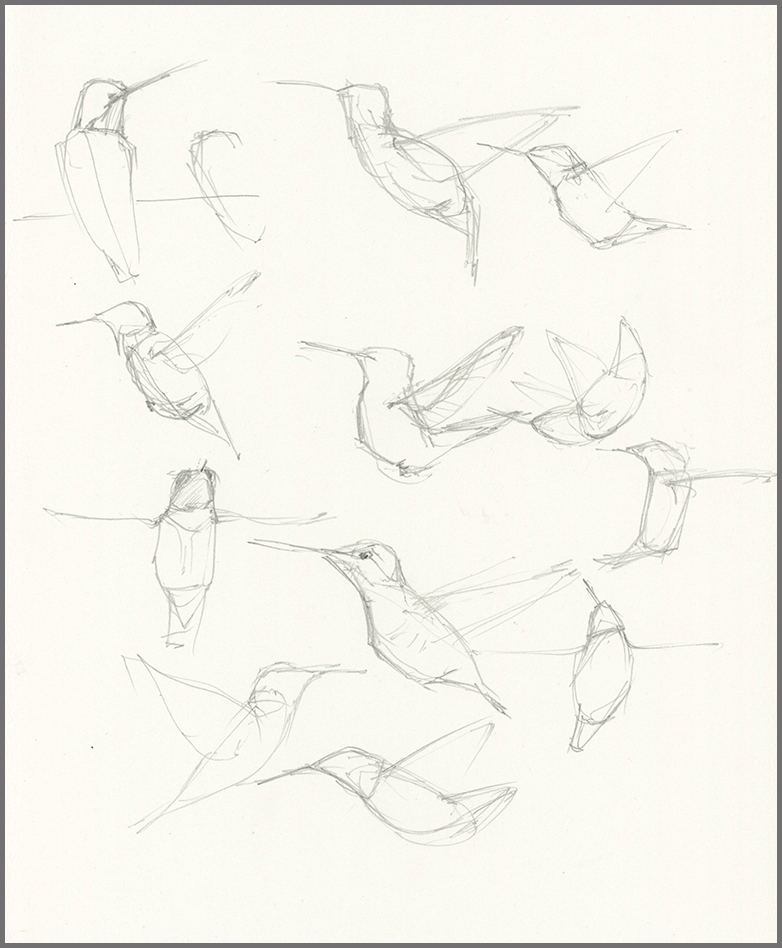
Tips and Techniques– When you are painting birds, do you ever overwork them to the point of killing them on paper? With such complex feather patterns and colors, that’s not an uncommon thing to do. It’s exactly what happened on my first attempt at painting hummingbirds last week. I immediately got too tight, and soon the birds looked static and lifeless. Even though I had invested several hours in the painting, I decided it would be better to start over than to press on. I began again by doing gesture drawings (right) from life and from videos which forced me to convey the bird’s incredible postures and movements, rather than details and colors. From there, I started a second painting (above), working more loosely this time. The lesson: don’t be afraid to let a bird go and begin again if your painting isn’t working.
Join me for FACING BIRDS HEAD ON (via Zoom), a free program on Friday, September 17, 10:00-11:30 AM Pacific Time/1:00-2:30 PM Eastern Time at
Winslow Art Center, and TAPPING AUDUBON’S PASSION: Sketching Birds in Watercolor
Thursday, September 23, 2-5pm (via Zoom) at
Currier Museum of Art. Details on the Workshops page.
Your world for the moment
Too rainy, too humid, too buggy, too many other things to do; so it is that August is nearly over and I haven’t sketched in my garden since June. Determined not to miss the purple hyacinth vine climbing over the garden arbor, inviting me in as intended, I finally took pen and paint to paper. Thank goodness. In the process, I got lost in shades of lavender and magenta, and found a lovely world for the moment. What a good reason to become a gardener or an artist, or both.

Tips and Techniques- I like picking a single flower species and sketching it many times on the same page. I look for some choice blooms as well as ones that are starting to fade or have already gone to seed. Not only do I like learning about the plant, but I also enjoy the challenge of creating a pleasing composition with repeating forms, patterns, and colors. Give it a try. Pick one of your favorite blooms and really look at it. Take Georgia O’Keefe’s words to heart and make it your world for the moment.
HEADS UP! Winslow Art Center is offering a month of free events during September as a show of appreciation to its class participants and an introduction to its programming. Everyone is welcome to sign up– not just former students. Check out the great lineup. I am offering Facing Birds Head On, on September 17.


 Drawn In