
Leaves Down
We know it’s coming; sooner or later, the brilliant colors of autumn leaves will go from trees to ground. After slowly letting go little by little, a strong gust of wind came along last week and blew everything but the oaks down all at once. Suffice it to say, we have a lot of trees surrounding our house and we were blanketed overnight. Which explains this page and why I didn’t post it last weekend.

Tips, Techniques, and a Note…
After working most of the day last Sunday, I wandered around looking for a subject to sketch before sitting on the porch and realizing it was right under my feet in the pile of leaves that I’d swept off the roof earlier. It was a good reminder that starting where you are, as honest and as humble as that may be, is often the best way to begin.
I also wanted to note that I may not post as regularly in the coming weeks. I recently learned that one of my siblings has been diagnosed with a progressive and fatal lung condition and his health seems to be deteriorating quickly. It’s one of the heaviest and most difficult things my family and I have ever faced. I’d like to think that my sketchbook may be a place of solace, but we’ll see. I appreciate your support and understanding.
A bit of weaving
Grass and twigs, pine needles and spider webs, plant fibers and lichen, pen and paint. We weave our nests over hours and days, the birds and I. The birds, of course, are the first artists. I’m just picking it up where they left off, in awe of the fine details and beautiful forms they’ve created.

Tips and Techniques- Sketched with a Micron 005 sepia pen and painted with combinations of ultramarine blue, burnt sienna, raw sienna, and burnt umber. Nests from the collection of the New York State Museum.
The Pleasure of a Soft Pencil
Though I typically pick up a pen and watercolor when I have time for art, I just really felt like drawing this weekend. A soft pencil, smooth paper, and loose lines were just what I needed. I’ve got 30 bulbs to plant and though each one seems unique and interesting, these five will have to do. The spade is waiting.
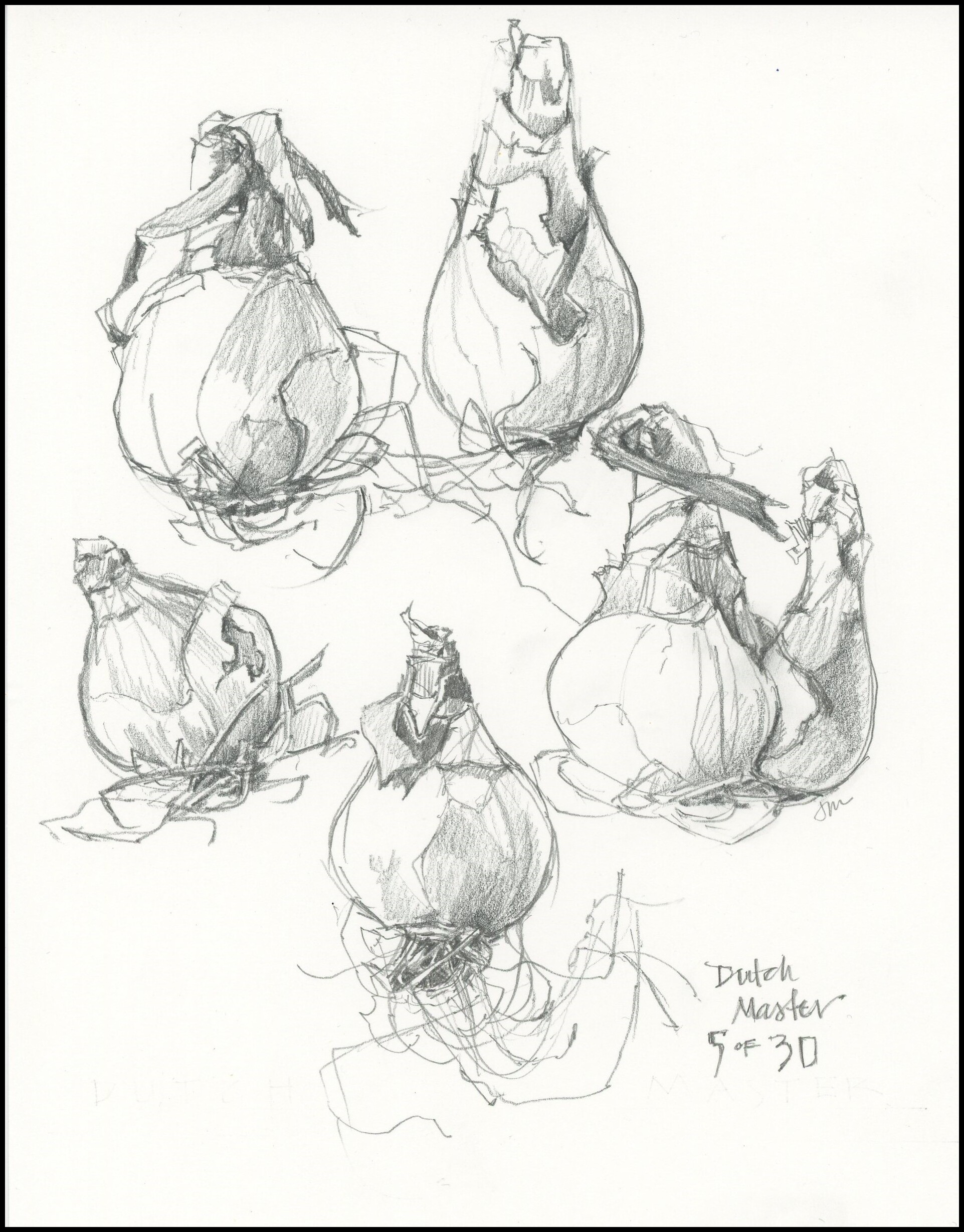
Tips and Techniques- Sketched with a Staedtler Mars Lumograph 3B pencil on Canson Bristol 100lb paper.
Otherworldly Stars
I’m back in the basement collection of the Scripps Institution of Oceanography’s Benthic Invertebrate Collection this week. Not literally, alas, but channeling row upon row of jars filled with bottom-dwelling spineless creatures from the world’s oceans and drawing upon photos from my visit earlier this year. I’m not striving to bring these brittle stars and sea stars back to life on the page, but rather to highlight their beauty and understand their complexity. Even though they have been “living” in jars for fifty years or more, I like thinking about how they once dwelled in the ocean, and I am glad they will live on for many years to come for researchers, students, and artists.
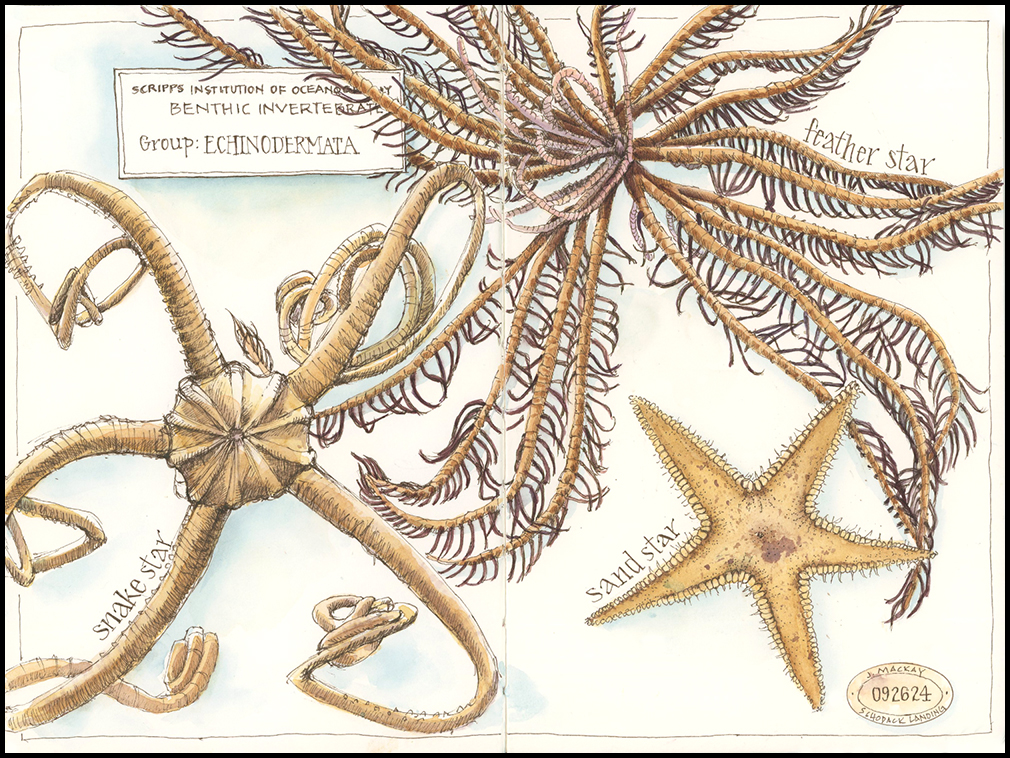
Tips and Techniques– Don’t overlook the dead stuff! Drawing specimens is a great way to study living species, to understand underlying anatomy, and to draw creatures that are not moving. Most museums will allow you to sketch in pencil or pen, nature centers may have kits you can take home, and university collections are sometimes available to artists. If you want to join me and get in on the action, check out Collecting Nature, Exploring Museum Collections.
Indian Summer
Back in my own habitat this week, I enjoyed sitting and sketching in the field in the warmth of Indian summer sunshine. The goldenrod is in its glory, while other plants are fading. Still, I like showing flowers past peak and I find their curling petals and dried seedheads as worthy of sketching now as when they were in their prime.
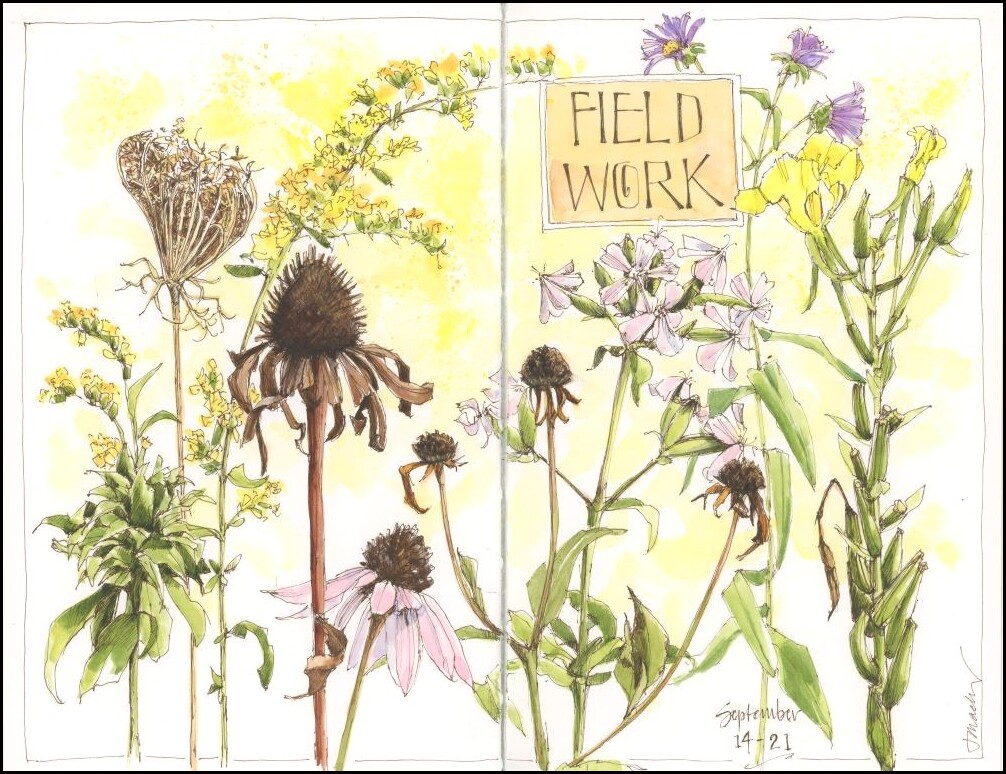
Tips and Techniques– Consider not only what you want to convey with your subject, but also how you want your page to feel. After sketching this page using a sepia 005 Micron pen, and adding color and the title, I decided to add a loose wash of yellow in the background. That choice gives this page added warmth and offers a nod to the abundant goldenrod in the surrounding field. Had I chosen not to add yellow, or to use blue to mirror the sky, the page would look quite different, and much cooler.
Diving into Seaweed
How often have you walked along the seashore or a rocky beach and not given a second glance at one of the most important players in the ocean: seaweed. Seaweed, or marine algae, live in the marginal world between the tides and in deeper waters where sunlight still penetrates. Arguably, they are the key to life for the world’s oceans and the larger species that we notice and care about. But as an artist, the variety, color, and beauty of algae are just as fascinating.
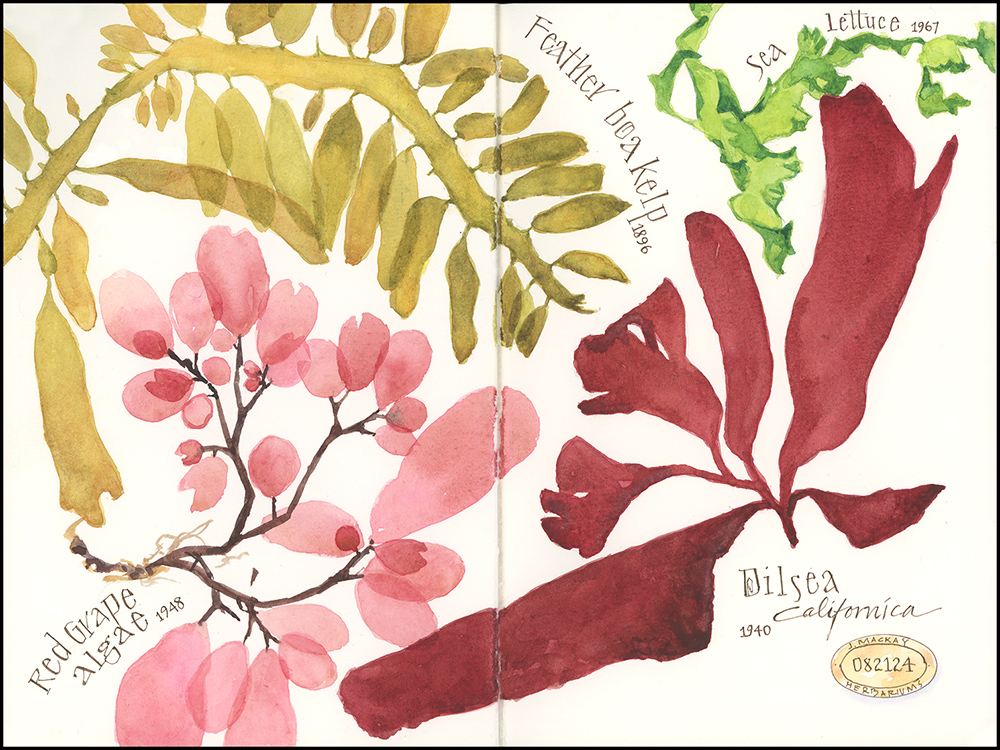
Seaweeds are identified and grouped by the color of their reproductive spores: green, red/pink, and brown. The color of their fronds varies widely but derives from just a few pigments in their cells. Green algae have green pigments only. Brown algae can range in color from golden to olive to dark brown with just two pigments, green and brown. Red algae have red and blue pigments, as well as green, which gives this group an incredible color range from pink to maroon to purple.
The algae on this page come from herbarium collections. The oldest dates to the 1890s, a time when algae pressing was not only done for scientific study, but also as a popular artistic pursuit.
If you would like to take a deeper dive and paint algae with me this fall, check out my new online class series Collecting Nature in Ink and Watercolor starting Tuesday, 9/24 at Winslow Art Center. The series also includes sea stars, butterflies, and nests. Visit the Workshops page for additional fall classes.
Leap of Faith
With nesting season over and summer on the wane, birds have quietly started to leave us. Most go south, making incredible journeys across land and ocean. But others simply go out to sea, where they spend the winter riding the waves. The beloved Atlantic Puffin is one such seafarer. Along rugged coasts in the North Atlantic, young birds born just this year jump from islands and cliffs where they were reared and head out into the open ocean alone. Their parents do the same, spending the next eight months at sea. I love the thought of those young birds taking a leap of faith into unknown waters and living in that wild expanse of ocean in the months and years to come.

Tips & Techniques– This is the final painting in my Seabird Portrait series. The Atlantic Puffin joins the Northern Gannet, Common Tern, Black Guillemot, and Double-crested Cormorant. When doing a series, it’s helpful to carry some similar elements through each piece. It could be the text style, color palette, layout elements, or similar subject matter. As you can see, there are some variations here, but the series mostly hangs together. Have you ever done a series? What are your tips?


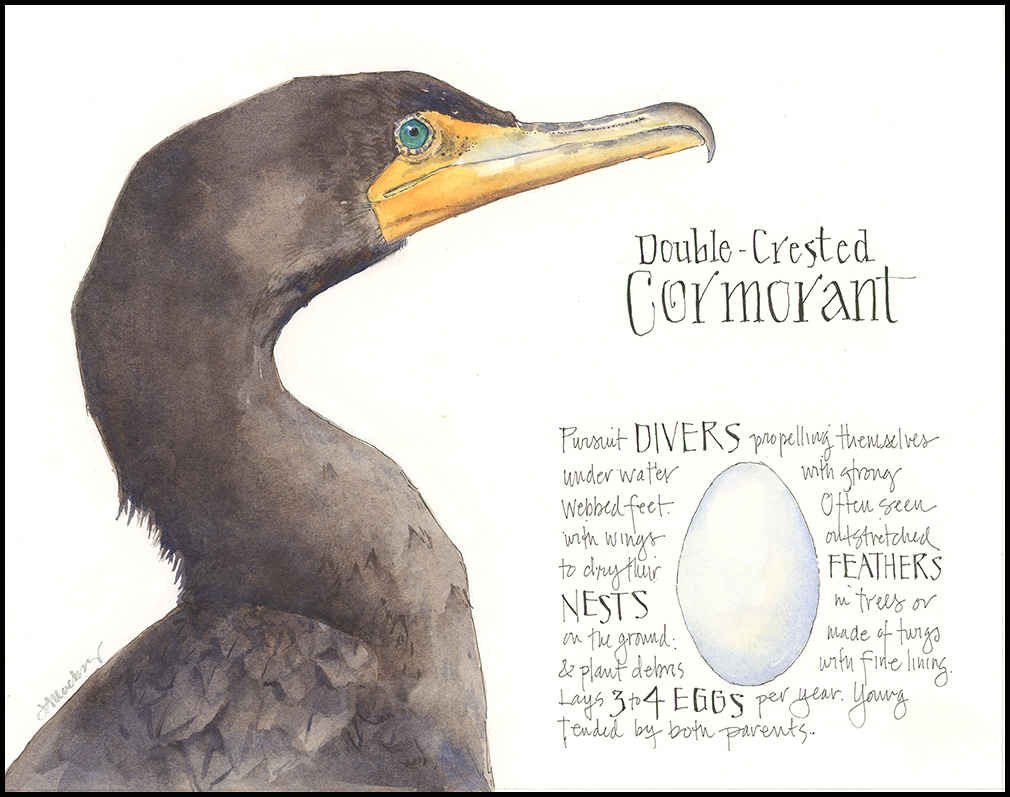
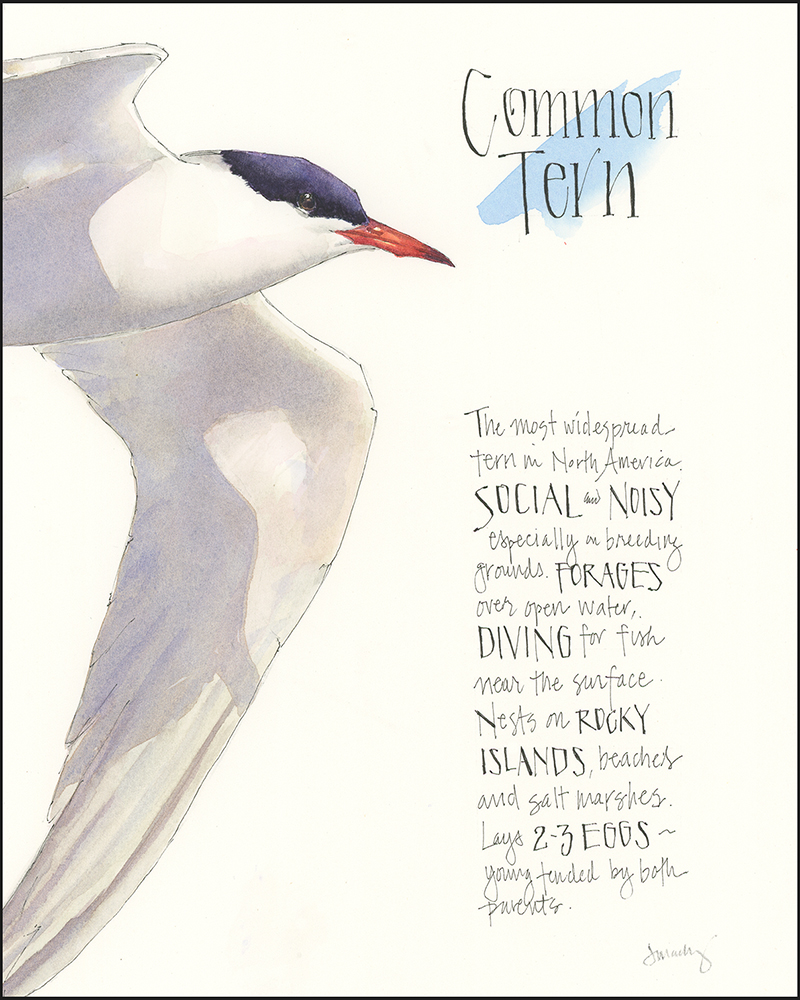
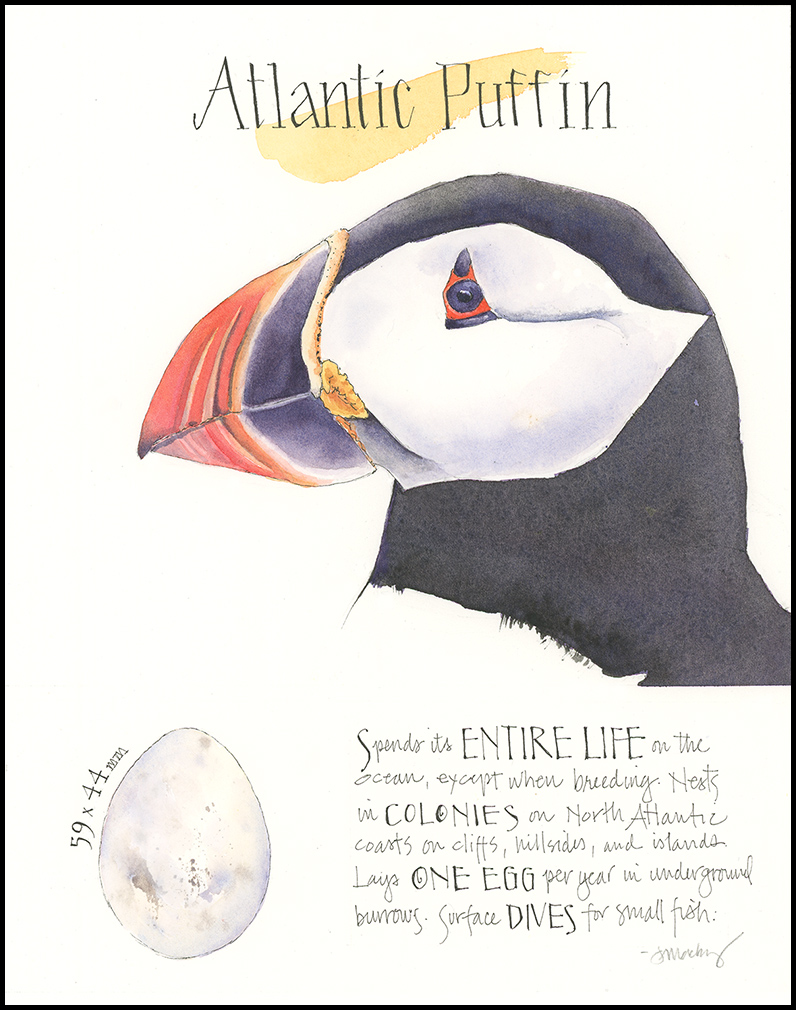
Coming up: I have new in person and online classes coming up this fall. I’d love you to join me!
Finally! Mushrooms
I’ve been waiting patiently for mushrooms to come. It’s been hot and humid. It rained. It was humid again. Perfect mushroom weather. Still, I waited. Mushrooms, it seems, have a mind of their own. Some years they come. Others, they don’t. One year there are twenty or more varieties. The next year ten. And then, finally, they appeared. I seized the moment and here’s the result.

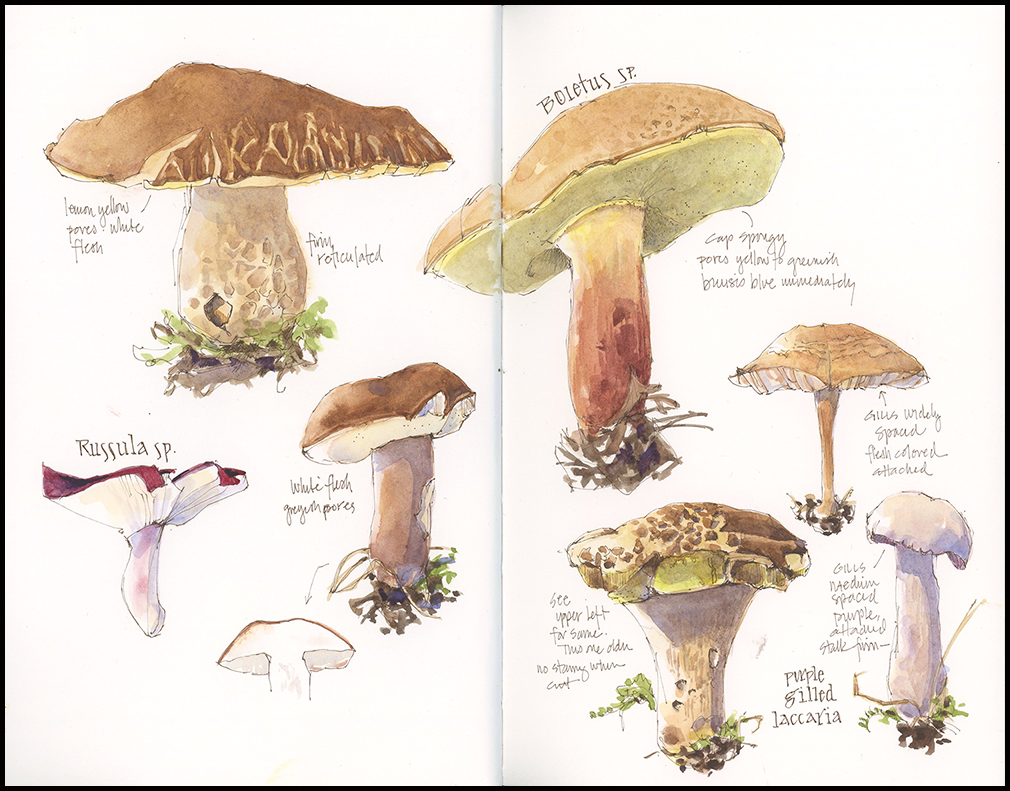
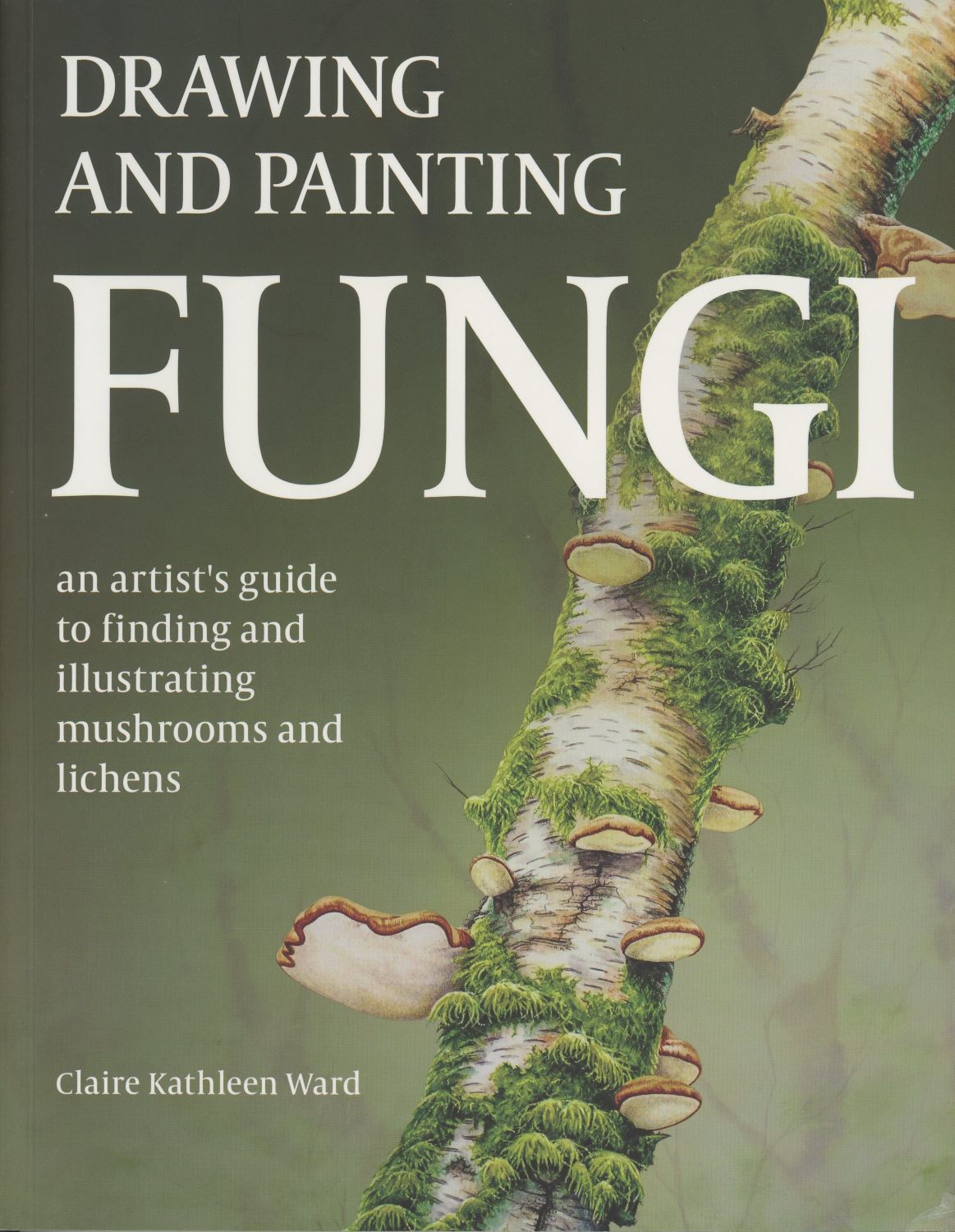
Tips and Techniques– If you are a fungi enthusiast—or are intrigued to know more—I highly recommend Drawing and Painting Fungi, An artist’s guide to finding and illustrating mushrooms and lichens by Claire Kathleen Ward (Crowood Press, 2024) Ward’s book is not only amazingly comprehensive and incredibly beautiful, but also a joy to read. It’s illustrated with Ward’s detailed drawings and paintings, as well as artwork by others, including yours truly. I realize that makes me a biased reviewer, but believe me, this book is a triumph.
It never gets old
When bird nests are carefully preserved, they can last a long time. The ones you see here were constructed and collected at least 100 years ago. They eventually found their way into the ornithology collection of the New York State Museum in Albany, where they were carefully wrapped with cotton batting, boxed, and stored in metal cabinets. I was thrilled to get a peek inside recently and be allowed to take out several nests to photograph and sketch. I’ll use the photos in upcoming classes and projects, but seeing the real thing was a treasure. Like the subject itself, sketching nests just never gets old.

Fall Workshops– I’ve just listed several in person workshops for fall 2024. If you live near New York’s Capital Region or Massachusetts’ Berkshires, I’d love for you to join me. Plus, Winslow Art Center has just announced is lineup of travel workshops for 2025– I’ll be teaching one in Italy in October 2025. I’ll post a new online class through Winslow Art Center soon.
Hidden in Plain Sight
Most birds protect and conceal their eggs in carefully constructed nests, in tree cavities or underground burrows, or high on rocky ledges and sea cliffs. Not so with terns. These seabirds nest together in colonies and lay their eggs right on the ground on small islands and stony beaches. Terns make just a small scrape on the ground and the females add beach debris or dead vegetation, shell fragments, or stones to provide some camouflage. The beauty and success of this strategy lies with the eggs and chicks themselves, whose markings blend perfectly with their surroundings. Hidden in plain sight, you could easily walk right by– or on—them and never know it. Hence, the protective fencing on beaches where terns nest. This Common Tern hatched on an island in Maine monitored by the Audubon Seabird Institute and, to the best of my knowledge, is now out flying over the waves of the Atlantic.
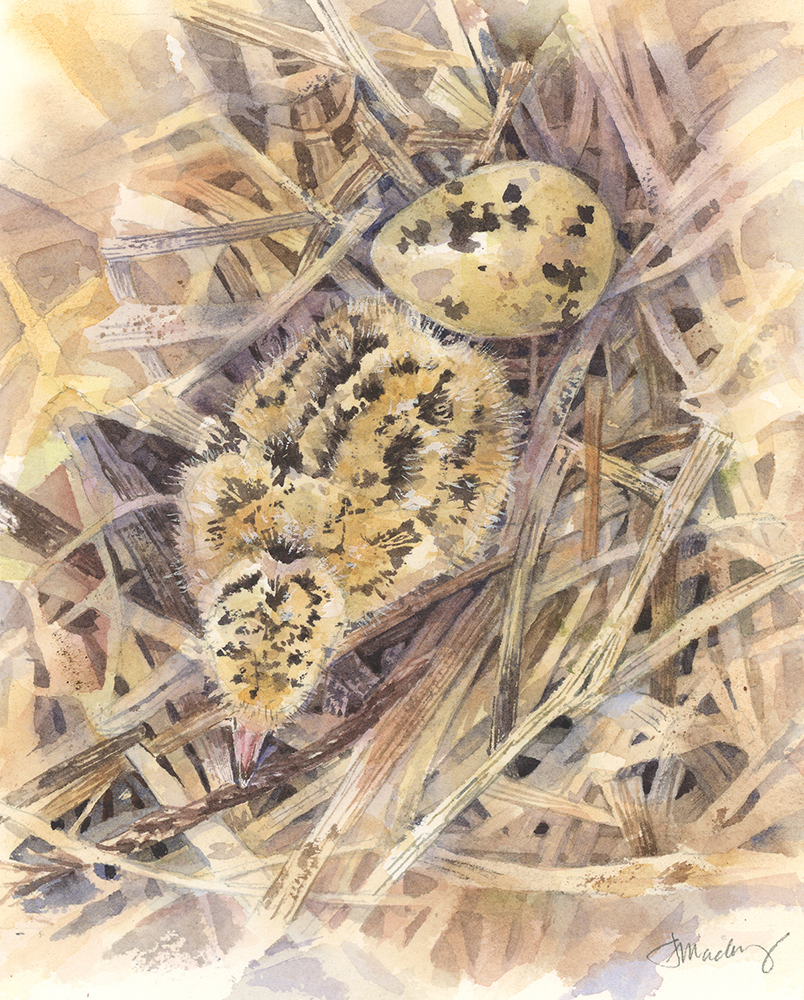
Tips and Techniques- Patience is a virtue, but especially so when doing a piece like this. Walking away and coming back can help you see things more clearly when painting a complex subject. I worked on this for an hour or two at a time over several days, chipping away strand by strand. Each time I returned to it, I had a fresh perspective on what to tackle next. Even if you just leave a painting overnight, you’ll often see things you missed when you return to it or feel confident calling it done when you take another look.


 Drawn In