
May Showers
So much for April showers bringing May flowers! We’ve had more than our share of May showers, too. The flowers have come despite the wet weather, but it’s been hard to get out to enjoy it all. I’ve been sketching in snippets of time, trying to capture blooms before they’re knocked to the ground. I started these three pages weeks and days ago but haven’t had time to finish them. So, for better or worse, today’s downpours gave me time to paint. Here’s hoping May showers bring June flowers…and a bit of sunshine.
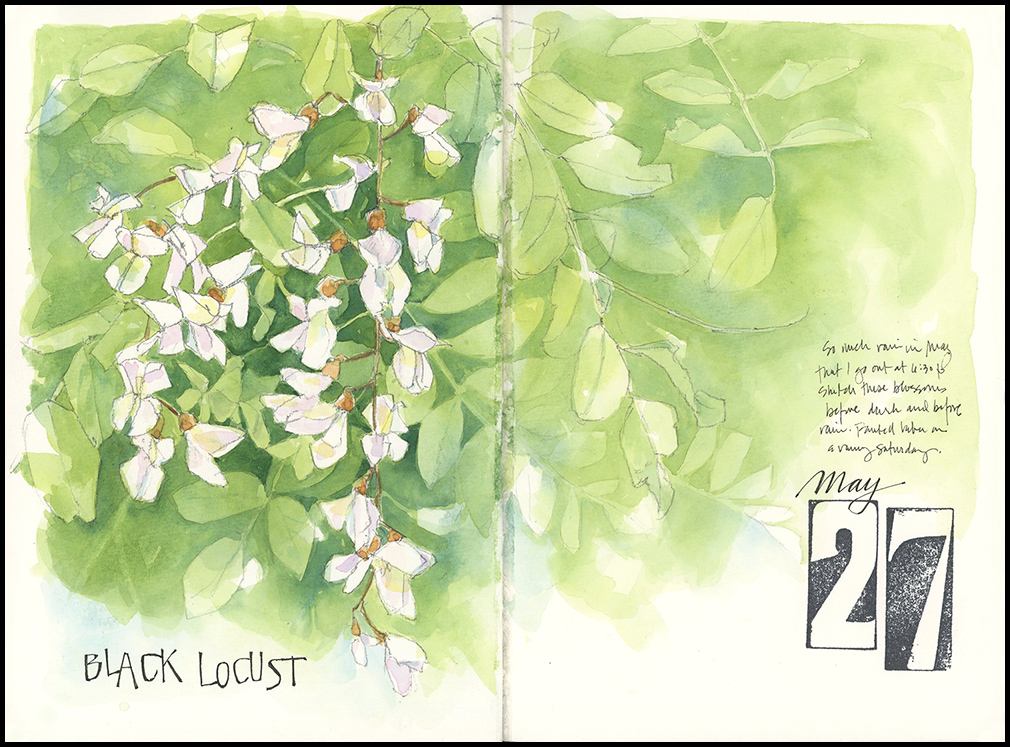
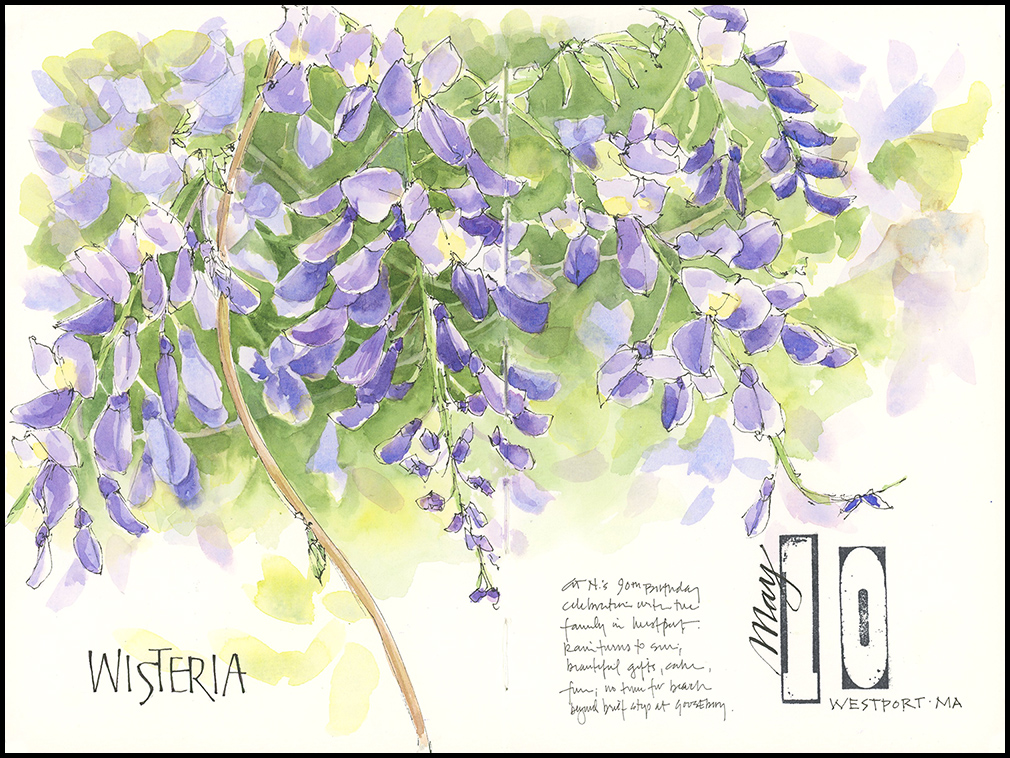
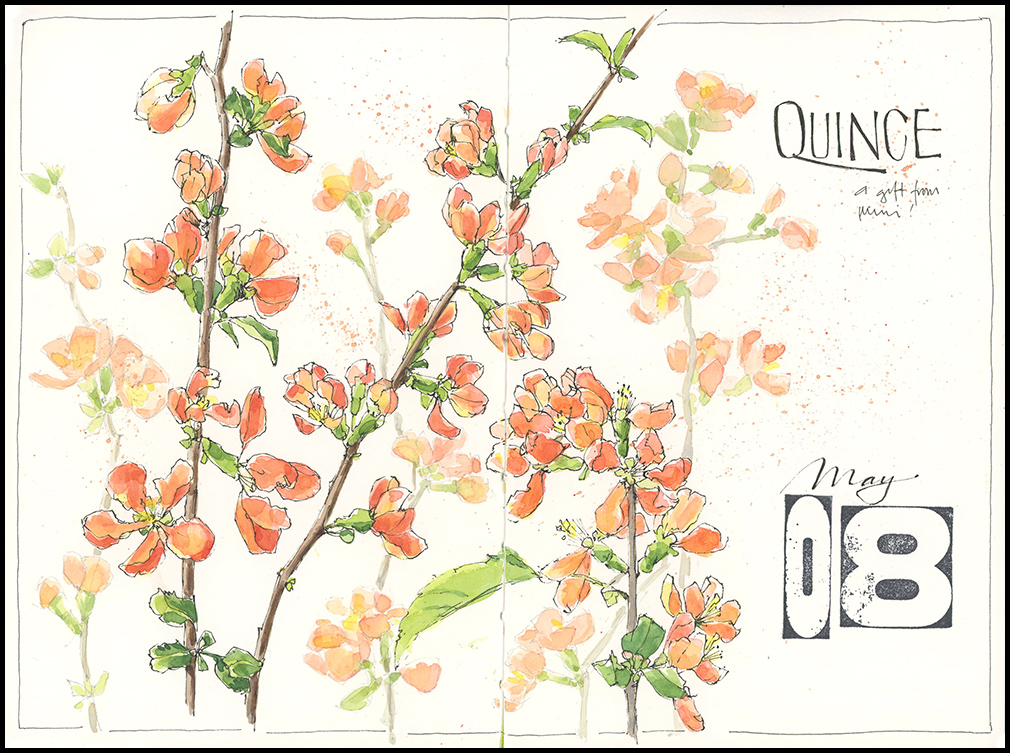
Tips & Techniques- The delayed finish for these three pages gave me time to think about how to treat them in a way that might tie them together. My large number stamps for the date and use of a consistent text style did the trick. Though the stamp is bold, it helps to balance the pages, adds an element of fun, and fits the looseness of the drawing style. I think I’ll continue using it. I missed capturing my allium, but I’ll try it again when the poppies bloom.
Stopped in My Tracks
While out for a run last week, this giant mushroom on the side of the road quite literally stopped me in my tracks. I took a quick look and knew I had to sketch it. Driven by curiosity and enthusiasm, I managed one of my fastest two miles in recent memory completing a loop that led me back to it. The mushroom was so large it wouldn’t fit life-sized in my sketchbook, so I used a 9×12” sheet of watercolor paper. I’ve since returned to the small grouping of mushrooms where this one grew and memorialized a smaller one in my sketchbook. But this one will always be king.
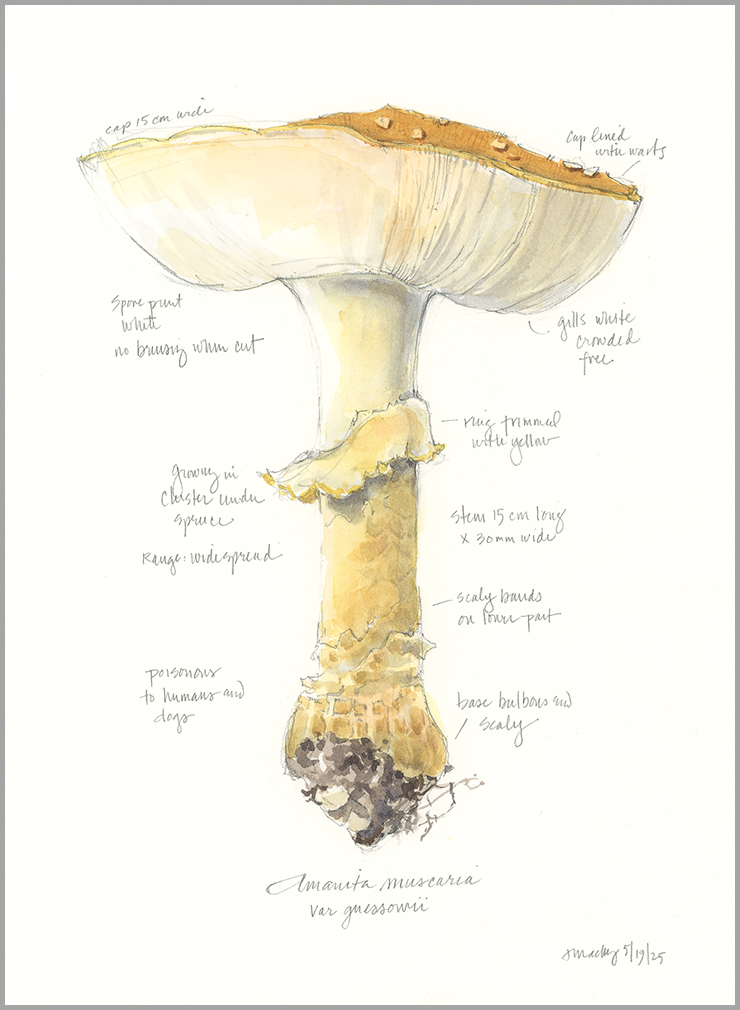
Tips & Techniques– You needn’t take up running to find great nature subjects, but spending time outside is key. When you’re out walking, cycling, mowing the lawn, or gardening, take note of what’s happening around you— start with what’s blooming that wasn’t last week or with the bird songs you hear. Let a of spark curiosity or wonder lead you to pick up a pencil or pen and see where it takes you.
Front and Center
I have several half-finished flower paintings in my sketchbook and allium in bloom that’s calling me from the garden. A Louisiana waterthrush is singing to beat the band by the streamside and a blue-winged warbler just showed up in the thicket by the woods, but there aren’t enough hours in the day to capture them—yet. I just wrapped up teaching The Art of the Bird, so nests have been very much front and center on my desk. At risk of seeming single-minded, I hope you’ll indulge me with another nest posting before I get going on the rest of spring.

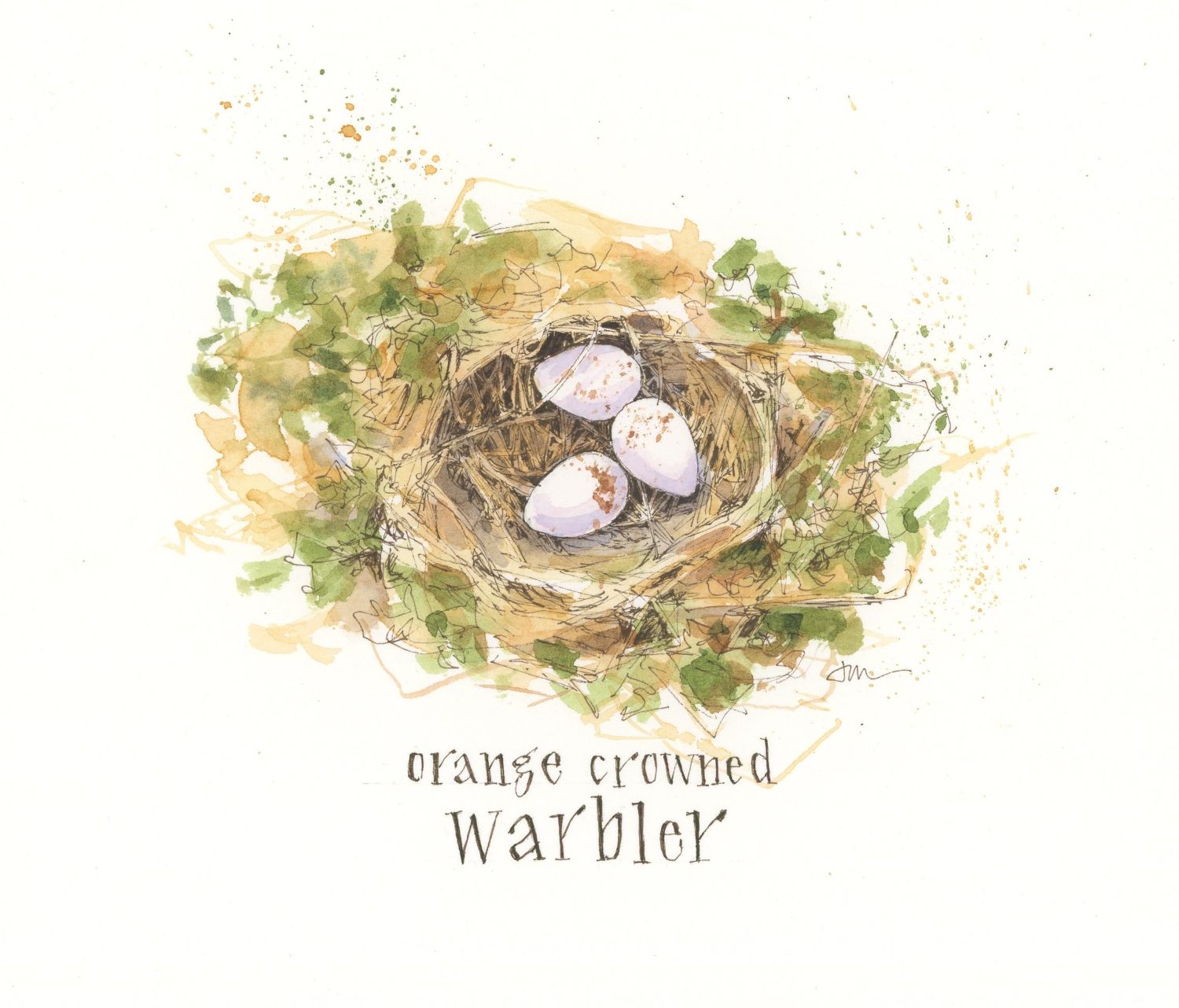

Tips & Techniques– No matter your subject, it’s important to pay attention to developing a full range of values from light to dark. Especially with a nest, where it’s easy to get lost in the details, it’s important to start light and build to the darks and details. My students worked on nests that were increasingly complicated, but by paying attention to the light and shadows, they came away with nests that had interest, depth and beauty.
A Lovely Beginning
I found four bluebird eggs in a carefully woven nest of fine grasses in our nestbox today. I suspect that there will be five tomorrow, and then the female will begin to incubate them. Waiting until a full clutch is laid ensures that the young birds hatch, grow, and fledge together. Most of the other songbirds that nest here are just getting started or are yet to return. New songs fill the blossoming woods and fields each day – what a lovely beginning for the new season.
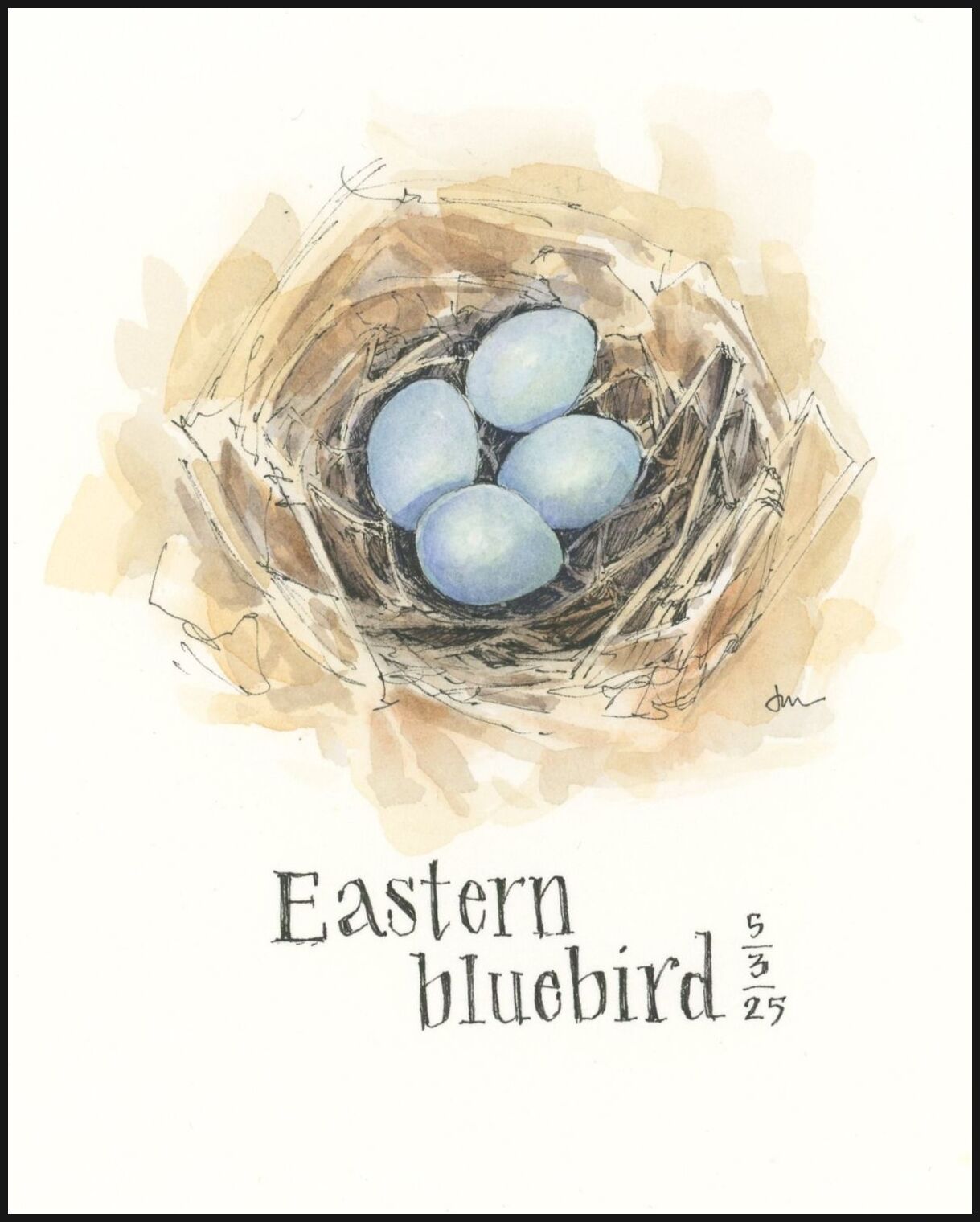
Tips & Techniques- When painting a nest that is made of very fine materials, you might decide just to focus on the eggs and suggest the nesting material. Some careful pen or pencil lines and loose paint will often do the trick. And a word of caution: If you find a nest with eggs at this time of year, snap a photo to work from rather than sketch it in the field. This will create the least disturbance for the birds.
Spring Begins with Yellow
Bright pops of color against a landscape of brown, gray, and increasing green, who wouldn’t be happy about yellow flowers in early spring? Not only are we heartened by the blooms, so too are the flowers’ pollinators. Flies are among the first insects to awaken in spring. It turns out that they lack color vision, but they can perceive bright blooms against a darker background. And although they add moments of annoyance while sketching, I have to give them their due in service of spring.
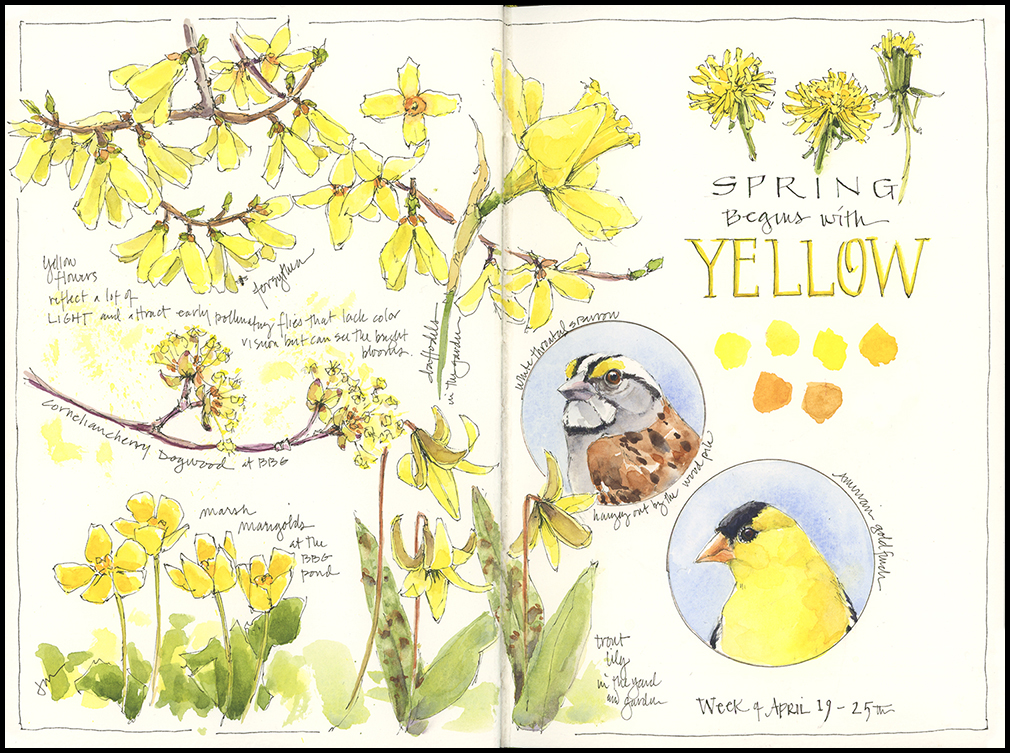
Tips & Techniques– If you want to sharpen your color awareness, choose one color and fill a sketchbook page with it. Test out different pigments to see which hue suits your subject best. You can do this at any time of year, but it always seems to work best in spring when shades of greens, yellows, violets, and pinks abound.
Painting the Colors of Spring, May 17 (Pinks and Reds) and June 14 (Greens), 10am-2pm. If you’re in New England, join me for the upcoming sessions of this in person workshop at the Berkshire Botanical Garden in West Stockbridge, Mass. Click on the link at the end of the individual session to register. The May session is waiting list only, but there are still spots for June.
A Welcome Sign
Today, I bring you Skunk Cabbage, Symplocarpus foetidus, one of my favorite spring plants. I love its hardy nature– poking up even through the cold ground in its eagerness to welcome spring. Its hooded spathe and hidden spadix are gorgeous, if perhaps overlooked or underappreciated. Its roots are also absolutely incredible: strong, deep, and grounded. And its unfurling green leaves, bright in sunlit wet woodlands, are a reminder to tap our own inner strength, push through the mud of adversity, and shine forth.

Low Tide Sampler
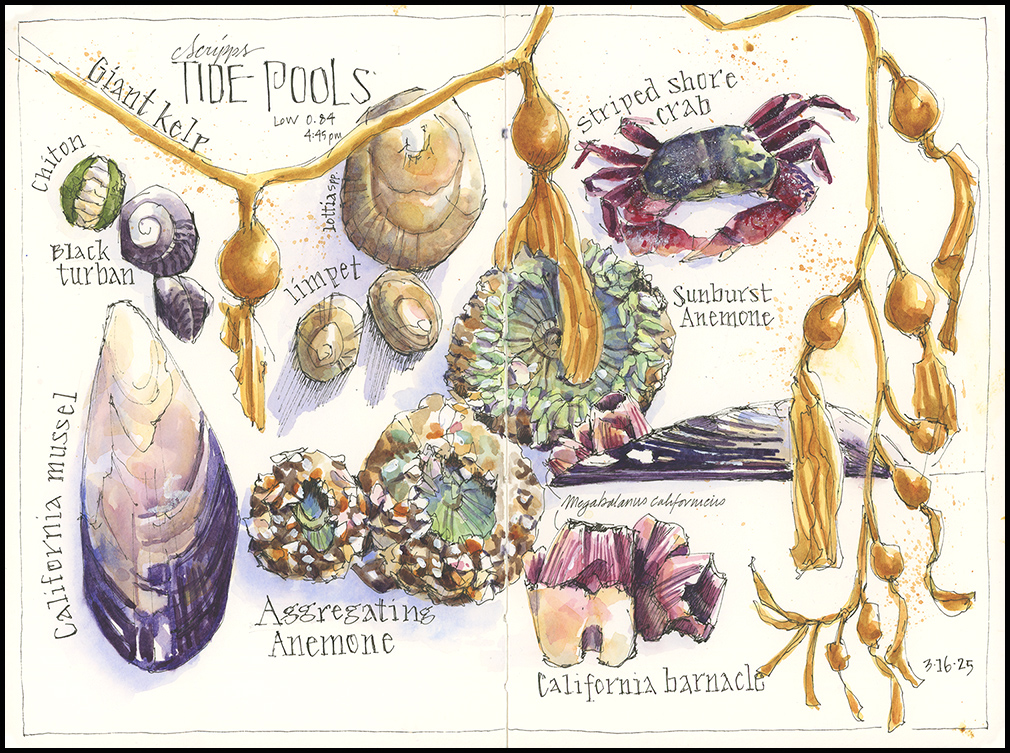
I’m continuing to explore tidepool life from our recent trip to California, while it snows on our daffodils here in New York. This Low Tide Sampler includes several phyla of animals commonly found along the coast. Species within each group share characteristic traits and, once you get to know them, it becomes easier to identify species that are new to you and to recognize features that resemble their relatives. The Pacific sand dollar, for example, is like a flattened sea urchin; its five starred pattern resembles its relatives, the starfish. I especially love the way exploration, art, and learning come together on a page like this. Pick any species in nature and you can enjoy a similar deep dive!

I’m hoping the weather warms and it stops raining and snowing here in the Northeast so I can return to sketching outdoors close to home. If you live in this area, consider joining me for Painting the Colors of Spring at the Berkshire Botanical Garden in West Stockbridge, MA, starting next Saturday, April 19. This series includes three Saturday sessions that you can sign up for individually or altogether: April 19, May 17, June 14, 10am – 2pm. It would be lovely to see you in person! (Note: click the link next to the individual session if you want to sign up for just that one in the series.)
It’s all about water
On our recent trip to California, we visited the Pacific coast near San Diego and the desert at Anza Borrego Desert State Park. In both places, adapting to life with and without water influences everything. On the coast, we explored tide pools, where twice a day species that live on the margin between ocean and land showcase a myriad ways of staying moist when the tide goes out. The area we explored is a designated marine reserve which helps protect the rocky and sandy intertidal areas these species rely on.
In the desert, plants and wildlife tap into what little water there is and hold onto it with tenacity. We hiked along a dry wash up to a small oasis where birds, insects, and other wildlife find water and are sheltered by California fan palms, the only native palm tree in the state. Hummingbirds buzzed everywhere and I was thrilled to hear Canyon wrens and see a pair of Loggerhead shrike.
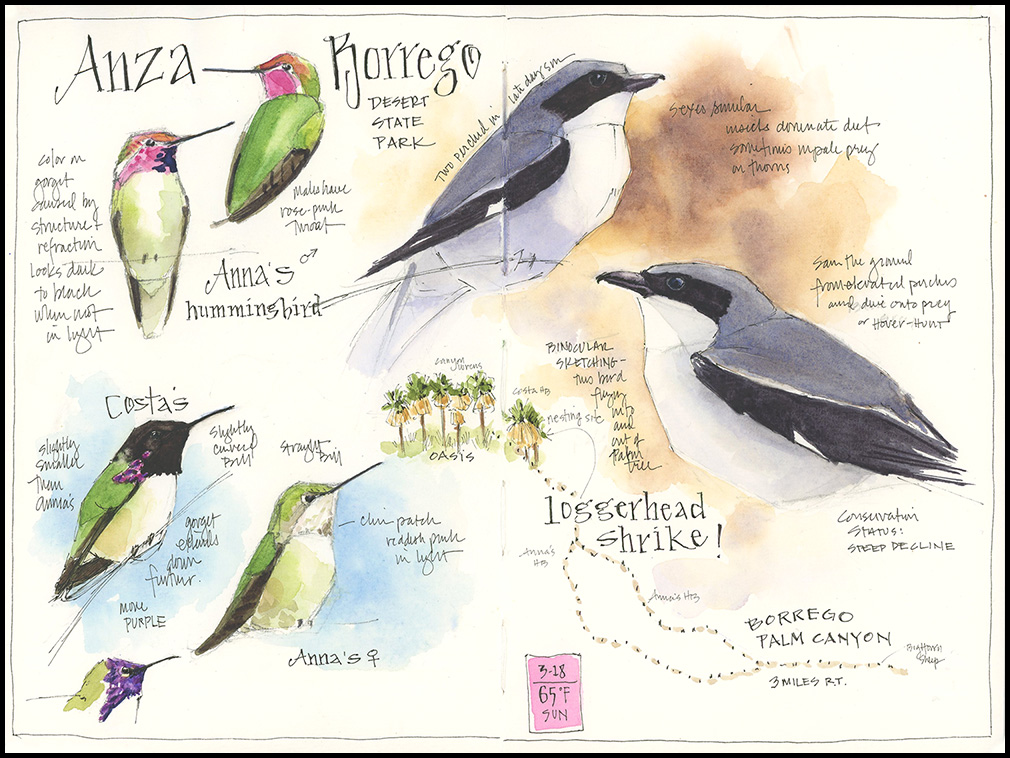
For people, too, it’s all about water. While its hard to argue the attraction to sunny weather and coastal living, the cost is clear. San Diego imports 90-percent of its water from Northern California and the over-used Colorado River. Ninety percent of California’s coastal wetlands have been paved over and built upon.
We visited a restored wetland at San Elijo Lagoon Ecological Reserve, and it was a treat. More than 40 percent of North American bird species have been sighted here as they migrate north and south. I haven’t encountered American Avocets or rattlesnakes in many, many years. So, despite being rather startled when I nearly walked over the snake, I consider myself lucky to have seen both.

Our journey through aquatic and arid landscapes underscored the profound importance of water as a critical lifeline. As I sketched and enjoyed these preserves, the value of stewardship was ever present. Our adventure in California was a vivid reminder that every drop counts.
Tips & Techniques- There’s so much to learn when traveling. Lead with curiosity and use your sketches as an opportunity to explore more!
Winslow Art Center’s Spring Fling Festival is coming up April 10-13. It’s a great chance to sample instructors and take advantage of free classes. I’m leading Sketchbook Happy Hour on Friday, 4/11. Check it out!
Deep Dive
I had the privilege of doing a deep dive into two incredible collections at Scripps Institution of Oceanography while visiting California last week. The Marine Vertebrate Collection contains two million preserved fish specimens representing 5,600 species. The benthic invertebrates include 800,000 specimens and 7,600 species. These have been collected over decades from diverse marine habitats, including coral reefs, seamounts, hydrothermal vents, hydrocarbon seeps, the abyssal plain, and deep trenches. If you don’t mind dead creatures in glass jars, it’s awesome.
The curators of both collections gave me time to wander through the collections and set up spaces in their labs for me to paint. I could have spent my entire vacation there, but then I would have missed walking the beach and poking in tide pools, birdwatching in coastal wetlands, and exploring the desert. Those sketches are coming soon.
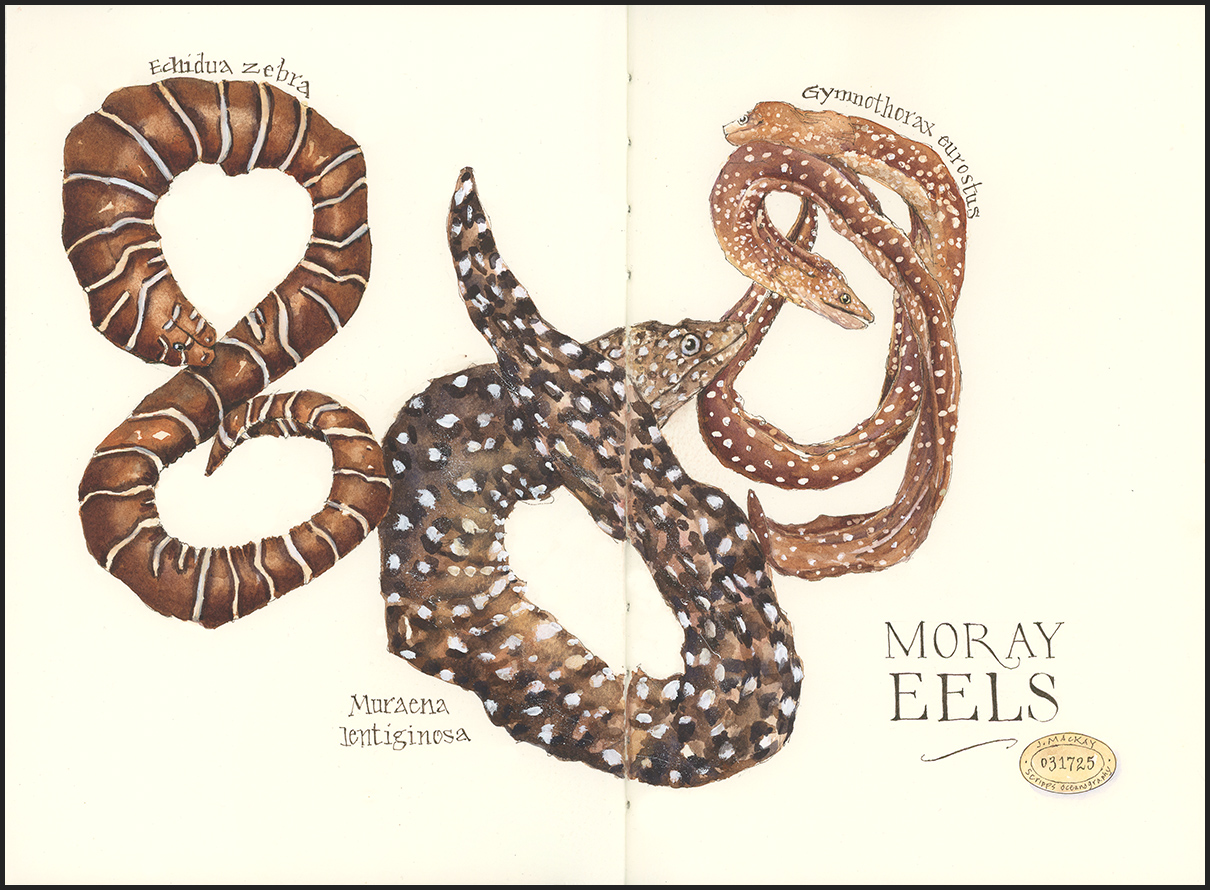
The colors and patterns of moray eels, though faded out of water, remain spectacular.
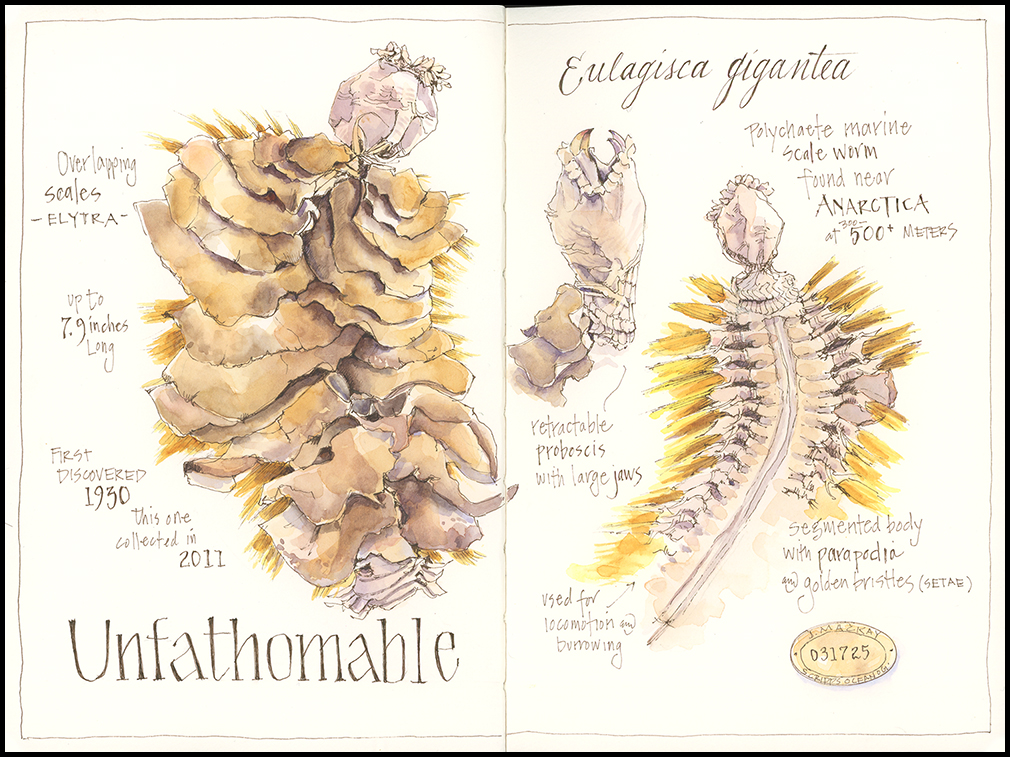
I had no idea what this was when I selected it; I just knew I’d never seen anything like it. As it turns out, few people have, since it is a marine worm that lives in deep, cold Antarctic waters.
To learn more: Watch this video to go behind the scenes of the Benthic Invertebrate Collection or visit the Scripps collection website.
I have online and in person classes coming up– check them out on the Workshops page.
Lasting Construction
The Eastern Towhee is a bird of forest edges and shrubby fields where they scratch around on the ground for seeds, fruits, grains, and insects. I see them occasionally foraging under our shrubs and I hear them frequently in spring and summer calling from the brushy field bordering our property. What I’ll never see is their nest in the wild, which is always well concealed on the ground. Hence, I put the towhee on my short list of nests to pull from the shelves when I visited the NYS Museum ornithology collection in 2024. This one is a perfect construction of grapevine bark and small twigs. Built by the female in about five days with the intention of lasting a season, this one is more than 125 years old.

Tips & Techniques– While I like the energy inherent in sketches where time is limited, I sometimes lament the sloppiness that can come with it. In contrast, I find it satisfying to work slowly and see what I can achieve by being more careful. This piece is clearly in the slow category. Try working both ways. It will give you options for picking the approach that suits your time and the subject at hand, and push you to become comfortable with both.
The Art of the Bird— If you’d like to learn more about sketching and painting nests (as well as eggs and feathers), check out my upcoming online class, The Art of the Bird. Starting Tuesday, April 1, this 2-hour class is every other week through the beginning of May through Winslow Art Center.


 Drawn In