
In Cold Rain
A cold rain is falling on the winter beach. A solitary loon, a few surf scoters, and a flock of bufflehead bob in the steely-gray water, disappearing now and again beneath the waves. This is no day for sketching seabirds. I retreat to the car and drive to a windswept spit of land that divides ocean from tidal marsh. A flock of gulls are right where I had hoped they’d be at the edge of the parking area, facing into the wind, occasionally preening or picking at clams or flying up and settling back down. I crack open my sketchbook in the front seat and draw. Gulls are perfect subjects, striking a variety of poses until the page is filled and I go home for tea.

click to view larger; watercolor in Stillman & Birn Zeta sketchbook
Spreading Magic
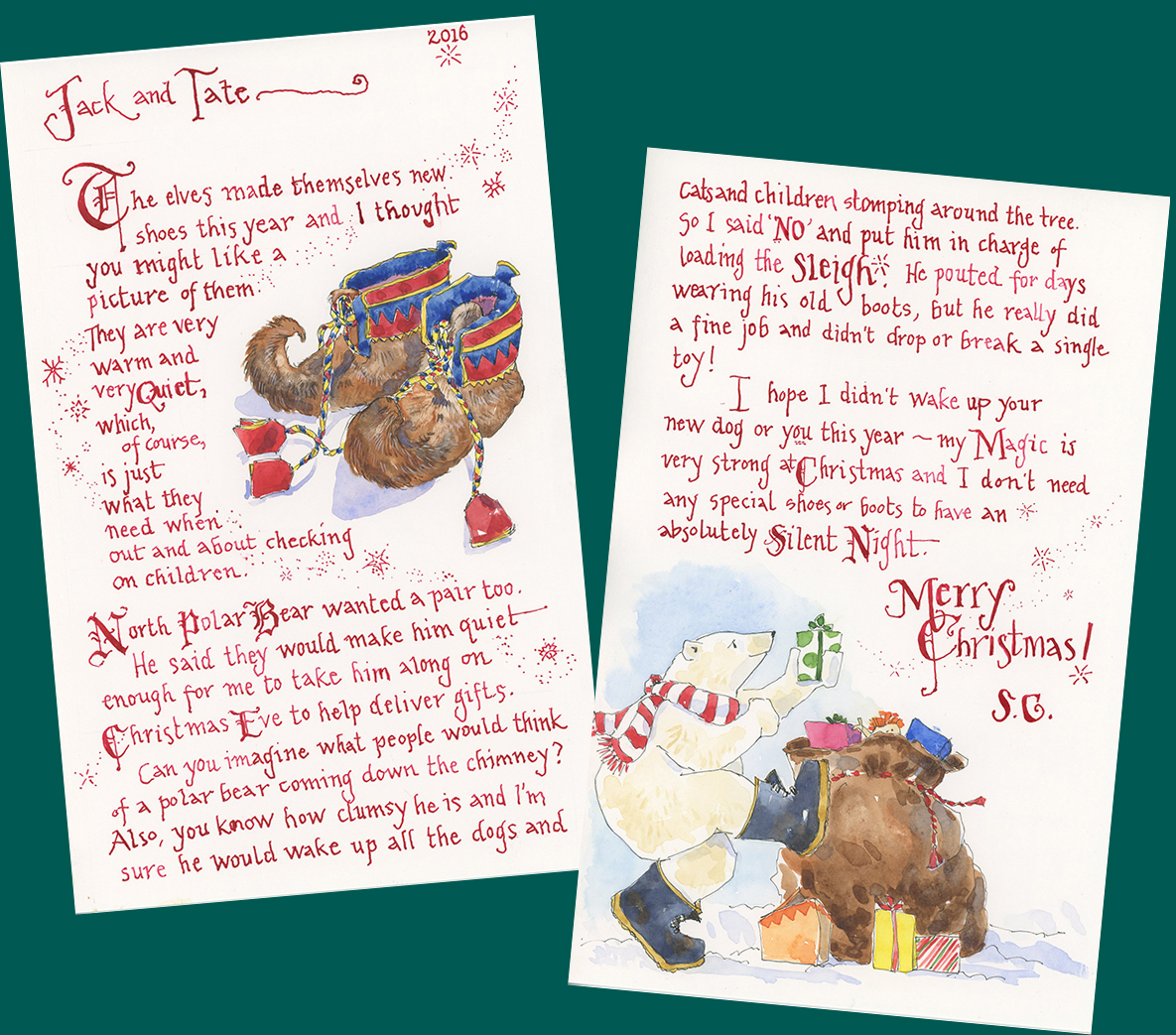
‘Tis the season to spread a little magic! If you’ve ever read J.R.R. Tolkien’s The Father Christmas Letters, you know what a gem they are. Full of beautiful illustrations and humorous stories, the letters Tolkien wrote to his children from Father Christmas spanned 20 years from 1920 to 1942. Those letters inspired me to pick up Santa’s pen when my children were growing up and, years later, to continue the tradition with letters to my neighbor’s children, now ages nine and seven. I often do a little research on the North Pole to put me in the right frame of mind before writing. A photo of colorful fur boots from Lapland caught my eye this year and sparked the story.
Wishing you a wonder-filled holiday and the chance to spread some magic of your own!
click to view larger
Holiday Rush
Forget shopping. Making and giving holiday gifts is one of the things I like best about the holidays…but the final rush is definitely here. With a week to go before Christmas, creative ideas and good intentions are flowing as fast as the hourglass fills. So…a quick post today of one of my latest projects.
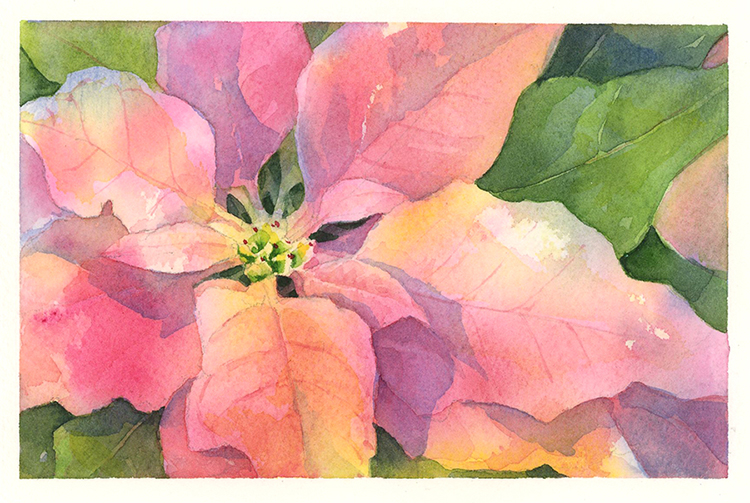
Poinsettia; watercolor on Arches 140lb cold pressed paper
Breaking the Cyber Barrier
How fun it would be to put all of you in the same room and thank you in person for following this blog. I would need a 15,600-square-foot space to accommodate all 1,300 of you, so a sincere thanks via the Internet will have to do. Your comments, compliments, and questions help fuel my artwork throughout the year.
I did, however, have the pleasure of gathering together 11 Connecticut sketchers last weekend for a holiday sketch party at my home. Most of us knew each other only through an online Facebook group, so it was a treat to break the cyber barrier. Here’s my sketch page from that event.
The Centerpiece
For the past two weeks I have been sharing my kitchen table with an enormous baldfaced hornet’s nest (a gift). I realize that this is a highly peculiar and unappetizing centerpiece, but there is simply no other place in my house that can accommodate it and a similarly oversized sketch pad. To be honest, I didn’t think we would be dining with it for more than a few days. The night I brought it in, I made two large, quick sketches and started a painting. But I wasn’t satisfied— the nest was more subtle, detailed and complex than I expected. Then one morning at breakfast, I saw more clearly how the nest was constructed, the patterns of the waved paper, how the lilac leaves where cemented in, how subtle shadows helped define each section. I decided to start again. Here’s the finished drawing. My table is now decorated for the holidays and the nest has been relegated to the garage— for later dissection and more art.

“The Centerpiece,” graphite on Strathmore 400 series drawing paper, 18”x24” (actual nest size 20”x10”). Click to view larger.
Though silent when I brought the nest in, I was still quite relieved to learn that baldfaced hornets live only one season and do not 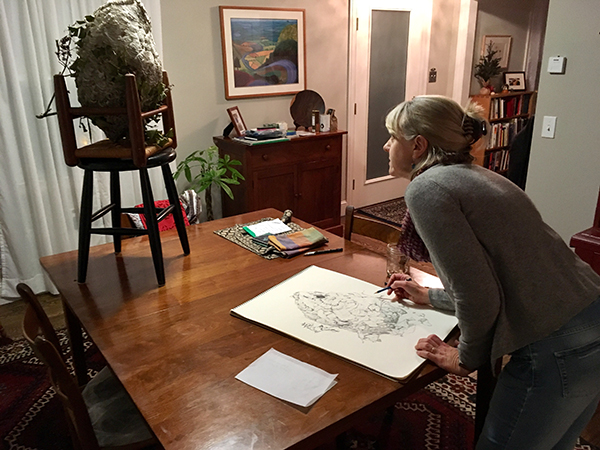 reuse their nests from year to year. Only fertilized queens overwinter (but not in the old nest) and emerge in spring to build a new nest and start a new colony. Baldfaced hornets build their nest by chewing old wood and mixing it with saliva to form a papery substance — which is rather astonishing when you think about such small creatures creating something of this size and complexity.
The Pember Collection
A Victorian glass and cherry cabinet full of nests and eggs, collected in the late-1800s, stretches 15-feet from end to end at the Pember Museum of Natural History in Granville, NY. I’ve been going to the museum once a year for the last 10 years and I never tire of that case. The variety of the collection astounds me; I will never exhaust its sketching possibilities. I spent two hours absorbed the details of 125 year old nests before running out of time on my recent visit. If only the birds knew what a legacy they left.
My advice for sketching at a museum: check in upon arrival to introduce yourself and ask whether there are any restrictions. Keep your supplies contained—pencil, pen, and sketchbook with a small set of watercolors or colored pencils work well. Recognize when other museum goers, and especially kids, want to look at what you are observing. If you’re comfortable and people seem interested, invite them to have a look at your artwork. I’ve met a number of aspiring young artists in museums and always enjoy encouraging them.
The Pember Collection- A gallery of sketches dating to 2006 (click to view larger)


ATTN sketchers/painters/photographers:
If you love sketching or photographing birds and nature, want to improve your skills, and have a fun week exploring the beautiful rocky coast of Maine, check out Arts and Birding, a five-day workshop at the Hog Island Audubon Camp, June 11-16, 2017. I am the program director and one of the instructors and I guarantee a great experience! Beginners to advanced participants are welcome—we work in a very collaborative, positive atmosphere. Register by Dec. 20 using the “EARLYBIRD” discount and save $50. Get Details >
Holding On
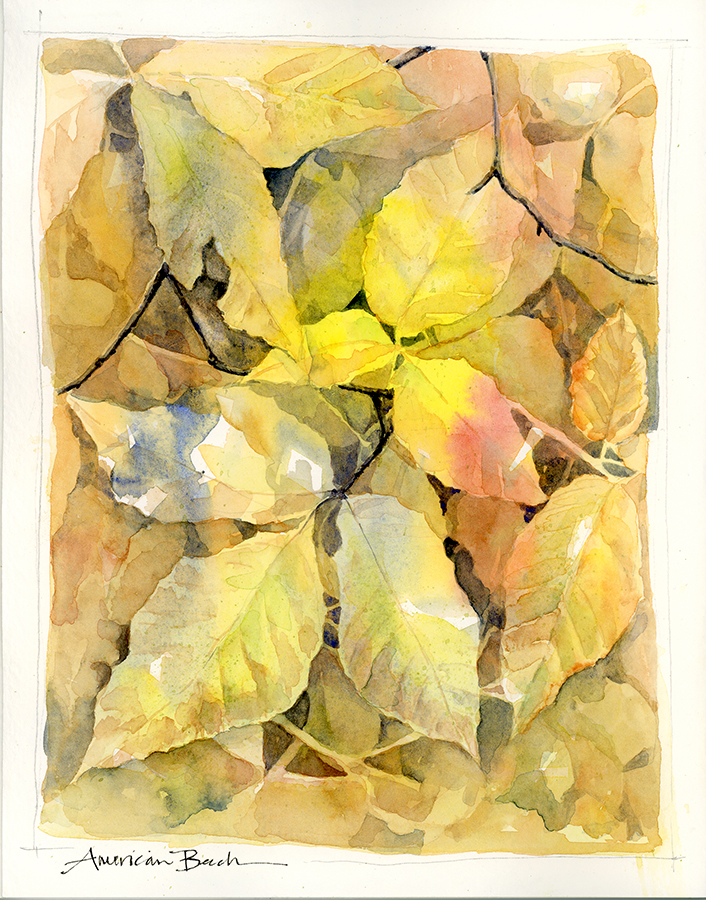
I appreciate the last vestiges of autumn: curled beech leaves in barren woods; uneaten grapes still hanging from tangled vines; oak leaves that refuse to fall. They hold on until the bitter end. And why not? Why not go for one last day of warm sunshine; one final chance at glorious existence before letting go. Wouldn’t you?

click to view larger
Making Muffins
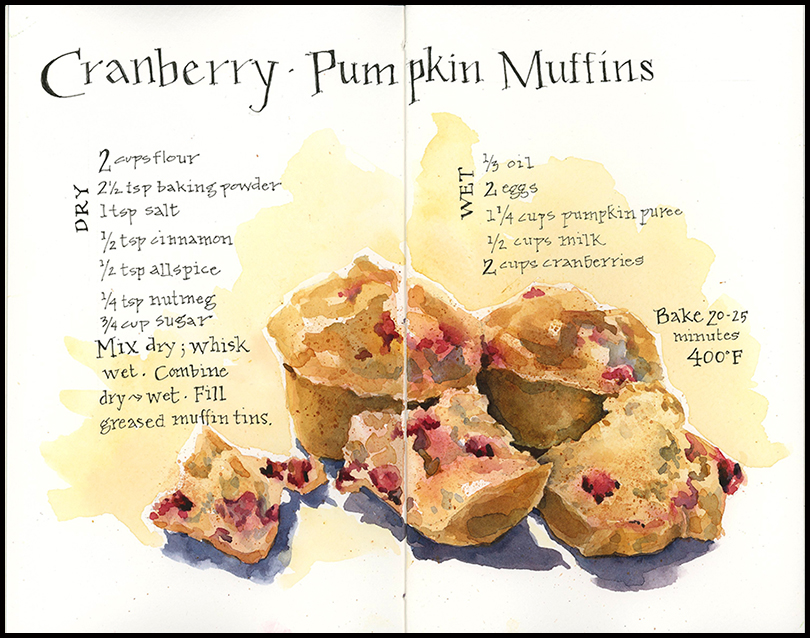
What could be better on a cold Sunday in November than baking, eating, and painting muffins? And while there’s no recipe for painting muffins, I scanned this several times while in progress to share how I approached it.
I painted this on Fabriano soft press 140lb watercolor paper in a handmade journal, using a limited palette of alizarin crimson, quinacridone gold, and phthalo blue. That’s not a combination I typically use, but I wanted to try it. I also added a little burnt sienna toward the end. Eat, paint, enjoy!
Click to view larger
The Things We Take for Granted
I take the beauty of fall for granted. That’s not to say that I don’t appreciate it or that I am not awed by its glory. Only that I take for granted that it will be so, year after year. For those of us who live in the Northeast, it is a given that winters will be cold and long, that spring will burst forth in birdsong and flowers, that summer will be prized for its heat and fullness, and that autumn will complete the year with a cloak of gold.
I painted this page on location with a fellow sketcher who grew up in the Middle East. She marveled at leaves the way people who live in warm places marvel at snow when they see it for the first time. It surprised me; I had never given it thought. So here’s to a fine afternoon sketching and a valuable reminder to be grateful for things I take for granted.
Watercolor, Strathmore- 400 series sketchbook; click to view larger
About the technique– This sketchbook page was done with a watercolor technique known as “negative painting.”
- I first painted a wet-in-wet wash of primary colors (ultramarine blue, alizarin crimson, and Hansa yellow medium).
- When dry, I sketched an outline of the main leaves and began to paint around them with graded washes using combinations of the same three colors to create additional leaf shapes and patterns. Using a simple palette helps to ensure that the layers don’t get muddy.
- I continued to add more layers of paint, creating additional detail and a greater sense of depth. It’s kind of a dizzying process and you can easily get lost in it. The trick is stopping before tinkering too much and losing the spontaneous effects of the wet washes.
Watercolor, Strathmore- 400 series sketchbook
The Sun is Rising Yet
Today, I don’t know how to assuage grief; stem loss; draw hope. What color do you use when a new day dawns gray and stark and you no longer know your country?
So I walk streets littered with leaves, and wander through the graveyard looking for answers among stones. Here– a veteran, there– a mother, a child. Lives engraved in names and dates. On one of my favorites, these words: Change upon change, the sun is rising yet.
And then I come home to begin again, and start with the simple act of filling the bird feeders.


 Drawn In