
Imperfect
What is the value of imperfection? I’ve been mulling over that question as it pertains to artwork for a few years and still, I don’t have a clear answer. I love the work of natural science illustrators, for whom accuracy, precision, and beauty are paramount. Yet each time my own artwork approaches that kind of perfection, it somehow seems to be missing something. Embracing imperfection, which, after all, is what so much of life is about, increasingly appeals to me. Letting go, accepting, and finding beauty are good lessons to learn on any journal page—and these lilies, way past their prime, were the perfect teacher.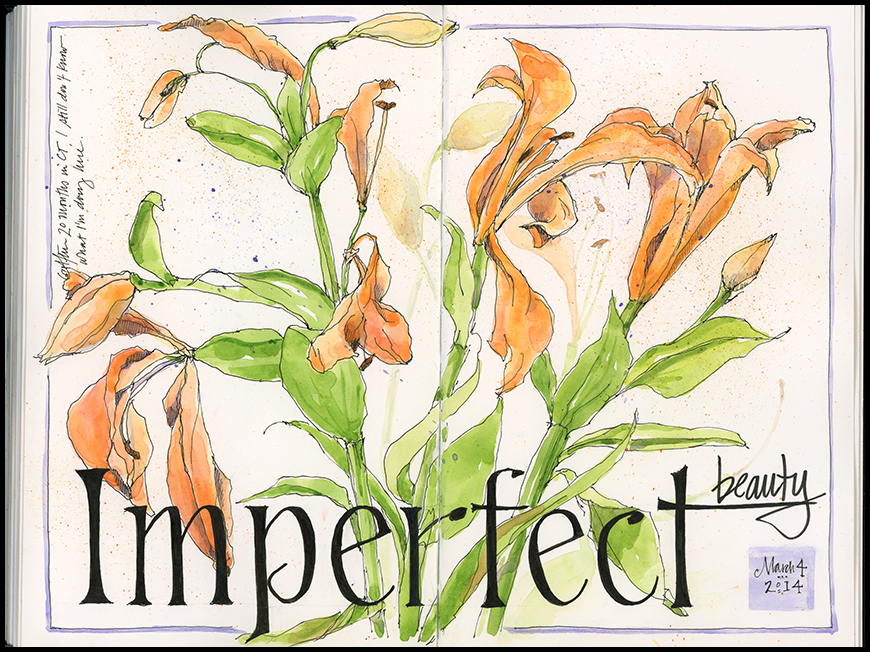
Tips & Techniques– This piece takes advantage of secondary colors—orange, green, and a spot of purple—to create harmony. The strong black of the text, done with a Micron graphic pen, nearly overwhelms the lilies, but also makes a strong statement. I could go back with a thicker black outline on the flowers, but that would likely lead to overkill.
Out of the Depths
What is it that makes fossilized crinoids so compelling? Is it the artful way these delicate creatures came to rest at the bottom of the sea? Or the amazing transformation from living animal to rock, forever preserved, then heaved and eroded from the depths of time? Or is it the sheer success of this class of echinoderms as a survivor—living, reproducing, and dying over millions and millions of years to this very day in the depths of the oceans?
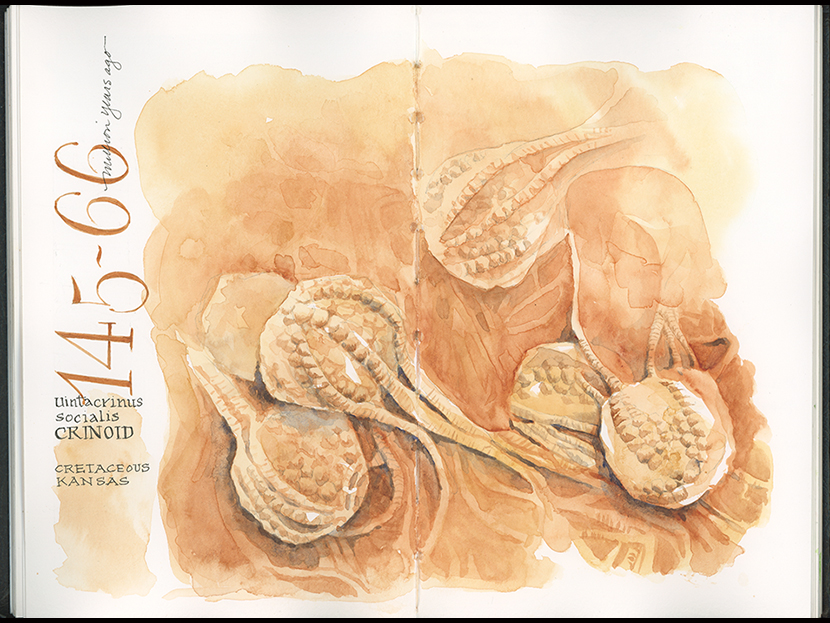
Click to view larger. Watercolor in Stillman & Birn Beta journal
I discovered the fossilized Uintacrinus socialis, a floating crinoid species whose arms could reach three feet long, at the Smithsonian Museum of Natural History in Washington, DC, and at Yale’s Peabody Museum of Natural History in New Haven, Connecticut. I found the other beautiful specimens (depicted below) at the Beneski Museum at Amherst College in Massachusetts (Platycrinus and Dichocrinus sp.) and the Peabody Museum (Sea Lily).
Tips & Techniques– Studying the anatomy of creatures you’re interested in painting can make a world of difference. Not only will it help you get the drawing right, it will deepen your understanding and appreciation for the nature of the world. Drawing the anatomy of a crinoid helped me figure out what features to look for in the fossil specimens and to see the similarities between crinoids and their echinoderm relatives– sea stars and urchins.
Birds and Books
The pages of Birds Worth Knowing, written by Neltje Blanchan and published in 1917 are yellowed and worn. With a classic old book feel and scent, they remind me of cheap paper tablets used by elementary students learning to write. As a scientific historian and nature writer, Blanchan’s work is descriptive and thorough. Still, it sits on my shelf, year after year, untouched. Giving renewed purpose to a page or two seemed fitting.
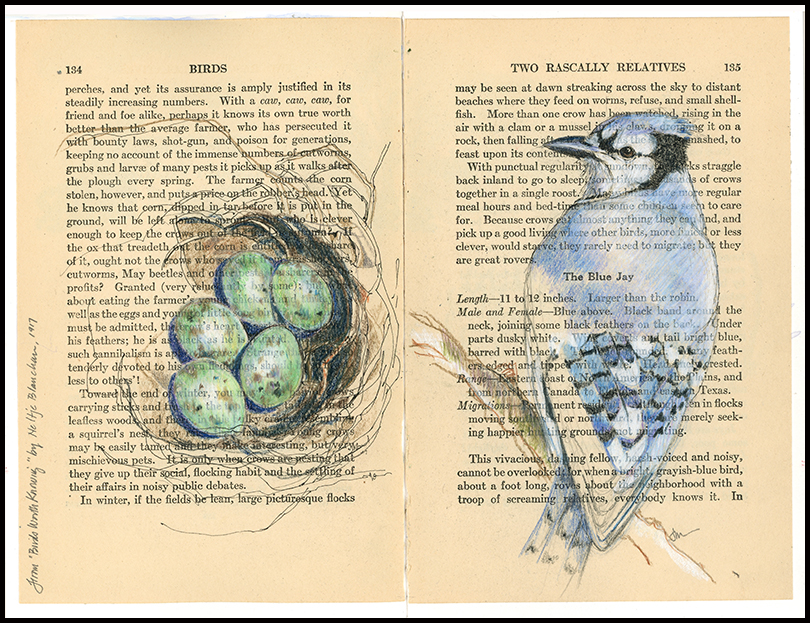
colored pencil; click to view larger
Tips & Techniques– I like to keep much of my day-to-day work in my artist journal. So when experimenting with different kinds of papers, I typically cut and paste them in. I sliced the pages cleanly out of the bird book with an Exacto knife and trimmed them slightly to fit my Stillman & Birn journal. I used permanent adhesive roller tape to bind the pages—it’s easy to use, clean, and flexible. Archival PVA adhesive also works well and might be best if you’re going to use gouache or acrylic paint on the page. Book pages are not well suited to watercolor.
The hardest thing about drawing on book pages is seeing your initial lines, which get lost in the type and toned paper. I needed to go over a few pencil lines in ink to better define and see them. Subjects that have strong values from white to black work especially well and the possibilities for marrying book text and images are endless. I intentionally left the jay and nest unfinished, as I wanted the page to have a sketchbook quality.
Loose Lines
It’s always nice when good sketches sneak up on you. They’re often the ones where you’re not trying too hard or thinking too much. Where your lines are loose and flow from object to paper quickly and without criticism. I wasn’t trying to create anything detailed or complicated here; I just wanted to capture form and light…which, I suppose is what we’re always striving for on paper.
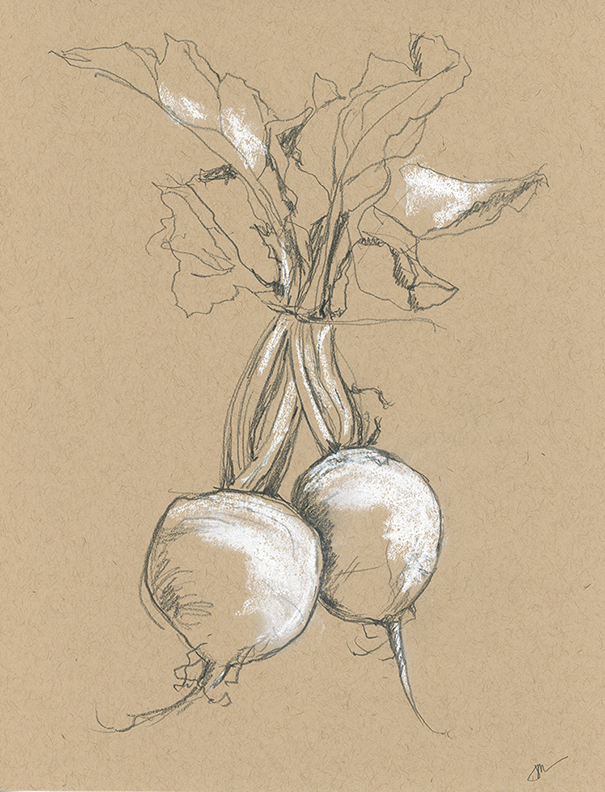
Click to view larger
Tips & Techniques- If you need to loosen up with your artwork, I recommend grabbing a pencil or pen and leaving the eraser behind. Look at whatever you’re working on for a minute or two, and then jump in. Keep your lines moving and your eyes on your subject. If you don’t like a line, go over it with another one (and another one, and another one). Give yourself just a few minutes to capture the essence. Then turn the page and start again. Do a couple of these quick sketches in succession. When you’re finished, take a read on how it felt to work this way. Freeing, eh?
The Simple Things
We caught a glimpse of the full moon last night before it disappeared behind clouds of snow. A simple circle, so much depth. I’ve always loved the constancy of the moon, the way it connects eons and continents and people in its perfect radiance.
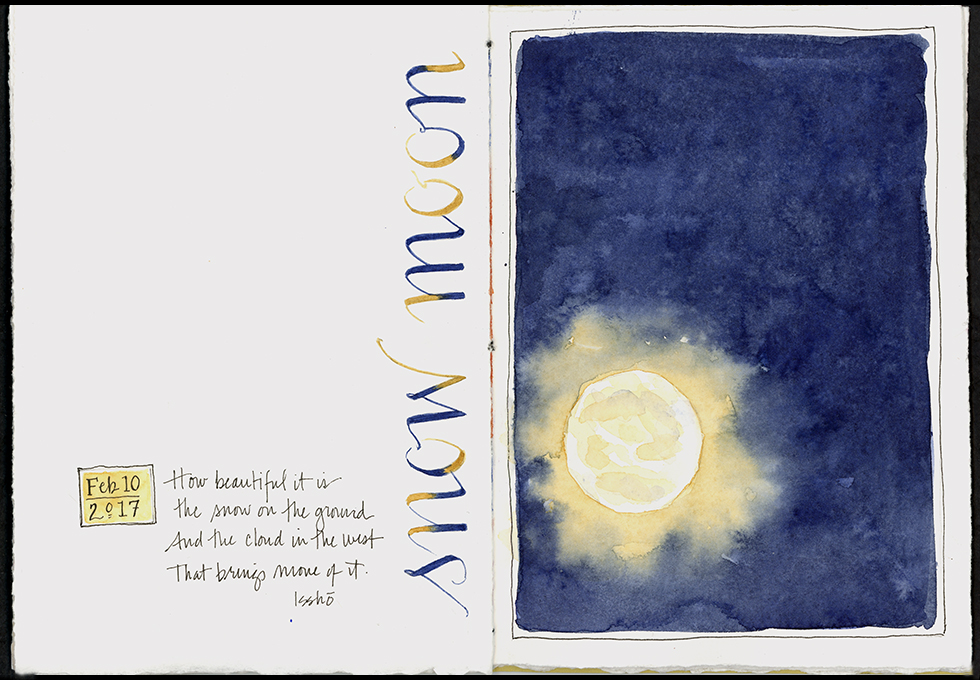
Handmade journal; click to view larger
I kept this page simple to echo the subject and to emphasize the beauty and mystery of the night. The haiku is written with a Micron 02 pen and the larger text is painted in watercolor with a size 1 brush, combining yellow ochre and indathrone blue. I kept the paint fairly dry, because these colors make a greenish gray when mixed. In cases where I do want the colors to merge in the letter I use wetter paint. Try it with your favorite color combinations to see how it works.
Marvelously Elusive
The marvel of bird eggs never escapes me. But painting them to perfection almost always proves elusive. I’ve been at it for years. I found these paintings done over the last 10 years in the back of my art file drawer this week and was reminded of the value of practice. Over and over, year after year, I learn, make mistakes, improve, try again. The trick with eggs is getting the edges clean and precise, while adding multiple layers of paint so that the egg takes shape. You can see that some of these made it and others didn’t. And the challenge of doing many eggs on a single page is that they all have to be right for the piece to work. So, I am curious– what’s your “egg?” What marvelous subject do you return to again and again in spite of difficulties and disappointments?

click to view larger


Back to the Drawing Board
A month ago I posted a drawing of an enormous hornet’s nest that took both a considerable amount of time to draw, as well as space on my kitchen table while doing so. Shortly thereafter a friend suggested that I had drawn it upside down! The opening on a hornet’s nest is typically at the bottom which, apparently, helps keep rain out, and I had drawn it at the top. Solving the problem wasn’t a simple matter of turning the drawing around— the shading and composition simply didn’t hold up when the drawing was flipped. So, with reluctance, I went back to the drawing board, as they say, for another go.

Graphite, 18×24″
Tips & Techniques: Although this piece took just about as long as the first one—15+ hours over the course of two weeks— I was able to take what I learned the last time and push the drawing further. The best part of doing a complex and subtle piece like this is that it forces you to really look at and replicate a full range of values from light to dark in order to get the object to take shape on paper. I used 2H, B, 2B, 3B, 4B, and 6B pencils.
Whether in black and white or color, I see artists struggle with values all the time. Failing to save the lights (in watercolor, the white of the paper) or being too timid to push the darks frequently leads to a flat drawing or painting. If that is something you have difficulty with, I recommend making a simple value scale with a variety of materials, including pencil, pen, and paint. Here’s a very simple scale, with just light, mid-tone, and dark. You could do a range of five or a full scale with many subtle tones to practice.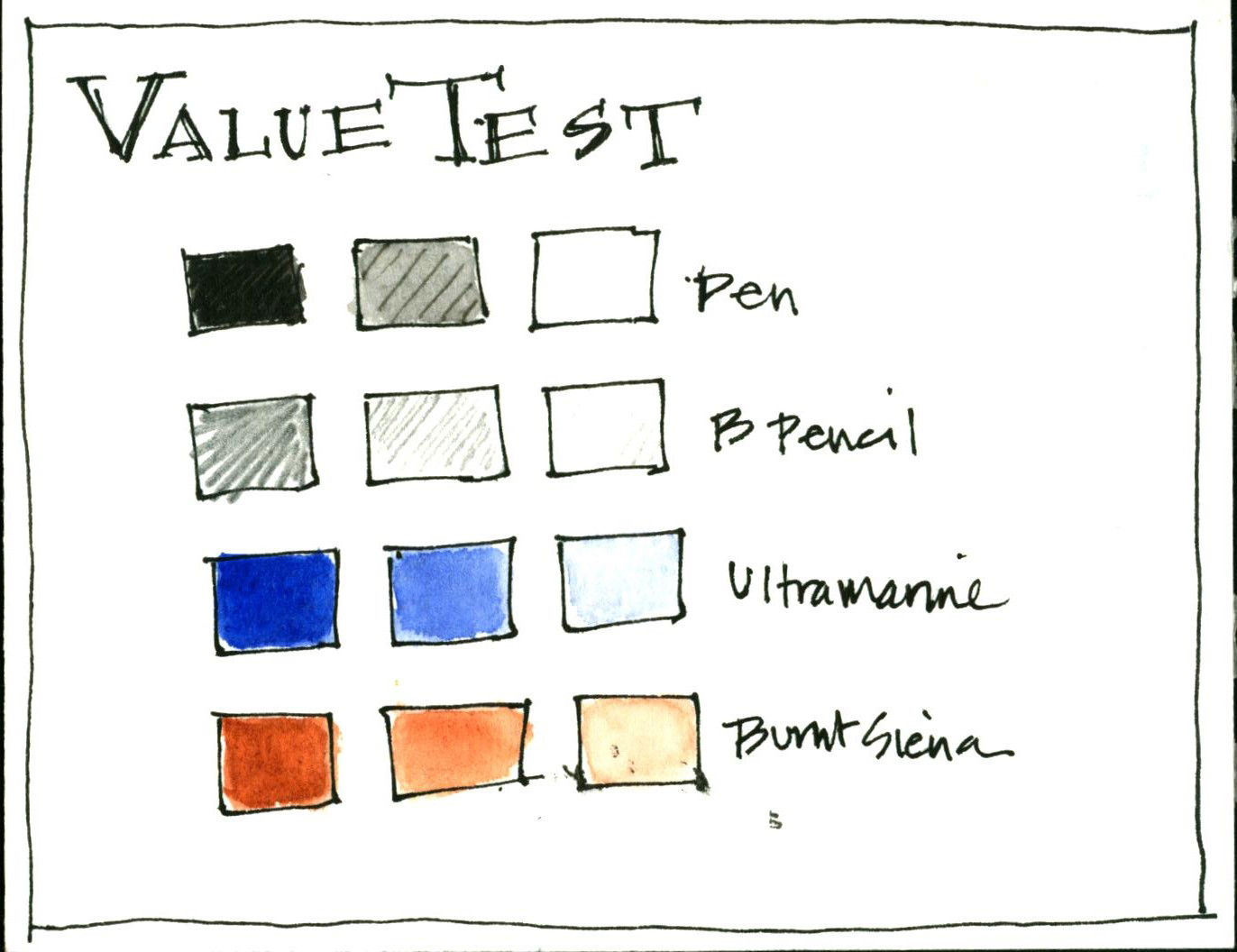
Keep the scale handy as a reference. Hold it up next to a drawing or painting you are working on and check whether you’ve got a good range of light to dark. If not, go back to your subject and look again. With practice, you’ll start to see and incorporate a full range with confidence.
Field Guide to Remotes
Here’s a quick sketch I should have made years ago. No attempt at beauty or precision, just a down-n-dirty guide so that I can finally watch a movie without assistance.
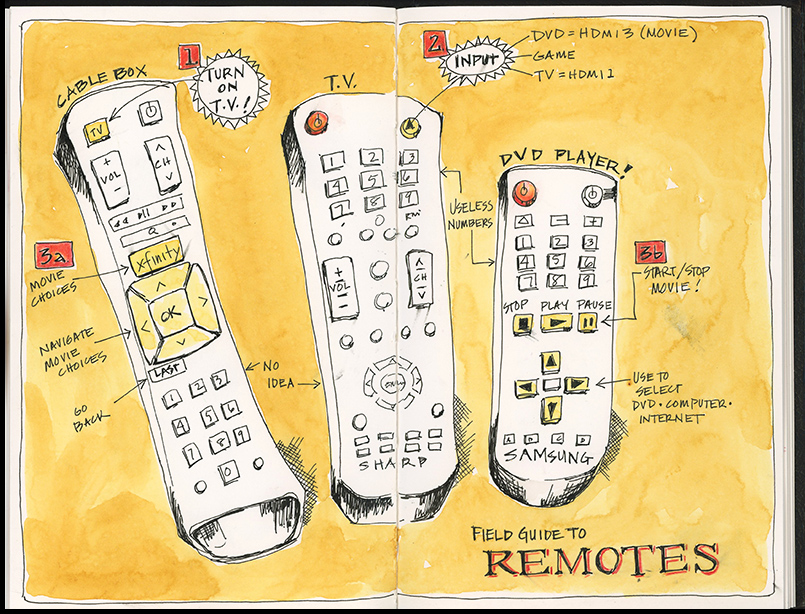
I wanted to do this page quickly and without fuss, so I used a Uniball gel pen instead of my usual Micron 02. The ink isn’t water soluble, but it sure smudged easily.
Mystery Nest
Tangled in a thicket at the edge of a wooded wetland, the nest stood out like the prize it was for hiking on a cold winter day. As readers of this blog know by now, finding and painting nests is a recurring theme and a true pleasure for me. In fact, the subject of my first post was a nest. But this one is quite unique—almost two nests combined, it seems to me. It’s possible that a nest begun by one pair of birds was co-opted by another species, as sometimes happens; or that mice took over after the birds were finished and piled an enormous moss blanket on top of the woven base (though I saw no evidence of rodents). Either way, it’s a fine mystery and I’m happy to have it live on inside my sketchbook.

Click to view larger; “In the thin light of winter woods, we find the promise of next summer.”
If you have come across a nest similar to this or have ideas about what birds it may have belonged to, I’d love to hear about it. I can eliminate a lot of possibilities, but I’m stymied. The nest was 7 inches across with a 3 inch cup, constructed 5 feet off the ground at the edge of a wooded wetland in central Connecticut.
Winter Birds
A solitary half-dead dogwood and a tangled hedgerow of vines and shrubs is all the landscaping that came with our house when we bought it last September. It’s not much, as they say, but it’s home. And, it turns out, it’s home to a surprising variety of birds as well. They are attracted mainly to the bird feeders we hung from the dogwood, though the shelter of the hedgerow and a neighboring elm provide good cover, too. For the price of sunflower seed and suet cakes, I’m enjoying the show from my kitchen window.

click to view larger
Though my backyard count is just an informal tally, it has been a longstanding tradition to count birds at Christmas time. The nascent Audubon Society began a winter bird census in 1900. Today, Audubon and other organizations use data collected in this long-running census to assess the status of bird populations, and to help guide conservation action. Find out more: www.audubon.org/join-christmas-bird-count


 Drawn In