
A Day at the Beach
When March feels like January and the urge to go outside and sketch no longer seems sane, I’m in trouble. I could use a change of scenery and fresh artistic inspiration, but, alas, there’s nowhere to go. So I’ve turned to my collection of beach finds to take me to warmer places and sunnier days. I like imagining whelks and horseshoe crabs crawling on sandy bottomed shores and blue mussels, sea stars, and urchins crammed into rocky cervices. Out there in the Atlantic, summer is just a dream away.

Tips and Techniques– A collection like this is perfect for rainy days and times when you just want to practice. I decided to sketch directly in pen and use a size 12 round brush to keep this loose and spontaneous. Had I gone for a more precise approach, I’d still be working on it. When you sketch a collection, start with one of the largest objects first. Then add your second and third objects close to it. Build out from there. You can always tuck smaller items into tight spaces or fill gaps in the design.
Savory and Sweet
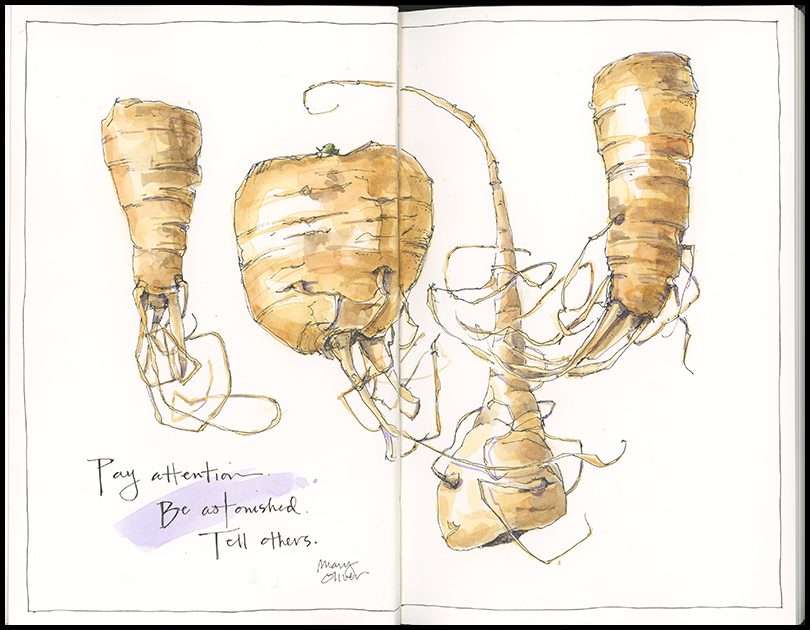
My sketches this week are an effort to appreciate the small pleasures of life and to look for joy in the everyday. Typically, I wander out into nature for inspiration, but I didn’t need to go beyond my own kitchen this week. For the savory: a bunch of ordinary parsnips that seem to dance on the page. And for the sweet: a delectable batch of cream puffs that I made from scratch for the first time ever. If I could offer you one or the other, there’s no question which it would be. Instead, I give you both and wish you sweet moments to savor during the week ahead.

Heads up: Registration opens March 3 for the Hog Island Audubon Camp in Maine with lots of covid-19 safety precautions in place for this season’s programs. I will be directing Arts & Birding, June 20-25, with an all star lineup, including artists Sherrie York, Barry VanDusen, and Sean Murtha.
Day after Day
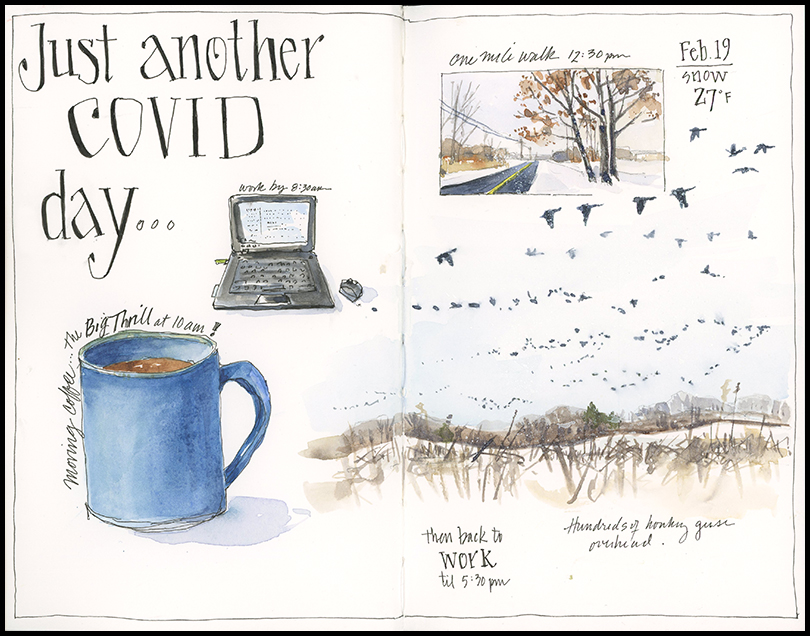
You know the drill. The days blur into weeks and suddenly it’s late February. We’re nearly a year into the pandemic and, although I’m grateful for how fortunate I have been, I’m tired too. My sketchbook typically reflects moments of beauty and discovery, but I thought I should also record the sameness and sentiment of “Just another Covid day.” I was glad for the geese…and the coffee.
Outside, Inside
It’s been mighty cold here this week— the temperature most days hasn’t crept out of the teens—decidedly not outdoor sketching weather. But I did manage a walk in snowy woods, where tracks of squirrels, deer, mice, and beaver gave away the presence of far heartier mammals. I also found this fine turkey feather, which was enough to get me started on this sketchbook page. This weekend is the Great Backyard Bird Count, a global count and celebration of birds. I was happy to record 16 species this morning from the warmth of the kitchen, while the thermometer outside read -7 F.

Tips and Techniques– Here my top tips for painting bird feathers, which are trickier than you might think. Practice helps!
1. The Center Vane (Rachis)– Start with this line, keeping your edges clean and tapering from bottom to top. The rachis is cylindrical, not flat, and often casts a slight shadow, which can really make your feather look “right.”
2. Shape– Barbs extend out and upward from the center rachis. Though they are sometimes unlocked at the edge, there should not be gaps at the center; most feathers have crisp edges unless barbs are unlocked.
3. Bottom Barbs– Keep them delicate and downy; wet the paper first and drop paint into it.
4. Color– Even dark feathers are semi-transparent. Avoid overworking. The fewer strokes the better.
5. Shadow– Add if you want to help give dimension, but keep it light.
Note: Feathers are protected by the Migratory Bird Treaty Act. Sketch them where you find them or return them to the field when you are finished.
Workshop this week! The Nature Explorer’s Sketchbook
2/18/21, 5:30-7pm, FREE; ages 10+
Register: Columbia Land Conservancy
If you like exploring nature or drawing or both, this session is for you! Ask questions and draw along with me as I share some activities and tips from my new book to spark your curiosity. This session is especially suited to the 10+ old artist, explorer, or nature lover — and adults who have wanted to try nature journaling.
Nest Gallery
A tangle in the brush. Strips of woven grape vine and grass. A downy mass of cattails bound with sedges and reeds. No matter where I find them or what they’re made of, I simply find bird nests irresistible. I have been drawing and painting bird nests weekly since November, in part because I’ve been teaching a class on The Art of the Bird, but also because I love the challenge and the beauty of painting nests. So, today, you get a gallery of nests…enjoy! (Click any image to view larger.)
1. Collecting on Paper- These nests are in the collection of the Pember Museum of Natural History, which recently reopened after months of pandemic closure. I spent two hours in front a single glass case, pen in hand, and could easily have gone another two.

2. Vireo- Using ink and watercolor is my favorite approach to rendering a nest. It gives me the satisfaction of drawing and a solid roadmap for adding color.

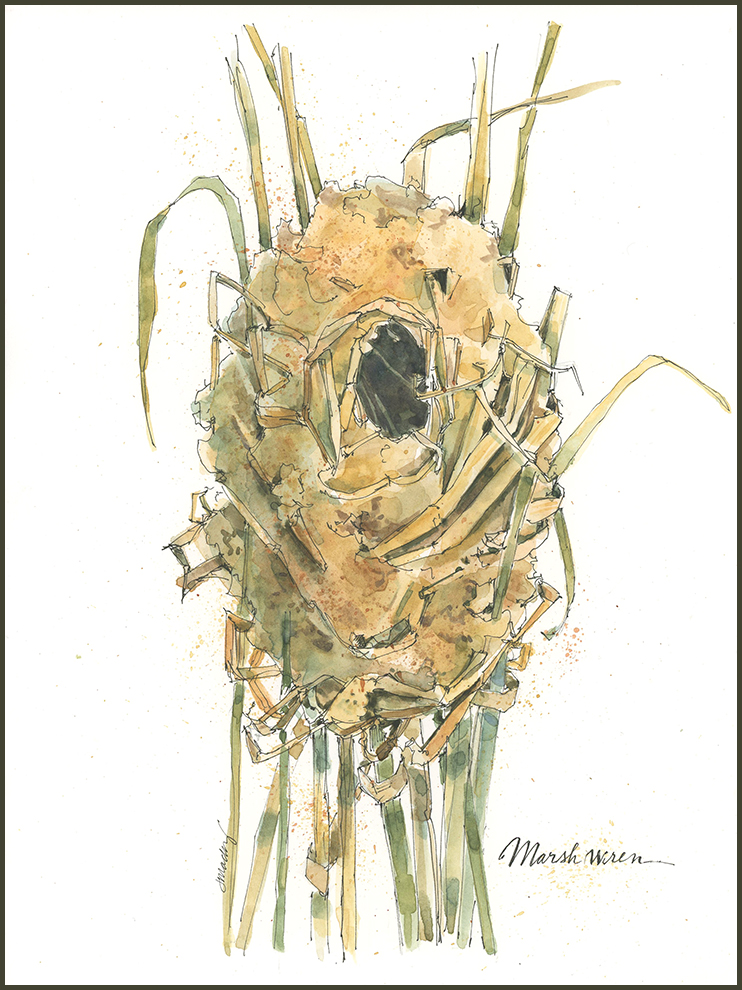
3. Marsh wren- I did the all watercolor nest as part of a class demonstration. Afterward, I decided to do it again using ink first. Which do you prefer?

4. Black chinned hummingbird- This was another class demonstration with a simpler nest to help participants work on making nests dimensional with light and shadow.

5. Red-winged blackbird- The larger strands of a blackbird’s nest make it easier to weave with paint.

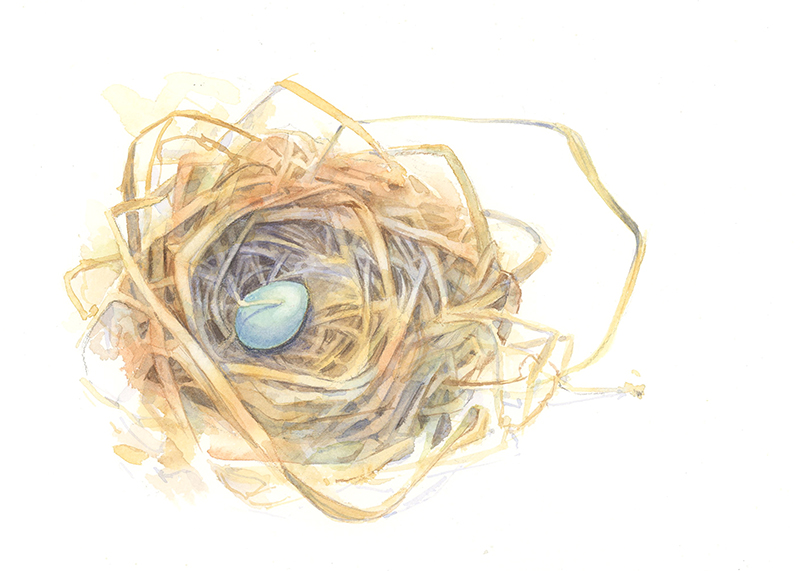
6. A single egg- When my cousin asked me to paint a nest with a single blue egg to celebrate the birth of her first grandchild, I gladly accepted. I did two versions– one with ink and one without– to offer her a choice of styles. And while the due date has come and gone, I’m happy to say that the nest was delivered on time.

New online workshop: The Artist Sketchbook, February 23 through March 16, Tuesdays 6-8pm EST/ 3-5 pm PST. Class limited to 12 participants. Get details >
Running Start
I’ve been a runner for many years. I’m not particularly good or fast or driven, but I appreciate that running keeps me fit and gets me outside year-round. It also gives me an opportunity to see what’s happening along the rural routes I frequent. I watch for birds, notice roadside wildflowers, enjoy big skies, and frequently catch a glimpse of something that becomes the inspiration for painting. Such was the case last week, when a flock of small birds flitting among a cluster of cattails caught my eye. I went back later and made a preliminary sketch from the car on a frigid afternoon. This gave me a decent running start on this piece, which I then painted at home.

New! Explorer’s Gallery
Calling Young Nature Explorers! Since the release of The Nature Explorer’s Sketchbook in November, families, grandparents, neighbors, friends, and educators have been sharing the book with the special young people in their lives. Now, I’m inviting youth to share the art of their discoveries in the new Explorer’s Gallery in The Nature Explorer’s Sketchbook section of this blog.
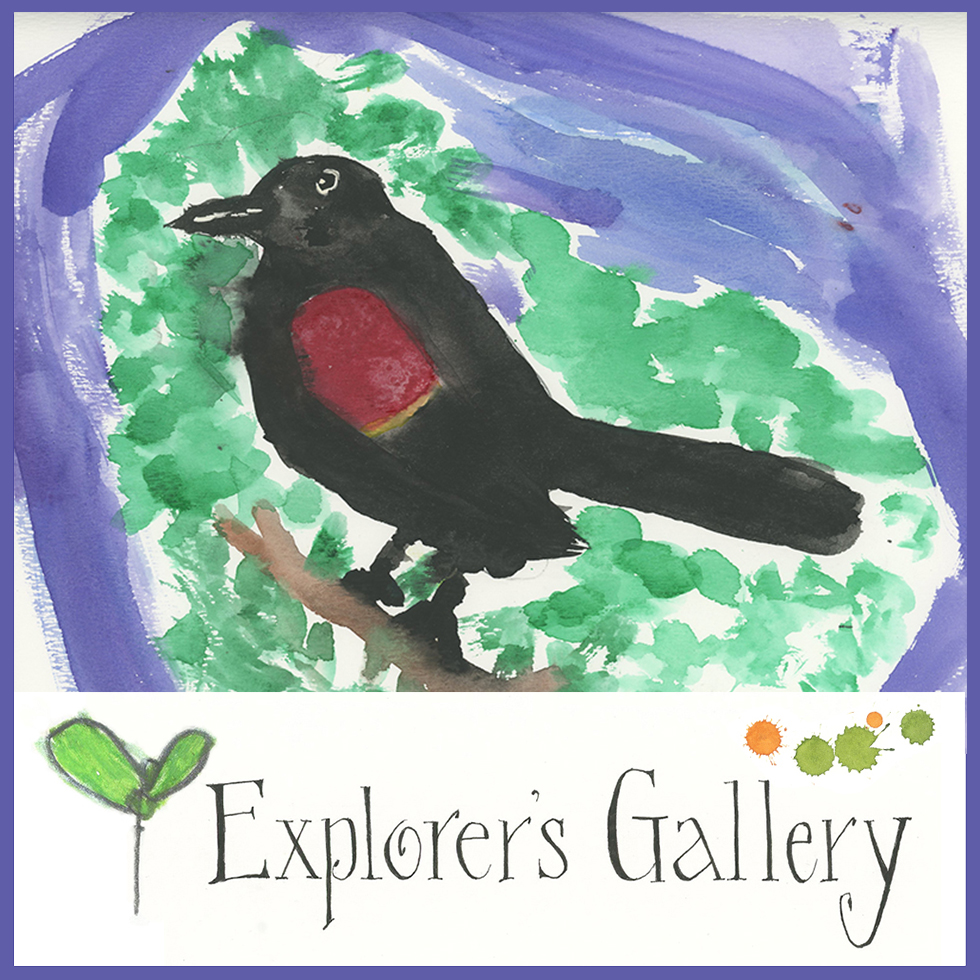
If you know kids who have been exploring and sketching nature, send photos of their artwork to explorers_sketchbook@jeanmackayart.com. Include the youth’s first name, age and state (e.g., Alice, 10, NY), and watch the gallery for new artwork each week.
Help spread the word! I can’t wait to see and share what young people are discovering!
In Search of the Perfect Pear
A simple fruit. Painted millions of times over thousands of years. Perhaps it seems ordinary then to choose pears for my recent workshop to illustrate ways to improve layouts and add different types of lettering to sketchbooks. But once the workshop ended, the fruit’s lovely form and subtle colors continued to captivate me. So, I had to have one more go at it in my sketchbook. I’m sure it won’t be the last.
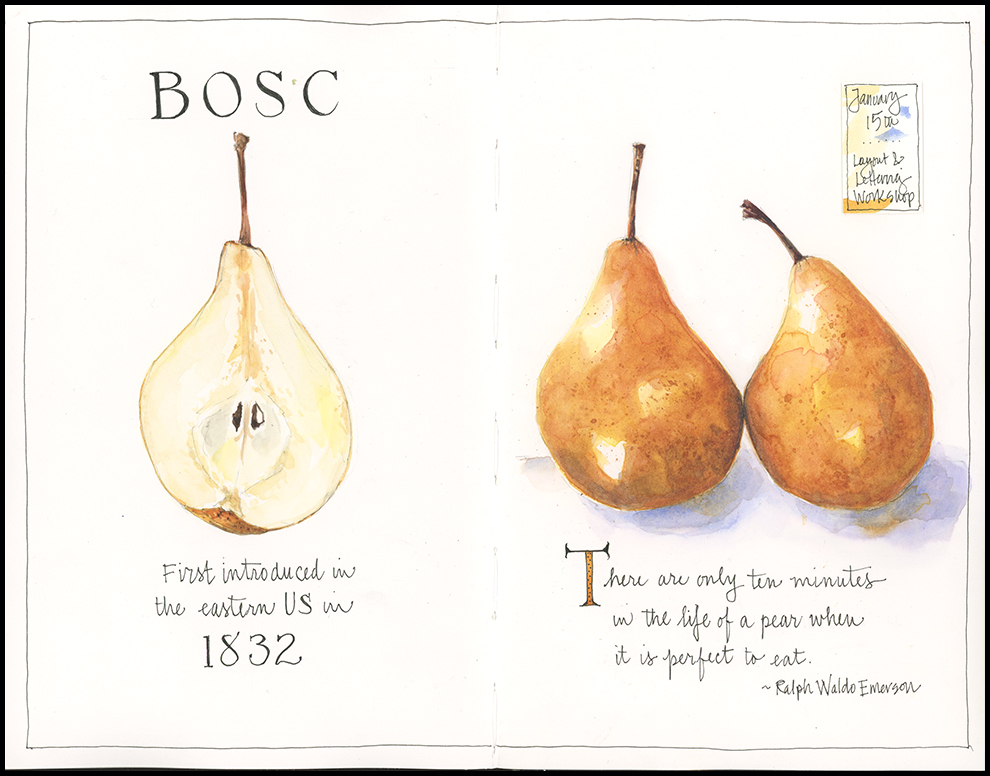
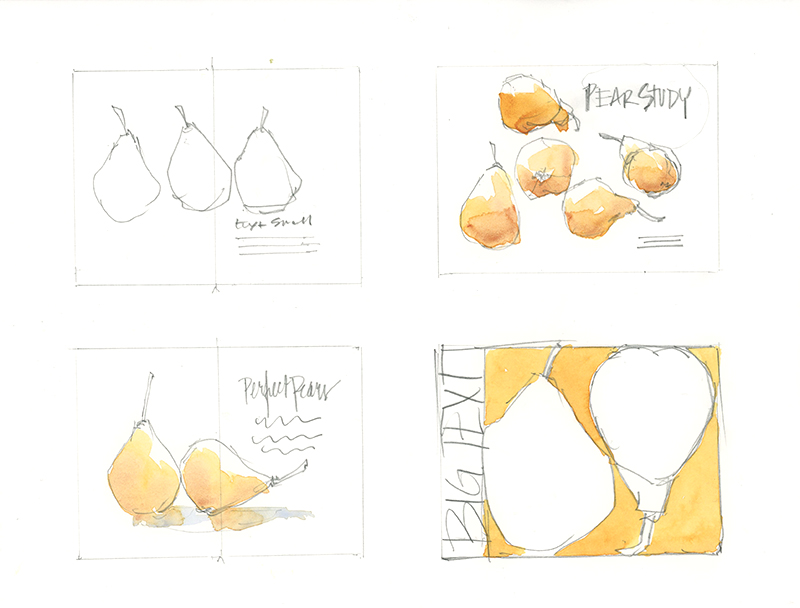
Tips & Techniques– During the workshop, we created a variety of thumbnail sketches of pears to play with different layouts. This is an excellent exercise for considering possible layouts, as well as for thinking through color combinations and values before committing to a painting. Pick a simple subject and see if you can create four to six different ways to approach it. This practice will expand your thinking and may lead you to fresh ideas or new techniques for working in your sketchbook and beyond.
Keep Looking
You would think that finding the walnut-sized egg case of a praying mantis in a two-acre overgrown field would be like finding a needle in a haystack. And, indeed, it is. I walked deep into the field, following deer trails and battling thorns and waste-high goldenrod stems. I didn’t go out especially looking for the egg cases. I just needed to get out in the cold, to go wandering in a rare moment of sun, during this dark week in American history.
Finding hope in times of unimaginable tyranny and loss seems equally elusive.
But there, amidst a small grove of white pines, among matted goldenrod and tangled thorny wild roses, I spied it: one frothy egg case, and then another. In all, I found six.
So, my simple takeaway—as much for myself as for you: keep looking.

Upcoming Programs:
Technique Takeaway: Improving Your Sketchbook Layouts and Lettering
Friday 1/15/20, 2-3:30pm (PST) / 5-6:30pm (EST) $40
Register: Winslow Art Center
This program will offer approaches to thinking about page design and improving your sketchbook page layouts. We’ll also explore ways to add text as a graphic element, or simply as a way to capture additional information and meaning.
The Nature Explorer’s Sketchbook
Thursday 1/21/21, 6-7 pm, FREE; ages 10+
Register: Mohawk Hudson Land Conservancy
Ask questions and draw along with me as I share some activities and tips from my new book to spark your curiosity. This session is especially suited to the 10+ year-old artist, explorer, or nature lover — and adults who have wanted to try nature journaling.
Back to the Drawing Board
What a simple, extraordinary drawing tool a pencil is. Unpretentious. Inexpensive. Humble. Yet, the pencil still manages to be demanding. With no color to hide behind and no tricks up it’s sleeve, the pencil requires focus on line and value to bring subjects to life. Artists refer to “pencil miles” or “the thousand-hour pencil” for good reason. There’s no substitute for drawing practice. The pencil demands that you to put in your time.

Tips and Techniques– I went back to drawing this week because I was trying to gain efficiency in my lines when drawing birds. I wanted to try committing to memory bird shapes, features, and feather groups to make me more adept at sketching when in the field. I found working on blue jays particularly challenging because of the head crest, patterning, and shape of the beak. The most fun part of this page was painting the pencil itself, which seemed especially fitting given the jay-colored Staedtler pencils used (F and 2B).

Cool Beans! I’m thrilled to share the news that The Nature Explorer’s Sketchbook has won a 2020 American Graphic Design Award from Graphic Design USA. From more than 10,000 entries, only a small handful of projects were selected as winners. Congratulations and many thanks to Kris Fitzgerald at 2K Design for her award-winning performance and creative excellence in helping bring the book to life!


 Drawn In