
Two Terns
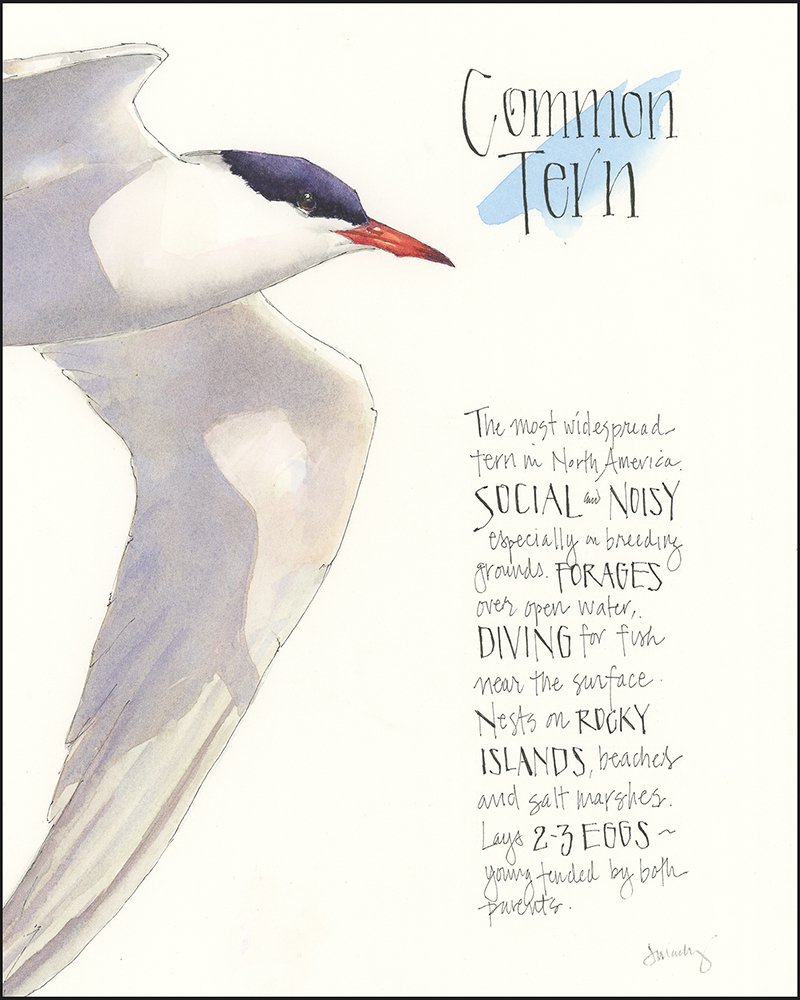
Out of the fog the terns come calling. I hear their chatter over the waves before I see them, and then, there they are, rapid wing beats passing overhead. More emerge from the mist. They hover over the water and then fall from the sky, striking small fish below the surface. As luck would have it, I’m at Gooseberry Neck this morning, a small spit of an island in southern Massachusetts that attracts seabirds, shorebirds, and songbirds to its open water, rocky beaches, and shrubby interior. I’m grateful to be in the wilder world of ocean and sky; grateful for terns, before the sun and the rest of the day breaks through.
I painted these two terns for my Seabird Portraits class, experimenting with different color palettes and layouts. I’d be curious to hear which you like better.

Vacation Sketching
I’m back from a week on the island of Vinalhaven, which lies 15 miles off the coast of Rockland, Maine. While I’m incredibly grateful for the time away, I’m also longing for more. My week was full of exploring tidal coves, hiking through moss carpeted spruce forests, swimming in the island’s former granite quarries, sinking into new books, and sketching. I could have easily kept going and, as the week wound down, I realized too late that I didn’t schedule quite enough time for painting. Alas, it’s all good. I’m happily thinking of next year.
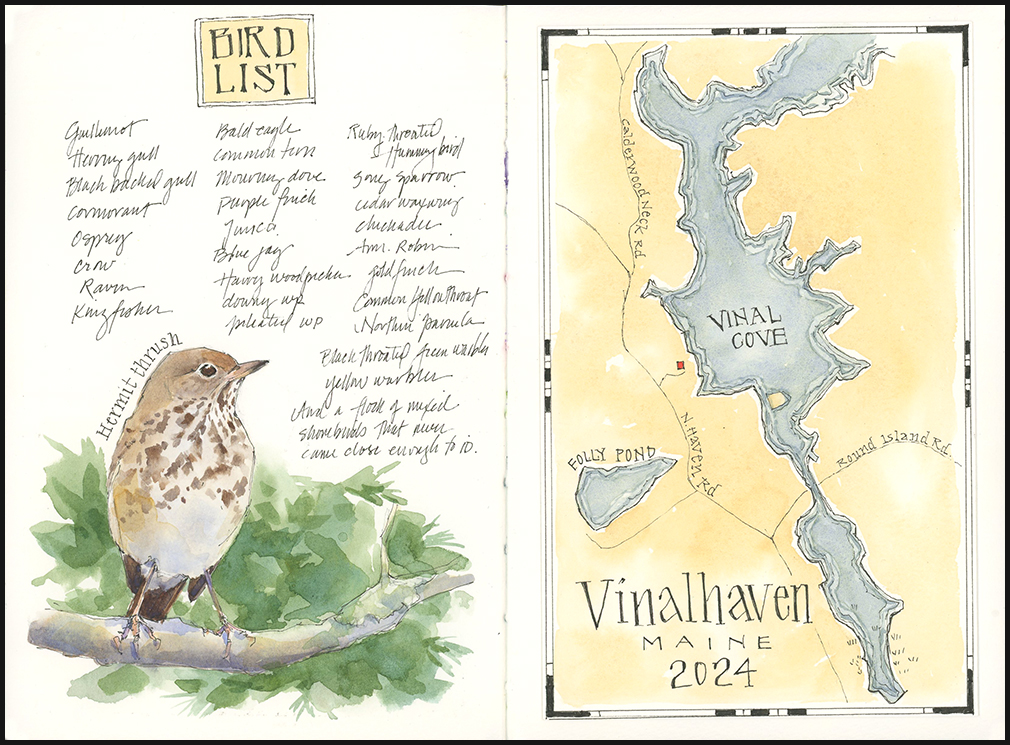
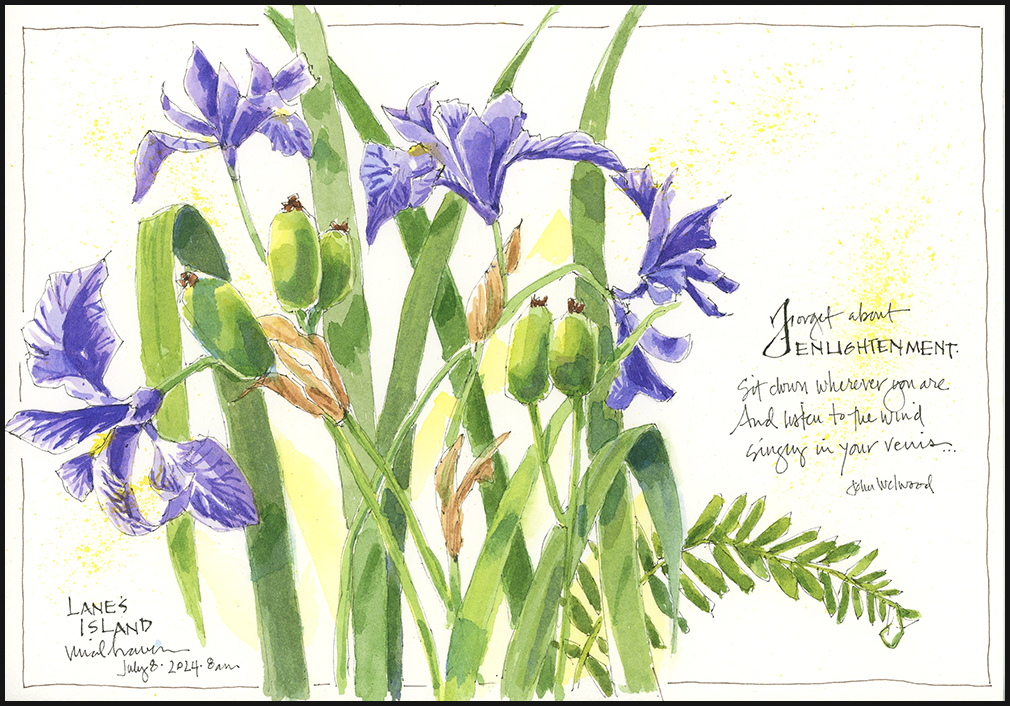


Tips and Techniques– Take my advice and think about how much sketching and painting time you want to have while traveling or on vacation. Then factor it into your schedule. I wish I had set aside larger blocks of time each day rather than fitting it in around other activities. There’s always so much to do, but you run the risk of letting everything else come first if you don’t plan for it.
What lies ahead
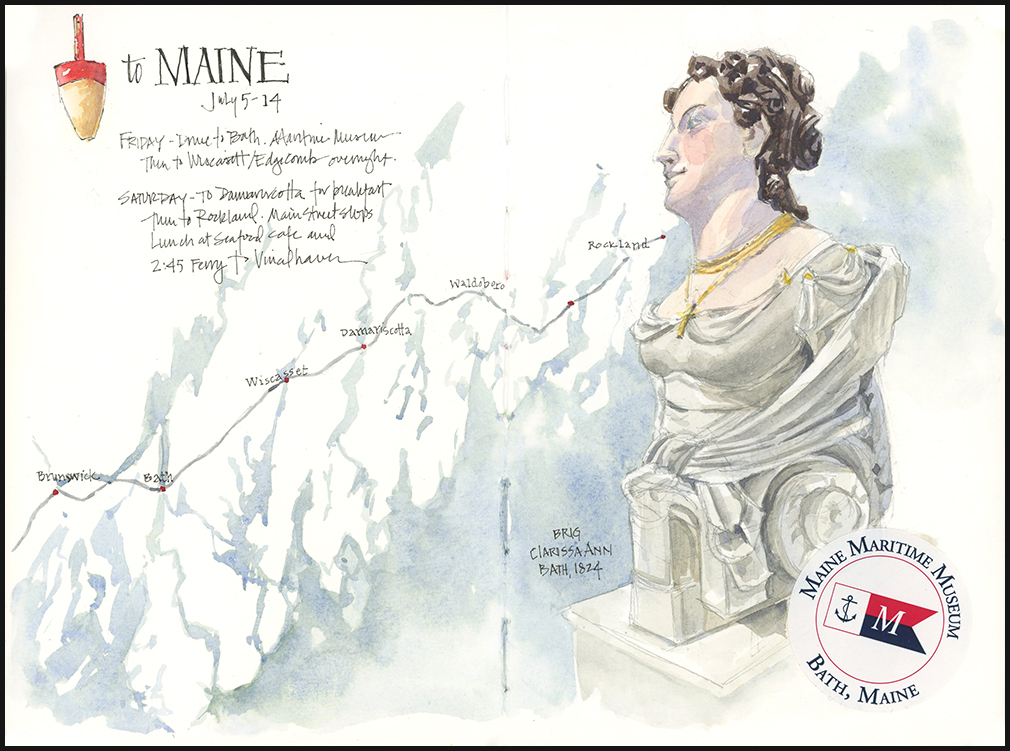
A map and a blank page—what better way to start a vacation?

Tips and Techniques– Making a map often requires careful drawing, so you may find it helpful to do it in advance of your travels. You can add elements as you go right on the map or make sketches in the margins surrounding it. You can also decide how much of the place to include—you may want to zoom in on a particular area or tackle something larger. I’m thinking about including a series of maps for this trip but we’ll see…who knows what lies ahead?
International Guillemot Appreciation Day
IGAD! It’s a big day for guillemots. If these small seabirds only knew that there are people around the world championing them today! Would they puff out their chests with pride, flash their white wing patches, or wave their bright red feet in the air? Or, perhaps, unassuming as they are, they would go about their usual seabird business, diving for fish, cruising the waves, tending their young.
This auspicious day was begun some 32 years ago by a group of seabird researchers in Maine. Noting the lack of attention paid the guillemot compared to the love showered on its close relative the puffin, they set out rectify the situation. There’s even a Facebook group for those that love June 27th as a day to appreciate those under-appreciated guillemots. I’m wearing my old red Converse and sharing this post to do my part.

Tips and Techniques– If you’d like to paint and learn more about seabirds join me for Painting Seabird Portraits in Watercolor, online at Winslow Art Center starting Tuesday, July 16.
Odds and Ends
It’s been much too hot and humid to be outside, let alone sketch outdoors. So, I pulled out some things that I have wanted to paint but haven’t made time for. The seaweed floats are from a trip to California several months ago where I picked them up dry from the beach and stowed them home. I had read that you can rewet seaweed and lo and behold, it’s true! I put them in a tray of water and they went from blackened dried up bits of algae to beautiful floating fronds. The bird specimen and numbers are things I saw in Italy that were low priorities at the time, but that I find fascinating, nonetheless. And were it not so hot, I would be sketching in my garden or out along the roadside. Most of the flowers look better here in my sketchbook than outside where they are drooping from torrential rains. Wishing you all cooler weather ahead and satisfying indoor projects in the meantime.
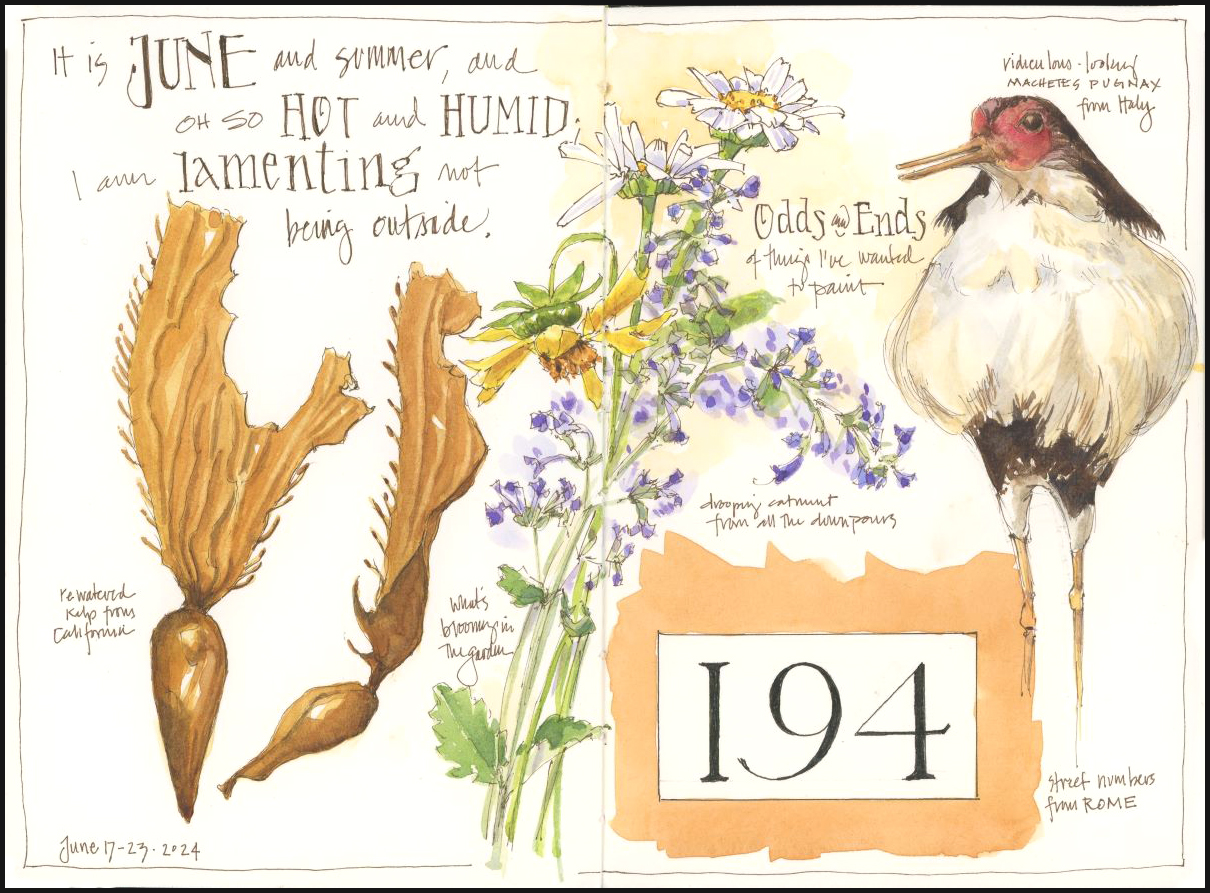
Tips and Techniques- I set out knowing that this would be an odd collection. But as the page evolved, I saw that I might tie these disparate items together with text to explain my rationale and a wash of yellow ochre. In the end, I find it strangely satisfying, mainly because I like each of these unusual elements. So my tip is not to overlook adding odds and ends to your sketchbook. They don’t have to be pretty or important or meaningful– your sketchbook is a perfect place to record things that strike your fancy.
A Most Intriguing Package
I received a wonderful surprise in the mail last week. Sent to me by a former class participant, the well-wrapped container held two mahogany seed pods—one closed and one open. The mahogany tree has evolved to create a serious package for its next generation—the pods are hard as rock, thick walled, and tightly sealed. When the time is right for them to release their winged seeds into the wind, the pods split open in five segments. Pods that fail to open simply fall to the ground – which is why it is ill advised to park a car under this tree. Fortunately for me, I enjoyed all of the beautiful benefits of sketching with none of the risks.

Tips and Techniques– I love doing pages like this, where I can study a single thing in multiple ways. I used a sepia 005 Micron pen for the drawing—a nice match for the brown of the pod—and then added watercolor. Even with a largely one-color subject, it’s important to look for the variation in hues and values. I used an underwash of yellow ochre, layers of burnt sienna and ultramarine blue, and a bit of alizarin crimson to lend a reddish tone to parts of the husk. I mixed burnt sienna with cobalt blue for the outside of the pod, along with some white gouache for texture. If you want to try something like this, I recommend picking a largely monochromatic subject and seeing how much variation you can get.
Not quite finished
Every time I thought I was finished with this journal page, something else begged to be included. First, an additional flower, then another flower pod, another leaf, and finally two seed heads. But while I was adding the seedheads, several ebony jewelwings appeared and I thought, okay, yes, you can be part of this too. So here it is, a week of poppies come and gone and a week of painting in the garden. It’s time to turn the page.
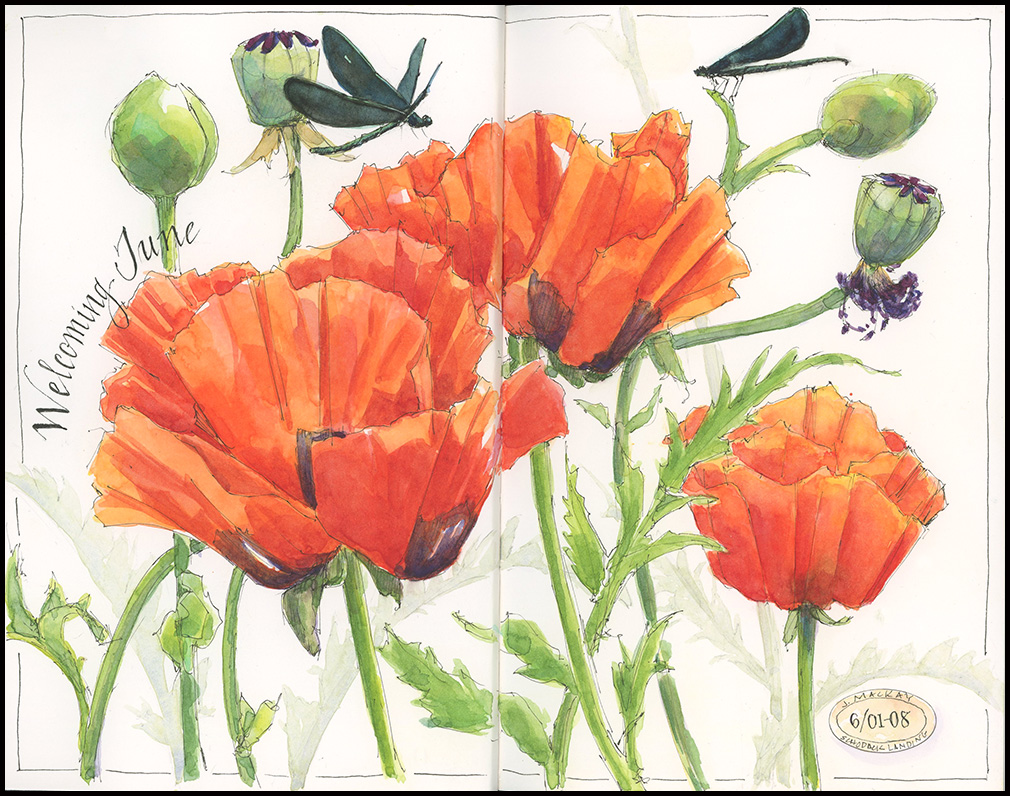
Tips & Techniques– While it is important to plan your composition and color scheme for a finished painting, that doesn’t happen in the same way when working spontaneously in a journal. I often start with what strikes me and keep adding until the page feels complete. Each time I add an element, I think about the overall composition, but sometimes an addition pushes me in a new direction. Sometimes it creates a problem that needs to be solved. Sometimes the page unfolds beautifully, and sometimes it doesn’t. Because it’s a journal, the result is intended to be a reflection of your experience more than a perfect painting. Learning to embrace the imperfect is part of the process.
Seabirds Up Close
I’ve spent many summers watching seabirds from the deck of the Maine State Ferry, on boat tours to the Atlantic Puffin colony on Maine’s Eastern Egg Rock and, more recently, on Iceland’s rocky cliffsides. From common sightings, like gulls and terns, to more unusual ones, like storm petrels skimming close to the surface or gannets plunge diving into the water, it’s always a thrill to see what’s out there. The Double-crested Cormorant is a common bird to watch for. It’s is easy to spot from its characteristic behaviors: sitting low in the water one minute and disappearing the next to dive for fish, flying low over the water, or perching on buoys or rocks to dry its outstretched wings. Rarely do you get an up-close look at its stunning turquoise eyes or bright orange bill. So, I hope you enjoy this portrait and get a chance to spot one through your binoculars soon.
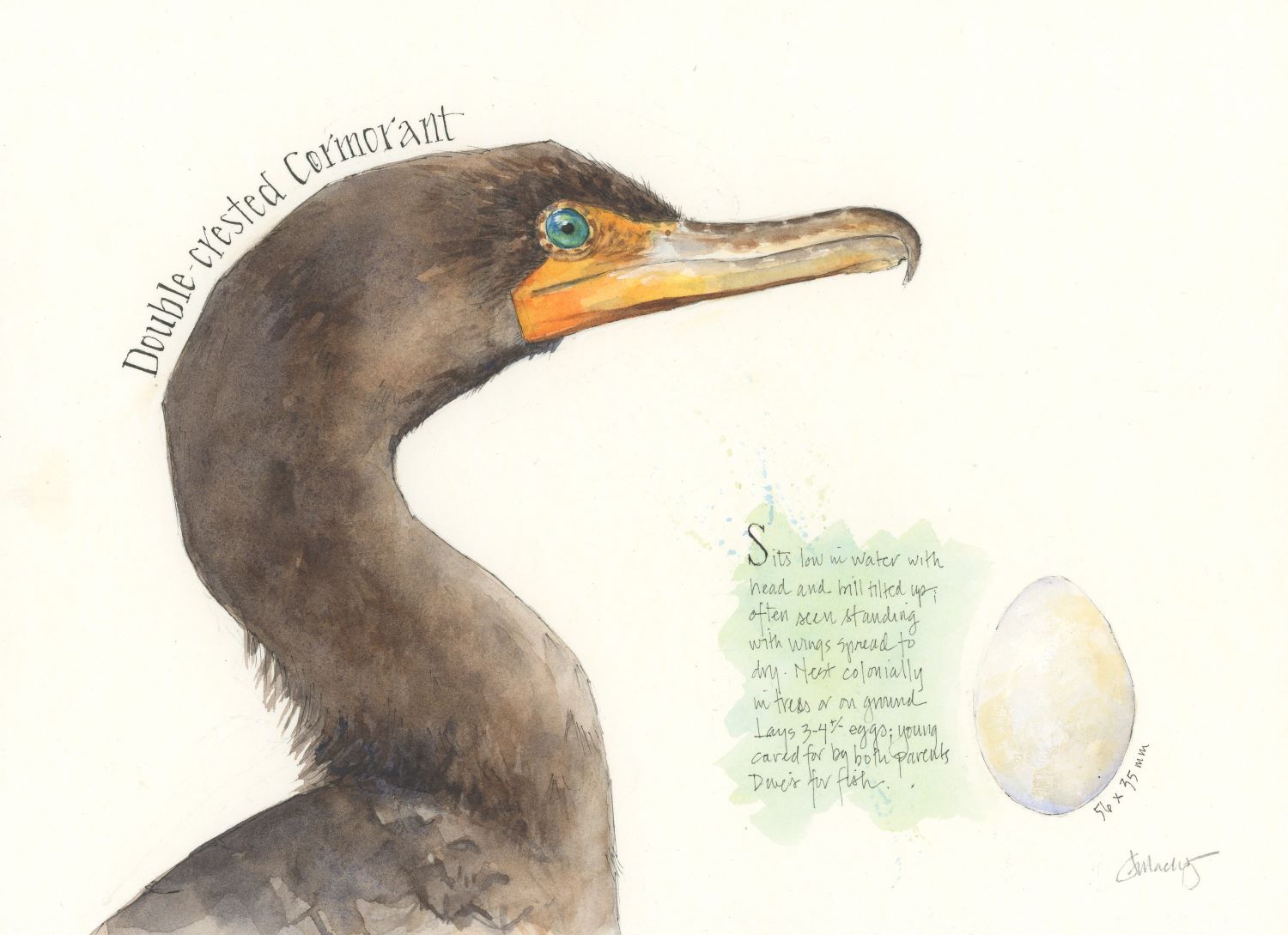
Tips and Techniques– Join me in July and August for Seabird Portraits in Watercolor, a four-class online workshop. Each class will focus on one bird species. Tuesdays 6-8pm Eastern, July 16: Northern Gannet; July 30: Common Tern; August 13: Double-Crested Cormorant; August 27: Atlantic Puffin. Register at Winslow Art Center.
Answering the Call
When poppies bloom, you can’t wait. You can’t say: I’ll paint them next week, or even tomorrow. By next week, they may be gone. Tomorrow it may be raining. You have to set aside the vacuum, the groceries, the weeds that need pulling. You must go out and paint.

Tips and Techniques– If you are unsure of which colors to choose for a particular subject, do some color tests. This can be invaluable for deciding which pigments will work best before you are committed to your painting. I tested a lot of red pigments and combinations of reds and yellows before settling on the colors I used here: Pyrrol scarlet and Hansa yellow medium for the flowers, and Hansa yellow light and Prussian blue for the leaves. The centers and darks are Ultramarine and Alizarin crimson.
Glorious Globes
I discovered allium growing in a wild garden a few years ago and I’ve been enthralled by it ever since. This is the third year of blooms for the bulbs I planted in our garden and love the bright purple globes popping up amidst the green foliage of poppies, daisies, and other perennials that will bloom next. I hope you enjoy its unfolding as much as I have.
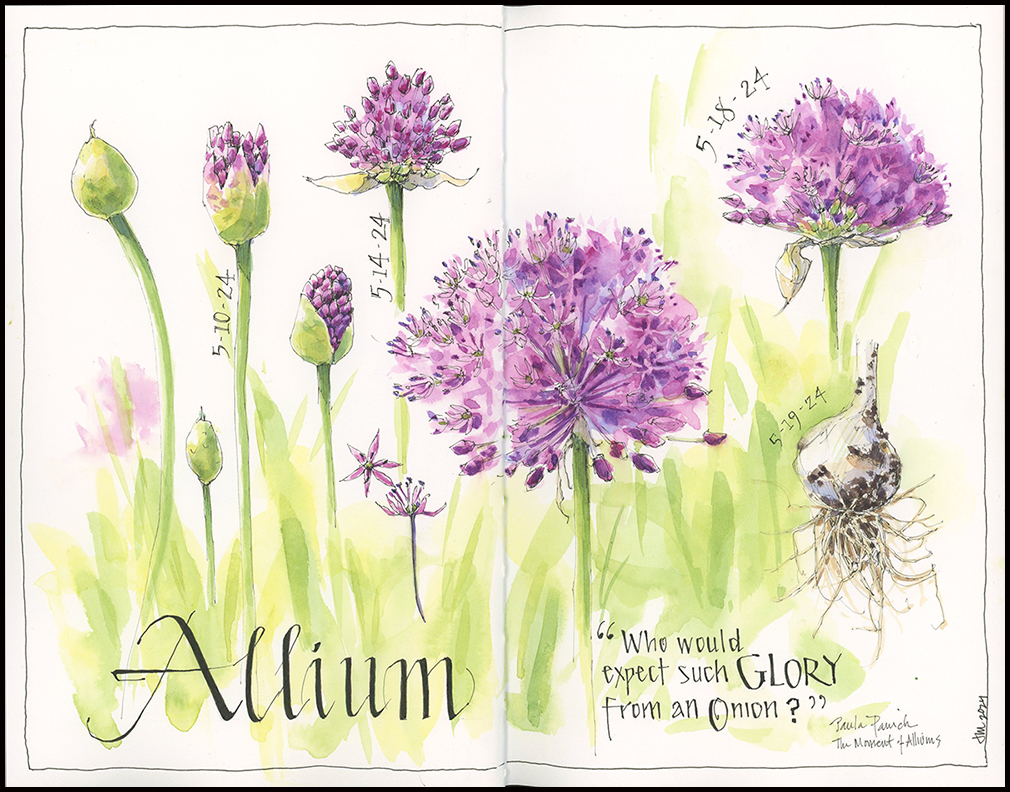
Tips and Techniques– When you have fussy, small florets like allium or lilacs, you can paint a few of the small blooms and use a wet-in-wet technique and some negative painting to suggest the rest. Combining precise elements with loose watercolor produces more evocative blossoms and invites the viewer to fill in the details.


 Drawn In