
Acrobats in the Freezing Wind
I remember the first time I saw a starling, now at least 35 years ago. I was in a bank parking lot and a small flock was strutting and pecking around on the lawn. I thought they were such extraordinary birds—as Mary Oliver writes, “chunky and noisy but with stars in their black feathers”—and I excitedly went home to look up my find. When I discovered they were ordinary European starlings, I felt foolish. If I was going to get to know birds, I was going to have to do better.
Now here I am, all these years later, revisiting my foolishness. I see starlings gathered at the edge of snowy and stubbled cornfields. And then they lift off in unison, dancing across the sky — “acrobats in the freezing wind” — extraordinary after all.
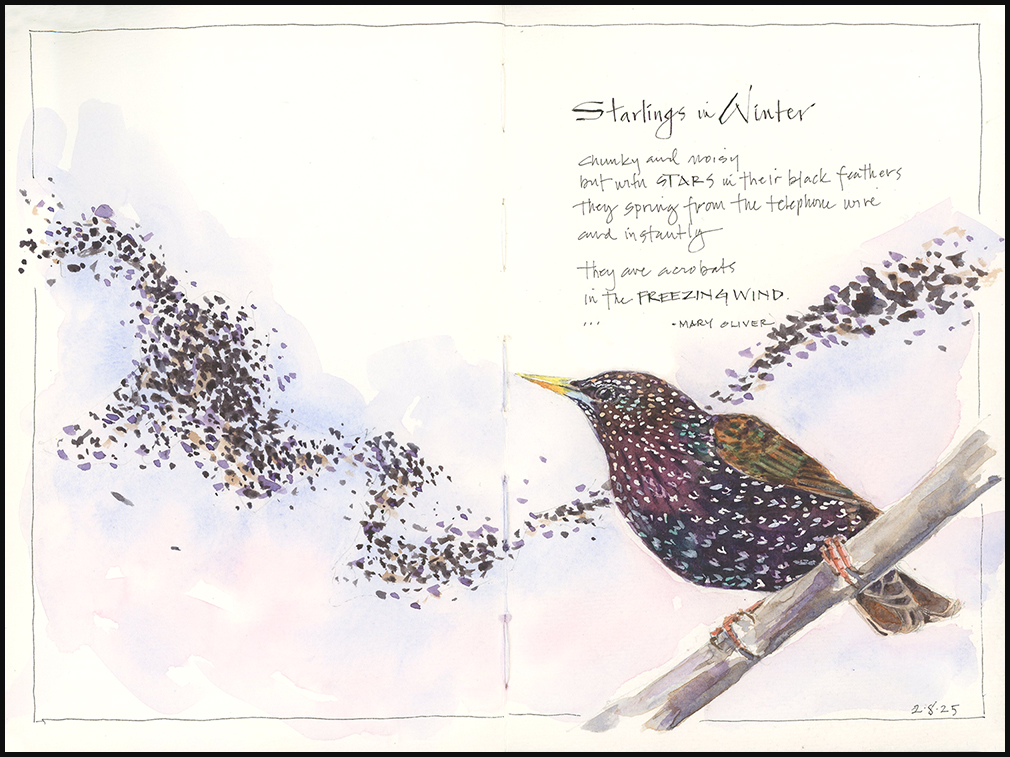
Tips & Techniques- Starlings look black and brown from a distance, but they have a remarkable variety of color up close, and especially during the breeding season. While you could paint them using black paint, you would lose the vibrance and variety achieved with color mixes that yield richer darks. I used masking fluid for the white markings and then painted several layers of alizarin crimson, ultramarine, burnt sienna, and veridian watercolor to convey the iridescent purples and greens. Once the masking fluid was removed, I toned down some of the whites on the underside with a pale and loose wash of these same colors, and used them again to suggest the murmuration across the page.
From the Collection
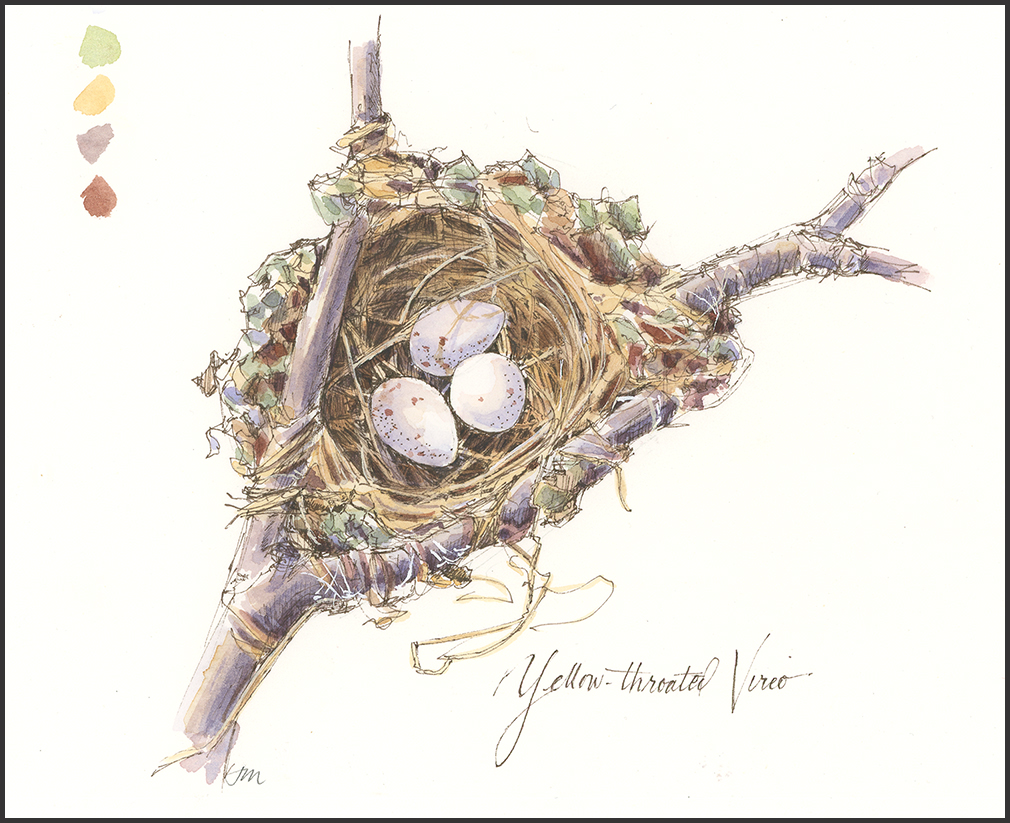
I’m taking advantage of bitterly cold days to paint a few bird nests that I’ve wanted to spend time with from the collection of the New York State Museum in Albany. Maybe that seems like an odd thing—spending time with a bird nest—but I find that when I am doing a detailed drawing and painting like this, I can’t help but think about the bird that made it, the young that fledged from it, the materials it is made of, the weather it survived, and the person who collected it. In this case, the solitary vireo and its offspring are but an echo across generations of birds. But here is this gem, beautifully decorated with strips of birch bark, lichen, paper wasp nest, and soft plant fibers, and here I am, happy to bring into the light once again.

Tips & Techniques- Drawn in ink with a Micron 005 pen and painted in watercolor with a touch of white gouache on New York Central Art Supply 140lb, hot pressed, 100% cotton watercolor paper. I bought a block of this paper from Jerry’s Artarama after being given a sample pack. I find texture and absorbency of this paper are a dream to work on. If you’ve struggled with other hot press papers, you might try this one.
Goldenrod Dancers
Slow drawing is just my speed this weekend. I was laid low this week by a terrible cold, and I’ve barely had energy to do anything but rest on the couch. I was glad I felt up to sitting at my desk yesterday and today to be absorbed in the curled and complex leaves of goldenrod that was stunted by the goldenrod bunch gall midge. I loved just turning off everything else—the cough, the sore throat, the impending snow, the projects that didn’t get done this week—and just drawing. This may get a bit of watercolor, or not, but that’s a decision for another day.
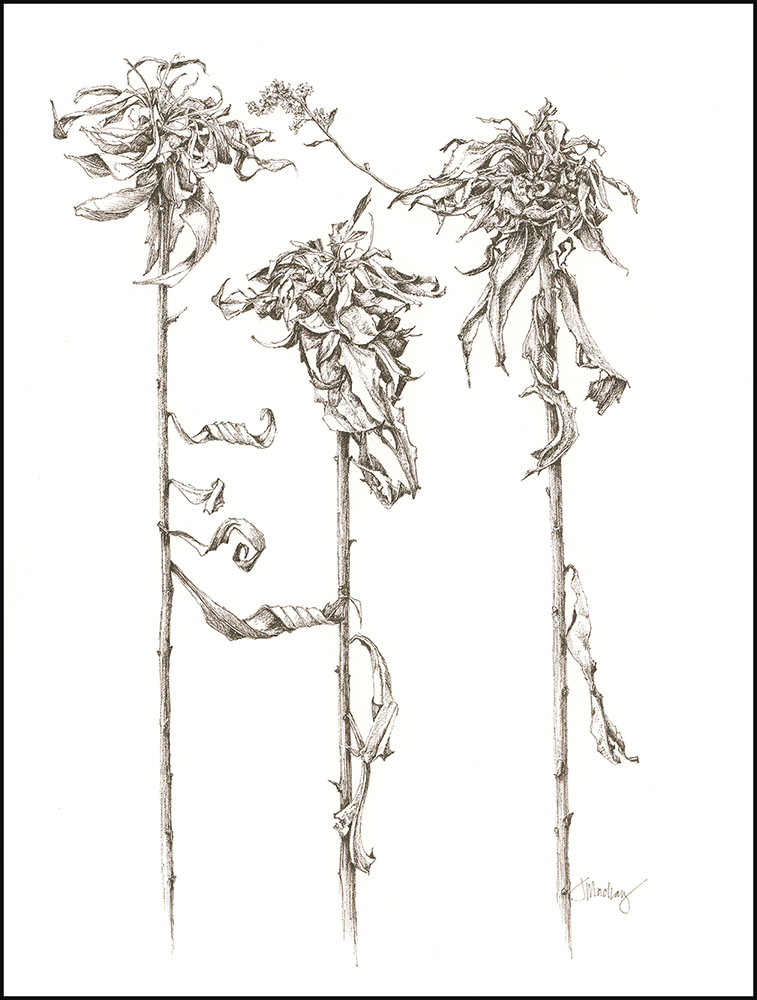
Tips & Techniques– Those of you who have followed me for a while know that goldenrod galls are a perennial subject. What made this different was the paper—it’s 140lb Fabriano soft press watercolor paper. Soft press is hard to find and only comes in sheets. It’s right in between hot and cold press paper, so it has just a bit of texture and behaves well when adding watercolor. The texture and absorbency of the paper doesn’t allow a Micron 005 pen to glide smoothly across it, but it makes the pen feel more like a pencil when shading and gives the drawing an Old-World feel. Always good to mix it up!
Becoming part of the silence
I love this quote by Irish writer Robert Lynd. “In order to see birds, it is necessary to become part of the silence.” He seems to have understood something profoundly true. Though we may see birds every day—by happenstance or on purpose– really knowing birds requires being quiet enough to enter their world. Unseen. Unobtrusive. Observant. I can honestly admit that I hardly do it enough. But when it happens, whether for just a moment or an hour, it’s a special thing.

Tips & Techniques- If you are doing a piece like this, my advice is to take your time. You’ll be making a lot of decisions: choosing the quote, the bird(s), the text style, size and spacing, the colors, and the paper. Play around to see what works before setting on a final design. I tend to work a little at a time, so that I can experiment with different elements. I chose New York Central Art Supply 140lb hot pressed watercolor paper and used 02 and 005 Pigma Micron pens for the black text. My palette was burnt sienna, yellow ochre, burnt umber, and cobalt blue for the Carolina wren and cobalt and a touch of burnt sienna for the word BIRD.
If you’d like to learn more and try your hand at Birds & Words, check out my new online class at Winslow Art Center starting in February.
On the Perch
“You’re on the perch,” my former boss would often say to me when I was at my computer. I was working for the Audubon Society then, and the phrase was part greeting, part acknowledgment of the task at hand. Though my work has changed, I’m still facing a computer most days and, thankfully, on the perch at my art desk most evenings.
This week, I am experimenting with two of my favorite things: birds and words. There are endless possibilities—the fun is figuring out which combination of birds, hand-drawn letters, layout, and words will give me the feeling I want to convey. My desk is strewn with calligraphy books, pens, and papers. Sometimes, I start with the birds, sometimes the words.
It’s enough to fill a long winter on the perch.
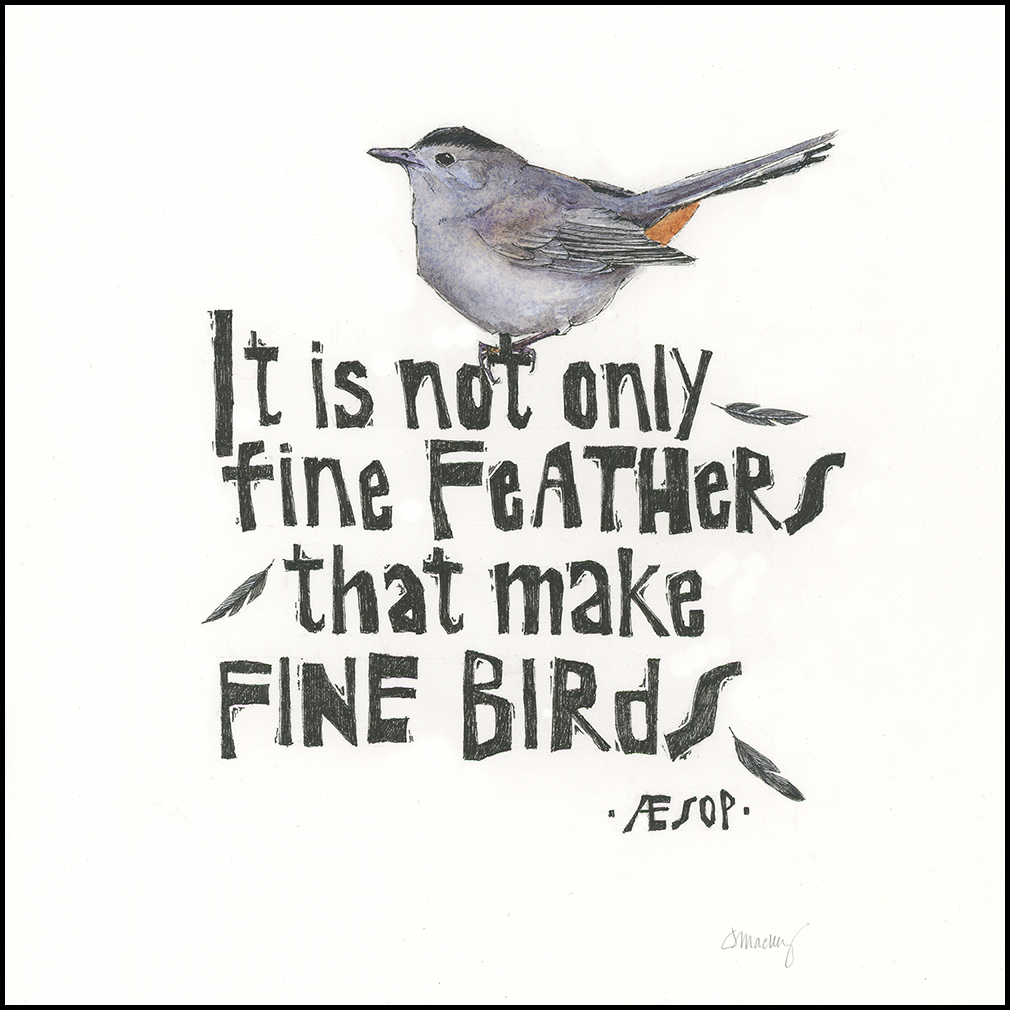
Tips & Techniques– If this sort of thing appeals to you, join me for BIRDS & WORDS, my new online class at Winslow Art Center starting Tuesday, February 4, 2025. Try your hand at combining text with artwork to lend greater meaning to your sketchbook pages or artwork. We’ll practice both hand-lettering techniques and drawing and painting birds in ink and watercolor. Each class will introduce a different approach to adding text, including large letters, poetry, and quotes.
Holiday Baking
Most of my creative time and energy during the holiday season goes into gift making, wrapping, and baking, and this year was no different. As a result, my sketchbook comes up short. So as the year closes out, I thought I’d devote a page to remembering the recipes I enjoyed making and consuming last week. I do wish I could share my sublime toasted hazelnut coffee cake with you as thanks for following my blog all year long. Alas, it is gone, so I send my favorite wooden spoons and a photo, along with my heartfelt thanks and best wishes for a Happy New Year.


Tips and Techniques– When time is short, or you just need put pen to paper, don’t overlook sketching common household objects. Spoons, silverware, toothbrushes, food, pens and paints, shoes– it’s all fair game. You’ll learn a lot about painting different textures when you choose different types of objects. I enjoyed capturing the patterns on these spoons– you can create wood texture in ink first or directly in watercolor or layer one on the other.
What’s your favorite household item to sketch?
Winter Flowers
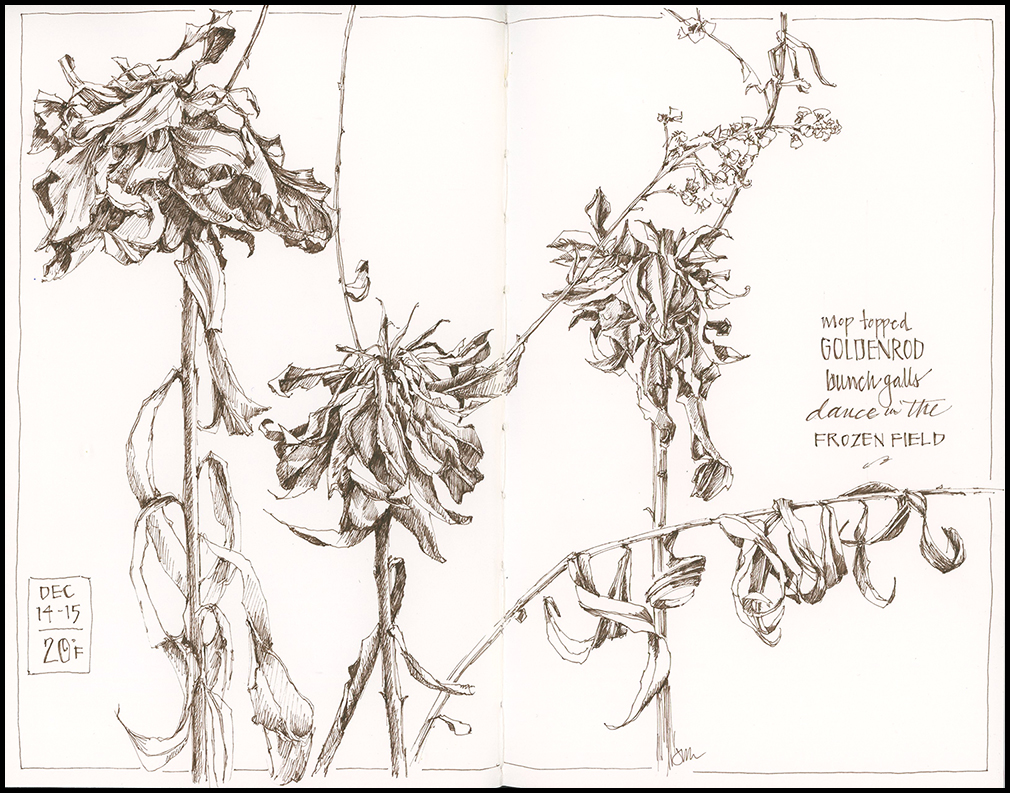
Mop-topped goldenrod dance in the frozen field. I find them a fitting celebration of winter: stark and windswept, but still lively and lovely, especially when tinged with frost. I like walking out into the cold field and sketching a few right in place, feeling the same air and wind that chills and rattles their thin leaves. I also appreciate being able to take a few home to study and sketch without wind or gloves.
On this first day of winter, I wish you a season full of new discoveries, unexpected gifts, and wonder enough to share.
Along the Roadside: November
If you were to walk along the roadside here, you would see a landscape of tawny browns, russets, and grays, mixed with pale ochres and faded greens. But every now and then, a pop of red hangs on, waiting for wind or birds to snatch it away. It’s late November’s palette. I appreciate its bright surprises, glinting in the cold sun.

Tips and Techniques- Even when it’s cold, I often take my sketchbook with me when out for a walk. I stop to sketch what catches my attention and hope that a page will emerge from it. On days when I don’t bring my sketchbook, I still pay attention to what’s growing or dying along the roadside, so that I might come back around to it another day. I sketched this page with a Micron sepia 005 pen and added watercolor and text back at home. Wishing you many good walks!
Retreat
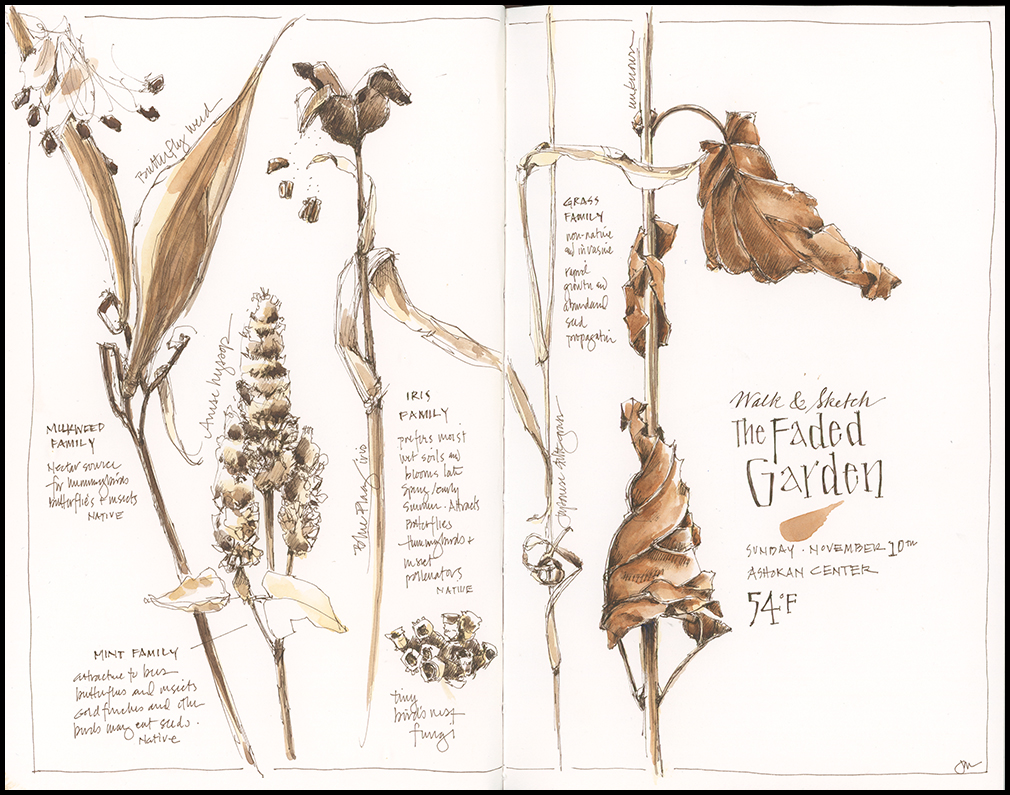
The sketches I’m posting today are from my weekend teaching at the Botanical Art & Nature Sketching Retreat at the Ashokan Center in New York’s Catskill Mountains earlier in November. Sixty-eight people from all over the country came for the weekend and it was an incredible convergence of artists. I was honored to teach alongside extraordinary botanical artists Wendy Hollender, Lara Call Gastinger, and GiacoMina Ferrillo, and to be in the company of so many warm, enthusiastic, and supportive people. Given my brother’s deteriorating health, I wasn’t sure whether to go but I’m so glad I did. Jim was in good hands with my extended family and the retreat gave me the opportunity to center myself before facing his loss.


A Note of Thanks…
I am so grateful for the outpouring of support extended by this community upon reading of my brother Jim’s death last week. Your kindness and condolences have been a much-needed comfort.
With much gratitude,
Jean
I’ll Look for You
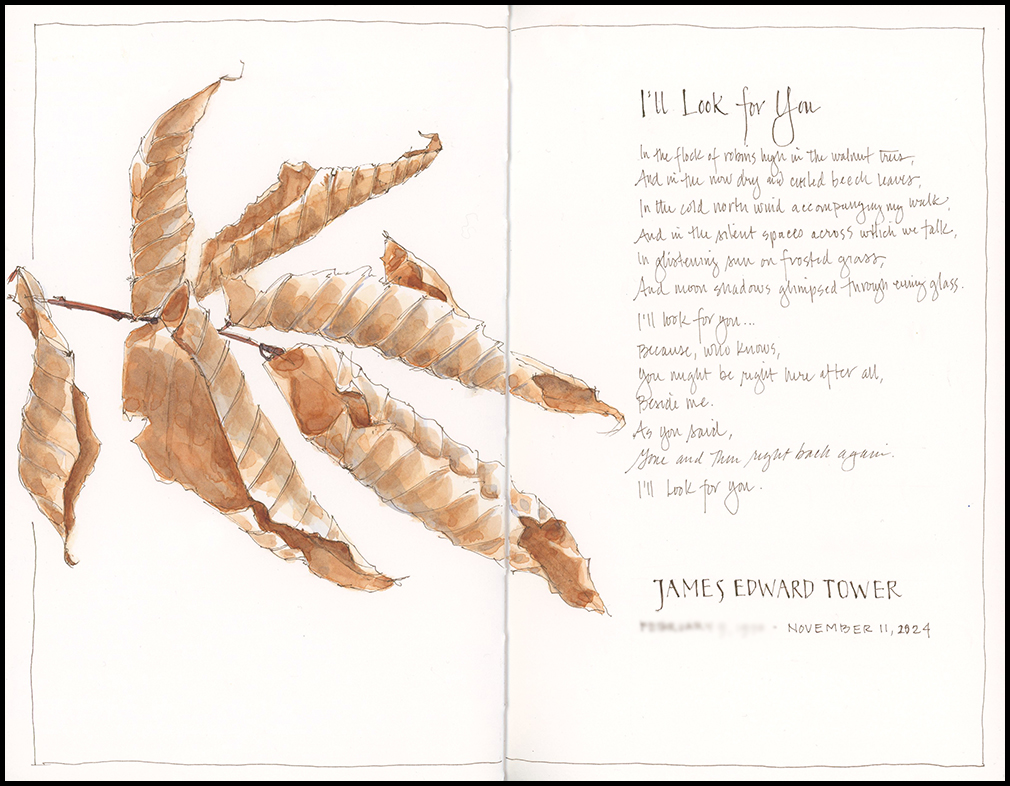
Losing a brother is like losing part of yourself– part of your childhood, your growing up, your everyday life. You grieve for yourself and for the future without him, but also for those who lost a friend, a teacher, an uncle. My brother Jim died last Monday night of a progressive and fatal lung disease. His decline over the last few weeks was precipitous and heartbreaking. I’m grateful that we shared many intimate and honest moments together, including on his final day. When I told him how much I would miss him, he looked at me and said, “You never know, I might be gone and then be right back with you.” This poem and page came about because of that.
Thank you for your kind thoughts and condolences.
I’ll look for you
In the flock of robins high in the walnut trees,
And in the now dry and curled beech leaves,
In the cold north wind accompanying my walk,
And in the silent spaces across which we talk,
In glistening sun on frosted grass,
And moon shadows glimpsed through evening glass.
I’ll look for you…
Because, who knows,
You might be right here after all,
Beside me.
As you said,
Gone and then right back again.
I’ll look for you.


 Drawn In