
Unexpected Detour
Well, I can now say with confidence, never again. Our planned 400-mile cycling tour (see previous post) was a combination of great cycling, good people, sleepless nights, extremely hot temperatures, and unexpected detours when my husband got sick. These pages aren’t beautiful, but they are an honest snapshot. I found it nearly impossible to record much along the way, but I thought I’d share this anyway to give you an idea of the trip and what a simple travel journal can look like. As always, thanks for following along!

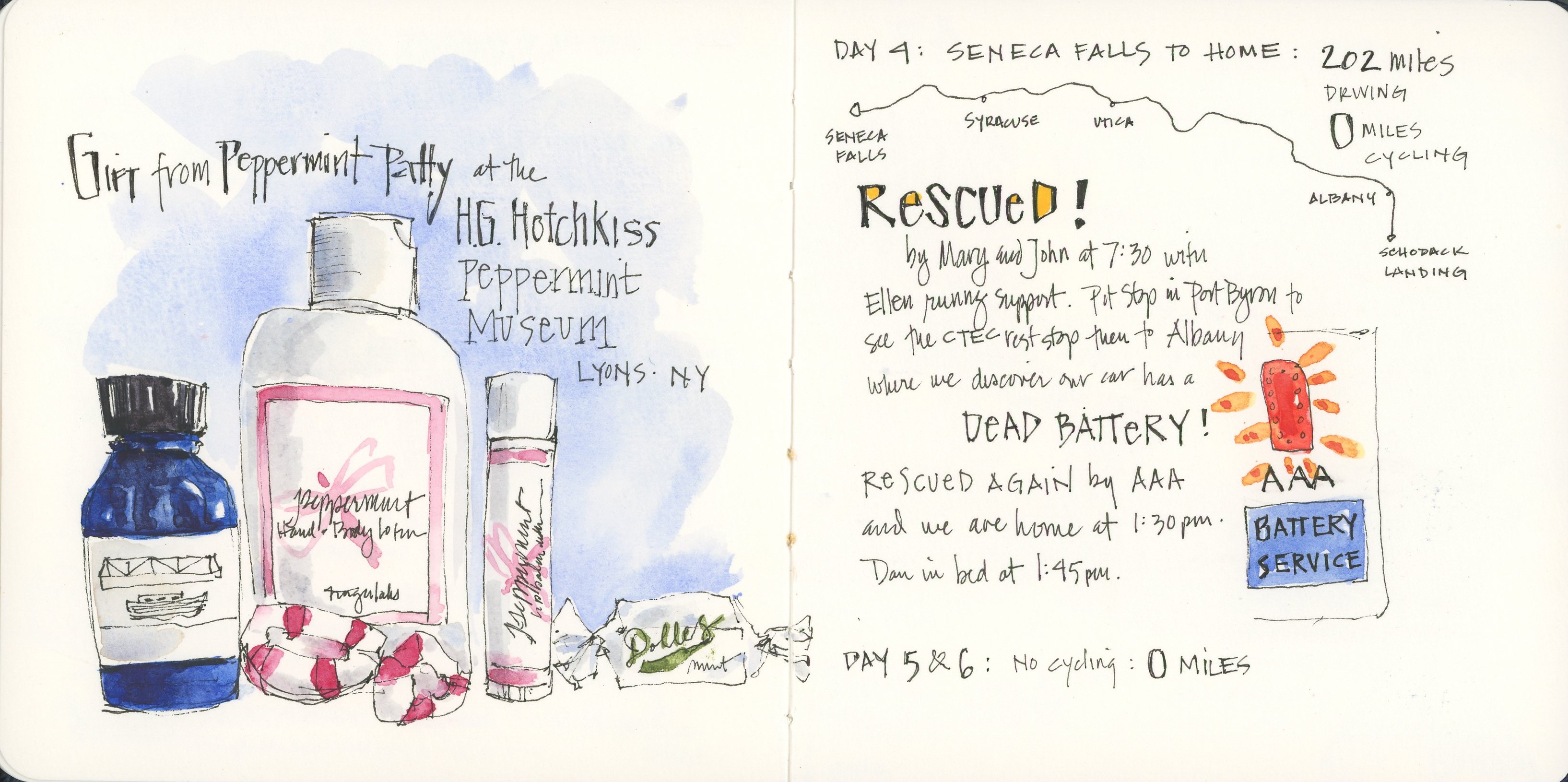

Never again?
The first time I cycled 400 miles across New York along the Erie Canal, I swore I’d never do it again. Too hot, too long, too exhausting. It was 2010 and we brought our sons, then 13 and 15, on the highly organized and supported 8-day Cycle the Erie Canal tour. It seemed like a good idea when we signed up, but by the time we started, my older son was in the throes of being a miserable teenager and much of the ride was a slog. In 2012, I agreed to ride again at the prompting of my younger son who made a compelling case for experiencing a sense of accomplishment and adventure. This time, I was more prepared. More Gatorade, more food, more training, and no older son, who spent a happy week with his cousins. In 2014, my husband and I ditched our kids and set off again. The ride seemed far easier and more fun, though I felt ready to replace my pelvis by day 6.
So, here I am, 11 years later, 11 years older, and ready to go. It’s the Erie Canal’s Bicentennial and I’m eager to celebrate and revisit the lovely towns along the waterway. Here’s the start of my cycling journal…I’ll post the rest upon my return. And then, (maybe) I’ll never do it again.
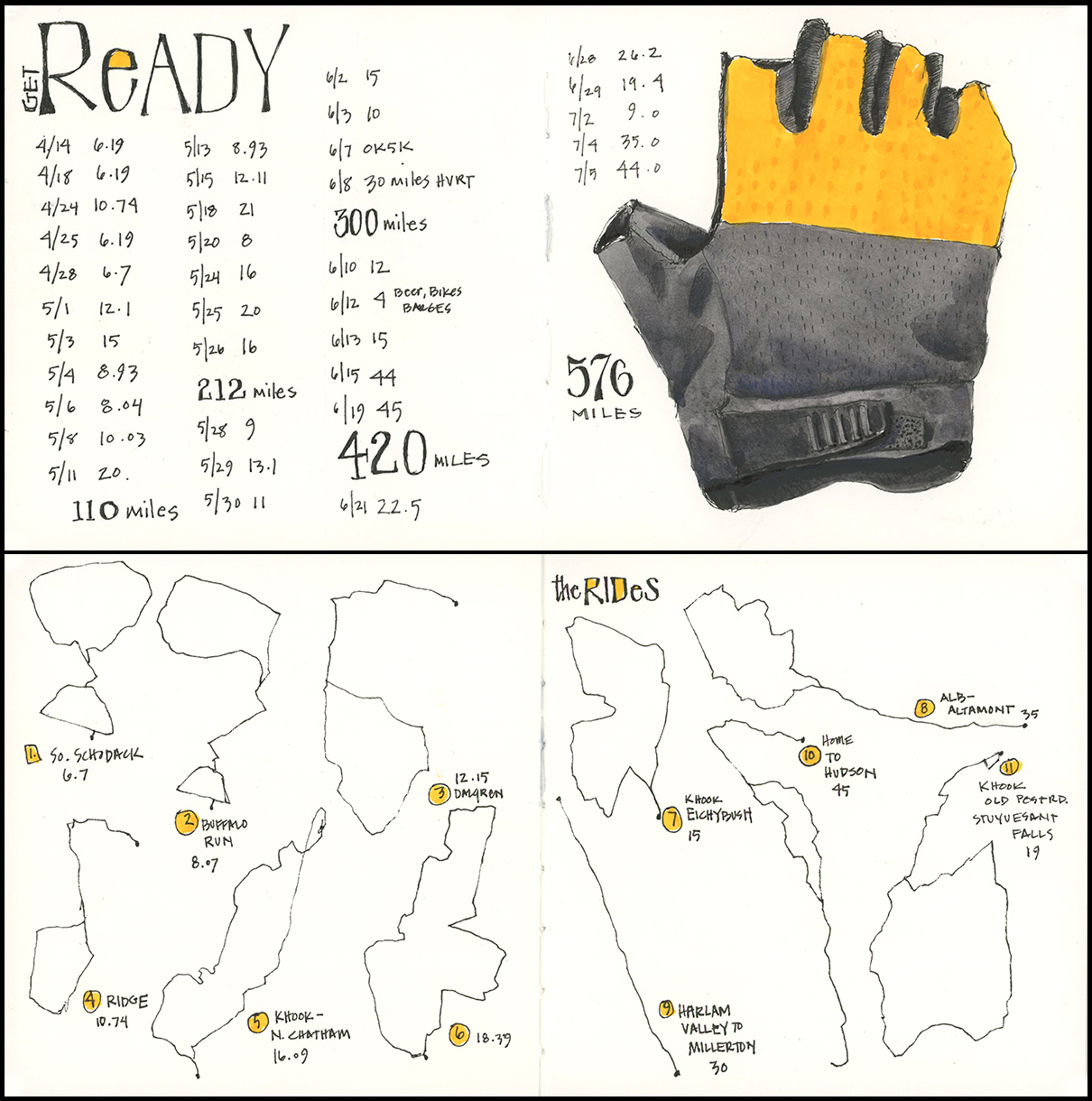
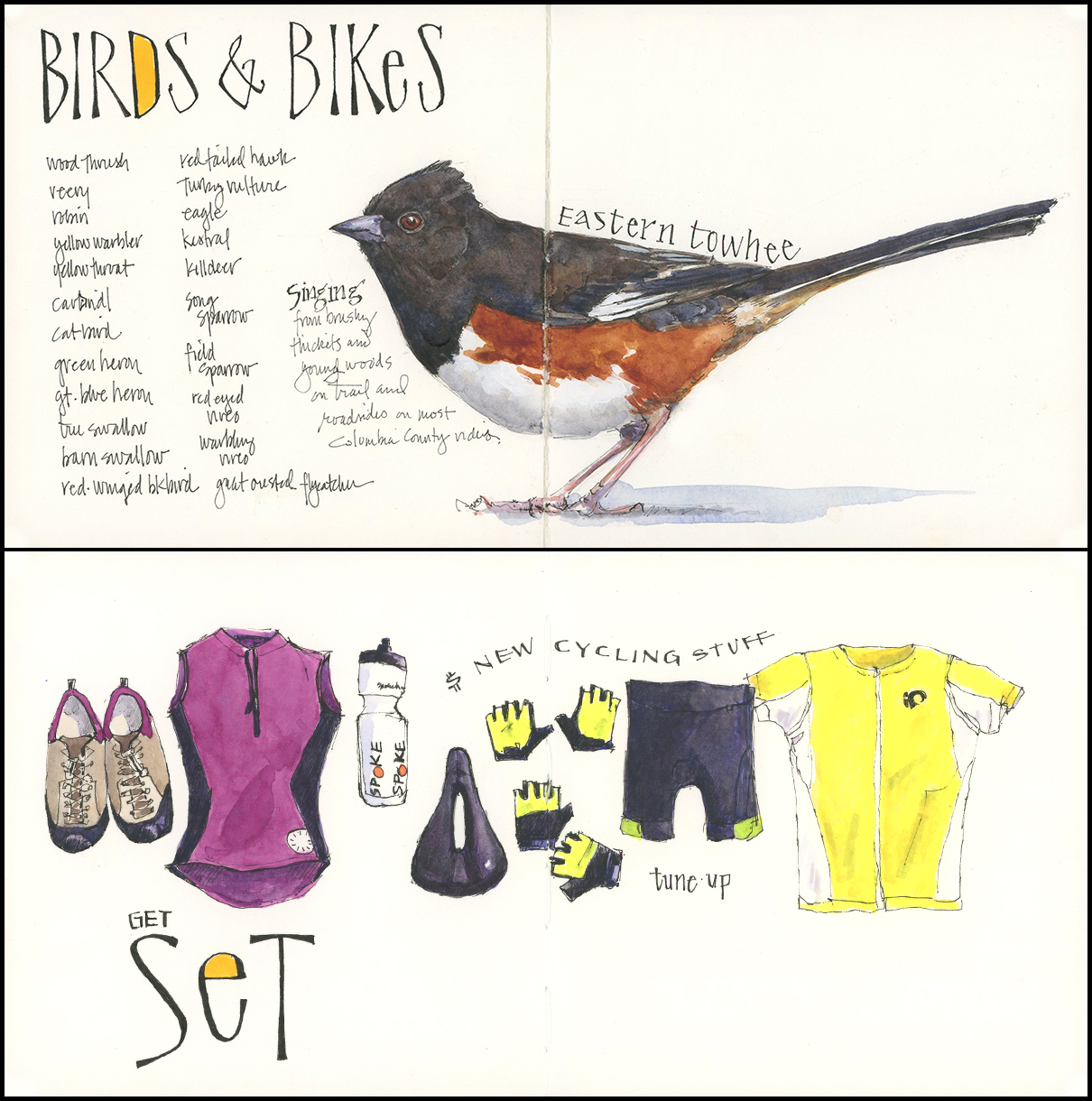
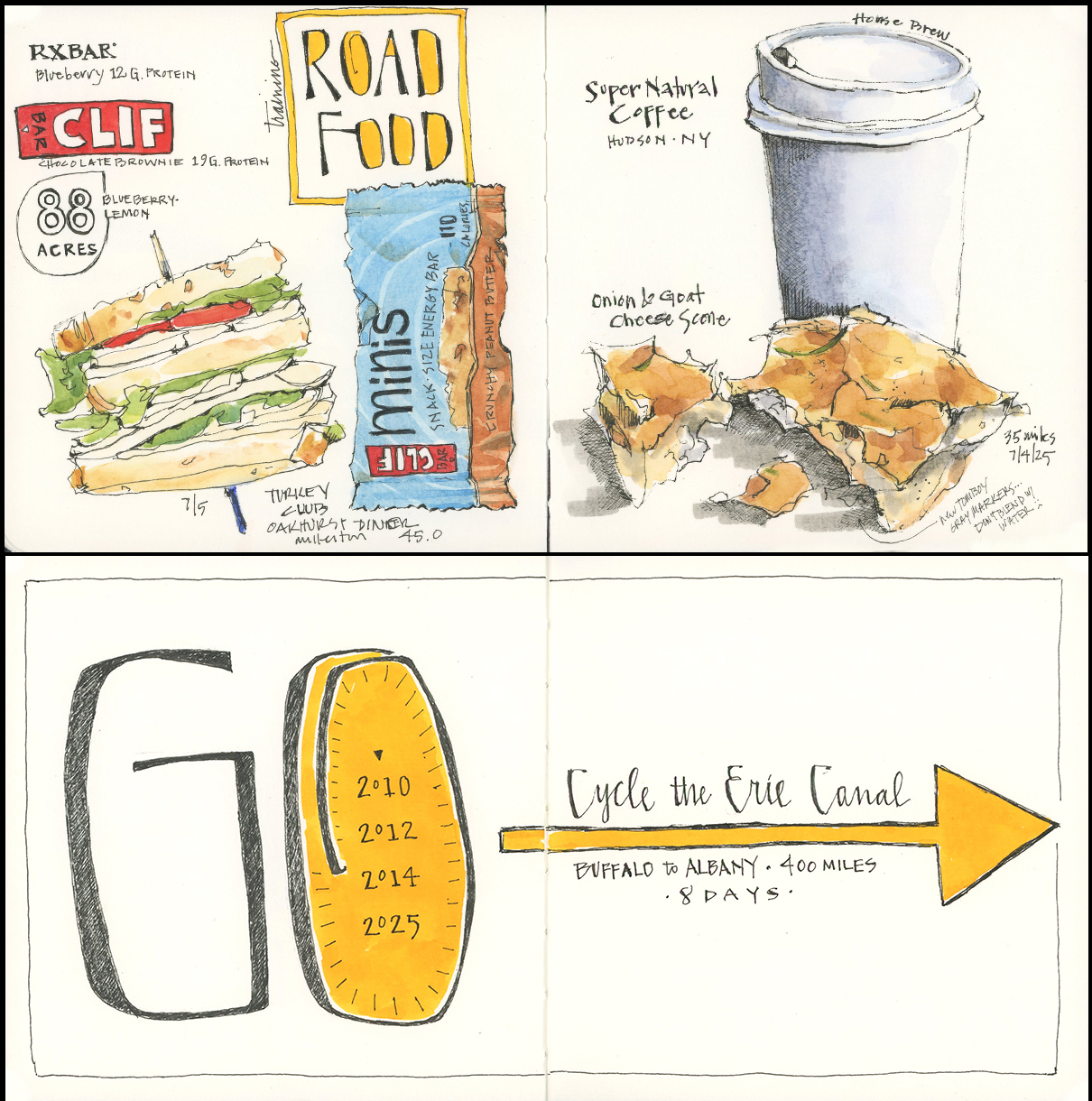
Tips and Techniques– When keeping a travel journal, I say: everything goes. Even though some of the things you record may seem mundane (like what you packed or ate or some stupid thing you encountered), those elements are often the most fun to look back on. I have kept a small journal on each of my cycling trips and they recall the triumphs and trials of each ride in ways that photos can’t. On this trip, I plan to focus on small details, quirky moments, a bit of humor, and food—which will be just what I need to make it to Albany. My other tip is to start a travel journal before you set off. It gives you a chance to test any new materials and decide on what is essential to bring. (Materials: Pentallic 5.5″ square watercolor sketchbook, Micron pen, watercolor, and Econoline deep yellow marker)
Farmers Market: Apricots!
Ah summer! Farmers markets and farm stands are abundant now with beautiful fresh vegetables, fruits, and flowers. People stroll relaxed and chatty, stop for coffee or a bakery treat, pet dogs, smell the flowers, compliment the growers and makers. What a pleasure. I’m ever grateful to have a small but robust weekly farmers market and several lovely farm stands nearby. The apricots are just in, and this piece pays tribute to the bounty and my good fortune.

Tips & Techniques- So many decisions go into making a piece of art. You must make choices about subject, composition, and color, as well as materials, lettering style, and final finishing touches. A sketchbook gives you the freedom to experiment with all of those choices. It lets you practice, build skills, and let go of feeling like the result has to be perfect. I certainly tried a lot of things on this page, but the thing I most wanted to try was making the small white on black sign for the apricot bars. I did it using a Micron 005 pen to work around the letters with hatches and scribbles and then added a layer of purple watercolor to fill the space and simulate the chalkboard type of signs you often see at the farmers markets. (Materials: Fabriano CP140lb paper, Micron 005 and 02, watercolors: Nickel Azo Yellow, Pyrrol Scarlet, and Ultramarine Blue for the apricots and Yellow Ochre, Burnt Sienna, and Quin Gold for the bars)
Join me for Fun Farmer’s Market: Creative Layouts and Lettering online starting this Thursday, July 10 and add some fun to your sketchbook this summer combining creative layouts and lettering with colorful farm fresh fruits, vegetables, and flowers.
June
It’s been a while since I took my sketchbook for a walk. That’s mainly because I’ve been cycling more than walking lately in preparation for a bike tour in July. In a few weeks I’ll be cycling 400 miles from Buffalo to Albany, New York, with the Cycle the Erie Canal ride. It’s an eight-day tour that attracts 650 cyclists from all over the country each year. I’m excited, but also nervous about riding 50-60 miles a day. Hence, the training. But even at cycling speed I’ve enjoyed noticing what’s blooming— vetch and birdsfoot trefoil in roadsides ditches, daisies and clover in grassy margins and upland fields, and black-eyed Susan and coreopsis just starting to open. Day lilies and milkweed will soon take over the show. For now, enjoy June.
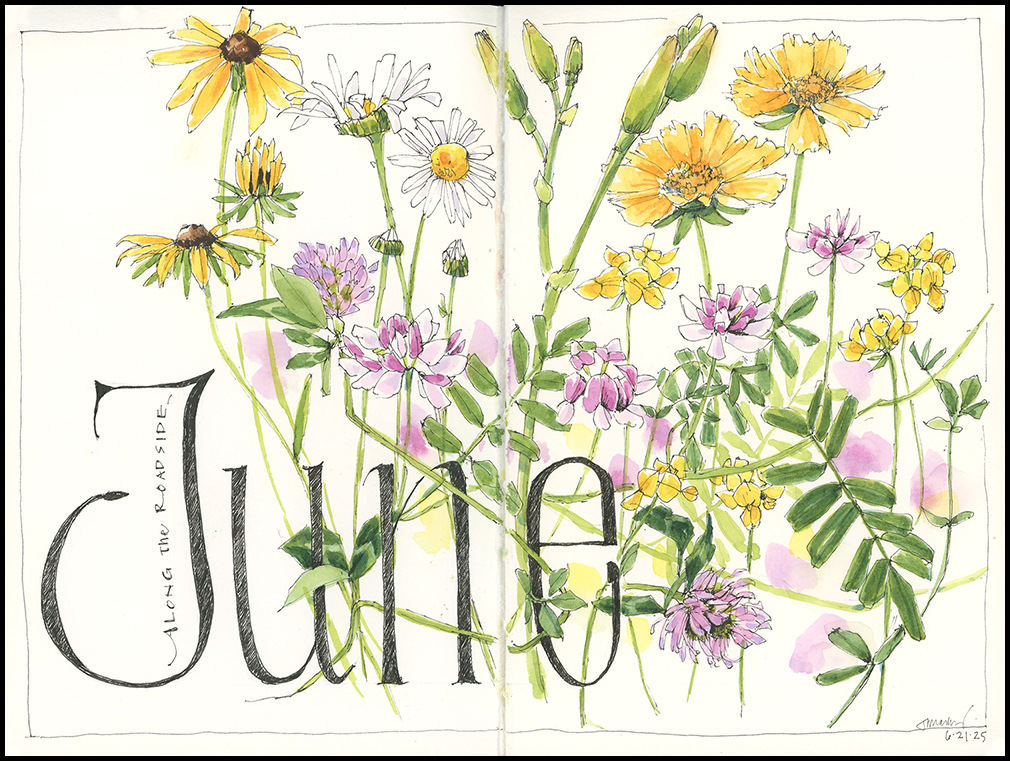
Tips & Techniques- Travel light for a walking sketch. I take only my sketchbook and a pen when sketching along the roadside. Work quickly and loosely, zeroing in on a bloom or two of each plant and walk on until you find something else to add. Let the composition evolve, filling the page until it feels complete. I paint and add text back at home where it’s safer and cooler. For color, make notes, snap a photo, or pick a bloom for reference. The end result may be a little bit of a jumble, but it also will be a nice record of the season and your walk. Materials: Handbook Watercolor Sketchbook with 140lb paper, Micron 005 pen, watercolors.
A Trio of Peonies
I don’t know whether it’s been my neglect or all the rain, but our peonies put on a less than stellar display this year. We had a few blooms and, thankfully, I cut three to enjoy indoors before a big downpour that I knew would knock them to the ground. These three have made a lovely display on the kitchen counter and I finally spent a few minutes sketching them before their inevitable fall from grace.

Tips & Techniques– The drawing stage of this page began with a continuous line drawing. Basically, you put your pen on the paper and don’t pick it up again until you’ve captured your subject. I gave myself a 10-minute time limit, but you might try it with less. The nice part about working this way is that it builds hand-eye coordination and creates a nice flow and looseness to the drawing. After sketching the blooms, I added some hatching to create tone and depth, and then I added a loose watercolor wash to the flowers and background. The final result is a bit wonky, but I love that I managed to capture the peonies without a lot of fuss, in a limited time, and before they faded completely.
Materials: Stillman & Birn Zeta sketchbook, Micron 02 pen, with alizarin crimson, manganese blue, and Hansa yellow medium watercolors
So Fleeting!
Our poppies unfolded this week and enjoyed a brief three days of sunshine. I’m working on the sketch of day four now, post downpours; flames ragged and nearly extinguished.

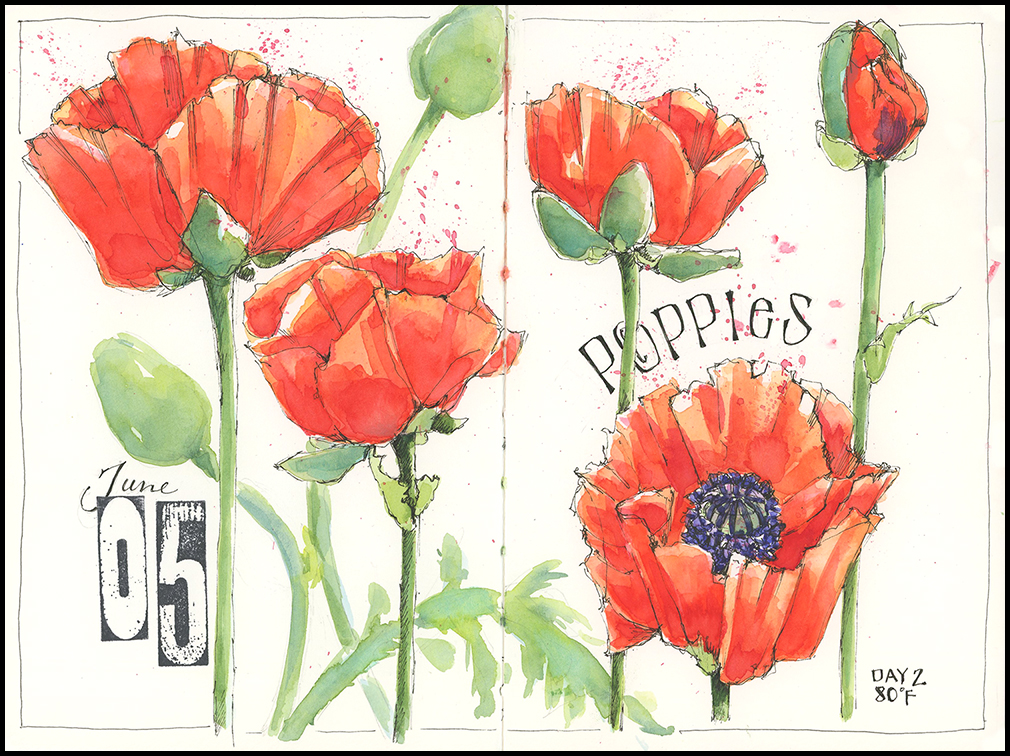

Tips & Techniques- Instead of offering a tip this week, I thought I’d ask you for one: What types of tips or techniques are most useful or interesting to you? Your answers will help to shape future information included here. Thanks!
Spark Your Creativity!
If you are an artist, or an aspiring one, you already know the value of practice—there’s no substitute for making marks on paper. But sometimes, you need more than that to jumpstart your creativity or to take your artwork to the next level. I’m excited to announce several new classes and workshops designed to offer techniques, ideas, support, and inspiration. I hope you’ll consider joining me!
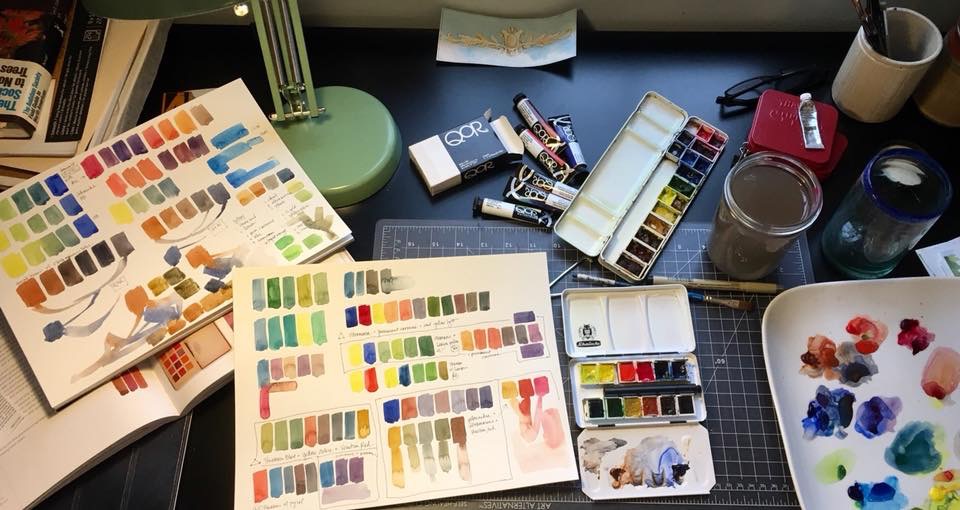
Fun Farmer’s Market: Creative Layouts & Lettering
Online at Winslow Art Center
Thursdays July 10, 24, August 7, August 21; 3:00-5:00 PM Pacific /6:00-8:00 PM Eastern
Add some fun to your sketchbook this summer by combining creative layouts and lettering with colorful farm fresh fruits, vegetables, and flowers.
Sketching Umbrian Nature in the Fall
October 3 – 10, 2025, Hosted by Winslow Art Center
Castello di Petroia, Gubbio, Umbria, Italy
An unforgettable travel workshop experience! Working primarily in a sketchbook, we will weave together elements of the natural and cultural heritage of this extraordinary place. Expansive vistas of fields and mountains; a canopy of spreading oaks, ripening olives, pomegranates and grapes; and a medieval castle and working farm are our subjects for the week.
Botanical Art & Nature Sketching Retreat at Ashokan
With Wendy Hollender, Lara Call Gastinger, Giacomina Ferrillo, Jean Mackay, & Vern Fannin
Friday, Oct. 31 – Monday, Nov. 3, 2025
The Ashokan Center, Olivebridge NY
Escape to New York’s breathtaking mountains for an unforgettable four-day Botanical Art & Nature Sketching Retreat at the historic Ashokan Center. This immersive experience is designed for artists of all skill levels who want to deepen their connection with nature, refine their botanical art and sketching techniques, and enjoy the camaraderie of fellow creatives.
Looking Ahead to 2026…
Sketching the Nature of Place
Sofia in Monsaraz, Portugal
June 3-8, 2026
Sign up now to express your interest and be added to the exclusive early access list. Registration will open once the class has sufficient interest. Get 5% off just by confirming your interest by 9/5/25.
Immerse yourself in the extraordinary setting of Monsaraz, Portugal and delve into ways to explore and capture your experience of place, from landscapes, plants, and wildlife to food and culture.
May Showers
So much for April showers bringing May flowers! We’ve had more than our share of May showers, too. The flowers have come despite the wet weather, but it’s been hard to get out to enjoy it all. I’ve been sketching in snippets of time, trying to capture blooms before they’re knocked to the ground. I started these three pages weeks and days ago but haven’t had time to finish them. So, for better or worse, today’s downpours gave me time to paint. Here’s hoping May showers bring June flowers…and a bit of sunshine.
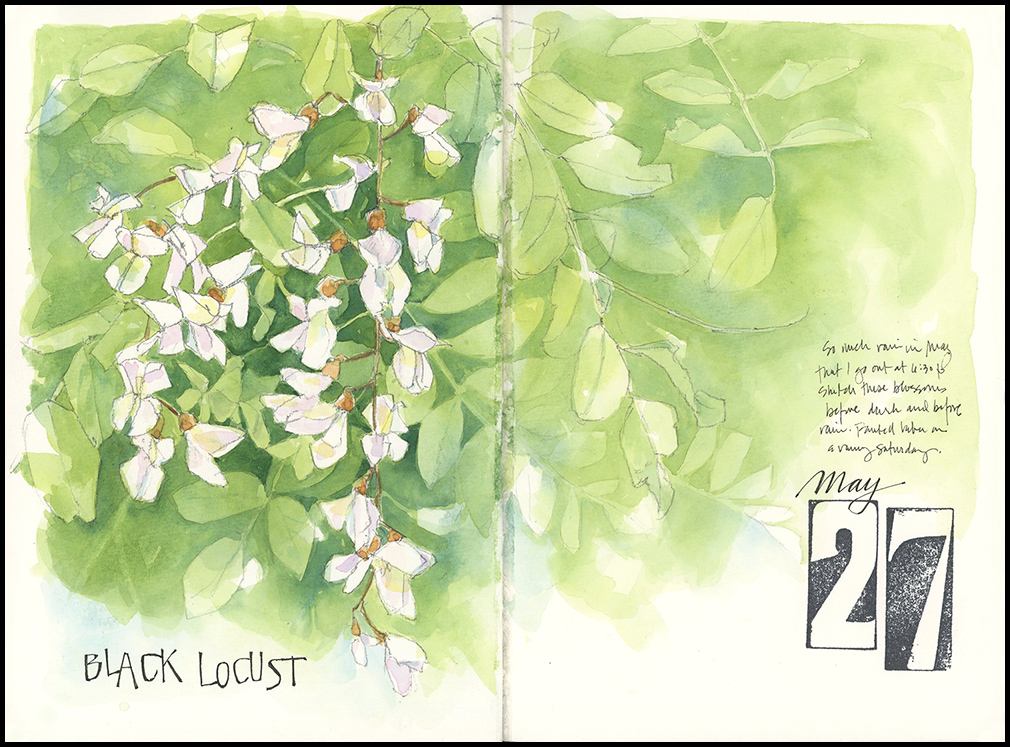
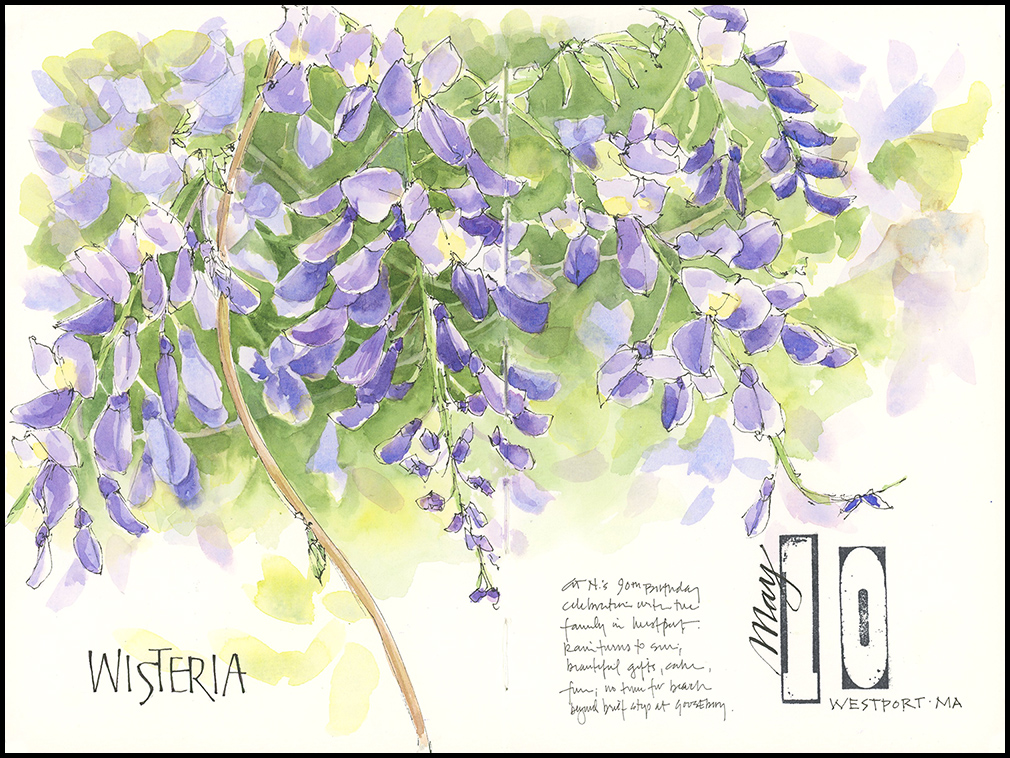
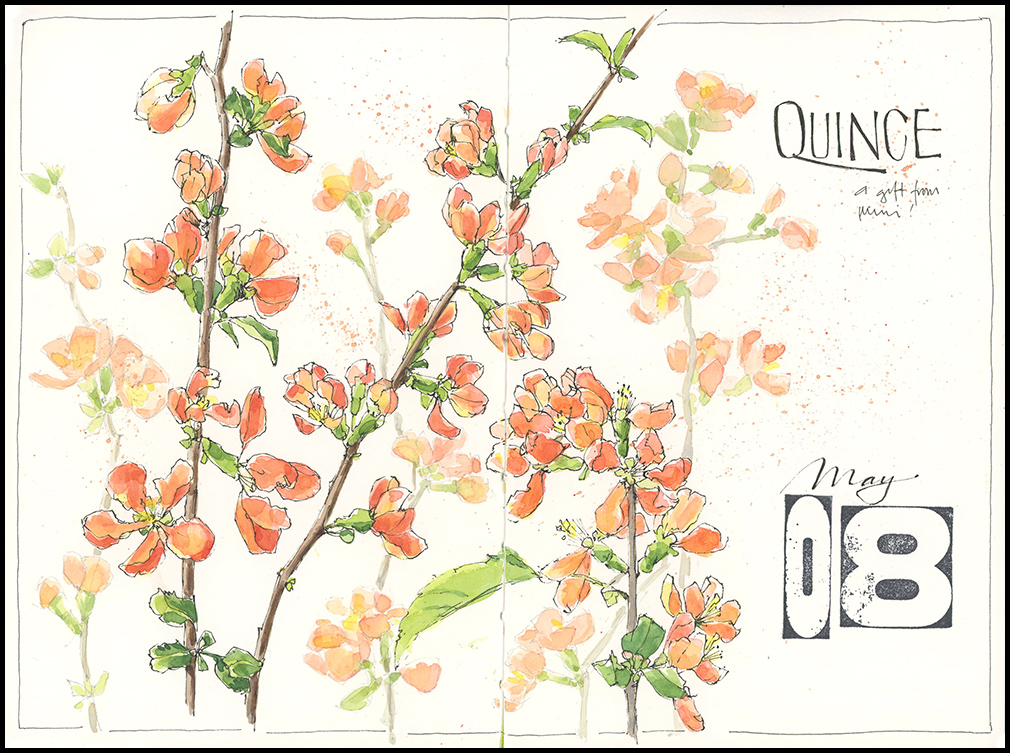
Tips & Techniques- The delayed finish for these three pages gave me time to think about how to treat them in a way that might tie them together. My large number stamps for the date and use of a consistent text style did the trick. Though the stamp is bold, it helps to balance the pages, adds an element of fun, and fits the looseness of the drawing style. I think I’ll continue using it. I missed capturing my allium, but I’ll try it again when the poppies bloom.
Stopped in My Tracks
While out for a run last week, this giant mushroom on the side of the road quite literally stopped me in my tracks. I took a quick look and knew I had to sketch it. Driven by curiosity and enthusiasm, I managed one of my fastest two miles in recent memory completing a loop that led me back to it. The mushroom was so large it wouldn’t fit life-sized in my sketchbook, so I used a 9×12” sheet of watercolor paper. I’ve since returned to the small grouping of mushrooms where this one grew and memorialized a smaller one in my sketchbook. But this one will always be king.
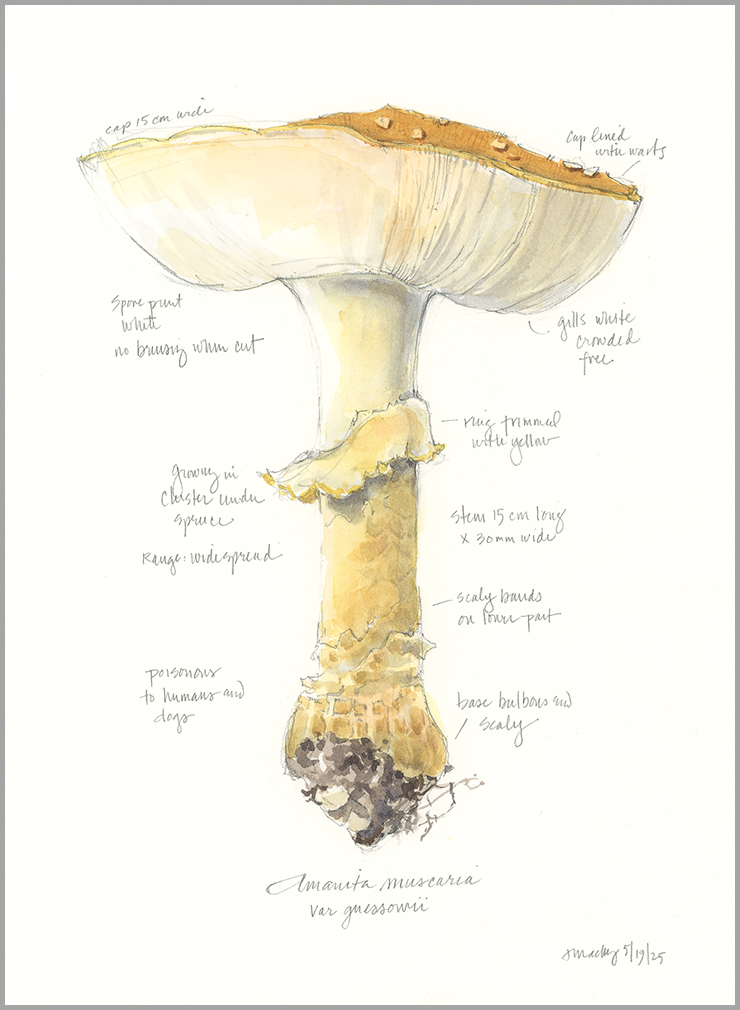
Tips & Techniques– You needn’t take up running to find great nature subjects, but spending time outside is key. When you’re out walking, cycling, mowing the lawn, or gardening, take note of what’s happening around you— start with what’s blooming that wasn’t last week or with the bird songs you hear. Let a of spark curiosity or wonder lead you to pick up a pencil or pen and see where it takes you.
Front and Center
I have several half-finished flower paintings in my sketchbook and allium in bloom that’s calling me from the garden. A Louisiana waterthrush is singing to beat the band by the streamside and a blue-winged warbler just showed up in the thicket by the woods, but there aren’t enough hours in the day to capture them—yet. I just wrapped up teaching The Art of the Bird, so nests have been very much front and center on my desk. At risk of seeming single-minded, I hope you’ll indulge me with another nest posting before I get going on the rest of spring.

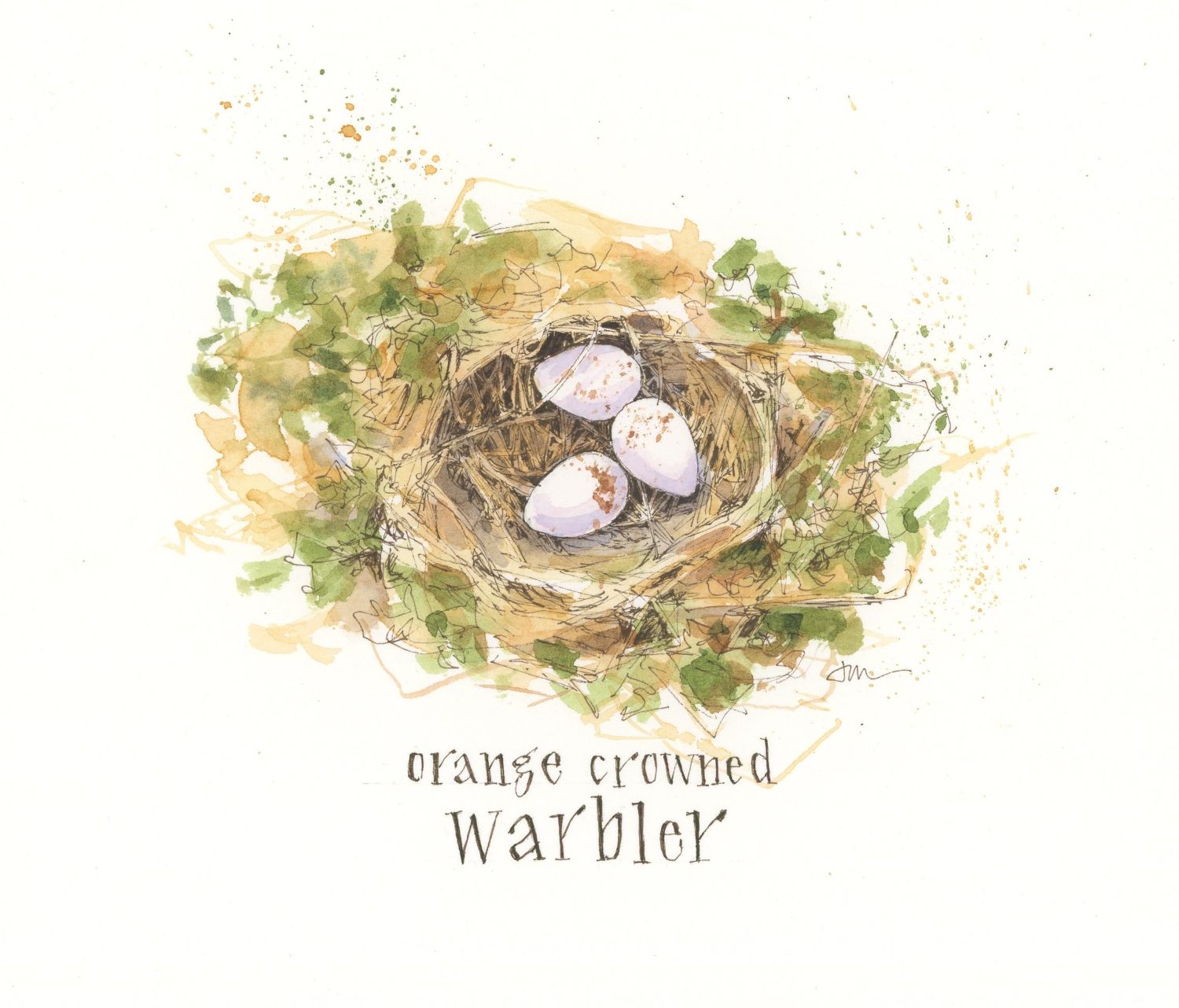

Tips & Techniques– No matter your subject, it’s important to pay attention to developing a full range of values from light to dark. Especially with a nest, where it’s easy to get lost in the details, it’s important to start light and build to the darks and details. My students worked on nests that were increasingly complicated, but by paying attention to the light and shadows, they came away with nests that had interest, depth and beauty.


 Drawn In