
Still Bearing Fruit
Last weekend, I cut the last of the frost-wilted flowers, fed the compost pile, and left a few flower heads for the birds. I thought the garden was finished for the season, until I took a second look at the blackened seed heads. They became the perfect subject for testing my new Pilot Metropolitan fountain pen. I love the way the pen glides over the paper—smooth and fine, not scratchy, just a pleasure to use. The ink is not permanent, so I can’t add watercolor to it, but the line quality is lovely. I’m almost looking forward to sketching what’s left of the dried tangle of runner beans.

Hard to Resist
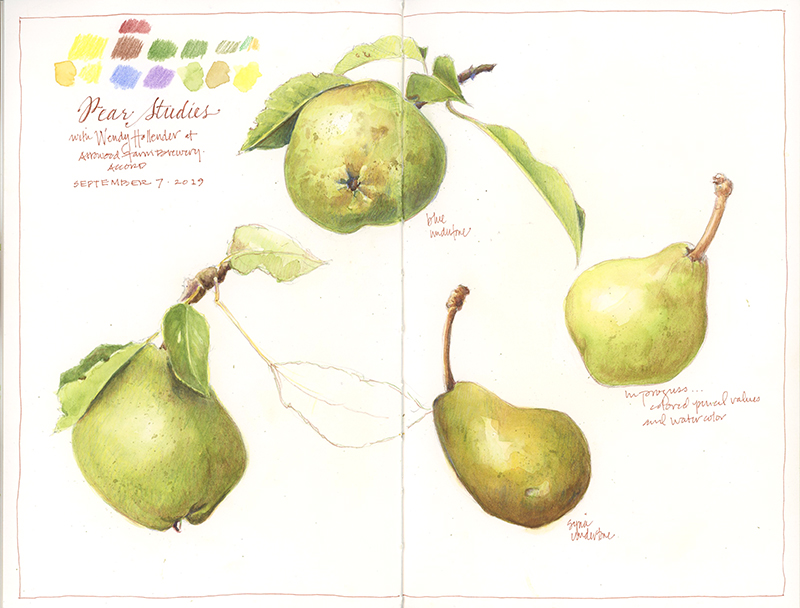
It’s hard to resist Seckel pears in the fall. I don’t mean eating them, so much as drawing and painting them. There’s something lovely about the squat shape and subtle variety of green and gold and red. My instinct was to fill an entire page with pears, but after beginning the first few, I quickly realized that I didn’t have the patience to do ten or twelve. So, four pears on a Saturday morning is all there is.

Tips and Techniques– I did these using a combination of colored pencil and watercolor. I set out to do them entirely in colored pencil, but quickly remembered why I am not a colored pencil artist—it just takes so darn long to shade forms. Although I like the control of colored pencil, I love the speed and luminosity of watercolor, and I’ve come to appreciate what watercolor can do all on its own when you learn to let it go. Still, it’s interesting to combine these two mediums and I recommend trying it just to play with the possibilities.
So Many Seeds
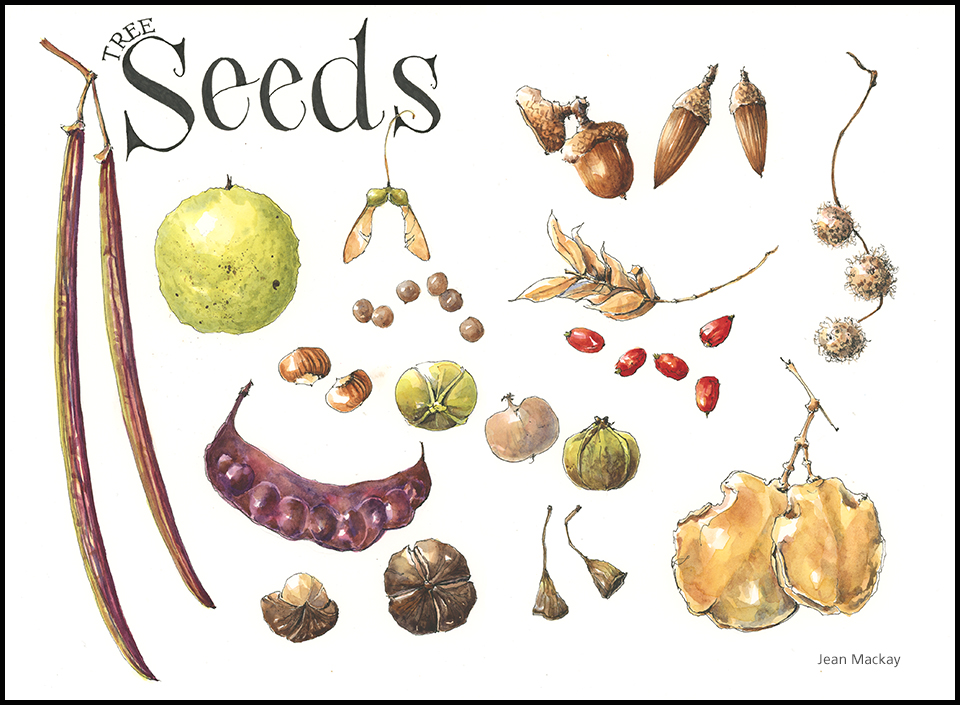
My yard is littered with walnuts, the driveway with acorns, the side yard with sugar maple keys. My desk, too, is nearly taken over by tree seeds of all shapes and sizes and in various states of decay. I have been collecting them for the past few weeks in order to make this painting. Collection pages are so much fun to do. Whether seeds or mushrooms or amphibians or moths, I enjoy learning about each species and about the group as a whole. And I enjoy the challenge of making the individual parts come together on paper. This piece is nearly done, but for labeling each of the tree seeds. What script to use is my final decision— as is figuring out what those three wiry balls on the right are (I know the rest—do you?)
Treat Yourself to an Island in Maine
Arts and Birding- For Photographers and Artists- July 19-24, 2020
Hog Island Audubon Camp in Maine
Registration for this workshop opened on 10/21 and is already half full! If you are thinking of signing up for 2020, don’t wait too long or you’ll end up on the waiting list. Arts and Birding provides a unique opportunity to immerse yourself in the sights, sounds, and rhythms of life on an island on Maine’s stunningly beautiful rocky coast. Yes, we’re enthusiastic about birds, but we also explore the island’s spruce forest, tide pools, and striking vistas, take a boat trip to see puffins, and offer daily skill sessions in your choice specialty of sketching/painting or photography. Beginner to advanced participants are welcome. We work in a fun, positive, collaborative atmosphere. Please feel free to leave a comment to ask questions– I’ve been directing this program for six years and it is truly a highlight of my year!
Take it on the road
I love going out along the roadside and seeing what’s there to sketch. I have yet to do it every month, but at some point I’ll have a nice record of the year. I bring just my journal and a pen, which gives me the ability to safely walk the weedy margins and sketch things that strike me as I go. I make color notes or take reference photos and paint later at home.
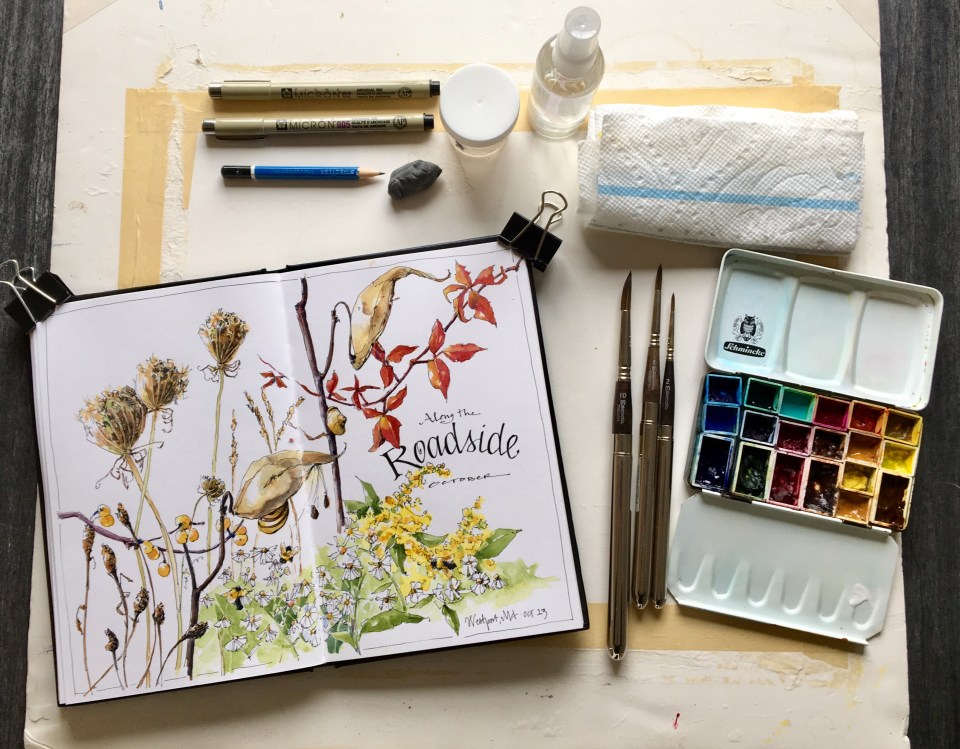
Tips and Techniques– Several of you have asked about my travel art supplies, so here you go! What you see above is what I typically bring, whether close to home or farther afield. These supplies fit in a plastic bag that I can tuck in my backpack or handbag, or in a dedicated sketch bag with a long shoulder strap that I sometimes carry. I love being able to do so much with a few basic supplies.
- Sketchbook: Stillman & Birn 5.5×8.5” Zeta or Beta
- Pens: Pigma Micron 02 and 005 black for sketching and text
- Pencil: Steadler F and kneaded eraser
- Brushes: Escoda Versatil Travel Brushes, size 2,6,8. A bigger brush for painting landscapes would be helpful for larger washes.
- Paint: Schmincke box with Windsor and Newton, Daniel Smith, and QoR paints
- Miscellaneous: Paper towels, clips for holding the pages, spray bottle for moistening paints, small water container
If you are looking to carry less on your next sketch outing, try paring down to only what fits in a large Ziploc bag. Lighten up and enjoy!
8 Tips for Travel Sketching
I’ve been wrapping up the sketches that I started while on my Great Western Road Trip— a 10 day drive from Boulder, Colorado, to Pasadena, California, via Arches, Canyonlands, and Bryce Canyon National Parks in Utah. This trip had a much tighter itinerary than previous vacations and it put me to the test in terms of sketching on the go. I thought I’d share a few tips gleaned from my experience in hopes that they help you on your next trip.
- Pare down to a few basic supplies. The more stuff you have the harder it will be to carry, set up, and break down quickly. I put my journal, pencil, pen, and paints into a large Ziploc bag that fits in my handbag or backpack.
- Seize the moment. Travel sketching requires a combination of seizing opportunities and making opportunities to fit art into your trip. It isn’t easy. This is especially true if you have a hectic itinerary or if you are traveling with non-sketchers, or both. Make the most of the time you have, whether five minutes while waiting for your traveling companions, a 30-minute airport layover, or an hour in your hotel at the end of the day.
- Create the moment. If you know in advance that you will be going somewhere you’d like to sketch, tell your traveling companions and let them know approximately how much time you need. This enables everyone to plan their time and spares you from feeling as if you are slowing the group.
- Start, even if you can’t finish. If you see something that strikes you, put down a line and take a photo for reference. Draw what you can in the time you have. You can always come back and finish later, but if you don’t start, you’ll lose the moment and the freshness of sketching live.
- Adjust your expectations and the size of your artwork. You’re not out to make a masterpiece; you’re out to record fun, interesting, and memorable parts of your trip. Work smaller if it helps.
- Mix it up. Sketch a variety of subjects, from landscapes to single objects to food. The more varied your pages, the more you will capture the essence of your trip.
- Incorporate artistic elements from the place. This may include colors, fonts, or designs drawn from the art or culture of the place you are visiting.
- Let enthusiasm fuel you. More than likely, there will be no ideal conditions for drawing or painting while traveling. You may not have great seating, weather, light, or time. Expect to be challenged and let your enthusiasm drive you. Your sketches may not be perfect, but they’ll convey a sense of fun, discovery, and excitement from your trip.


Workshop Opportunity: Travel Sketching in Watercolor
Saturday, November 9, 2019; 9am – 1pm, Art School of Columbia County, Ghent, NY
Sure to be worth the trip, this workshop will focus on techniques and layout ideas for sketching on the go and capturing your travel experiences in watercolor. Register by emailing: artschoolcolco@gmail.com
Great Western Road Trip- Part 1
Big skies, vast landscapes, towering rocks carved by water, wind and time. The American West is a place like no other on the continent. Under the guise of driving our son from a summer internship in Boulder, Colorado, to his senior year of college in Pasadena, California, my family took to the open road last week for a Great Western Road Trip. Along the way, we hiked the western slopes of the Rocky Mountains and explored Arches, Canyonlands and Bryce Canyon National Parks in Utah. And then we drove out of those untamed spaces and into the sprawl of freeways in southern California before flying back east.
In the words of John James Audubon, “I wish I could draw it all.” Alas, with so much hiking and driving, it was hard to find the time; I still have several pages to finish. So here is part one. Stay tuned for the next installment with my top tips for travel sketching.


Switching it up
My go-to artist materials are watercolor and ink, so I enjoyed switching it up this week by using colored pencils. I started with pears during an artist’s “Sip & Draw” with master botanical illustrator Wendy Hollender. Wendy often starts with a single colored pencil to develop the basic form and values and then applies layers of watercolor and colored pencil to further develop her subjects. You can see some of this process below, where I left some leaves and pears unfinished (click to view larger).
In this second piece, I used a single burnt sienna colored pencil for the entire nest. I started with the inner part of the nest to develop the darkest values and worked my way outward to build the form. I like the ghostly quality that came from blowing out some of the lightest tones.

Tips and Techniques– If you are feeling stuck or looking to expand your repertoire of techniques, try a new artist medium. It may broaden your thinking and your skill set or give you new ideas to incorporate into your artwork.
Leave the Light On
While its customary to leave an outside light on at night for family or guests who are arriving late, I have taken to leaving a light on for an entirely different sort of guest. Each morning I am eager to discover who has come in the night to hang out on our back porch. We have had some exceptional visitors this week and I’ve thoroughly enjoyed getting to know who else lives in my neck of the woods.
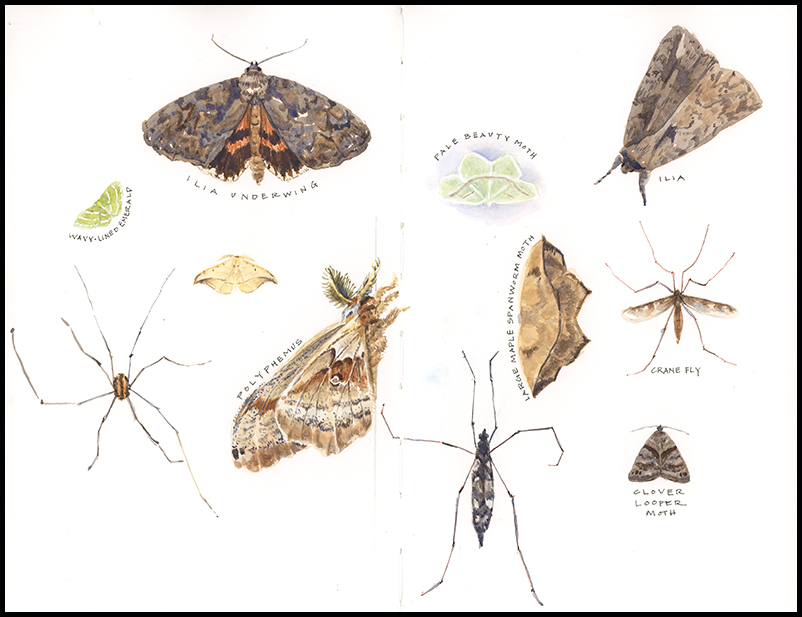
Tips and Techniques– One of my goals with these moths was not to fuss too much, which is easy to do when faced with such detailed markings. I try to capture each moth with about three passes:
- I lay in the shape and “ground” color first with a wet wash, typically using two colors to get some variation. I begin directly with paint, rather than drawing first. I find that I can capture the basic shape this way with much greater speed. While one moth is drying, I start another and rotate among them.
- Next, I start to delineate the wings from the body and add the primary pattern of markings. The paint is less wet on this pass.
- On the third go around, I use a very dry brush to add remaining details. The antennae are last, as is identifying and labeling each one. This technique worked for all but the Polyphemus moth, which is ridiculously complex and took far more time than the others.
Sound Advice
A pop of red amidst a tangle of greens, scarlet runner beans wind their way to the top of the garden trellis, sending flowers to the sun and beans drooping toward the ground. Just a few months ago, they were a mere handful of purple and black streaked seeds. Now, they dare you to imagine that they were ever anything other than extraordinary. And so, I think that writer Robert Brault is onto something: If you’ve never experienced the joy of accomplishing more than you can imagine, plant a garden.
(Click to view larger.)
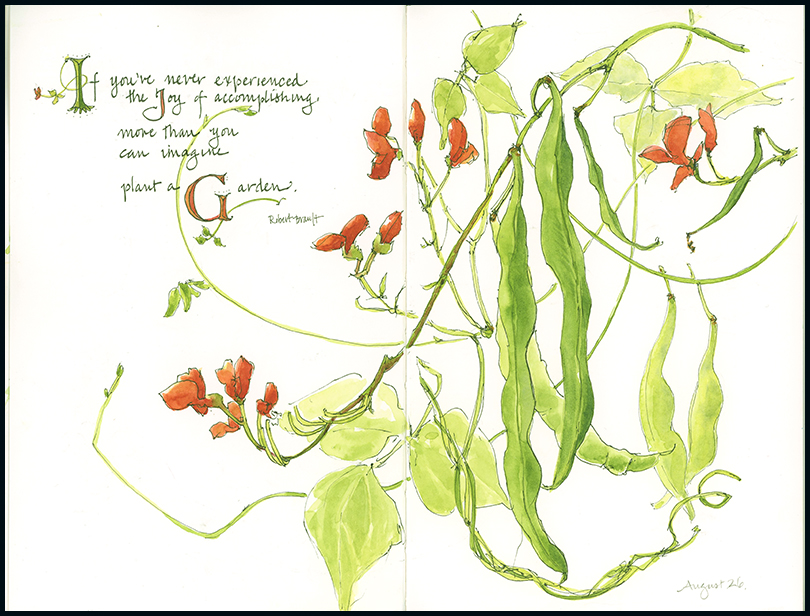
Tips and Techniques: Sometimes, the composition of a piece is sitting right in front of you, and sometimes you have do a bit of rearranging to make it work. I saw the central elements of this piece—the three main dangling beans and the diagonal vine with red flowers on the left side of the page—right on the trellis. But I needed to add flowers, leaves, beans and tendrils from several different runner beans to complete the composition. As an artist, don’t feel that you need to draw exactly (or only) what is in front of you. Give yourself creative latitude to move things around or eliminate something to create a stronger composition.


 Drawn In