
From Bulb to Bloom
I’ve enjoyed watching my amaryllis over the last month as it shot up out of the bulb, grew taller each week, and finally exploded in colorful blooms. I drew it each week and ran out of room on this page just as the blossoms emerged. When I tried painting the flowers on a new page, I found I couldn’t do them justice in the confines of my sketchbook. So, I started again, this time on a 12×16 sheet of hot press watercolor paper, and that did the trick.


Tips and Techniques- Look for subjects that lend themselves to a series. Like the amaryllis, it could be plants emerging and blooming. Or try the opposite and sketch flowers as they pass peak and wilt. You could also choose fruit to draw from different angles or an apple or pear as you eat it. It’s a good exercise to compose a page of several like objects and fun to watch and record as something grows or is diminished.
Simply Complicated
It was a banner year for the White Pine tree in our yard. Laden with green cones at the uppermost branches throughout the summer, the tree rained down pinecones throughout the fall. I decided to collect a basketful before winter, thinking I might find them useful as holiday décor. They did, indeed, look nice in an old metal basket on our back porch, but the more I looked at them, the more I wanted to draw them. The simplicity of this sketch belies how very challenging that was to do. My plan was to paint five or six cones of varying sizes, but after the first, I changed my mind. And here you have it.

Tips and Techniques– If you want a drawing challenge, pick up a pinecone. There is a fractal design underlying their spiral structure and, while knowing that helps, it is still easy to get lost trying to figure it out. I recommend starting with pencil and using the darker values to help you find your way.
Brushstrokes
How do we measure a year? In months, weeks, days, hours? Or perhaps in moments lived. Experiences remembered. In births and deaths. In friends made or lives touched. Miles walked. Milestones achieved. Breakfasts and dinners shared. Gardens planted and harvested. Travels taken. Birds come and gone. In what we create, give, leave behind. In brushstrokes, bold and subtle. I hope you’ve made some good marks in 2023.
Thank you for following and sharing your thoughts and feedback. I’m very grateful for your support.

Tips and Techniques– When drawing outside in winter, try to capture as much information as you can before stopping. Block in major shapes, note values, and add a few details if you can. Then snap a photo and add more details and color indoors to finish. I sketched this nest directly with a Micron 005 sepia pen while standing in a thicket of goldenrod and new white pines as the late afternoon light faded. I’m not sure what bird made this nest, but it certainly chose a tangled spot. It was a struggle to unravel both nest and vines before my feet got too cold and sent me packing. Still, sketching outside opens good possibilities for winter subjects, and I’m always glad to be outdoors poking around.
A Winter Gift
It’s been cold and clear here for the past few days. I walk or run my usual two-mile loop on a country road; Canada geese fly overhead, their calls ringing out in the chill sunshine. I find myself glad for blue skies and brown fields, for stark vistas, and for subtle details among the roadside’s remaining weeds. A curled leaf, a thorny seedhead, a bright berry—slim pickings alone, but together they make the winter seem special for its own stark beauty.
I send you my warmest holiday wishes and share with you these sentiments from the Christmastime letter of Renaissance pioneer and architect Fra Giovanni Giocondo (c.1435–1515):
“The gloom of the world is but a shadow. Behind it, yet within our reach, is joy. There is radiance and glory in darkness, could we but see. And to see, we have only to look. I beseech you to look!”

The Beginning of Something Beautiful
The great promise of the amaryllis begins as soon as you open the box and take out the naked bulb. The fact that this thing, this ball of a plant, will produce a huge red flower is remarkable. But it seems to me that it is also beautiful right now. Maybe it’s just that I like drawing tangled roots. Or perhaps it’s the papery peeling skin and ghostly stalk that intrigue me. Maybe it’s all that potential holed up inside such an unlikely package. In any case, it’s the beginning of something beautiful. I hope this page is the same as I add to it over the coming weeks.
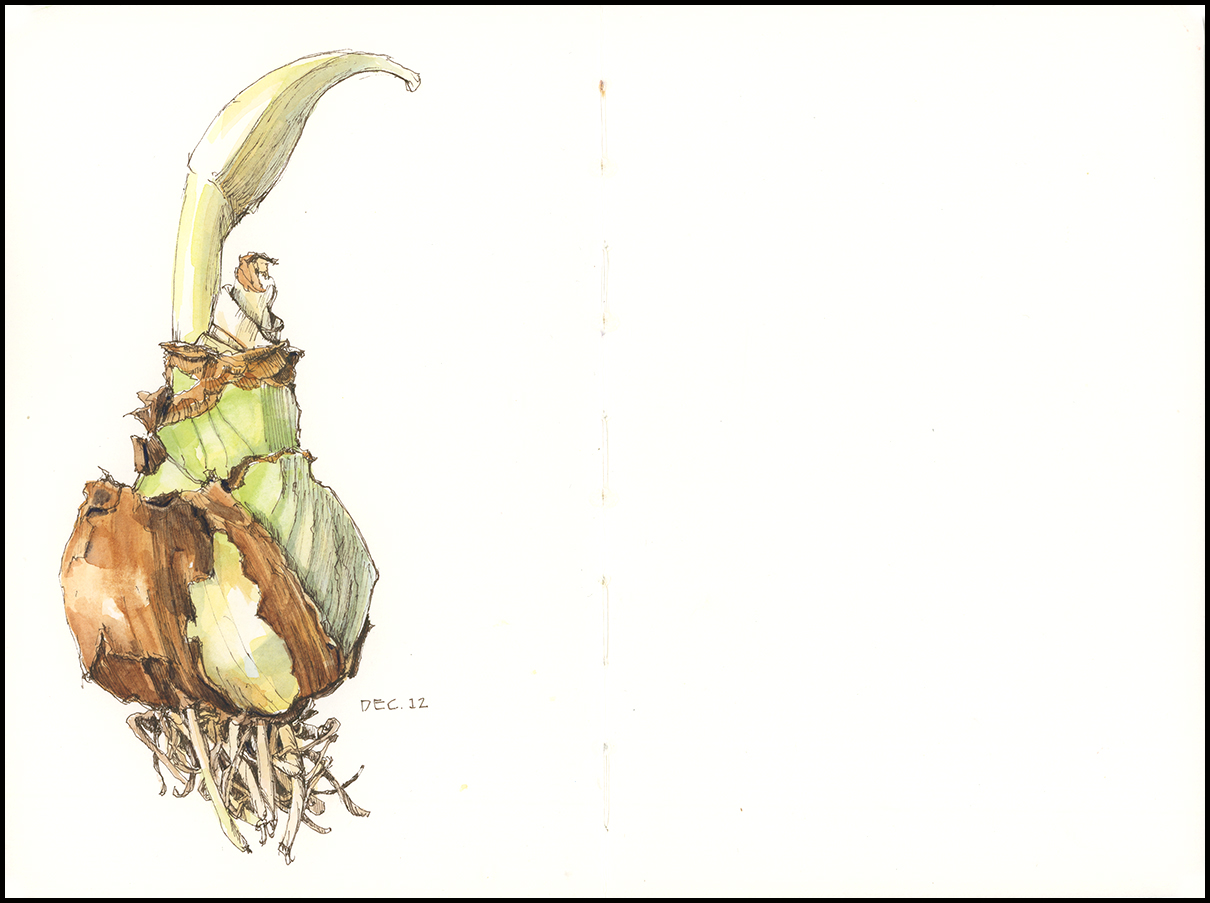
Tip and Techniques– If you are inclined to draw or paint flower bulbs, don’t wait until they bloom. There’s a lot to be learned and enjoyed by sketching the bulb before you plant it. Begin by drawing the big shape of the bulb and note its size relative to what’s coming out of it. Likewise, start with the larger roots and the ones that are in front and then add more behind. Keep looking at your subject– the more you look, the more you’ll see. Once you have the big shapes down, you can start to refine them and add detail. Do the same once you start painting. Start on the largest areas first and work your way to the finer details. Enjoy the unfolding!
New class—Check out the workshops page for a new four week series of Collecting on Paper through Winslow Art Center, beginning on January 4.
Captivated by Water Lilies
The beauty of water lilies is most closely associated with French Impressionist artist Claude Monet. From the late 1890s to his death in 1926, Monet created nearly 250 oil paintings of the many moods and changing light of the water lily pond in his garden. Water lilies have also captivated botanists, whose pressed plant specimens are preserved in herbarium collections around the world. Since I have neither pond nor oils nor pretense of becoming an Impressionist painter, I was drawn instead to the dried form of Nymphaea odorata, the white water lily. It’s not as showy or colorful when pressed, but I find it beautiful, nonetheless, with its simple curves and striking, subtle colors.

Tips and Techniques- Before beginning a painting, play around with different paint combinations to see what will work best for your subject. I made this painting almost entirely with just three colors: ultramarine blue, alizarin crimson, and quinacridone gold. This combination created muted and transparent colors that worked perfectly for the green and maroon leaves and the brown rhizome and stems. Diluted with lots of water, it also produced the subtle tones of the flowers and dragonfly wings. Using a limited palette makes it easier to create subtle shifts in color and create harmony throughout a painting.
The Last of the Garden
We put our garden to bed last weekend, composting what remained of stalks and dried leaves and scattering coneflower seeds in the meadow. Still, there were a few flowers, now faded and dried, but nonetheless impressive, that I culled from the rest. I love the curve of their petals and leaves and the hint of color left in a few of the zinnias. They’ve been on my desk all week, reminding me to look for beauty not only in its prime, but in every season.
Wishing you a Happy Thanksgiving. I’m grateful for your support for my artwork and for your many generous comments all year long.
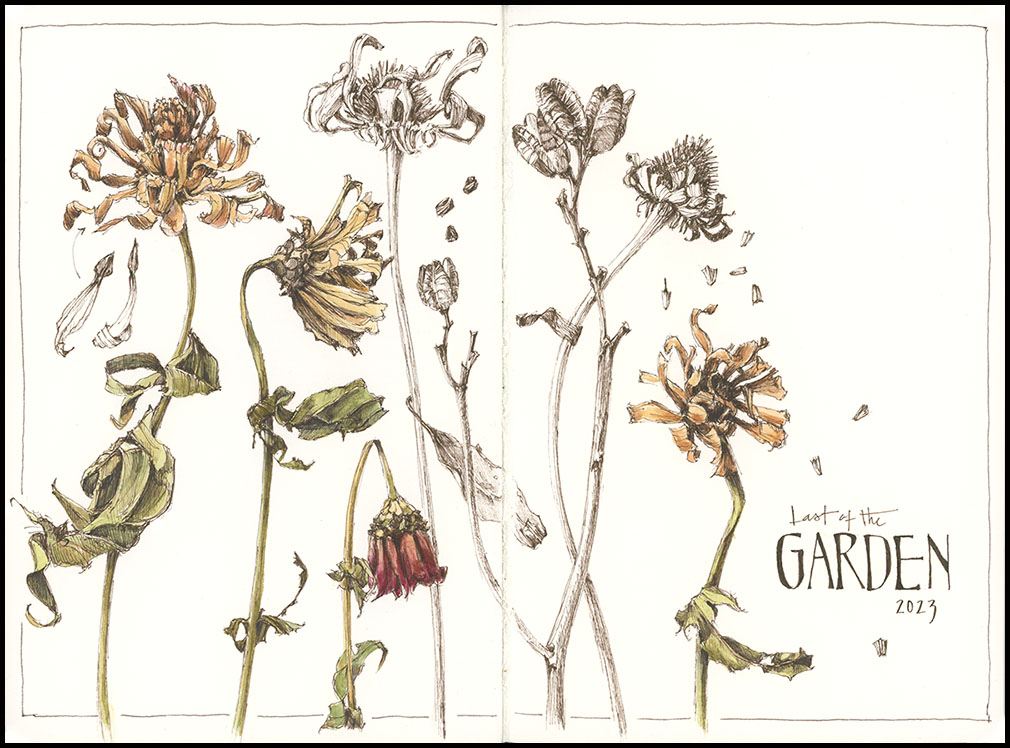
Tips and Techniques– This page taught me how much you can get from a nearly spent pen. I used two Micron 005 brown pens that were nearly out of ink yet managed to make lot of fine lines and subtle shading. This size brown Micron is not easy to find, which is why I’m using these to the last drop of ink– I had to order more online. If you are interested in trying one, you may need to do the same. More art supplies, you say? Now, that’s a good day.
Incredulous
The colors and patterns that adorn the bodies and wings of beetles, moths, and dragonflies are nothing short of astonishing. My reaction to seeing them is like hearing an incredulous story: you can’t make this stuff up. And, in fact, you don’t need to…all you need to do is look.
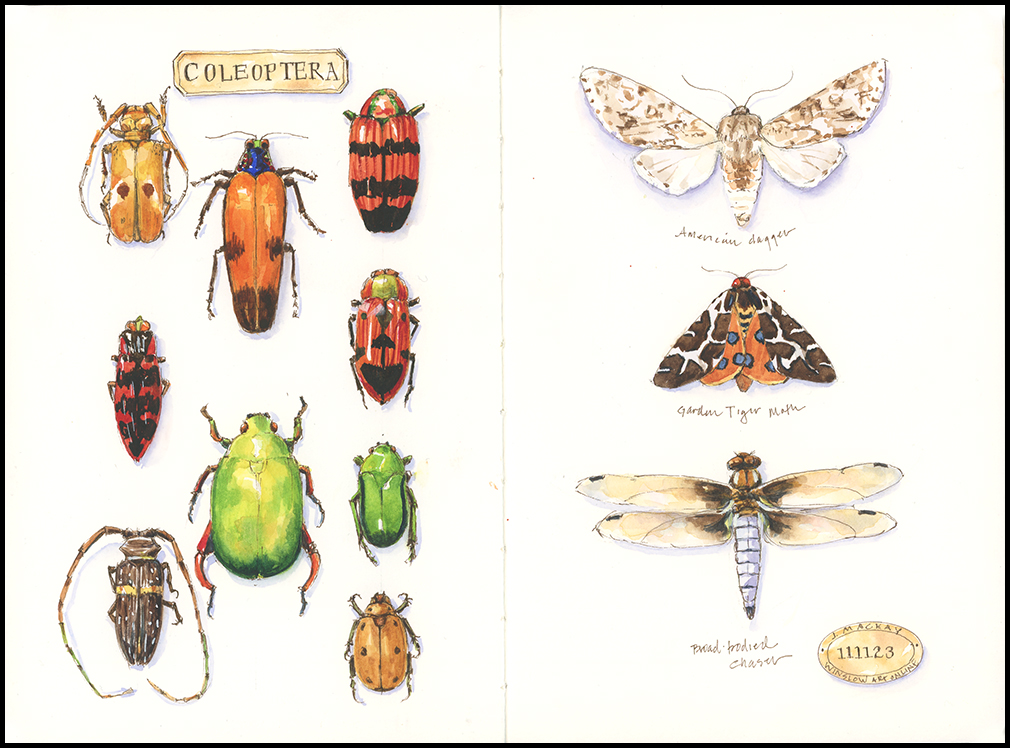
Tips and Techniques– When painting insects I start with the lightest “ground” color(s) on the body or wings. Sometimes the base layer is best created with a wet-in-wet wash of one or more colors that merge right on the paper. Once dry, I lay down the patterns on top of the base layer in a series of dry washes with a small brush. If the surface is shiny or iridescent, I leave a bit of white paper to produce that effect. Insects are classified in the phylum arthropods, and their three pairs of jointed legs resemble the claws of lobsters and crabs—which are also arthropods.
Passing on a Sense of Wonder
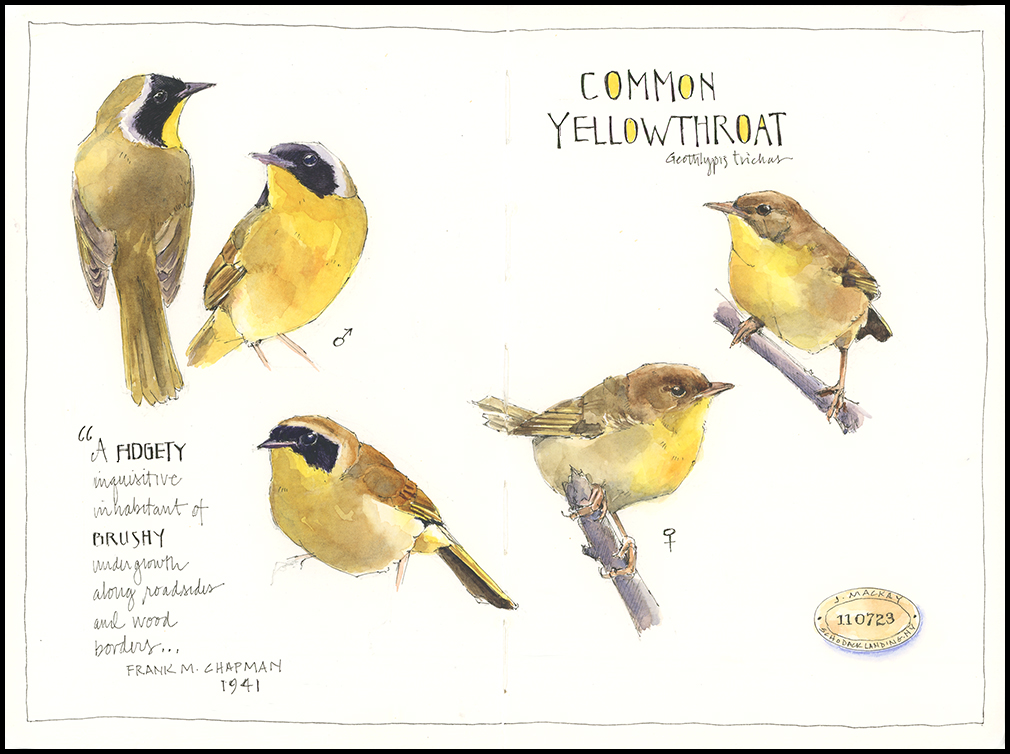
“What Bird Is That? A Pocket Museum of the Land Birds of the Eastern United Stated Arranged According to Season” by Frank M. Chapman, published in 1941, sits on my bookshelf next to several other old field guides. This guide is special not only because of its lively descriptions of birds, but also because it previously belonged to my mother-in-law, Alice, who I never knew. The book makes me think about the ties that connect us to generations past and future. Chapman, as curator of ornithology at the American Museum of Natural History, pioneer of early field guides, and originator of the Christmas Bird Count, left a legacy of bird scholarship and enthusiasm; Alice passed on the simple pleasure of watching backyard birds. As for me, I am currently teaching a class encouraging participants to draw from their wonderment for nature to create their own “Paper Museum.” I like thinking that someone in the future may pick up one of these journals and find a sense of connection and joy in its pages.
Juncos Return
When the Dark-eyes Juncos return each year it’s a sure sign that fall is waning into winter. A small flock arrives like clockwork when the oak and beech leaves are the only ones still hanging on. Their white tail feathers give them away as they flash across the road and dart into the brush. I welcome them with mixed feelings—I hate to see October go, but I’m glad to watch them all winter, small black bodies puffed up against new snow or hopping out from under the porch on cold mornings. They’ll be our companions until spring winds send them northward and the season shifts again.
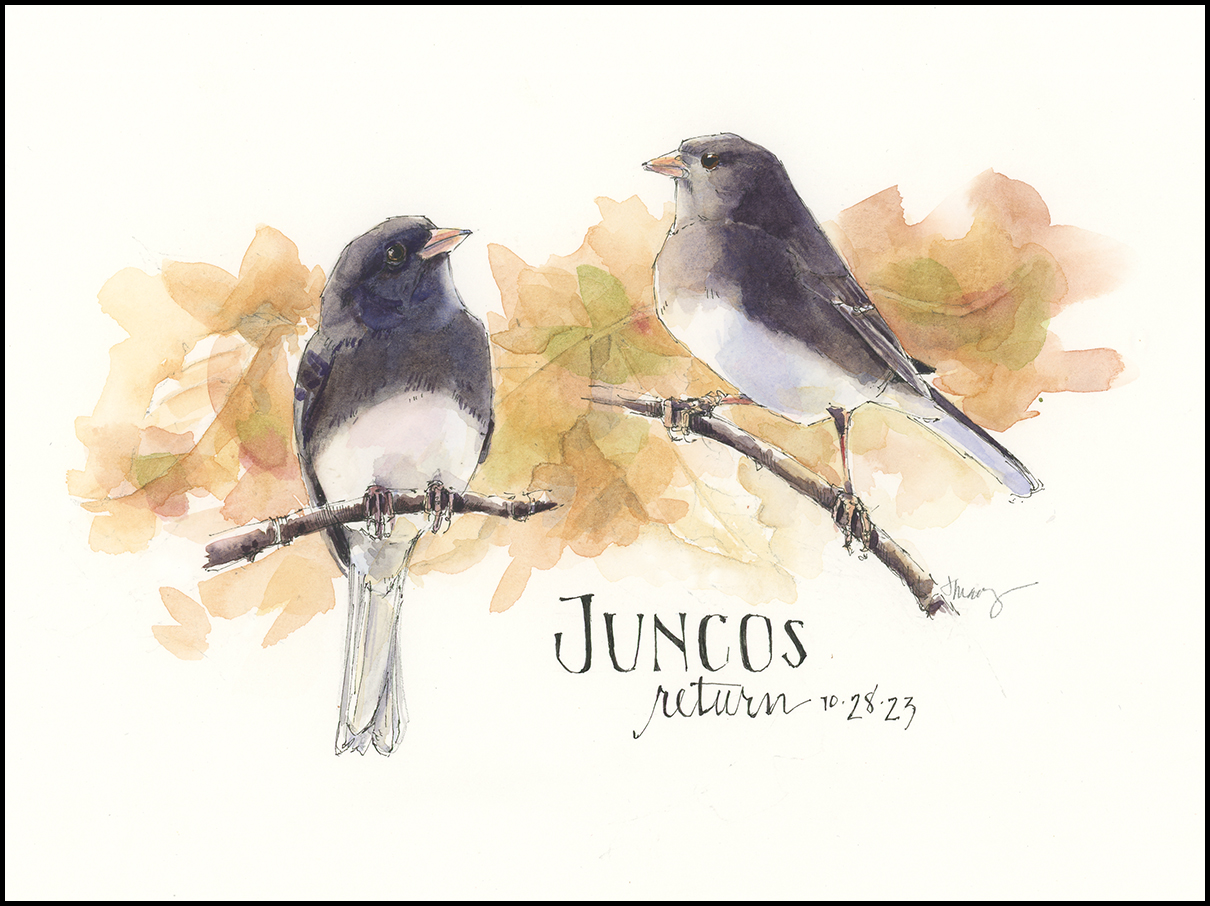
Tips and Techniques– I painted these juncos yesterday during my workshop “Knowing When to Stop” at Winslow Art Center’s free Autumn Art in Action Festival. At each stage of a painting, I evaluate color, values, details, shadows, and composition, slowing building up layers of paint until I’m satisfied with each of those things. These criteria help me make decisions about what to do next and can help prevent paintings that are under-or-overworked. If you struggle with knowing when to stop, try looking through that lens and see if it helps.


 Drawn In